Utah
In conservative Utah, some communities are ditching fossil fuel power for clean energy

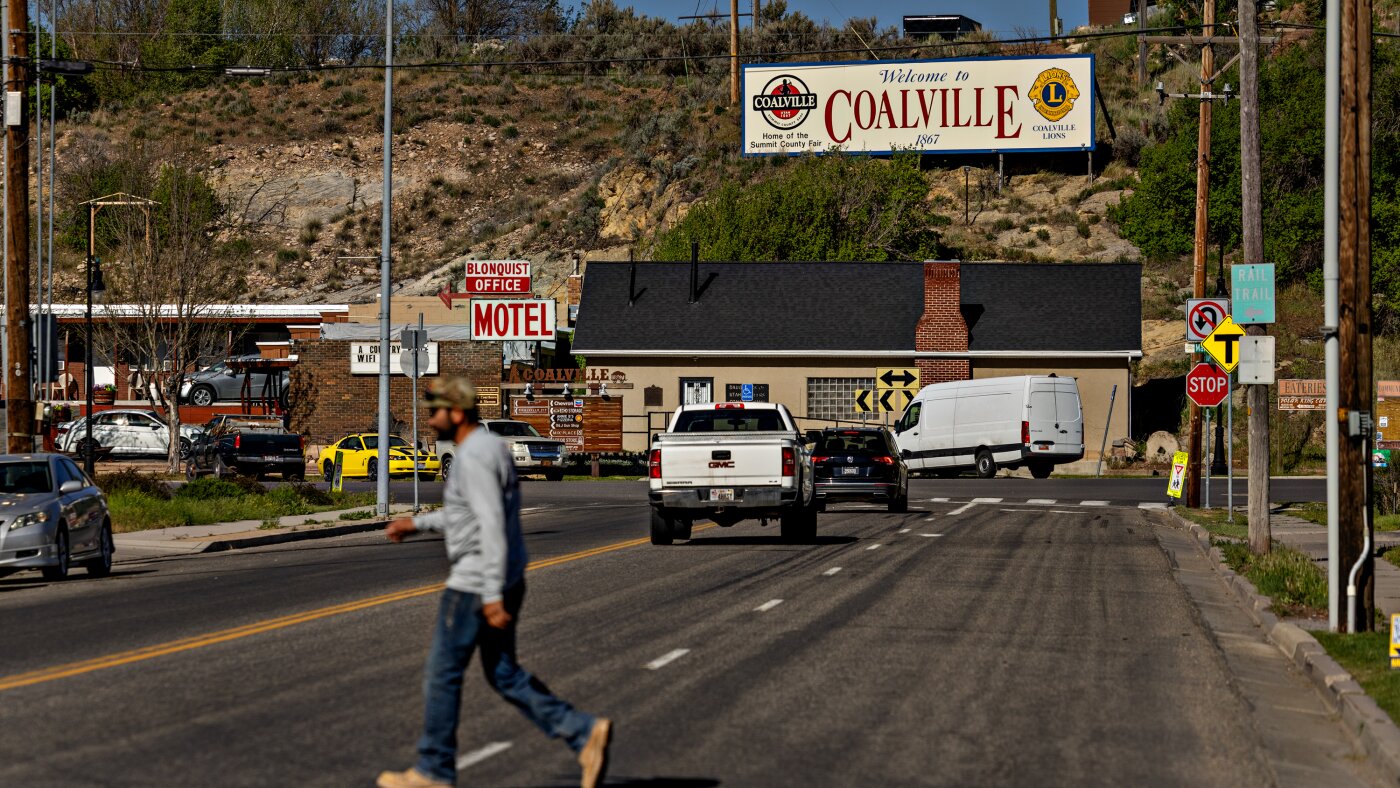
In conservative Utah, a group of communities joined forces to bring more renewable energy to the electric grid. The group ranges from the state’s largest city to rural towns, such as Coalville. Their effort could be a model for other U.S. cities to take climate action, even as the federal government pulls back on clean power.
Kim Raff for NPR
hide caption
toggle caption
Kim Raff for NPR
NPR is dedicating a week to stories and conversations about how communities are moving forward on climate solutions despite significant political headwinds. As the federal government halts plans to address climate change, states, cities, regions, and even neighborhoods are trying to fill the gap by cutting climate pollution and adapting to extreme weather.
COALVILLE, Utah — Since the first day of his second term, President Trump has targeted renewable power. He has signed executive orders aimed at reviving the coal industry. He’s pushed policies to halt new solar and wind development.
Despite this, a coalition of big cities and small towns in conservative Utah is charting a different path — one that will bring more renewable power to the electric grid. The effort could be a model for other U.S. cities to take climate action, even as the federal government pulls back on clean power.

Utah’s capital, Salt Lake City, is one of 19 communities that formed Utah Renewable Communities. Roughly three-quarters of Utah’s electricity comes from coal and natural gas. The coalition is aiming to bring new clean energy to the grid by 2030.
Joe Sohm/Visions of America/Universal Images Group Editorial
hide caption
toggle caption
Joe Sohm/Visions of America/Universal Images Group Editorial
Utah’s capital, Salt Lake City, is one of 19 communities that formed Utah Renewable Communities. The collaboration has a big goal: generate enough clean electricity to offset the power used in their nearly 300,000 homes and businesses.
To do this, the coalition plans to build renewable energy projects. Think solar arrays and wind farms.
It’s taken years to get to this point. They’ve had to get regulations updated to work directly with the regional utility to add clean energy to the grid. And they’ve had to figure out how to pay for projects.
Now the rules are in place. And the utility, Rocky Mountain Power, a division of PacifiCorp, is on board.

Coal mining history goes way back in Coalville, a small town in northern Utah’s Summit County. But adding more renewables to Utah’s energy mix is about looking to the future, Summit County Sustainability Director Emily Quinton said, improving reliability and costs for customers in the years to come. “Clean energy is not just here and now,” she said. “It absolutely is a long-term investment that I think leads to a stronger grid in the long run.” Here, a statue commemorating the town’s coal-mining history stands outside Coalville City Hall.
Kim Raff for NPR
hide caption
toggle caption
Kim Raff for NPR
Utah’s bond with coal runs deep
As the name suggests, coal was once the lifeblood of Coalville.
A life-size statue of a miner on Main Street serves as a reminder of the town’s roots. This small mountain town was one of Utah’s first coal communities. Coal was discovered in the area in the late 1850s.
“We do have a legacy here,” said Emily Quinton, sustainability director of Summit County, where Coalville is located. “Not just the coal that was mined here, but we’re in a state of Utah where the state rock is coal.”
Now, Summit County and Coalville are two of the Utah communities betting their future not on coal, but on renewables.
The coalition’s push for clean energy comes at a time when three-quarters of Utah’s electricity is generated from coal and natural gas. These fossil fuels produce planet-warming pollution that drives climate change. State leaders have taken recent action to keep Utah’s coal industry alive, including legislation extending the lifespan of coal-fired power plants that were set to be decommissioned.

But Utah’s energy mix is changing. Roughly 22% of its electricity comes from renewables, such as wind, solar and hydropower. The coalition of 19 cities, towns and counties — which also includes red rock tourism hotspots Moab and Springdale — is working together to expand that trajectory.
It’s a unique strategy, particularly at a time when the federal government has done a U-turn on supporting renewables.

With so many different types of communities in the collaboration, Summit County Sustainability Director Emily Quinton said it’s important to recognize and honor the various reasons people have for joining. “Some people are going to be motivated by pollution that can be avoided by clean energy,” she said. “Some people are going to be motivated by a core climate action goal of reducing greenhouse gas emissions.”
Kim Raff for NPR
hide caption
toggle caption
Kim Raff for NPR
“The fact that our efforts here have been happening over the course of multiple federal administrations already,” Quinton said, “it shows us that at the local level, you can continue to move on climate strategies regardless of the federal winds.”
That doesn’t mean it has been easy. The coalition has been working toward its goal for several years, driven by residents’ demand for more clean energy options, she said. But it’s taken longer than the communities expected.
“It’s obviously difficult to try to work with 19 different processes,” said Quinton, who is also the coalition’s board secretary. “But I’ve been so impressed this whole time that we have functioned, I would say, very well as a collaborative.”
The state Legislature first had to pass a law in 2019 to make this type of community-utility collaboration possible. The legislation created a framework for the state to regulate it.
That was no small feat, explained Steve Handy, the Republican state representative who championed the bill. In Utah, renewables have often been politicized. Handy said pushback came over what supporting solar and wind could mean for towns where coal is an economic driver.
But in Handy’s view, adding more sources to Utah’s energy mix just makes sense.
“Utah needs all of the power that it can get with the data centers, the advent of artificial intelligence, EVs,” he said. “We can’t get it just from coal-based, fossil fuel-based, because that is now one of the more expensive options.”

Many residents in Park City, Utah, feel the urgency to address climate change, especially this year. Record warm winter temperatures zapped the snow that’s the foundation of the economy and identity of this mountainous area.
Kim Raff for NPR
hide caption
toggle caption
Kim Raff for NPR
The urgency of climate change
The winter sports hub, Park City, is also part of the coalition. Residents feel an urgency to reduce planet-warming pollution, especially this year, said Luke Cartin, director of lands and sustainability for Park City.
He watched as a ski lift chair hovered over a grassy hill. This slope near where skiers and snowboarders raced during the 2002 Winter Olympics is typically blanketed in snow all spring.
This year, historically warm temperatures zapped the snow that’s the foundation of Park City’s economy and identity. Utah and other Western states had their warmest winter on record.

Utah’s snowpack levels typically peak in early April. A dry winter paired with a warm spring meant Utah’s meager snow cover melted away several weeks ahead of normal this year.
David Condos/KUER
hide caption
toggle caption
David Condos/KUER
Then came the early spring heat waves. Researchers with World Weather Attribution found those heat waves would have been virtually impossible without human-caused climate change.
“Instead of just saying, ‘Hey, we held up a sign, but nothing happened,’” Cartin said, “we made this change in one of the most conservative states in the country.” It’s something, he said, “the community can take pride in.”
The Utah coalition’s work is getting noticed. Cartin said he’s fielding questions from communities in other states about how they could do something similar.
“That’s been the really interesting part of being able to present in Montana and Idaho,” Cartin said, “being like, ‘Hey, we figured this out. You can figure it out, too.’”

Park City Director of Lands and Sustainability Luke Cartin said the Utah collaboration’s efforts have been fueled by residents’ demand for more clean energy options. “There’s this pent-up emotion and want and need for this,” he said. “This can make very strong economic sense, and it can also solve a lot of other larger existential threats as well.”
Kim Raff for NPR
hide caption
toggle caption
Kim Raff for NPR
Political headwinds
Without the coalition, the projects it’s considering likely would not get built. PacifiCorp, which runs the regional utility Rocky Mountain Power, has rolled back its plans to build new renewable energy resources.
That’s been a response to the Trump administration’s moves that favor fossil fuels. Specifically, the 2025 One Big Beautiful Bill Act undid parts of the Biden-era Inflation Reduction Act that had offered tax incentives for wind and solar.
“This significantly changed the economic modeling of the company’s resource planning, changing the least-cost, least-risk portfolio of resource types that are in the best interests of customers,” PacifiCorp spokesperson David Eskelsen wrote in an email.

A gravel road leads to a group of homes in Castle Valley, Utah. People living in this small desert town have felt the impacts of a warming climate, said Town Council member Pamela Gibson, and they see the logic in pursuing renewables. “I think most people recognize that there is a thing called climate change, and it is man-made, and that we should be doing everything we can,” she said.
David Condos/KUER
hide caption
toggle caption
David Condos/KUER
Large solar and wind projects provide more cost-competitive energy than natural gas, nuclear and coal projects, according to financial services firm Lazard. Renewable energy is also proven to be reliable when it’s paired with large batteries and other types of grid management.
Politically, other red states could face challenges to pass legislation like Utah did in 2019, said Severin Borenstein, faculty director of the University of California, Berkeley’s Energy Institute at Haas.
A single initiative won’t do much to stop global climate change, he said. But even a small-scale program, such as Utah’s, could help change the narrative.
“That sort of leadership and setting an example, I think, is the real value of these sorts of efforts,” Borenstein said. “They can build momentum from towns to counties to states and ultimately to the federal government, if it can be shown to be cost-effective.”

Some communities in the Utah coalition have already taken small steps toward going renewable. Moab recently installed a rooftop solar array on City Hall to power its municipal offices. “Living in a rural place, a remote place, we have an attitude that if we want it, we’re going to have to go out and find it,” said Alexi Lamm, the town’s sustainability director. Now, the collaboration will allow Moab to offer clean power to all of its residents.
David Condos/KUER
hide caption
toggle caption
David Condos/KUER
The switch to renewables
Utah’s Public Service Commission officially approved the program earlier this year. Communities have until June 2 to pass local ordinances confirming their participation.
Once that happens, the program will have Rocky Mountain Power enroll every home in participating communities. They’ll add a $4 monthly fee to residents’ electric bills starting next year. Low-income residents can get the fee covered, and customers can still opt out.
For many rural communities, switching to all renewable power without this coalition would be next to impossible.
Take Castle Valley, population 347. This community along the Colorado River in southeast Utah is another program participant.

Castle Valley resident Alice Drogin checks on plants at her small business, Canyon Nursery. She’s hopeful her greenhouses will someday run on clean power because of the Utah program. “I have in-floor heating, so I do like my electricity,” she said, “and I would love to be able to have it sourced with renewable types of energy.”
David Condos/KUER
hide caption
toggle caption
David Condos/KUER
Town Council member Pamela Gibson said residents wouldn’t consider themselves “radical environmentalists.” But they’ve seen climate change impact the valley — like this year’s warm, dry winter — and they want to protect their home for the future.
“We can’t solve all the problems,” Gibson said. “But if we all get together, it’s drops of water in a big pond. And we can eventually fill it up.”
Utah Renewable Communities plans to announce its first clean energy project this summer and begin generating power by 2030.


BEAVER COUNTY, Utah — A massive community effort is underway as volunteers and Beaver County crews distribute thousands of sandbags to protect homes from the potential path of floodwaters.
After the Cottonwood Fires, residents have been waiting for weeks for relief to come in the form of rain, though officials now warn it may come all at once with an increased risk of flooding and debris flow.
Emergency Service Director Les Whitney believes that the fire has left plenty of debris to bring trouble for residents.
“We got a lot of water. We’re bringing debris with it, so tree branches, tree limbs, logs, lots of different size firewood, and that’s all in the creeks. We’re worried about that plugging up our bridges and stuff, so we have heavy equipment and excavators located in strategic places so that we can keep those bridges open,” said Whitney.
An estimated 140 homes and condominiums were spared from the flames, but remain in the paths of floodwaters.
Residents can also pick up sandbags at the Beaver County Sheriff’s Office or at the Beaver County Rodeo Fairgrounds.

EAGLE MOUNTAIN — An Eagle Mountain man currently on pretrial release in 4th District Court who is accused of abusing his dog has been arrested again for allegedly punching the same animal.
Keith Reaves Davis, 43, was booked into the Utah County Jail on Wednesday for investigation of aggravated cruelty to an animal.
Utah County sheriff’s deputies were called Wednesday afternoon to a grocery store on a report that a man was beating his dog after it had gotten off its leash and was stopped by a bystander, according to a police booking affidavit.
“I reviewed security camera footage from the grocery store, and an individual matching the description of the suspect was seen holding the dog in the air by one paw and repeatedly striking the dog on the right hind leg area. I observed the male strike the dog several times before dropping the dog from approximately 1-2 feet. The strikes appeared to be as hard as the male could hit,” the arresting deputy wrote in the affidavit. “The dog did not cry out or whimper as if the dog was accustomed to the abuse.”
When questioned, Davis “admitted to striking the dog because it was not behaving,” the affidavit states.
An animal control officer who responded to the scene to take custody of the dog noted it was the same dog he had taken from Davis exactly three months earlier during another animal abuse investigation.
In that case, Davis was charged in 4th District Court with aggravated cruelty to an animal, a class A misdemeanor; and public intoxication, a class C misdemeanor, after deputies received a tip from a neighbor that a dog was being abused at Davis’ home, according to charging documents. When questioned, Davis “acknowledged hitting his dog as punishment,” the charges state.
Deputies also reviewed videos that the neighbor had filmed. The neighbor told investigators “there was blood from the dog on the ground of the garage and (the neighbor) can hear the dog screaming as if it’s being hurt. Deputies got the videos from the (neighbor) and you can hear very loudly the dog screaming and crying with a lot of loud banging noises. In one of the videos, you can hear the dog sounding like it is being choked by a collar and is grasping for air,” a police booking affidavit states.
Davis’ next court hearing in the April case is scheduled for July 28.
In their latest booking report, sheriff’s deputies note that they “believe further harm will be inflicted on this dog if it is released back to the male a second time,” and have recommended the dog not be returned to Davis.
The Key Takeaways for this article were generated with the assistance of large language models and reviewed by our editorial team. The article, itself, is solely human-written.


Two years after October 7th attacks, Gaza war reshapes global politics
Two years after Hamas attacked Israel, Gaza lies in ruins and global alliances have shifted. Correction: A previous version of this video incorrectly identified the conflict. The conflict is between Israel and Hamas.
A man was arrested in Utah after allegedly stabbing a Muslim employee at a mall multiple times and telling investigators he targeted the victim because of his religion, according to court records.
Peter Michael Larsen, 48, was booked into the Salt Lake County Jail on suspicion of attempted murder and prohibited dangerous weapon conduct following the attack on July 13 at the Valley Fair Mall in West Valley City, Utah, court and online jail records show. West Valley City is a suburb of Salt Lake City.
The West Valley City Police Department said the incident occurred shortly before 3 p.m. local time, when Larsen approached a man working at a kiosk at the mall.
“After a brief interaction, the suspect pulled out a knife and began stabbing him multiple times,” police said in a statement on X. “A few bystanders interfered, and were able to separate the suspect from the victim and subdue the suspect until police arrived.”
The victim, who was not identified by authorities, sustained multiple stab wounds and was taken to a hospital in critical condition, according to police and court records.
Larsen told investigators that he had “targeted the victim with intent to kill him because of his religion (Muslim),” police said in an affidavit obtained by USA TODAY. The affidavit also states Larsen said he believes he is “a catalyst” and “intends to kill Muslims.”
The incident remains under investigation, and police said they were looking into any possible relationship between the suspect and victim. USA TODAY reached out to the West Valley City Police Department for comment.
Police: Suspect poses a ‘substantial danger to the public’
The suspect approached the Muslim man, asked for his name, asked about his religion, and indicated he wanted a bottle of water, The Salt Lake Tribune reported, citing comments from Imam Shuaib Din, who leads the Utah Islamic Center and had been in contact with the victim’s family.
As the victim turned to get the water, the attacker began stabbing him, Din told the newspaper. Police said in the affidavit that they received multiple 911 calls at around 2:30 p.m. local time reporting two men “involved in a physical altercation where one male was stabbing the other.”
When officers arrived at the scene, they observed bystanders pinning the suspect to the ground and “had already removed the knife from his hand,” according to the affidavit. Police said the victim was “bleeding profusely” and was then transported to the hospital.
The victim was identified by friends as Syed Sohail Uddin, local television station FOX 13 and The New York Times reported. A GoFundMe fundraiser organized on his behalf said he was stabbed 15 times and required multiple surgeries.
Larsen was also transported to the hospital “due to being punched in the head from bystanders trying to get the knife out of his hand,” according to the affidavit. He was later medically cleared and taken to the police station for an interview.
Police said in the affidavit that Larsen posed “a substantial danger to the public if released based on his violent actions today, ideologies and pre-planned mass casualty events.”
Advocates condemn stabbing attack at Utah mall
Muslim advocacy groups, including the Council on American-Islamic Relations (CAIR), condemned the attack.
“This horrific attack is yet another reminder that anti-Muslim rhetoric has real-world consequences. When Muslims are routinely demonized, portrayed as threats, or treated as less deserving of equal rights and dignity, some twisted individuals inevitably act on that hatred,” CAIR National Executive Director Nihad Awad said in a statement on July 14.
Civil rights advocates have noted a rise in Islamophobia in the United States over the last two-plus decades following the Sept. 11, 2001, attacks, and more recently because of immigration policies and the fallout of the Israel-Hamas war, according to Reuters.
CAIR, which is the nation’s largest Muslim civil rights and advocacy organization, reported last year that it received a record number of complaints of discrimination and Islamophobic attacks amid the war.
The organization received more than 8,650 complaints in 2024, the highest number since CAIR began publishing its annual civil rights report in 1996, according to the report released in March 2025. Complaints rose more than 7%, breaking the previous record set in 2023.
The Utah attack follows several high-profile incidents targeting Muslims in recent years, including the fatal stabbing of a 6-year-old Palestinian American boy in Illinois in 2023 and a deadly shooting at a San Diego mosque earlier this year.
Contributing: N’dea Yancey-Bragg, USA TODAY; Reuters
-

 Los Angeles, Ca1 hour ago
LADWP begins long-term repairs after West Hollywood water main rupture
-

 Detroit, MI2 hours ago
Livestream: Mayor Sheffield, Detroit health chief to address wildfire smoke threat
-
 San Francisco, CA2 hours ago
A sculpture of a giant naked woman goes on sale in San Francisco. Bring a crane
-

 Dallas, TX2 hours ago
No ‘straight answer’: Why Pioneer Cemetery is the latest battleground at City Hall
-

 Miami, FL2 hours ago
TSA hosts news conference ahead of World Cup third place match at Miami Stadium
-

 Boston, MA2 hours ago
ICE Boston arrests Barbados national during targeted operations in Attleboro
-

 Denver, CO2 hours ago
Denver Broncos training camp is 2 weeks away
-

 San Diego, CA3 hours ago
Daily Business Report: July 17, 2026, San Diego Metro Magazine

