Utah
Daily news: Wildfires continue to burn throughout Utah with varying effects

This is your rundown of the daily news for Monday, July 15. In this edition:
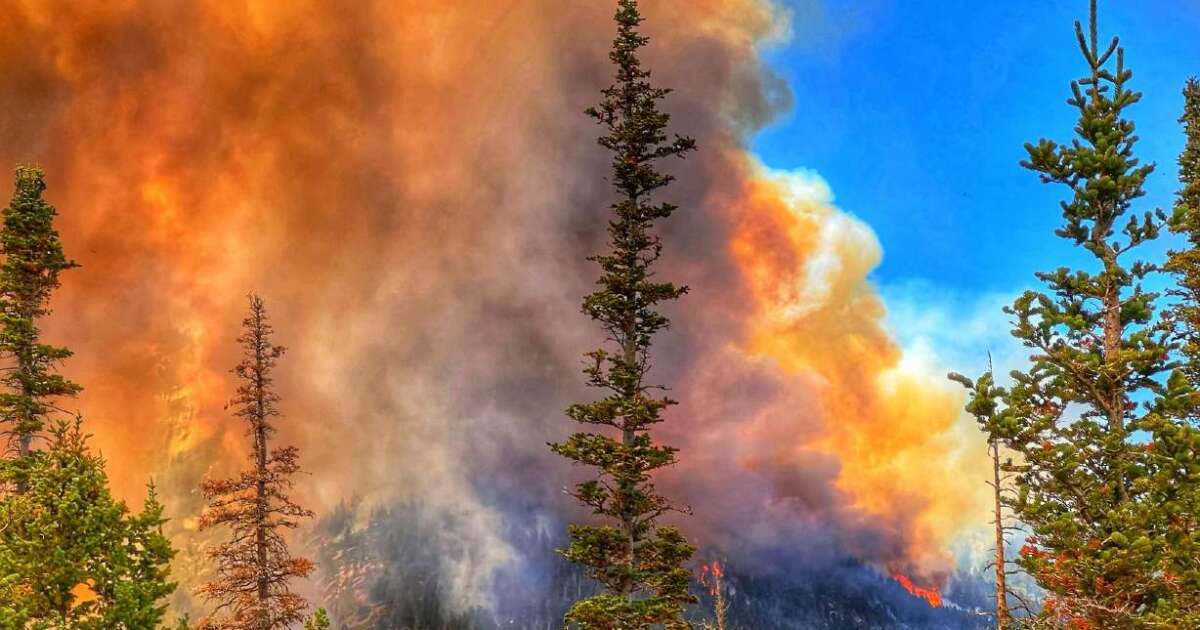
Red flag warning issued for the Flaming Gorge area as Speirs Fire grows
The Speirs Fire sparked Saturday evening south of Flaming Gorge Reservoir. Initially estimated at 30 to 50 acres, it had grown to more than 580 acres by Sunday.
Utah Fire authorities began working to suppress the fire, located east of Highway 191 near Speirs Peak, around 6 p.m. on July 13.
Smoke jumpers reportedly arrived Saturday evening to assist resources already on the scene and have been working to construct a fire line since.
Additional crews were dispatched and arrived on Sunday.
The Speirs Fire remained active overnight and had grown over 530 acres by Sunday afternoon.
A Red Flag Warning remains in place for the area, with dry thunderstorms and high winds expected to contribute to critical fire weather conditions.
Deer Springs Fire gradually reaching containment
The Deer Springs Fire has grown to 11,783 acres and 70% containment.
The fire was first discovered on July 7 and appears to be human caused.
Utah Fire Info say division strength has reportedly decreased down to three, with more personnel expected to demobilize as fire containment increases.
Graff Point Fire remains uncontained
The Graff Point Fire, located near Cedar City, has burned close to 300 acres and is at 0% containment.
There was less smoke in the area on Sunday compared to Saturday, although fire officials say fire activity could increase with high wind potential.
More resources and crews are now on the fire line.
Three hikers found dead after various heat-related incidents
A father and daughter have been found dead after getting lost and running out of water at Canyonlands National Park.
San Juan County officials say the 23-year-old woman and her 52-year-old father, both from Green Bay, Wisconsin, were hiking when they got lost and ran out of water. The air temperature at the time was more than 100 degrees Fahrenheit.
Also, a body was found at Snow Canyon State Park in southern Utah near Ivins on Saturday. First responders were dispatched to an unrelated medical incident nearby and were responding to a report of two people suffering from a heat-related incident.
First responders found the two and provided first aid. Police said they showed signs of heat exhaustion and were “swiftly” transported to a hospital.
While on the scene, a passerby reportedly contacted the officials and said a third individual—a woman—was found unconscious a short distance away.
First responders found her and determined she had died. She has been identified as a 30-year-old woman, although no further identification has been released.
Police remind Utahns that as temperatures soar, it’s “absolutely vital” to drink water regularly, especially when outdoors. Dehydration can lead to serious health issues, including heat exhaustion, and heat stroke. Watch for signs of dehydration, like dizziness or excessive fatigue


EAGLE MOUNTAIN — An Eagle Mountain man currently on pretrial release in 4th District Court who is accused of abusing his dog has been arrested again for allegedly punching the same animal.
Keith Reaves Davis, 43, was booked into the Utah County Jail on Wednesday for investigation of aggravated cruelty to an animal.
Utah County sheriff’s deputies were called Wednesday afternoon to a grocery store on a report that a man was beating his dog after it had gotten off its leash and was stopped by a bystander, according to a police booking affidavit.
“I reviewed security camera footage from the grocery store, and an individual matching the description of the suspect was seen holding the dog in the air by one paw and repeatedly striking the dog on the right hind leg area. I observed the male strike the dog several times before dropping the dog from approximately 1-2 feet. The strikes appeared to be as hard as the male could hit,” the arresting deputy wrote in the affidavit. “The dog did not cry out or whimper as if the dog was accustomed to the abuse.”
When questioned, Davis “admitted to striking the dog because it was not behaving,” the affidavit states.
An animal control officer who responded to the scene to take custody of the dog noted it was the same dog he had taken from Davis exactly three months earlier during another animal abuse investigation.
In that case, Davis was charged in 4th District Court with aggravated cruelty to an animal, a class A misdemeanor; and public intoxication, a class C misdemeanor, after deputies received a tip from a neighbor that a dog was being abused at Davis’ home, according to charging documents. When questioned, Davis “acknowledged hitting his dog as punishment,” the charges state.
Deputies also reviewed videos that the neighbor had filmed. The neighbor told investigators “there was blood from the dog on the ground of the garage and (the neighbor) can hear the dog screaming as if it’s being hurt. Deputies got the videos from the (neighbor) and you can hear very loudly the dog screaming and crying with a lot of loud banging noises. In one of the videos, you can hear the dog sounding like it is being choked by a collar and is grasping for air,” a police booking affidavit states.
Davis’ next court hearing in the April case is scheduled for July 28.
In their latest booking report, sheriff’s deputies note that they “believe further harm will be inflicted on this dog if it is released back to the male a second time,” and have recommended the dog not be returned to Davis.
The Key Takeaways for this article were generated with the assistance of large language models and reviewed by our editorial team. The article, itself, is solely human-written.


Two years after October 7th attacks, Gaza war reshapes global politics
Two years after Hamas attacked Israel, Gaza lies in ruins and global alliances have shifted. Correction: A previous version of this video incorrectly identified the conflict. The conflict is between Israel and Hamas.
A man was arrested in Utah after allegedly stabbing a Muslim employee at a mall multiple times and telling investigators he targeted the victim because of his religion, according to court records.
Peter Michael Larsen, 48, was booked into the Salt Lake County Jail on suspicion of attempted murder and prohibited dangerous weapon conduct following the attack on July 13 at the Valley Fair Mall in West Valley City, Utah, court and online jail records show. West Valley City is a suburb of Salt Lake City.
The West Valley City Police Department said the incident occurred shortly before 3 p.m. local time, when Larsen approached a man working at a kiosk at the mall.
“After a brief interaction, the suspect pulled out a knife and began stabbing him multiple times,” police said in a statement on X. “A few bystanders interfered, and were able to separate the suspect from the victim and subdue the suspect until police arrived.”
The victim, who was not identified by authorities, sustained multiple stab wounds and was taken to a hospital in critical condition, according to police and court records.
Larsen told investigators that he had “targeted the victim with intent to kill him because of his religion (Muslim),” police said in an affidavit obtained by USA TODAY. The affidavit also states Larsen said he believes he is “a catalyst” and “intends to kill Muslims.”
The incident remains under investigation, and police said they were looking into any possible relationship between the suspect and victim. USA TODAY reached out to the West Valley City Police Department for comment.
Police: Suspect poses a ‘substantial danger to the public’
The suspect approached the Muslim man, asked for his name, asked about his religion, and indicated he wanted a bottle of water, The Salt Lake Tribune reported, citing comments from Imam Shuaib Din, who leads the Utah Islamic Center and had been in contact with the victim’s family.
As the victim turned to get the water, the attacker began stabbing him, Din told the newspaper. Police said in the affidavit that they received multiple 911 calls at around 2:30 p.m. local time reporting two men “involved in a physical altercation where one male was stabbing the other.”
When officers arrived at the scene, they observed bystanders pinning the suspect to the ground and “had already removed the knife from his hand,” according to the affidavit. Police said the victim was “bleeding profusely” and was then transported to the hospital.
The victim was identified by friends as Syed Sohail Uddin, local television station FOX 13 and The New York Times reported. A GoFundMe fundraiser organized on his behalf said he was stabbed 15 times and required multiple surgeries.
Larsen was also transported to the hospital “due to being punched in the head from bystanders trying to get the knife out of his hand,” according to the affidavit. He was later medically cleared and taken to the police station for an interview.
Police said in the affidavit that Larsen posed “a substantial danger to the public if released based on his violent actions today, ideologies and pre-planned mass casualty events.”
Advocates condemn stabbing attack at Utah mall
Muslim advocacy groups, including the Council on American-Islamic Relations (CAIR), condemned the attack.
“This horrific attack is yet another reminder that anti-Muslim rhetoric has real-world consequences. When Muslims are routinely demonized, portrayed as threats, or treated as less deserving of equal rights and dignity, some twisted individuals inevitably act on that hatred,” CAIR National Executive Director Nihad Awad said in a statement on July 14.
Civil rights advocates have noted a rise in Islamophobia in the United States over the last two-plus decades following the Sept. 11, 2001, attacks, and more recently because of immigration policies and the fallout of the Israel-Hamas war, according to Reuters.
CAIR, which is the nation’s largest Muslim civil rights and advocacy organization, reported last year that it received a record number of complaints of discrimination and Islamophobic attacks amid the war.
The organization received more than 8,650 complaints in 2024, the highest number since CAIR began publishing its annual civil rights report in 1996, according to the report released in March 2025. Complaints rose more than 7%, breaking the previous record set in 2023.
The Utah attack follows several high-profile incidents targeting Muslims in recent years, including the fatal stabbing of a 6-year-old Palestinian American boy in Illinois in 2023 and a deadly shooting at a San Diego mosque earlier this year.
Contributing: N’dea Yancey-Bragg, USA TODAY; Reuters

A Utah man told police he repeatedly stabbed a Muslim man because of the man’s faith and intended to kill him, according to court records filed Monday.
The Muslim man survived the attack Monday afternoon at a mall southeast of Salt Lake City. But he’s expected to face a long recovery after suffering more than 15 stab wounds, according to a GoFundMe page set up to help with medical expenses.
Bystanders were able to get the knife out of the suspect’s hand before police arrived at the scene at Valley Fair Mall, court records show.
The suspect, Peter Michael Larsen, was arrested on suspicion of attempted murder and carrying a prohibited dangerous weapon. He told police he targeted the employee over his religious beliefs, according to the court records, which didn’t list an attorney who could comment on his behalf.
The Associated Press was unable to locate any of Larsen’s immediate family in public records.
The Valley Fair Mall did not immediately respond to email and voicemail requests for comment.
Larsen, 48, was on parole for a previous violent felony, court records show. He is being held without bail.
Salt Lake County District Attorney Sim Gill, whose office is determining whether to pursue charges, declined to comment.
“We don’t want to say anything else until we receive the results of the investigation,” Gill said in a statement.
The Council on American-Islamic Relations, a Muslim advocacy group, called on elected officials to reject anti-Muslim rhetoric.
“Our nation’s political and community leaders have a moral responsibility to reject anti-Muslim hate in all its forms before more innocent people are harmed,” Nihad Awad, the organization’s national executive director, said in a statement.
In May, two teenagers killed three people and then themselves at an Islamic Center in San Diego in an attack that has left the community reeling. The AP obtained writings of both teenagers, including hateful rhetoric toward Jewish people, Muslims and Islam, as well as the LGBTQ+ community, Black people, women, and both the political left and right.
-

 Maryland2 minutes ago
Washington Nationals 1st-round pick from Potomac Md. signs contract – WTOP News
-

 Michigan8 minutes ago
Michigan AG Dana Nessel visits Kalamazoo to address rising energy prices
-

 Massachusetts14 minutes ago
Springfield attorney named to 2026 Massachusetts Super Lawyers list
-

 Minnesota20 minutes ago
Hundreds of Canada wildfires prompt US air quality alerts as smoke spreads south
-

 Mississippi26 minutes ago
Mississippi homeowners blame a noisy data center plant for sleepless nights. The mayor’s advice? “Consider selling.”
-

 Missouri32 minutes ago
Missouri health officials report 80 current cases of cyclosporiasis
-

 Montana38 minutes ago
Ye & French Montana Sued Over Sample of Paparazzi Fight Video: ‘Don’t Take No Photos!’
-

 Nebraska44 minutes ago
Twelfth Nebraska county temporarily bans data centers

