In most visitors, Alaska inspires wonder at its beauty, awe at its wildlife, and admiration for the hardiness of those who make their lives in its vast backcountry, enduring some of the harshest conditions on earth.
West
Two killed after plane crashes into Colorado mobile home park, setting two trailers ablaze

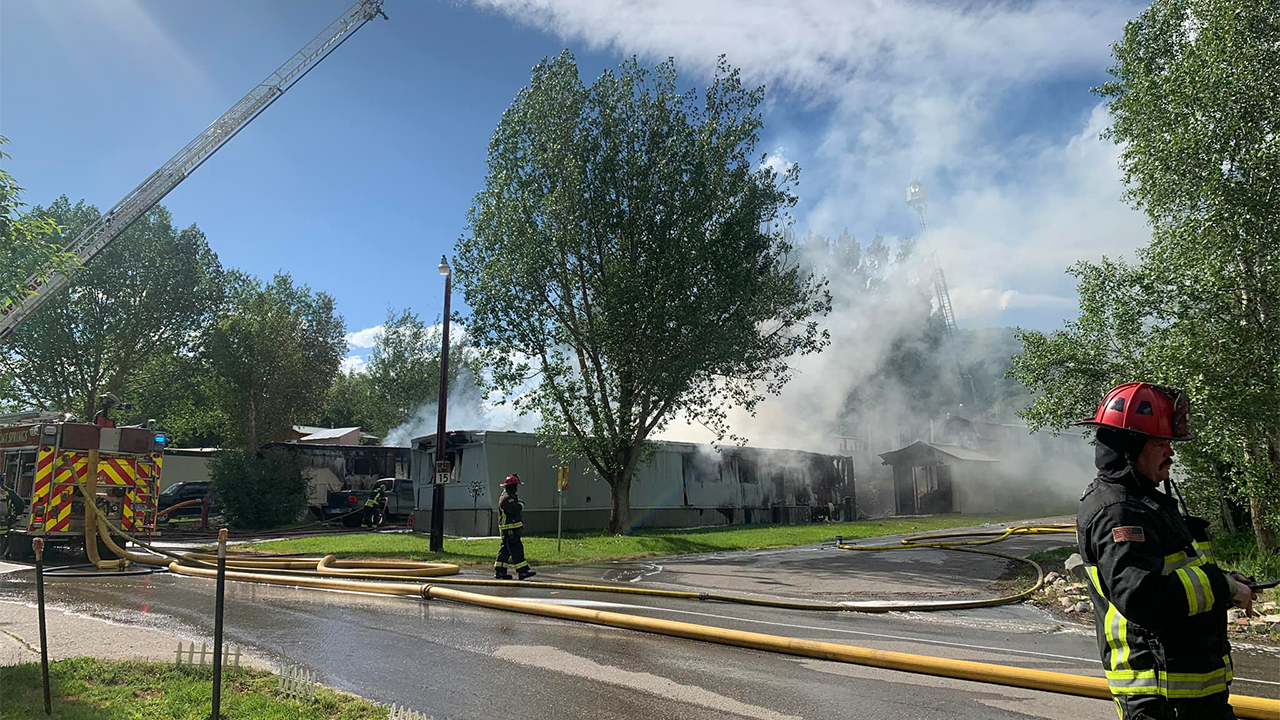
A plane crashed into a mobile home park in Steamboat Springs, Colorado, on Monday afternoon, killing two people and setting two trailers on fire, authorities said.
Steamboat Springs Fire Rescue said the aircraft went down in West Acres Trailer Park.
The two people killed were the pilot and a passenger, according to Steamboat Springs police.
Routt County Coroner Mitch Locked on Tuesday identified the crash victims as 67-year-old Dan Dunn and 42-year-old Jessica Pauline Melton, from the Colorado Front Range.
“Our hearts go out to the family and friends of the deceased,” police wrote on Facebook.
PILOT DEAD AFTER PLANE CRASHES INTO RIVER IN ‘VERY REMOTE LOCATION’: OFFICIALS
First responders extinguishing the flames. (City of Steamboat Springs)
The city said ten firefighters and off-duty personnel worked to extinguish fire at two homes and several outbuildings, as well as secure the scene for the downed aircraft.
“All first responding agencies are aware of the plane crash. Please do not overwhelm our 911 dispatchers,” the Routt County Sheriff’s Office said in a Facebook post. “First responders are already at the scene getting in the right resources. We will update the public as soon as we have more information.”
COLORADO RESCUE CREWS RACE TO FIND MISSING HIKER, DOG NEAR ASPEN TRAIL
Plane crashes in West Acres Trailer Park in Steamboat Springs, Colorado. (Steamboat Springs Fire Rescue)
The Federal Aviation Administration (FAA) told Fox News Digital that a twin-engine Cessna 421 crashed into the mobile home park around 4:30 p.m. while approaching Steamboat Springs Airport/Bob Adams Field.
The City of Steamboat Springs said the airplane was believed to be en route from Longmont, Colorado to Ogden, Utah.
Authorities were asking others to avoid the area while first responders worked to extinguish the flames. (City of Steamboat Springs)
Steamboat Springs police established a call line for residents and family members to reach out after the crash. All residents of the mobile park have been accounted for, the city said.
The Community Room at the Combined Law Enforcement Facility has been opened to residents affected by the plane crash in West Acres Mobile Park, police said. The Red Cross and Routt County Crisis Support are also on hand to assist.
Officials said at least two mobile homes caught fire when the small plane crashed into the trailer park. (City of Steamboat Springs)
The FAA and the National Transportation Safety Board are investigating.
Steamboat Springs is located in north central Colorado, about a three-hour drive from Denver.
Read the full article from Here

Continue Reading
Alaska
An Alaska vacation can remind Israelis the world doesn’t revolve around them | The Jerusalem Post

For Israelis, it can also inspire humility. Not because the Jewish state is smaller than Denali National Park, but because in Alaska, one is reminded that the world neither revolves around Israel nor is obsessed with it.
That realization came on a trip The Wife and I took to America’s Last Frontier last month.
“Where is your final destination today?” the woman checking us in for our flight home at the Anchorage airport asked chirpily.
“Tel Aviv,” I replied. “Where’s that?”
When I said it was in Israel, she smiled and said, “Oh.”
Lest one think this was just a fluke: on the plane a few hours later, another Alaskan asked where we were going. When we answered “Tel Aviv,” she said she had never heard of it.
Granted, two people do not a Pew Poll make, but they do offer a small corrective to the perception – fed by the media most of us follow – that the world is preoccupied with Israel, thinking about us obsessively, talking about us constantly, and cursing us unremittingly.
The last part, at least in Alaska, is also not true. During our two weeks there, we saw no “Free Palestine” graffiti, nor were we subjected to dirty looks or “child killer” comments when we said we were from Israel.
All of America, it turns out, is not Mamdani’s Manhattan, nor does social media present a proportionate picture of that country’s reality.
One of the problems with social media is that every incident of antisemitism is posted online. The incidents are real and rising at an alarming rate, but seeing them all in one place creates a disproportionate sense of how likely you are to encounter them while traveling.
Watch enough clips of a Jewish kid harassed on a New York subway or an Israeli couple berated at a hotel in California, and you begin to wonder whether the same thing awaits you when you ride an American subway or check into a hotel.
It doesn’t. Yet the cumulative effect is that you begin to wonder how open to be about your Israeliness. You don’t decide to hide it, but simply having to ask the question adds a mini-layer of apprehension before every trip.
When Israel comes along for the ride
You also learn to read the Uber.
“Honey,” I urged The Wife before we got into an Uber in Chicago during a brief layover, “you don’t have to say you’re from Israel.”
“Nonsense,” she said. “I’m not going to hide who I am.”
“Wonderful sentiment,” I replied. “The driver’s name is Rabah. Humor me.”
We didn’t volunteer our place of origin, nor did he ask.
But on the entire trip, that was the only time we consciously withheld that nugget of biographical information. Everywhere else, we proudly said we were from Israel – and it was fine. More than fine: it was often a conversation starter.
On a whale-watching excursion, we sat across from a young couple from China who work at Google. They were intrigued that we lived in Israel, and even more fascinated that we passed on the chicken sandwiches being served.
Instead of looking for sea creatures, The Wife spent a good part of the trip explaining why some of the fish in the sea we can eat and others we can’t.
“Honey,” I whispered at one point, a bit annoyed. “We didn’t pay all this money for you to give an introductory lecture on kashrut. Look for the damn puffins.”
Since October 7, another layer has been added to the anxiety of travel: whether your flight will be canceled at the drop of a ballistic missile.
One doesn’t just hop over to Alaska on a whim; it takes planning and a special occasion to justify the expense. For us, it was 40 years of wedded bliss, so we booked back in October after being warned that rental cars sell out months in advance.
We chose United. But just days after the war with Iran broke out, United – typically – canceled flights until mid-June, four days after our planned departure. We acted quickly – well, The Wife acted quickly – and switched to El Al. Still, it complicated the trip further.
Then came the more serious question: Do you leave the country when one of your sons or your son-in-law is in miluim in Lebanon, Gaza, or Syria?
My first instinct was no: you don’t leave when one of your children is serving. That may have worked before Oct. 7, when reserve duty meant a few weeks a year and could be planned around.
But today, when they have each logged upward of 350 days, saying you won’t leave while they are serving essentially means that you won’t leave at all.
Which, by the way, is hardly the end of the world. But what can I say? I like to travel.
So we went, even though as we were watching bears and sea otters, my youngest son was dodging drones in Lebanon.
“Go,” he said. “What are you going to be able to do by being here? And if, God forbid, something happens, you’ll come back.”
“That’s not the point,” I said. “How can we enjoy it if we are worrying about you?”
“You’ll figure out a way,” he teased.
And he was right. Sure, we worried, but less than if we were here. Distance, it turns out, has its advantages. I wasn’t glued to the news, tracking every development on his front.
Perhaps that was Alaska’s greatest gift. Not the calving glaciers, surfacing whales, or foraging bears, magnificent though they were. It was the realization that while Israel is the center of our world, it is not the center of everyone else’s. Every now and then, regaining that perspective is refreshing. ■
Arizona
Arizona AG continues to investigate Glendale apartment complex after Friday deadline to fix A/C

Arizona Attorney General Kris Mayes is giving a Glendale apartment complex until 5 p.m. Friday, July 10, to fix the air conditioning in every unit or face legal consequences. In a demand letter dated July 8, Mayes called Spectra West Apartments’ failure to provide air conditioning “both unacceptable and unlawful.” The complex could face civil penalties of up to $10,000 per violation if it does not comply. Resident Javier Montes said he chose to live at Spectra West because of its proximity to his job. “The reason I decided to live here because my work is just down the street. So, it’s just a five-minute walk for me, and so it’s very convenient for me.”

CALIFORNIA CITY, Calif. (KABC) — An Amber Alert was issued Friday by the California Highway Patrol for a 3-year-old child out of California City believed to be in imminent danger.
Emaria Peel, 3, was last seen Friday at about 7:17 p.m. in the area of Redwood Boulevard and 83rd Street in California City, according to police.
Authorities believe 31-year-old Charnay Mclin took Emaria. Investigators have not yet said what relationship, if any, Mclin has to the child.
The suspect was described as being 5 feet 9 inches tall, 185 pounds, with black hair and brown eyes.
The child was described as being 1 foot 6 inches, 20 pounds, with black hair and brown eyes.
Police believe they’re traveling in a gold-colored 2021 Kia Sorento with the California license plate: 36095DV
Mclin is considered armed and dangerous. Authorities wants anyone who sees them to call 911.
No further details were immediately known.
Copyright © 2026 KABC Television, LLC. All rights reserved.
-

 Cleveland, OH6 minutes ago
Cleveland’s First Round woes must end with the 2026 class
-

 Austin, TX9 minutes ago
Texas reports dozens of cyclosporiasis cases tied to contaminated fresh produce
-

 Alabama21 minutes ago
Small Plane Makes Emergency Landing In Peanut Field Near Florida-Alabama Line : NorthEscambia.com
-
Alaska24 minutes ago
An Alaska vacation can remind Israelis the world doesn’t revolve around them | The Jerusalem Post
-
Arizona29 minutes ago
Arizona AG continues to investigate Glendale apartment complex after Friday deadline to fix A/C
-

 Arkansas36 minutes ago
Office of Keep Arkansas Beautiful Now Part of the ARDOT
-

 California39 minutes ago
Amber Alert issued for 3-year-old out of California City in Kern County
-

 Colorado44 minutes ago
Colorado Highway getting bicycle bypass bridge


