West
Trump admin uncovers ‘staggering’ $8.6 billion in suspected California small business fraud

NEWYou can now listen to Fox News articles!
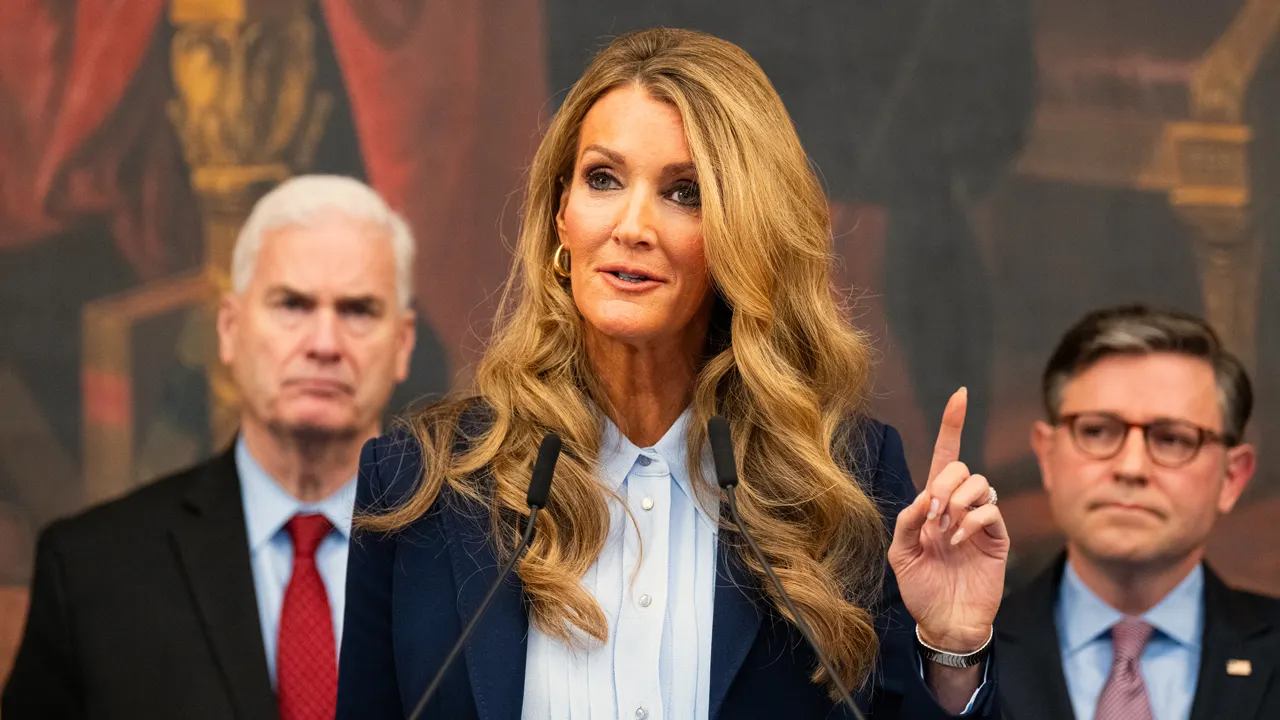
The federal Small Business Administration suspended more than 111,000 California borrowers after uncovering $8.6 billion in suspected fraudulent activity linked to the COVID pandemic, SBA Administrator Kelly Loeffler announced Friday.
“We have suspended nearly 112,000 borrowers tied to at least $9 billion in suspected fraud,” Loeffler said in a press release on Friday. “This staggering number represents the most significant crack-down on those who defrauded pandemic programs, and it illuminates the scale of corruption that the Biden Administration tolerated for years.”
The SBA reported that all in, it suspended 111,620 California borrowers who received 118,489 Paycheck Protection Program (PPP) and Economic Injury Disaster Loans (EIDL) loans, totaling $8.6 billion.
THE BORDER GETS THE ATTENTION WHILE FRAUDULENT GOVERNMENT BENEFITS BLEED TAXPAYERS DRY
The Small Business Administration announced the suspension of nearly 7,000 Minnesota borrowers after identifying hundreds of millions of dollars in suspected pandemic loan fraud. (Bill Clark/CQ-Roll Call, Inc via Getty Images)
PPP loans were a COVID-era federal relief program that gave small businesses money to keep workers on the payroll, while EIDL loans are part of an SBA program that provides low-interest disaster relief loans to help businesses survive during times of diaster, including the pandemic.
“Once again, the Trump SBA is taking decisive action to deliver accountability in a state whose unaccountable welfare policies have created a culture of fraud and abuse at the expense of law-abiding taxpayers and small business owners,” Loffler continued.
CHILDCARE EXPERT EXPOSES KEY ROADBLOCK TO UNCOVERING POTENTIAL FRAUD SCHEMES IN MINNESOTA: ‘REALLY DIFFICULT’
The announcement follows California Attorney General Rob Bonta saying on Thursday that the Trump administration was promoting “baseless claims” of persistent fraud in the state.
California Attorney General Rob Bonta dismissed Trump administration claims of widespread fraud. (Reuters/Fred Greaves/File Photo)
“Trump claims California is wasting money when, in reality, our programs are helping lower-income individuals and lower-income families get healthcare, food and housing assistance,” Bonta said on Thursday.
“Trump claims, wrongly, California is perpetuating fraud when we are the victim,” he added.
Bonta’s office noted that California has recovered nearly $2.7 billion in various fraud schemes across the last 10 years, “including by partnering with the federal government.”
EXCLUSIVE: SENATE BILL TARGETS MINNESOTA-STYLE ‘RUNAWAY FRAUD’ TO FORCE SCAMMERS REPAY TAXPAYERS
Fox News Digital reached out to Bonta’s office on Friday for additional comment.
Newsom’s office directed Fox News Digital to the Governor Newsom Press Office X account, which mocked the SBA announcement.
“OMG. The Trump Administration found MAJOR FRAUD in programs THEY control, Newsom’s Press Office’s X account posted, linking to a New York Post exclusive on the announcement.
“The state has no role running / administering these programs.Were they hiding this??? California doesn’t hide fraud … we fight it. Nearly 1,000 arrests + over $125 billion STOPPED under @CAGovernor Gavin Newsom.”
Quality Learning Center in Minnesota was found at the center of an alleged childcare fraud scandal in the state. (Madelin Fuerste / Fox News Channel)
Loeffler continued that the alleged California fraud comes after the SBA suspended 6,900 borrowers in Minnesota associated with 7,900 potentially fraudulent PPP and EIDL loans, which totaled roughly $400 million.
“As we did in Minnesota, we are actively working with federal law enforcement to identify the criminals who defrauded American taxpayers, hold them to account, and recoup the stolen funds. As we continue our state-by-state work, our message is clear: pandemic-era fraudsters will not get a pass under this Administration,” Loeffler said, comparing California to its investigations in Minnesota.
CLICK HERE TO DOWNLOAD THE FOX NEWS APP
Minnesota became ground zero for welfare and social services fraud surrounding the pandemic late in 2025, when investigators uncovered sweeping fraud schemes that could top $9 billion.
Read the full article from Here



A vegetation fire was burning in northern Napa County Monday afternoon northeast of Angwin.
Cal Fire said the Hardin Fire began at about 2:40 p.m. in the area of Hardin Road and Pope Canyon Road, east of Chiles Pope Valley Road.
The fire had burned 55 acres as of 3 p.m.
A status report at 3:45 p.m. said that crews were making good progress on the fire and that there were no evacuation orders at this time.
As of 5:10 p.m. forward progress of the fire had been stopped, and containment was at 35%.
The cause was under investigation.
Denver, CO
Denver Country Club caddie earns full-ride Evans Scholarship, becomes first in family to attend college

DENVER — What started as a summer job has turned into a life-changing opportunity for Denver-area student Vanessa Olivar.
The 18-year-old Denver Country Club caddie has earned the prestigious Evans Scholarship, a full tuition and housing scholarship awarded by the Western Golf Association to caddies who demonstrate strong character, academic achievement, financial need and a strong caddie record.
Watch Bradey King’s story on how Olivar persevered to nab this scholarship in the video below.
Denver Country Club caddie earns full-ride Evans Scholarship
Olivar is one of 15 students from Colorado to receive the scholarship this year and will attend the University of Colorado Boulder this fall.
When she first heard about caddying through her high school’s assistant principal, Olivar said she wasn’t sure it was the right fit.
“I didn’t know anything about the game of golf,” she said. “At first, I was a little doubtful and nervous, but I thought it would be a great summer job. I quickly found out that it was more than just carrying a golfer’s bag.”
Over the past three years, Olivar learned the responsibilities that come with the job, from carrying clubs and providing yardages to building relationships with members and fellow caddies.
“I learned a strong work ethic, and the relationships that I built through caddying have really shaped who I am today,” she said.
Her dedication paid off when she received the news that she had earned the Evans Scholarship.
“I got that flag saying, ‘Congratulations,’ and I was so excited,” Olivar said. “Words couldn’t express how excited my family and I were for this great opportunity that I worked so hard for over three years.”
The scholarship carries even greater significance because Olivar will become the first person in her family to attend college.
“I’m a first-generation college student,” she said. “Coming from immigrant parents, I kind of had to navigate this world by myself.”
Her parents immigrated to the United States when they were 18, and Olivar said their sacrifices inspired her to pursue higher education.
“Being able to tell my parents they don’t have to pay for my college takes that weight off their shoulders, but also mine,” she said.
Western Golf Association officials say Olivar exemplifies the qualities the Evans Scholarship is designed to recognize.
“The scholarship is based upon four principles: Their caddie record, their academic record, their financial need, but really what’s most important is their character,” said Brian Wilkinson, the Western Golf Association Director at Denver Country Club. “Vanessa expresses the great character and leadership that we’re looking for in young women and men.”
At CU Boulder, Olivar plans to major in public health with a minor in business before pursuing dental school.
She said the opportunity has changed the trajectory of her future.
“I knew I wanted to go to college, and I wanted to have a further education,” Olivar said. “I just didn’t know how I was going to do that. I didn’t know caddying was eventually going to change that for me. It’s a scholarship that has changed my life forever.
Denver7
Denver7 | Your Voice: Get in touch with Bradey King
Denver7’s Bradey King reports on the entire sports landscape in Colorado, including Denver’s pro teams, but is always looking for stories off the field and in the non-professional ranks. If you’d like to get in touch with Bradey, fill out the form below to send her an email.

You easily could have missed it amid all of the attention around this year’s tournament, but in late December FIFA revealed the bids that they received from federations to host the 2031 and 2035 Women’s World Cups. The sole bid for 2031 was a joint proposal from the United States, Mexico, Costa Rica and Jamaica. Although a formal vote still needs to take place to approve the bid, this all but assures the USA of hosting the women’s tournament for the first time since 2003.
As part of the bid, 20 potential host cities were profiled, including Seattle, which was lauded for its long history with women’s soccer and support for collegiate and professional women’s sports.
Local organizers from the 2026 men’s World Cup have already started publicly talking about bringing the women’s tournament here, too.
Here’s what you need to know:
Seattle in strong position to be a 2031 Women’s World Cup host
Seattle is one of 20 U.S. cities profiled in joint bid with Mexico, Costa Rica and Jamaica.
Is the 2031 Women’s World Cup really coming to the United States?
While it’s not official until the FIFA Congress meets in November and votes on the bids, it appears to be a fait accompli at this point. With the tournament growing to 48 teams in 2031 and FIFA desiring to cycle each edition between different continents, no other bids were received for 2031. Similarly, a joint UK/Ireland bid is the sole proposal for 2035 and is expected to be approved at the same FIFA Congress meeting.
However, the vote was originally scheduled to occur at a FIFA meeting in April, but had to be delayed after the Trump administration refused to sign off on required guarantees while attempting to pressure FIFA and U.S. Soccer to adopt draconian anti-transgender athlete policies. Whether either side budges before November remains to be seen.
Why was Canada not included in this bid, unlike the 2026 Men’s World Cup?
Having recently hosted the 2015 Women’s World Cup on their own, Canada Soccer felt that the Concacaf bid would be received more favorably without their involvement, which opened the door to the USA and Mexico inviting smaller Concacaf nations to join them.
What does it mean that Seattle was profiled in the bid book?
The overall proposal lists 35 potential host cities and 49 venues, with a subset of 20 profiled more in-depth. Some of this likely reflects the reuse of content which was already available from the 2026 men’s World Cup bid book, and let’s be honest – it’s a lot easier to hype up the metronatural wonders of Seattle than somewhere like Birmingham or Salt Lake City.
The venues that are profiled were selected to represent “the diversity in geography, scale, and infrastructure readiness”, but all 49 venues will be given equal consideration when it comes time for FIFA to select host cities.

Why is Portland not in the bid?
That’s a good question! The minimum venue size for the women’s tournament is 20,000 and a number of stadiums of similar size to Providence Park are included. I expect that many of the smaller venues will be weeded out during the review process because FIFA wants that sweet, sweet ticket revenue, so perhaps they knew they’d be overshadowed by us.
How likely is Seattle to be selected?
The odds are good! For broadcast purposes, the tournament organizers will want to spread games across time zones and there are only a few West Coast cities in the proposal – Seattle, San Francisco/Bay Area, Los Angeles, and San Diego. Seattle also benefits from being geographically distinct, offering the potential to draw fans from the wider Pacific Northwest area, especially if Canada plays any games at Lumen Field. The rave reviews the stadium and city just received during the 2026 men’s tournament are also going to be a big net positive during the selection process.
Previous Women’s World Cup tournaments have typically included 6 to 10 host cities, but with the event doubling in size from 2019 (when 9 cities were chosen for 24 teams) and global media wanting matches spread out in more timeslots, there will be a need for more venues than ever before. The 2026 Men’s World Cup serves as a model, with 16 host cities for that 48-team tournament. Costa Rica and Jamaica will each have one venue and Mexico has six potential host cities, meaning the US will likely have at least eight host cities, if not more. It is also unlikely that multiple cities in close proximity would be selected – for example, no more than one of the three Florida candidates would likely be selected, if any; and likewise only one of Baltimore or Washington, D.C.
What will the atmosphere be like?
Much of what you’ve witnessed for the 2026 tournament will also feature in 2031. All of the fields will have natural grass surfaces. Host cities will have dedicated fan zones with supporting programming and watch parties, bars will host events, and you can expect a lot of traveling support bringing their own culture and stadium traditions to games.
Will this be another wild goose chase to get overpriced tickets?
Historically, the Women’s World Cup has been significantly more affordable and accessible than the men’s tournament. For example, packages with a ticket to both semifinals and the final in 2019 in France started at €50 (about US$60), and tickets to the 2023 final in Australia started at AUD $40 (about US$28), while group-stage games were even less expensive. The past five women’s finals have sold out, but there was ample time to get tickets in the lead-up to the games without submitting to a lottery to win a chance to wait in a second queue a month later for the possibility of buying a ticket that’s more expensive than your mortgage payment.
But the sport is growing quickly, with a huge influx of money and more sponsor and media attention around the globe, and more federations finally getting serious about investment and promotion for their women’s sides. The experience and demand in 2031 might look completely different from 2023. That said, even with higher demand and price inflation, tickets should not be remotely near the eye-watering dynamic prices being charged for the 2026 tournament, nor as difficult to obtain.
When will we know if Seattle is selected?
The first step won’t come until after the bid is formally approved this winter. Then there will likely be several rounds of review, with some candidate venues dropped after each round. The final venues for 2026 were selected about four years in advance, which means we might get an indication of Seattle’s status in late 2027. Until then, one of the biggest things you can do to help the cause is to continue showing up to other women’s soccer games happening in Seattle.
-

 Technology8 minutes ago
Microsoft tests Windows Search without all the ads and fluff
-

 World14 minutes ago
Iran-backed terror proxy Houthis threaten fresh attacks after Yemen airport strike
-

 Politics20 minutes ago
Hegseth announces joint task force with DOJ to prosecute leaks to journalists ‘with the full force of the law’
-

 Health26 minutes ago
Microwaved squishy toy explodes onto boy’s face and chest amid viral trend, causing horrific burns
-

 Sports32 minutes ago
FBI, Atlanta police target unauthorized drones flying near World Cup venues
-

 Technology38 minutes ago
Why careful people still end up on data broker sites
-
 Business44 minutes ago
Netflix to add videos from digital publishers to its homepage
-
 Entertainment50 minutes ago
Tom Segura and Christina Pazsitzky split after 18 years of marriage

