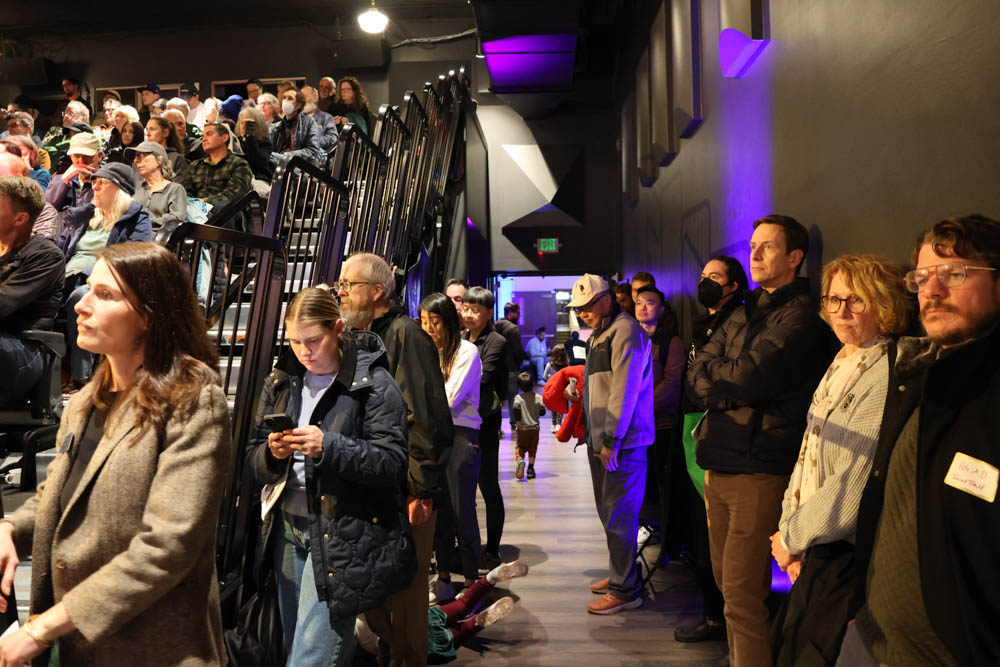
The event that brought a standing-room-only crowd to Youngstown Cultural Arts Center‘s Thelma Dewitty Theater tonight was announced as a “light-rail visioning forum,” but “floating forum” would have been more accurate: At the heart of it were Sound Transit managers floating their most promising options for getting West Seattle light rail cost back into “affordable” range.
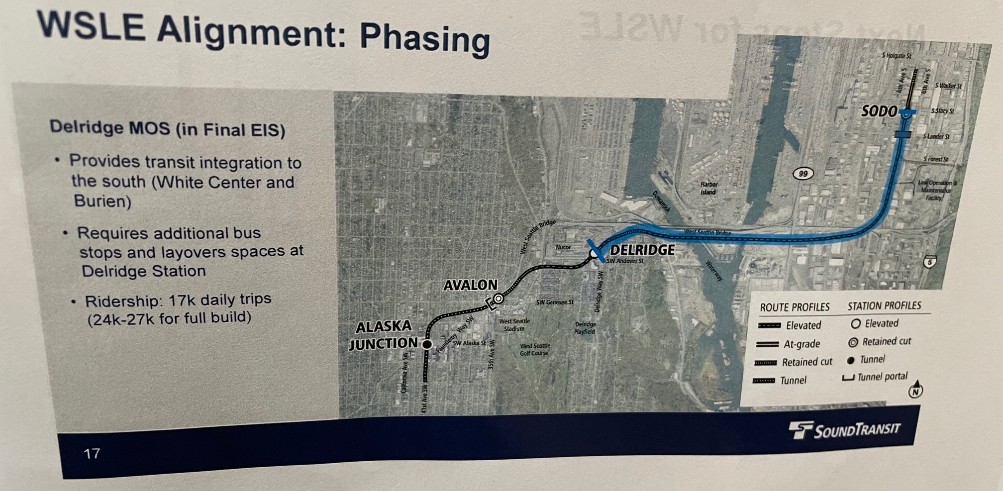
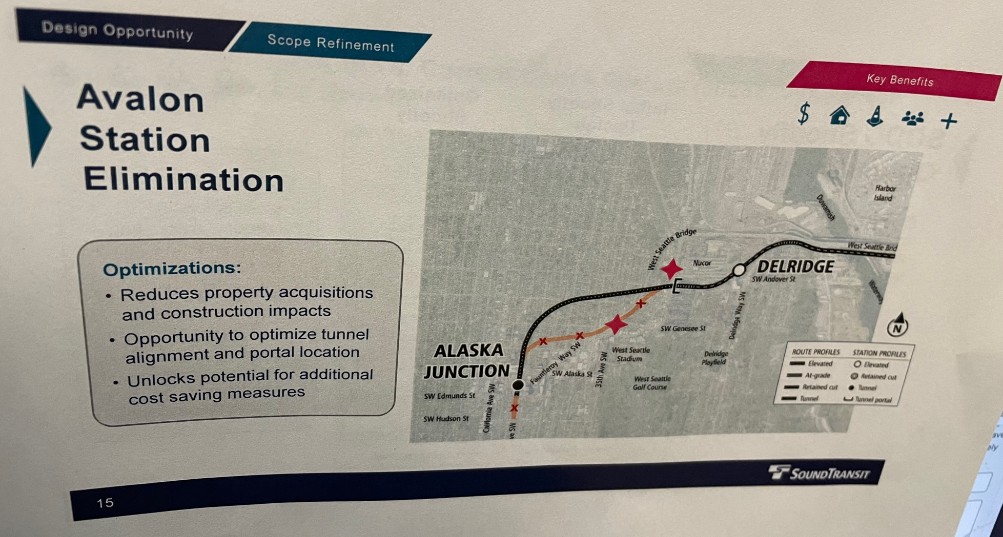
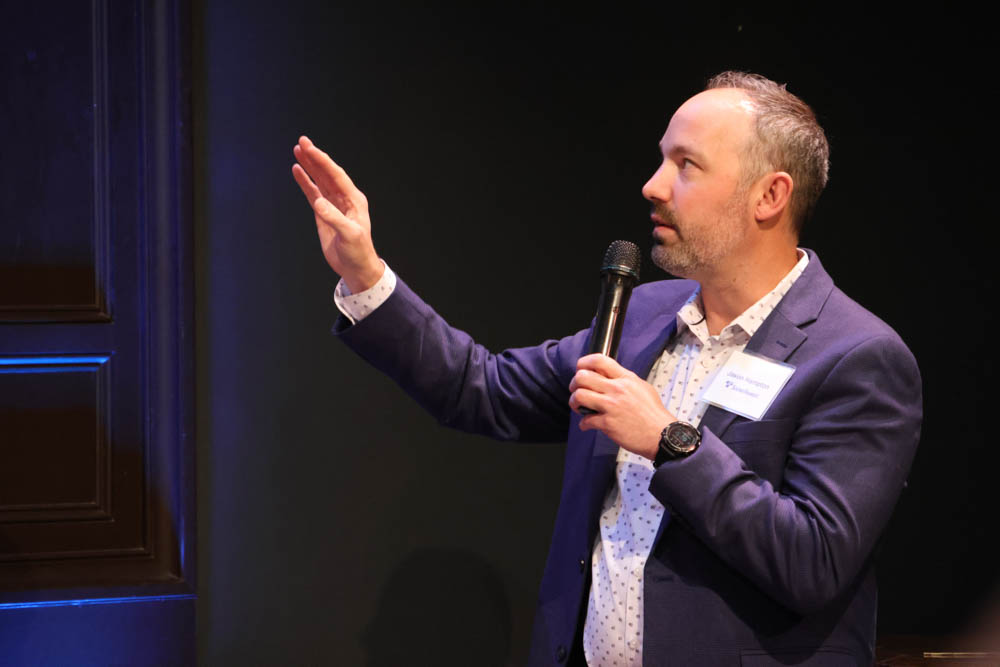
The biggest potential changes: “Phasing” West Seattle light rail – build between SODO and Delridge first, extend to The Junction sometime later – or dropping the Avalon station entirely. The latter has already been more extensively discussed than the former – both were presented at a board committee meeting we covered in September – and the way that ST’s Brad Owen and Jason Hampton discussed it tonight, it sounded almost like a done deal.
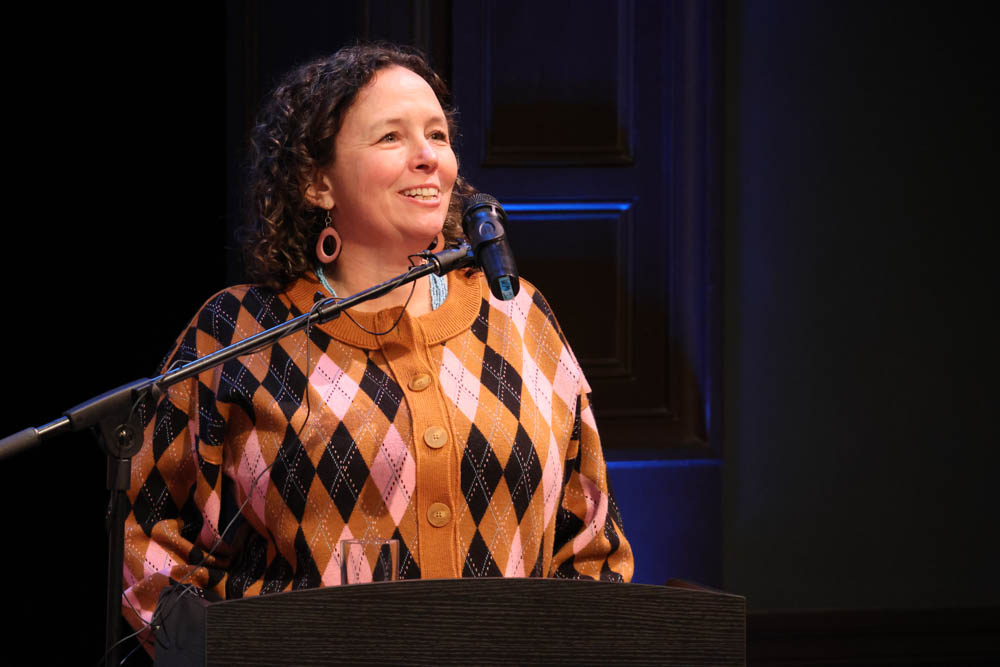
Nothing, however, has been decided, or is on the brink of decision, but it’s just a matter of months before the Sound Transit Board starts making decisions as part of its “Enterprise Initiative.” Before we talk more about what was shown tonight, here’s our full video of the hour-and-a-half forum, introduced by our area’s King Countu Councilmember Teresa Mosqueda, who mentioned she’s hoping to join the ST Board (which will have vacancies soon, such as King County Council chair Girmay Zahilay vacating his seat as he moves up to the one guaranteed for his new job as KC Executive):
Advertisement
The first half-hour was spent mostly in acknowledgments and preface; then came the heart of the presentation, followed by about 20 minutes for questions.
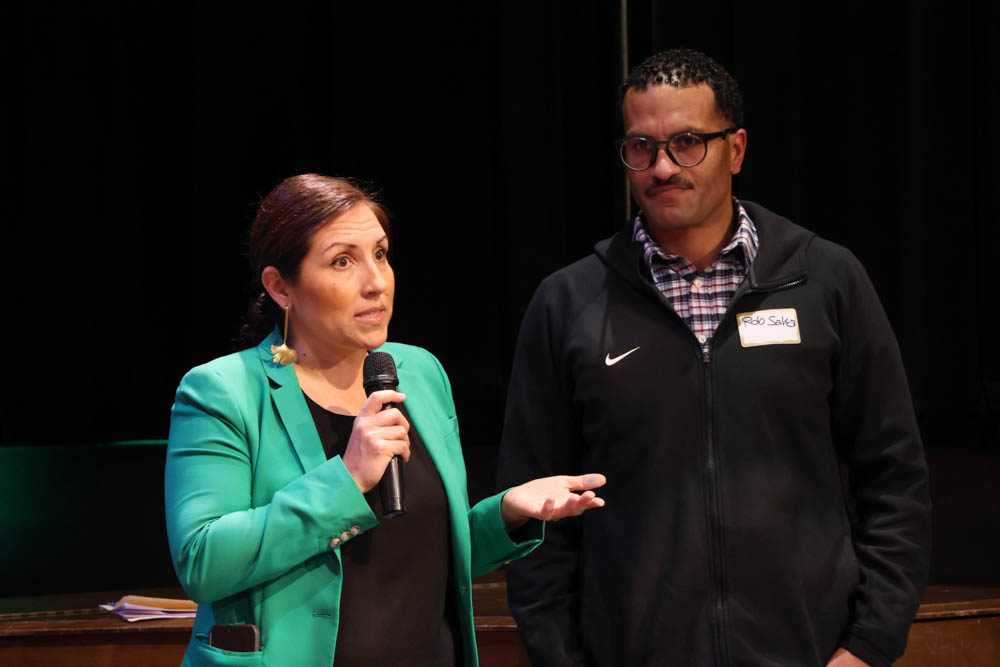
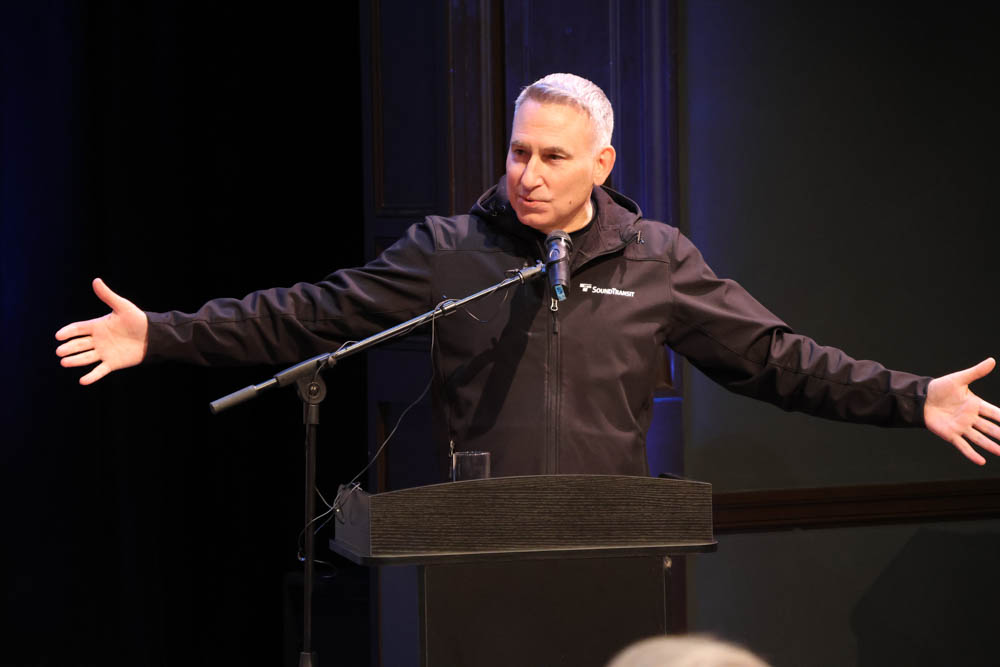
During her introduction, Mosqueda said the forum was important because “West Seattleites like details.” She is one herself, a North Delridge resident, as is the other local elected official she introduced, City Councilmember Rob Saka, who otherwise did not speak. Second speaker was ST CEO Dow Constantine, who championed West Seattle light rail during the years he was on the board as county executive (and noted tonight that his first swearing-in was exactly 16 years ago).
He said the “Enterprise Initiative” is all about trying to make the agency sustainable, explaining that it has evolved from a “capital construction fir” to a “substantial transit agency,” serving “up to 150,000 people a day” while building one of the nation’s longest light-rail lines – and figuring out how to close a $34 billion, 20-year budget deficit. In the big picture, Constantine said, by the time the FIFA World Cup games come here next year, ST will have built 63 miles in less than 17 years, pronouncing that a “history of success” that should offer hope “we can solve today’s problems.”
More optimism was offered by Carrie Avila-Mooney, representing outgoing County Executive Shannon Braddock (who had been billed as a forum speaker), reminding those present that the project already had its Federal Record of Decision and therefore hope for the federal funding it would need. She said Braddock – a West Seattleite who had served as Constantine’s deputy executive – is a “huge, huge fan of building” West Seattle light raill
Advertisement
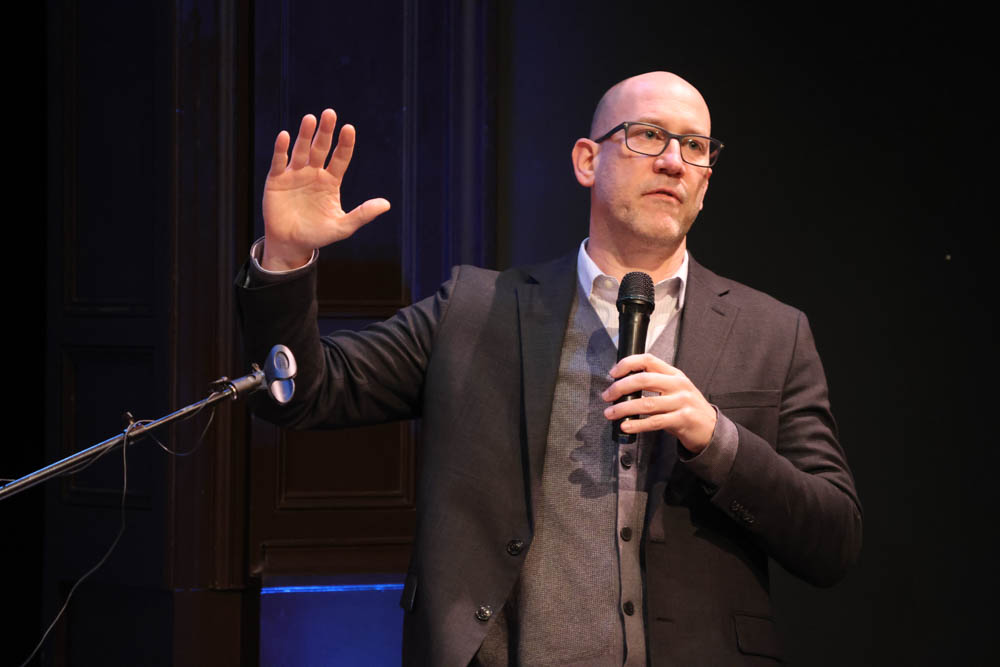
When Owen and Hampton from ST finally began their presentation, one of the early slides was notable for added rationale points arguing for the West Seattle line, including that it would be a travel alternative “if the West Seattle Bridge is congested or closed for repairs” and that it “facilitates future expansion to the south” such as White Center and the airport.
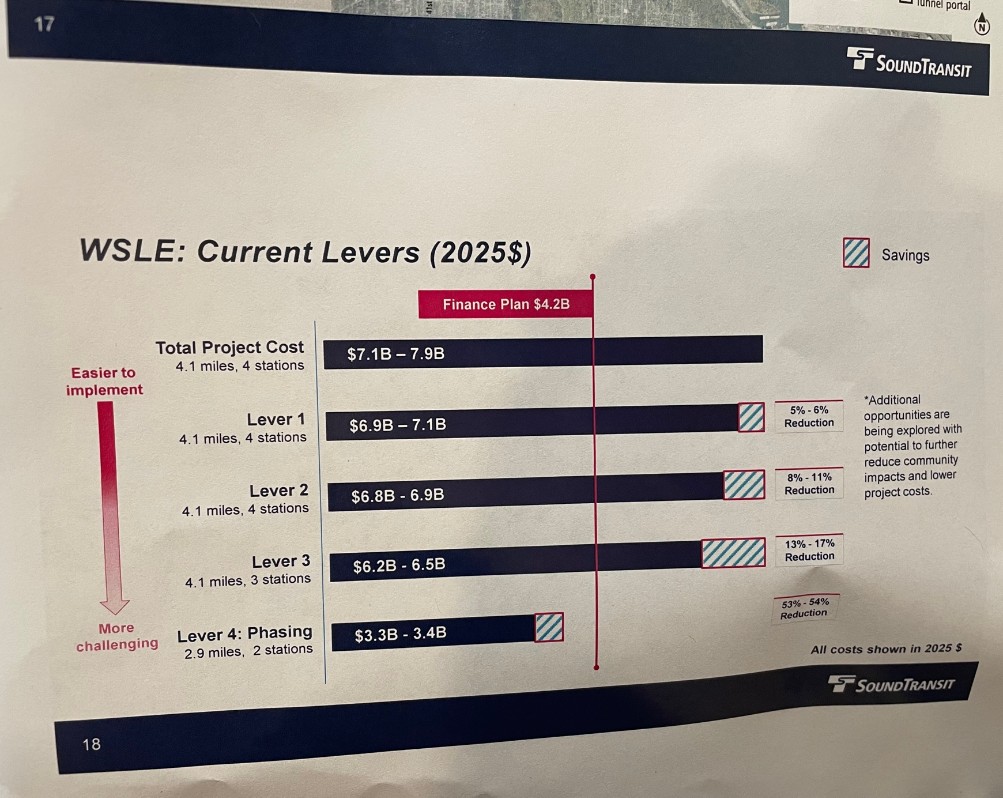
Owen said West Seattle is now about a third of the way through design – 30 percent – meaning they are getting “cost clarity.” That’s led to the previous reporting about the three-stop West Seattle line potentially costing up to $7.9 billion, while current financing would cover about $4.2 billion.
So that gap called for some “project-specific things we think we can move the needle on. Station optimization for SODO and The Junction would save some money, but not as much as eliminating the Avalon station or “phasing” by stopping at Delridge for an undetermined while.
ST describes potential savings in terms of “levers”:
The highest level “lever” would be phasing. If they stopped at Delridge for now, they project it would cost just over $3 billion, within the range of affordability, and that’s a “conservative” estimate, Owen said.
Advertisement
“Phasing is a very typical thing for these projects,” he insisted.
The next level of “lever” would apply to dropping the Avalon station, though that would only drop the cost into the $6 billion rang, still more money than the agency could cover.
Skipping the Avalon station also could enable a different entrance for the tunnel to The Junction, possibly sparing the West Seattle Health Club (among other properties) and reducing the impact to Longfellow Creek, the ST reps said.
They also briefly discussed possible optimization for the Junction station – a previously reported design change that would remove the plan for “tail tracks” south of the station – and changes to the Duwamish River light-rail-only bridge as well as the SODO station.
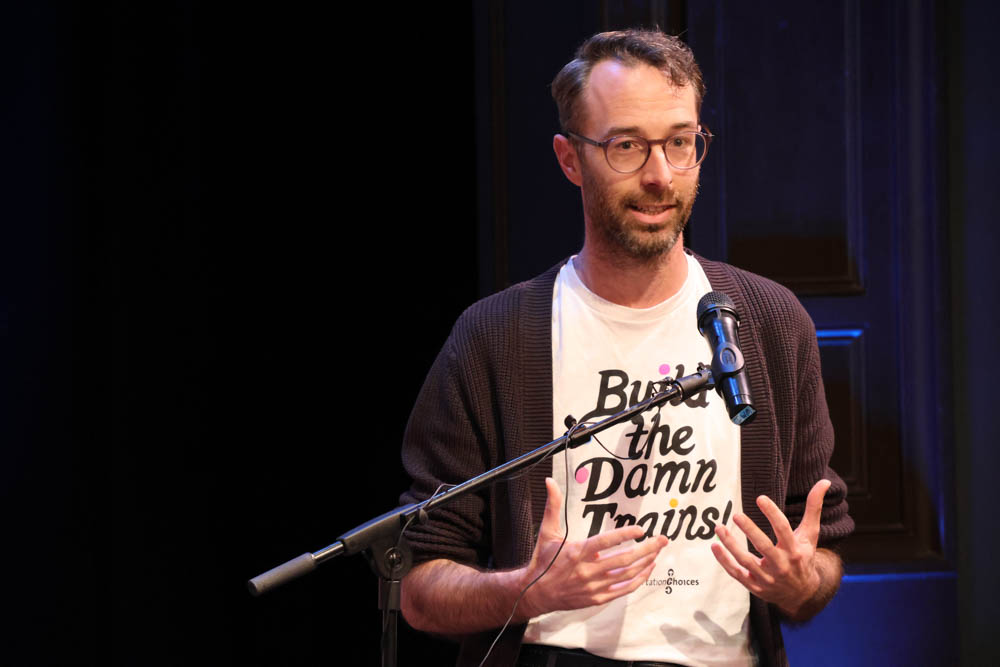
After the brief review of these possibilities, the podium was given to Kurt Hovenkotter of the Transportation Choices Coalition, a light-rail booster who explained his group’s recently announced Build the Damn Trains campaign.
Advertisement
He said that instead of cutting back on projects like this, ST should look at “creative” ways to turn the plan into reality. (We asked him afterward if he was suggesting a search for new revenue; he said no, they don’t want to see ST cut back on projects like this; instead, he said he supports ST’s quest for legislative approval to issue 75-year bonds without voter approval.
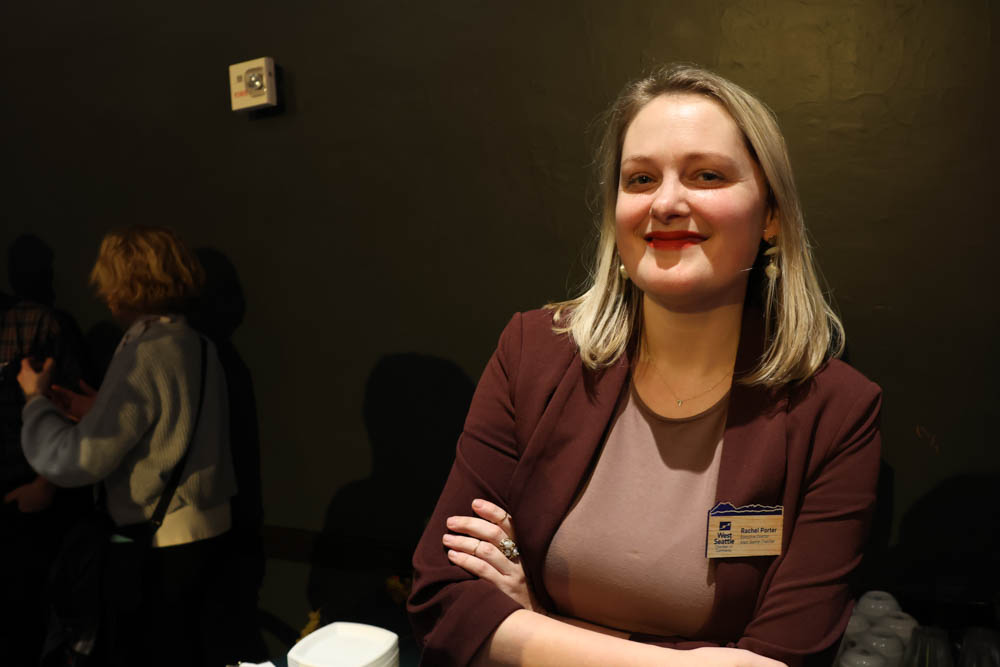
Less than half an hour remained when they started taking audience questions – both written ones collected from the crowd by people including Rachel Porter, executive director of the co-sponsoring strong>West Seattle Chamber of Commerce:
Those included a request for more information on what the “no Avalon station” concept might mean:
Hampton said the West Seattle extension wouldn’t see much of an overall ridership drop if Avalon was scratched – most of its prospective users would go to one of the other stations. Meantime, Owen acknowledged that they’re slowing the pursuit of properties until this is all figured out. Hampton acknowledged that they had acquired three homes, not because they needed the property quickly but because the owners requested early action due to life circumstances (as reported here in July). The ST reps said that if it ultimately turns out those properties aren’t needed for the project, they’ll “work with the property acquisition team” to determine what to do with them.
A few questions were asked via open microphone. One was whether there would be a “real town hall” devoted to people’s questions. Mosqueda said she hopes to have more events like this but in the meantime, all the officials and managers who were there are accessible for one-on-one questioning. Another attendee asked how to build the light-rail extension faster; Owen suggested the “phasing” was one answer – “when you have to build less, you could build faster.”
Advertisement
But while it’s decided whether they will build less, or make other changes, some residents and business owners remain in limbo, like Erin Rubin of Mode Music Studios and nonprofit Mode Music and Performing Arts, still likely to have to move no matter what changes are made in the plan, as their building remains in the Delridge station footprint, whether the project is “phased,” trimmed dow, or changed in some other way.
WHAT’S NEXT: The ST Board’s work on the “Enterprise Initiative” is expected to take another year or so, but decisions on plan changes and project changes are expected sooner, likely in the first half of next year. Until then, ST says it wants “feedback on design refinements,” so if you have thoughts on what was floated tonight – and/or other ideas – you can email westseattlelink@soundtransit.org.
SEATTLE — From my first visit as an adult, I was absolutely smitten with this city with snow-capped mountains and glistening bodies of water visible on all sides.
The decision to move here when my wife was accepted to Seattle University was probably one of the easiest and most fortuitous choices I’ve ever made. I loved the city’s topography, how people went outside no matter the weather and even the weather itself. I would often feel as if I was living someplace I would have chosen to vacation.
But it was soccer that made me feel like part of the city myself, like I had found my new home. I’ve often talked about how watching the Sounders win their first U.S. Open Cup at the George & Dragon was my first real introduction to the team. A few months later, I started working at Sounder at Heart. That summer, I experienced my first World Cup in Seattle. We showed up to a bar at 6 AM to get a spot for the USA-England match, and barely even got in. Bars all over town were packed, even when the USA wasn’t playing.
It was then that I started imagining what it would be like for the World Cup to actually come here.
Advertisement
Although the United States’ 4–1 loss to Belgium on Monday wasn’t exactly the way I wanted it to end, I can safely say the Seattle World Cup experience exceeded even my lofty dreams.
Picking one highlight from the six games is almost impossible as every game surprised me in different ways. In the immediate buildup to this tournament, the shine had seemingly started to wear off. Actually getting the World Cup was feeling like a pyrrhic victory, one of those “careful what you wish for” achievements. All anyone could talk about was ticket prices and corruption. Empty seats and unsold hotel rooms felt inevitable. I believed the mood and narratives would change once the soccer actually started being played, but my expectations had been massively re-set.
Once the games began, I immediately realized just how powerful the World Cup can be, especially in a setting like this. The crowd for Egypt-Belgium – Seattle’s first-ever World Cup match – was a near sellout, and it was then that I appreciated the power of the diaspora. I saw Egypt fans with tears in their eyes as they saw their compatriots gathered by the Great Wheel. Their march to the match was pure joy, filled with chants, giant flags and pharoah costumes. The match, itself, was a bit underwhelming – a 1–1 tie – but everyone seemed so happy. That set a standard that was probably exceeded in each game.
The only way stories like this are possible is through the support of readers like you. Support independent soccer journalism by becoming a subscriber to Sounder at Heart.
Advertisement
Join
The Bosnia & Herzegovina fan march was genuinely awe-inspiring, as it seemed to go on forever. I swear there were 40,000 people wearing BiH’s blue, yellow and white and they were all singing ‘Ljiljani’ once it was over. The atmosphere for Iran-Egypt was absolutely electric, and I honestly felt like the stadium might explode when Iran scored what seemed to be a late game-winner only for VAR to overturn it.
My favorite memories from this tournament, though, will likely be tied to the way Seattle really came alive for the two USA matches. To see an American downtown flooded with soccer fans is not something I ever thought I’d see, and for it to happen twice in my hometown only made it more special.
Advertisement
For the Australia match, I came into downtown from my home in Wallingford on a rental bike, traveling along the newly refurbished waterfront before 8 AM. There were already massive crowds gathered.
For this match, I chose to arrive on the Link Light Rail. It was the first time I used it to get to one of the World Cup games, but I wanted to experience what it was like to emerge from Pioneer Square station with hundreds of thousands of others.
Three hours before kickoff, Occidental Square was already packed as thousands of people watched the final moments of Spain-Portugal on the Brick Park big screen. Virtually every bar was already at capacity, with lines snaking out the doors. Inside the stadium, the north pavilion was already teaming with activity and lines to get into the various pro shops snaking through the concourse.
A short while later, I caught up to the USA march to the match. Led by horse-riding Civil War re-enactors, the march took 20 minutes to pass through the intersection of 1st and Main. As it passed, sections of fans broke out into impromptu “U-S-A” chants, sang other American Outlaw standards, played instruments and held a wide variety of signs. My favorite was probably Captain America punching out a Smurf (which were created in Belgium). There were others with Clint Dempsey, Grant Wahl, Weston McKennie and John Denver. They wore eagle costumes, dressed as Founding Fathers, and flag-inspired soccer shirts … so many stripes. I swear I didn’t see a single frown.
Joe Towner / PNWMF
Given the size of the crowd inside, I have to assume that the vast majority of those in the march weren’t planning to attend the game in person. They just wanted to be part of this intoxicating energy, equal parts hope, anticipation and FOMO. City officials said 25,000 fans participated in the march, 10,000 more than took part in the one before USA-Australia. Some estimates have suggested there were as many people downtown as there were for the Seahawks’ Super Bowl prade that pushed into seven digits. Hard as that is to believe – that a soccer match could attract a crowd like that – my eyes told me it was at least possible.
The Overlook Walk’s Salish Steps were packed, just as they were many other times during these magical few weeks. Otherwise vacant storefronts were suddenly impromptu soccer bars. The Historic Triangle Pub was revived, featuring a massive screen and overflowing beer garden just around the corner from the stadium. In the Chinatown/International District — which is one of the downtown neighborhoods that hasn’t benefited as much from the World Cup crowds — hundreds crowded into Hing Hay Park to watch the game. The demand for viewing spots was seemingly insatiable.
Advertisement
The good vibes flowed seamlessly into the stadium. The buzz was overwhelmingly positive, talk of a serious run was on lips all over the park. “Why not US?” wasn’t just an empty platitude spoken by Argentinian head coach Mauricio Pochettino, it was a mantra that turned otherwise uninterested Americans into believers.
Photos by Max Aquino / Sounder at Heart
Seattle, long overlooked on U.S. Soccer’s list of preferred sites, has been dubbed “The Cathedral of Cascadia” by none other than the USMNT’s Twitter account and fans did everything possible to live up to that lofty praise. I’m not one to get emotional about the National Anthem, but when 67,000 people are collectively singing “The Star-Spangled Banner” it’s hard not to get lost in the moment. Somehow, I didn’t even notice the four fighter jets that buzzed the stadium to punctuate the song. At Minute 1, fans broke out the classic “Boom-Boom-Clap”-style “U-S-A.” You’d have thought the USMNT players would have been ready to run through walls.
Instead, they were utterly incapable of channeling that into their play against Belgium. After four matches in which they played with energy and spirit, they came out utterly flat against their most talented opponents to date. At no point did they have control of the match. They were down 1–0 before the match was even 10 minutes old, and were a bit lucky not to be down 3–0 by that time.
The one moment the USMNT had a chance – following Malik Tillman’s wonderful free kick that brought the match level – was almost immediately spoiled when they allowed Belgium to re-take the lead immediately off the ensuing kickoff.
Advertisement
Still, there was hope coming out of halftime. It didn’t take long for that to be spoiled, either. In the 57th minute, goalkeeper Matt Freese came way out of his box and badly misplayed a seemingly innocuous ball over the top, allowing Hans Vanaken to loft an uncontested shot from 35 yards into a virtually undefended net.
There were more “U-S-A” chants and Eddie Vedder even tried to inspire the Yanks by chugging a beer while on the jumbotron during a hydration break.
If there was a shred of belief left in the building, it was slowly and achingly asphyxiated until Romelu Lukaku struck the final blow with a powerful strike off another sloppy turnover in stoppage time. Fittingly, he and the Belgium bench celebrated with a mocking “Trump dance,” acknowledging the role the president insisted on playing after potentially getting FIFA to declare Folarin Balogun eligible for the match despite getting a red card against Bosnia & Herzegovina.
The mood in the streets after was obviously a far cry from how the day started. Players spoke about letting themselves and the fans down. There’s an undeniable sense that an opportunity has been missed, that a confluence of events quite like this may never arrive again. That may be true for the USMNT and the greater American soccer scene.
But I’m not sure it’s true for Seattle. Our status as “Best Soccer City in America” is not new, even if it’s not a moniker we’ve tried to trademark. We reguarly brought 30,000 to Lumen Field when most of the MLS was lucky to draw half of that. Although the buzz around the Sounders has diminished a bit over the years, the World Cup crowds were actually smaller than the club’s most popular games.
Advertisement
Updated Seattle/PNW attendance records show World Cup matches occupying slots 6-10 (66,925 for each of final 5). Sounders own top 5. Among those bumped out of top 10: Sounders-Barcelona, DC United-Real Madrid, Man United-Celtic.
— Frank MacDonald (@frankmsounders.bsky.social) July 7, 2026 at 1:12 PM
It’s not that our city has discovered a love for soccer, but maybe this was the catalyst for its reawakening. Sounders leadership has a chance to embrace this moment and make sure it has legs long after the FIFA circus leaves town.
Our local leaders have a similar responsibility. We’ve always known that Seattle is a world-class city and now the world does, too. Our public transit is very good by American standards, but it can be world-class if we will it into existence. We showed how much energy can be harnessed when public space is given back to the people, and not handed to cars. Local businesses showed what they can do when unnecessary and burdensome paperwork doesn’t get in their way.
Advertisement
The World Cup was an event that I think exceeded all expectations, but the aftermath can be even better.
Thanks to Susan for the photo. She called to tell us about a dog stuck on the rocks off Beach Drive near Harbor West (the condos on pilings), and a crowd gathering to figure out how to rescue it from the rising tide. We were away from the desk at the time but after returning a little while later, we heard the situation mentioned on police radio, with word the dog had been rescued, so we didn’t head that way. Then late tonight Susan sent photos, explaining that the dog apparently is known to swim to those rocks and back, but for some reason got stuck this time, “until a paddle boarder and kayaker paddled out to it to coax it off the rocks and back to the shore.”