San Francisco, CA
The photographer who captured Black San Francisco in the 1960s: ‘We wouldn’t have seen it without him’


David Johnson saved a portrait he took as a teen of his younger brother and a relative while they were growing up in segregated Florida in the 1940s.
Johnson, who was the only person who could read and write in his household, knew nothing about photography then, he recalled in 2017, but something told him that one day he would be a photographer.
His decision would prove to be prescient. Johnson’s interest in the field led him to San Francisco in the 1940s, where he would become the first Black student of Ansel Adams, an accomplished documentarian of the city’s Black community and an activist.
Johnson captured iconic images of the Fillmore district, a thriving community for San Francisco’s Black residents before they were forced out by government “redevelopment” initiatives in the 1960s. He also documented the civil rights movement, including the 1963 March on Washington, and photographed high-profile figures such as WEB Du Bois, Langston Hughes, Thurgood Marshall, Nat King Cole and Eartha Kitt.
“He was quite a man,” Candace Sue, Johnson’s stepdaughter, said in an interview. “There are very few people who in their lifetime can achieve even one of the things he managed to achieve in his 97 years.”
Johnson died last month at age 97, but lived to see a renewed appreciation for his work. In recent years, Johnson’s photos were inducted into the Library of Congress and the Bancroft Library at the University of California, Berkeley, and featured in an exhibit at city hall. The Bancroft is home to Johnson’s archive, which serves as a primary source material of the era.
“[Johnson] is this great story of when a masterpiece finally finds its moment,” said Christine Hult-Lewis, the library’s pictorial curator.
Ansel Adams told him: photograph what you know
Johnson, born in Jacksonville, Florida, in 1926, was interested in photography from an early age. He got his first camera as a prize for selling magazine subscriptions as a teen, he said in an interview at the Bancroft Library in 2017.
He fell in love with San Francisco when he visited after being drafted into the US navy during the second world war. When his service was over, Johnson knew he wanted to study photography and wrote to Ansel Adams, who was overseeing a program at the California School of Fine Arts.
“[I] wrote a telegram and said ‘Dear Mr Adams, I’m interested in studying photography. And by the way I’m a Negro.”
Most schools in the south didn’t admit Black students, and Johnson didn’t want to travel across the country only to be turned away. “I had to cover my bases,” he said.
When a spot opened up, Adams offered him admission to the program and invited Johnson to stay with him until he could find a place to live. He was met by the acclaimed photographer Minor White, who would become his mentor. White and the other photographers around Adams’ home at the time wanted him to have a better camera and pooled together their old equipment, Jackie Sue Johnson, Johnson’s wife, told the Guardian.
“He was thrown in a group of people that didn’t look like him – they were all white, but they gave David all of their equipment that they weren’t using,” she said. “They taught him a lot. They just took him and really supported him.”
Adams and most of the other photographers were interested in nature, Jackie Sue Johnson recalled, but that was never David’s passion. “He didn’t have a car, and if he had a car he didn’t have gas money, so he couldn’t go to Yosemite and Muir Woods and take this wonderful nature photography.”
White and Adams told him to photograph what he knew. “What David knew is he knew his people,” said Jackie Sue Johnson, who along with her husband authored a book on his life.
Johnson headed to the Fillmore. Sometimes called the Harlem of the West, the Fillmore also had a thriving jazz scene before redevelopment ousted thousands of people. He remained in the neighborhood for years, and went on to work as a photojournalist.
His work centered people – a couple dancing close in a juke joint, men chatting outside a record shop and, in one of his favorite photos, a little boy in a cap sitting on steps.
“The pictures have this real poignancy of a place that just doesn’t exist in the same way any more,” Hult-Lewis said. The influence of Adams and his education can be seen in the quality of Johnson’s prints, she said, and the beautiful composition of his photos.
One of his most famous images is the Fillmore from four stories up. He climbed up the scaffolding of the Bank of America to capture a quick photo of a street corner from above, with street cars and vehicles in motion and pedestrians making their way from one side to another. Earlier in the day, he had taken a moving portrait of a disabled man on a skateboard.
“Athletes will say that when they hit several home runs, it was kind of their day. There are instances in my life and photography where it was just my day,” Johnson said in the 2017 interview. “The images just sprung out of nowhere. It was almost saying – that’s it, go for it.”
Johnson had a gift for capturing a single moment, Jackie Sue Johnson said. In another one of his more well-known photographs, a boy holding a flag sits in the lap of an Abraham Lincoln statue at a civil rights demonstration in San Francisco. “Lincoln, the flag, everything was there. It was almost like the gods set it up for me,” Johnson recalled.
‘More than just a photographer’: a foray into activism
For a time Johnson operated a studio in the Fillmore, but he eventually stopped working as a photographer and turned to other jobs to support his family, Hult-Lewis said. He worked at the University of California, San Francisco, where he co-founded the Black caucus to advocate for the rights of Black workers, Candace Sue said. Johnson and the NAACP sued the San Francisco unified school district to demand school desegregation as required by law.
“My personal saying is David was more than just a photographer,” Jackie Sue Johnson said. “He loved photography. It’s all he could talk about, but he was [also] a civil rights activist. He was always an activist. He was always trying to help or advocate for the underdog.”
Into his 90s, he would visit the San Francisco board of supervisors to advocate for legislation, particularly those supporting people with mental illness, his family said.
He never had exhibitions while he was working as a photographer, but his work has been rediscovered and recognized widely in recent years after it was featured in the 2006 book Harlem of the West.
“When I found his work I went hallelujah because it had a much more expansive description of this neighborhood,” said Lewis Watts, a co-author of the book, photographer and professor emeritus at the University of California, Santa Cruz.
“He was an incredible artist and an incredible person,” said Watts, who said he viewed Johnson as a friend, colleague and mentor. “The humanity in his work is reflected by the person that he was.”
In the years since, his photos have been included in a KQED documentary on the Fillmore District and exhibited at the San Francisco Museum of Modern Art, as well as city hall. It’s been a slow build, Hult-Lewis said, but Johnson was thrilled to witness it.
Johnson will be remembered for his civic contributions, Candace Sue, Johnson’s stepdaughter, said, and his documentation of the Fillmore.
“We remember and can see the joy and vibrancy of the Fillmore and what it was like before it was destroyed,” she said. “He documented what is no more and I don’t think we would see it the way we see it today without having that lens of the past.”


Fresh out of Stanford University, a young AI founder wanted to take the next step in the hallowed San Francisco startup playbook: purchase a so-called hacker house, fill it with his small team, and buckle down to build a company. He set his sights on Potrero Hill, a quiet, suburbanesque neighborhood that has experienced a breathless glow-up after OpenAI established its headquarters in the adjacent Mission Bay three years ago.
For his first-choice home, the founder wanted to come in strong. He bid 30% over asking, all cash. It wasn’t enough. He didn’t want to take any chances on the next home he found, so offered 50% over the list price, all cash, no contingencies.
“I thought we got it for sure,” the founder’s real estate agent, Milan Jezdimirovic, told The Real Deal. Jezdimirovic had attended every open house for the property, and made it clear to the seller his client was willing to be aggressive in purchasing the home. To go 50 percent over asking, all-cash, in the relatively modest Potrero Hill felt like a home run. Yet, they were outbid again.
Welcome to Area AI.
“I was speechless,” he said. “We did everything we could. It’s incredible what the ceiling is, I mean, there is no ceiling.”
As the artificial intelligence industry announces itself as the latest California gold rush, it has resuscitated San Francisco in ways old and new. Long desirable neighborhoods such as Presidio Heights, Cow Hollow and Jackson Square have seen their fortunes return from a pandemic lull. Yet, the city’s southeastern district, a paved bayside paradise known for loading docks, warehouses, and wide streets has seen a surprising surge in demand as major artificial intelligence companies and their battalions of one-percenter employees continue to plant their flags.
The moniker developed around 2023, when OpenAI relocated to 1515 Third St in Mission Bay, the neighborhood just south of McCovey Cove, the channel most famous as a landing spot for the home runs of Giants legend Barry Bonds.
Although divorced from the hubbub of the Financial District, Mission Bay attracted its own share of heavy hitters from the last tech boom. Now, much of that space is occupied by OpenAI, which took over nearly a million square feet previously occupied by names such as DropBox, Uber and Old Navy. Companies such as chipmaker Nvidia and crypto-exchange platform Coinbase have also expanded into the neighborhood. While the rest of the city continues to struggle with office vacancy rates, Mission Bay is nearly out of room, according to JLL.
That energy has had a gravitational pull. The University of California San Francisco recently spent nearly a billion dollars to expand its school of dentistry in Mission Bay, and the San Francisco Unified School District is preparing to open Mission Bay Elementary in August, its first new public school in decades.
“That whole area of the city is up and coming,” said Derek Daniels, San Francisco research lead for Colliers.
Mission Bay’s rise wasn’t random. The San Francisco Giants organization had been eyeing a redevelopment of Mission Rock – a northern carve out of the Mission Bay neighborhood — as far back as the early 2000s. The Giants, with developer Tishman Speyer, completed the first of the four-phase, 28-acre, $2.5 billion megaproject in 2024. It included two new office towers — with tenants such as Visa’s global headquarters, the Golden State Warriors and Blue Bottle — more than 500 housing units, 550,000 square feet of new office space, and 52,000 square feet of retail. Phase 2 doesn’t have a start date, but is slated to begin soon.
The effect has spilled into the residential market. The AI Boom has brought a flood of employees making base salaries around $500,000 who want to live near their offices, and the competition for Mission Bay’s apartments and condos has gotten fierce, with bidding wars pushing rents up sometimes by $1,000 or more, and condos going for well above asking price.
“For apartments, we will email the top five applicants and ask if there is anything else they can provide to help them stand out, and then they just start bidding against each other,” Jezdimirovic said. A recent rental hit the market for $7,890 and eventually leased for $8,700, while a recent three-bedroom rented for $15,000, he said. Over the last 12 months, the median prices for studios in Mission Bay have jumped 37 percent, two-bedrooms jumped 44 percent and one-bedrooms saw a 15 percent rise, according to Zumper.
The median price for a condo rose 13.2 percent over the last year, to $1.2 million, according to Compass. Jezdimirovic expects that number to continue to rise. He recently listed a 970 square-foot, one-bedroom condo for $1.2 million and eventually sold for $150,000 over asking.
“Today is not even comparable to 10 years ago,” Jezdimirovic said of Mission Bay. “Even just within the last two or three years, we’ve finally seen the full establishment of the neighborhood.”
The spillover effect has been dramatic for areas such as Potrero Hill. The neighborhood’s elevated views, easy highway access, and uniquely sunny weather have long made it a desirable landing place for young families. But over the last three years, it’s taken on a new role: as both a hot spot for hacker houses — homes essentially turned into dorms for tech entrepreneurs to live and work alongside one another— as well as the migration point for AI employees looking to settle down into family life or quieter living. In other words: Area AI’s suburb.
The median price for a single-family home rose 16 percent over the last year, reaching more than $2 million, according to compass. On average, homes are selling for 42 percent above asking, one of the highest rates of overpay in the city.
Jerry Rice Jr, (yes, son of that Jerry Rice), has worked as an agent in the area for 10 years and said he really began to see it surge around January. The area already has limited supply and few sellers — only 40 homes sold over the last 12 months — pressure that Rice said the AI wealth has only exacerbated.
“It’s been hot all year,” Rice said. “In Potrero Hill, you have all the benefits of the city without living in the city. The clients are largely family-oriented, with AI jobs and have a lot of liquid wealth. We’re seeing big cash offers.”
Rice said the nearby Dogpatch neighborhood, long characterized by warehouses and dilapidated buildings, is going to be the next beneficiary of the Area AI effect. The residential market has already started to creep up. The median price for a condo rose 7.3 percent over the last year, to $1.1 million, and total condo sales are up 15.2 percent, according to Compass.
The blue-chip startup accelerator Y Combinator, once led by OpenAI founder Sam Altman, relocated to the Dogpatch in 2023. Earlier this week, developer Brookfield, who has proposed a mega redevelopment of Pier 70 that would bring about 2 million square feet of commercial space and more than 2,000 new homes, requested adding 600 more units to the plan, bringing the total to 2,750.
“About 15 years ago, people told me the Dogpatch was nothing,” Rice said. “The Dogpatch is going to look totally different in five to 10 years. If I were an investor, I would start looking in that area, because that’s a hidden gem with a lot of upside.”
Brookfield ups market-rate unit count, building heights at Pier 70 project
OpenAI surges past 1M sf of offices in SF with latest Mission Bay lease
Residential
San Francisco
SF Giants, Tishman Speyer show look of first Mission Rock highrise Forget the glass towers. SF’s AI boom finds a home in a 19th-century neighborhood.
Read more


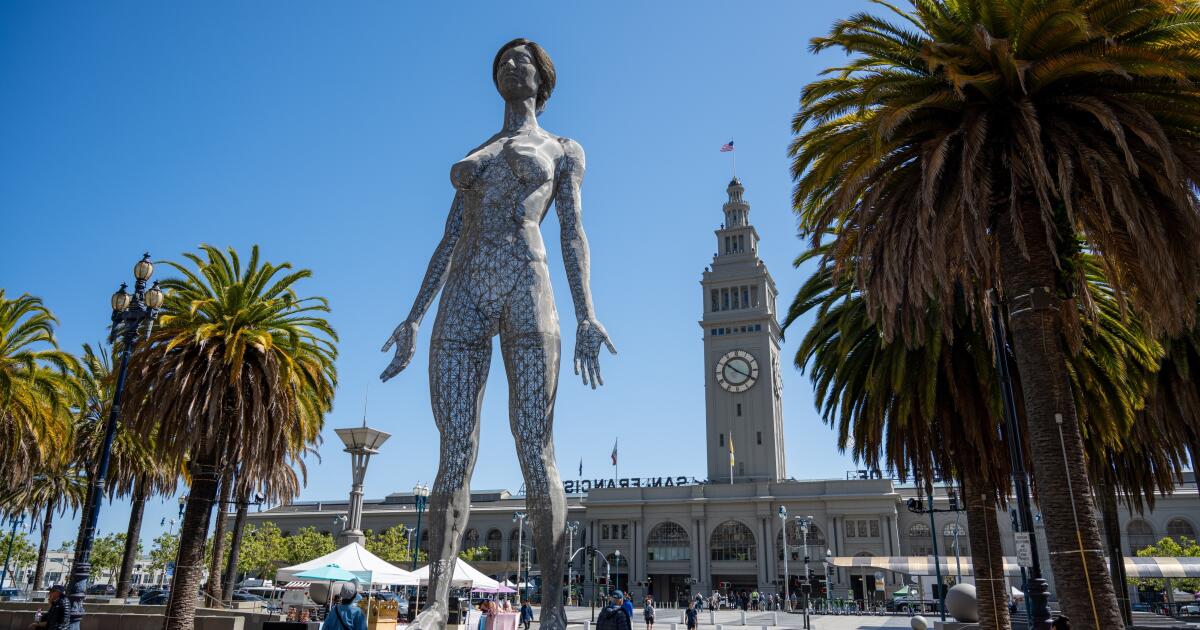
For sale in San Francisco: A 45-foot-tall metal sculpture of a naked woman.
Her name is R-Evolution. Her hair is pulled back and her facial expression is serene. Her mechanized chest expands and contracts, as if she’s breathing. And she tips the scales at 13,000 pounds (not that it’s anyone’s business what a lady weighs).
She will stand in Embarcadero Plaza across from the historic Ferry Building until October. Then she goes on sale. The artist says “she can go anywhere in the world,” but whoever buys or leases her will need a crane and a 60- to 80-foot bucket lift to resurrect her.
Since she was first unveiled as a temporary installation in April 2025, the giant statue, created by artist Marco Cochrane and modeled after California dancer and singer Deja Solis, has spurred debate about whether privately funded works are really public art. It also questions whether R-Evolution is a celebration of femininity in a free-spirited city that has long embraced public nudity or a hypersexualized shock piece from a male artist.
But debate, per the public and private entities who brought her to the plaza, is kind of the point. Art, they say, is supposed to be controversial.
An attempt to revitalize public space
R-Evolution is part of Big Art Loop, a privately funded initiative that aims to bring up to 100 temporarily installed large-scale sculptures — a minimum of 10 feet high or wide preferred — to public spaces along a 34-mile walking and biking trail over the next few years.
R-Evolution in Embarcadero Plaza in April 2025.
(Christopher Reynolds / Los Angeles Times)
Big Art Loop is funded by the Sijbrandij Foundation, a nonprofit established by billionaire Sid Sijbrandij, co-founder of the software company GitLab. It is curated by the art production agency Building 180, in partnership with the city’s Recreation and Parks Department and other public agencies.
“We’re going to continue to lean in to our arts and culture because that is driving our comeback here in San Francisco,” Mayor Daniel Lurie said in a September video promoting the Big Art Loop.
A city news release last year said R-Evolution’s arrival “aligns with San Francisco’s broader efforts to revitalize downtown” by increasing foot traffic to the battered business district, where office vacancy rates soared to record-high rates of more than 30% amid the pandemic-era pivot to remote work.
Controversial lady and Burning Man
Like a few of the Big Art Loop pieces, R-Evolution originally debuted at Burning Man, towering above the sweaty and stoned desert masses in 2015.
Critics of R-Evolution say the statue and other massive pieces along the billionaire-backed Big Art Loop did not get as much community input and were not subject to the same intense scrutiny by the San Francisco Arts Commission as other public artworks.
“I think what a lot of people, myself included, are frustrated by is the fact that these private entities are able to remake the public landscape in their own image,” Max Blue, a San Francisco Examiner art critic, told Gazetteer San Francisco in October, adding: “I don’t like these sculptures. I think a lot of them are just left over from Burning Man.”
Visual artist DJ Meisner told the Gazetteer: “It’s just so clear when you see the art that it’s like, ‘Oh, I’m supposed to be unbelievably wealthy and high looking at this.’ I’m neither of those things, so I’m just annoyed to be looking at it.”
Female representation or inappropriate?
Before R-Evolution was installed, an art vendor with a booth in Embarcadero Plaza wrote in a letter to the Arts Commission, saying she thought the statue, whose bare butt faces the Ferry Building, “might be very inappropriate for children.”
Another vendor wrote: “A naked woman statue designed by a man feels out of step with the times.”
The creator of the piece, Cochrane, said in a statement: “Women’s presence in public art is rare. When they are depicted, it is often through outdated or passive narratives. R-Evolution challenges that. She stands strong, aware, and grounded — calling for a world where all people can walk freely and without fear.”
Love her or hate her, she gets eyeballs
Julie Richter, a spokeswoman for Big Art Loop, told me in an email Thursday that R-Evolution, which had been slated for removal in April, got “very positive” feedback that led to her Arts Commission-approved extended stay through October. That feedback included positive reviews from most tourists, art vendors and nearby local businesses, according to a pitch to extend the statue’s stay by Big Art Loop and Building 180.
Near R-Evolution’s current perch, Vaillancourt Fountain — a colossal, crumbling Brutalist concrete sculpture that was unveiled in Embarcadero Plaza in 1971 and became a skateboarding mecca — was equally reviled and revered. Despite fans’ efforts to save it, the city removed it this spring.
Today’s top stories

The Visalia sign seen from Highway 99.
(Tomas Ovalle / For The Times)
These are California’s most affordable and least affordable cities
What we know about the boat accident near Alcatraz
- A memorial cruise turned tragic when a boat sank near Alcatraz Island, leaving one passenger dead, three missing and 17 rescued.
- The search for the missing was challenged not only by high winds and rough seas, but because the incident took place in a particularly deep channel of the bay dredged for cargo ships.
Scientists fear when the San Andreas fault finally snaps
- Scientists warn the region’s long earthquake drought is building dangerous strain on the San Andreas and San Jacinto faults, raising the odds of a devastating multi-county “Big One” in coming decades.
- With scenarios forecasting violent shaking from downtown L.A. to the Inland Empire, experts say the fault’s growing stress is a stark reminder to strengthen preparedness before nature resets the clock.
What else is going on
Commentary and opinions
This morning’s must-read
Other must-reads
For your downtime

The dining room at Baldi in Beverly Hills.
(Myung J. Chun / Los Angeles Times)
Going out
Staying in
A question for you: As temperatures rise in SoCal, how do you stay cool?
Email us at essentialcalifornia@latimes.com, and your response might appear in the newsletter this week.
And finally … your photo of the day

The trunk of a flooded car is seen in an underground garage along Palm Avenue in West Hollywood after a water main break sent thousands of gallons of water rushing down Sunset Boulevard and the surrounding area on Thursday morning.
(Allen J. Schaben / Los Angeles Times)
Today’s photo is from Times photographer Allen J. Schaben in West Hollywood, after a water main break sent thousands of gallons of water rushing down Sunset Boulevard and the surrounding area on Thursday morning.
Have a great day, from the Essential California team
Hailey Branson-Potts, staff writer
Hugo Martín, assistant editor, fast break desk
Kevinisha Walker, multiplatform editor
Andrew Campa, weekend writer
Karim Doumar, head of newsletters
How can we make this newsletter more useful? Send comments to essentialcalifornia@latimes.com. Check our top stories, topics and the latest articles on latimes.com.
-
 Politics2 minutes ago
Commentary: Trump’s voter fraud speech was bait. Stop biting
-
 Science8 minutes ago
Commentary: The doctor who helped save her is in another state, and telemedicine follow-up is prohibited
-
 Sports14 minutes ago
Commentary: LAFC star Son Heung-Min proves life after the World Cup can offer hope and redemption
-

 World26 minutes ago
Death toll from the two earthquakes that hit Venezuela hits 5,069
-

 News56 minutes ago
Where Wildfire Smoke Remains—And What To Do About It
-

 Los Angeles, Ca3 hours ago
Cybertruck driver arrested for DUI after Los Angeles pursuit crash
-

 Detroit, MI3 hours ago
DER Weekends: Pathways for first-gen students at the University of Detroit Mercy – WDET 101.9 FM
-

 San Francisco, CA3 hours ago
“There is no ceiling”: Welcome to Area AI

