San Francisco, CA
San Francisco makes upfront taxi pricing program permanent


San Francisco’s upfront taxi pricing program is here to stay after the San Francisco Municipal Transportation Agency’s Board of Directors voted to keep the program at their May 20 meeting.
“We’re thrilled to give San Franciscans and visitors a new and more convenient way to access the city’s taxi services and to have the peace of mind from knowing their fares before taking a trip,” said SFMTA Director of Transportation Julie Kirschbaum.
The Taxi Upfront Fare program started as a pilot in 2022. Passengers who request a ride using apps from Flywheel, Curb, or Arro would see a locked-in upfront price instead of one determined by the meter during the ride. Under the program, riders who request an UberX ride through the Uber rideshare app can also be routed to a nearby taxi instead of a rideshare driver.
MJ Keller, head of U.S. taxi partnerships at Uber, said the company plans to maintain the partnership going forward.
“As we continue to strengthen our relationship with the taxi industry, Uber appreciates the San Francisco Municipal Transportation Agency’s decision to make the Upfront Fare Program permanent,” Keller said. “By integrating taxis onto our platform, we’re providing taxi drivers with more flexibility and increased earnings opportunities while giving riders access to new transportation options. We believe this program continues to be a win for drivers, riders, and the City of San Francisco, and we’re excited to support its continued growth.”
According to data from the SFMTA, half of the city’s 1,300 taxi drivers took part in the pilot program. Those drivers gave close to 400,000 fixed-priced rides and made 25% more on average than drivers not in the program.
“I’ve been driving for a long time, and at first I was skeptical, but this program has been good for the taxi drivers who have been around for a long time, and the newer ones,” said Zee Sinada, Yellow Cab Medallion Owner and member of the SFMTA Paratransit Coordinating Council. “I begged the SFMTA to keep this program going, because there wasn’t enough business for the taxi drivers. But now, riders have more choices, and taxi drivers do, too. Financially, this is a difference of $600-$700 in extra earnings a week we’re talking about – this makes such a big difference.”
SFMTA officials credit the program at least in part for increasing taxi driving recruitment. They said there have been 300 new drivers since the start of the program, compared to 30 new drivers the year before.



SOUTH SAN FRANCISCO, Calif. – You’re not dreaming. Gas prices really are that high.
National average $4 a gallon, California $6
In fact, at the Shell station at 248 S. Airport Boulevard in South San Francisco, regular gas was going for $6.89 a gallon on Tuesday, about four weeks after the United States and Israel started a war in Iran.
Most people didn’t even stop to fill up; instead, drivers seemed to just pass the station by.
Juan Buenrostro did stop, though, and said it costs him about $300 to fill up his truck. He lives in Santa Cruz and had to drive to the Marina in San Francisco.
“It’s been crazy, man,” he said. “I have to work extra hours to make extra income. We’ve been struggling.”
That price is roughly double what the national average is. AAA said the average price of gas was $3.97 a gallon as of Tuesday, and the average price in California was $5.82.
Prices are so high that the state’s petroleum watchdog, the Division of Petroleum Market Oversight, has launched an investigation into possible price gouging, specifically at gas stations charging $7 or $8 a gallon.
A Chevron in downtown Los Angeles was selling gas for $8.71 a gallon this week.

Gas was selling for $8.71 a gallon at a downtown Los Angeles Chevron station. Photo: Fox11. March 23, 2026
Kate Gordon, CEO of California Forward and a former senior adviser to the U.S. Secretary of Energy, said $10 gas is not out of the question under certain conditions.
“Can you imagine a world where we’re paying $10 a gallon? … Yes, I can,” Gordon said.
Gas prices on March 24, 2026. Source: AAA
Last year, prices lower
A year ago, the average price in the United States was $3.13 a gallon, and the average price in California was $4.64 a gallon, according to AAA.
The highest average price for gas in California ever recorded was $6.44 on June 14, 2022, when Russia invaded Ukraine.
War in Iran
Regular gas was selling for $6.89 a gallon at a Shell gas station in S. San Francisco. March 24, 2026
Oil and gas prices have been soaring since the war in Iran began a month ago, and when Iran began retaliating against the United States by choking off the Strait of Hormuz – a critical oil passageway.
Gas prices are likely to remain elevated for some time, even if the war ends soon, because shipping and production have been disrupted and will take time to recover. Economists now expect slower growth this spring and for the year as a whole, as dollars that are spent on gas are less likely to be used for restaurant meals, new clothes, or entertainment.
Lower income households bearing the brunt
Lower and middle-income households are likely to be hit particularly hard, because they receive lower refunds, while spending a greater proportion of their earnings on gas.
Neale Mahoney, director of the Stanford Institute for Economic Policy Research, calculates that gas prices nationwide could peak in May at $4.36 a gallon, based on oil price forecasts by Goldman Sachs, followed by slow declines for the rest of the year. The notion that gas prices decline much more slowly than they rise is so ingrained among economists that they refer to it as the “rocket and feathers” phenomenon.
In that scenario, the average household would pay $740 more in gas this year, nearly equal to the $748 increase in refunds that the Tax Foundation has estimated the average household will receive.
And it’s only worse in California.
The impact will likely worsen the “K-shaped” narrative around the U.S. economy, analysts said, in which higher income households have fared better than lower-income households. The bottom 10% of earners spend nearly 4% of their incomes on gasoline, Pantheon Macroeconomics estimates, while the top 10% spend just 1.5%.

In the North Bay, the SMART commuter rail line will begin work next week to extend service to the city of Healdsburg, with plenty of challenges, both in construction and in finding long-term funding.
As the largest city north of Santa Rosa, Healdsburg is generating considerable excitement among those who await SMART’s arrival. But first there’s a lot of work to do, starting next week.
“It starts with a topographical survey,” said SMART Chief Engineer Bill Gamlen. “Monday, we’ll be moving into geotechnical boring, where we’ll have a drill rig out on the site, and we are taking cores of soil samples. There’ll be a lot of things going in parallel. We’re going to be taking things apart, tearing out old track, taking out old bridges, tearing up grade crossings. The bridge across the Russian River will be one of the first activities there.”
That bridge was built in the 1870s and will need a complete replacement to carry the weight of the modern SMART trains. The prep work will take about a year, with actual construction beginning next spring. The $270 million in funding for the extension is already in place and SMART expects to be pulling into the old Healdsburg station sometime in late 2028.
“We think it’s a big milestone,” said Gamlen. “You know, Healdsburg is a delightful place to go visit on the weekends, and even vacation there. So, we see a lot of ridership heading up to Healdsburg, a destination, probably, more than an origination point.”
But that’s a problem, according to Mike Arnold, an economist and outspoken critic of SMART, living in Novato. Arnold said he thinks SMART will never be financially feasible because it doesn’t take people to any large urban job centers.
“The primary problem is the economics,” he said. “Passenger rail in suburbia just doesn’t get the ridership. And the reason is because there just isn’t a place for people to get to easily. There is no major employment center in either Marin or Sonoma Counties. And so, therefore, when you take people to stations, how are they going to get where they want to go? The answer is, very few of them do, and that’s why they get very few riders.”
Currently, kids and seniors pay no fare, and Arnold said that means more than 40 percent of riders are riding for free. And he points to Hwy 101, where SMART was supposed to relieve traffic during morning commute times.
Changes in work habits, brought on by the pandemic, have decreased the number of commuters, but Arnold said it has simply compressed the traffic jams into a smaller time period, with little impact from SMART.
“You’ve narrowed the peak,” he said. “But when you talk about peak-hour congestion at 7:30 in the morning, it looks like it hasn’t changed at all. And the answer is, based on the count on the cars, it really hasn’t changed at all.”
The debate matters because in June voters will be asked to decide whether or not to extend, for another 30 years, the quarter-cent sales tax to continue funding SMART. The current tax will sunset in 2029, shortly after the Healdsburg extension is scheduled to be finished.
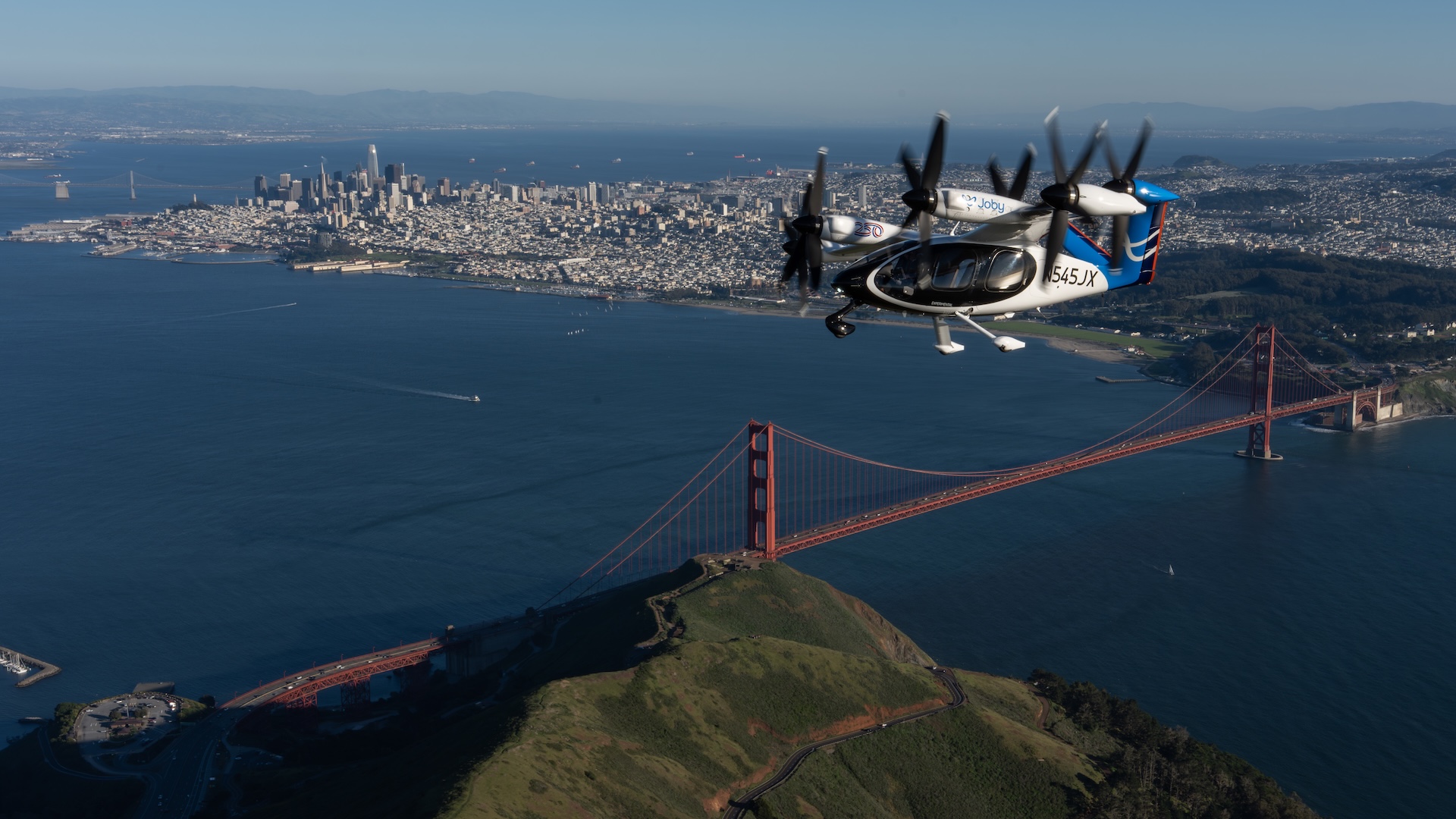
Joby Aviation has kick-started a nationwide tour of its flying taxi. The first flight saw its aircraft fly over the San Francisco Bay Area and around the Golden Gate Bridge.
The flight took place around the same time the FAA announced a nationwide pilot program aimed at finally making commercial air taxi services a reality.
Joby Aviation kickstarts nationwide eVTOL tour
The Joby air taxi is piloted, though the company eventually aims to automate its flight services. It will be capable of flying as many as four passengers on short, urban trips, reaching cruise speeds of roughly 200 mph. Its fixed wings feature six propellers and are capable of swiveling forward after takeoff for increased speed.
Joby Aviation’s nationwide tour, dubbed the “Electric Skies Tour”, will include demonstrations in several cities throughout the US.
In a press statement, the company stated: “With one of the world’s most recognizable skylines as a backdrop, the company showcased its operational readiness in a region defined by traffic congestion, demonstrating that the future of quiet, emissions-free flight, is not just a concept, but nearing commercial readiness.”
The San Francisco flight was conducted using a pre-production prototype, designated N545JX. According to a report by the San Francisco Chronicle, the N545JX aircraft “cruised along in virtual silence” as it flew across the bay. Separately, Joby revealed earlier this month that it had flown its first “FAA-conforming” air taxi.
“With an operational foundation built on thousands of test flights and more than 50,000 miles logged across its fleet, the company is now ready to scale its presence across the US,” the company said in its statement.
The Trump administration’s air taxi push
Joby Aviation also noted that it is among a handful of firms selected as partners in the White House’s recently announced eVTOL Integration Pilot Program (eIPP). The other companies selected are Archer Aviation, BETA Technologies, Electra, Wisk, Ampaire, Elroy Air, and Reliable Robotics.
“Here’s an opportunity for the industry to roll out in a similar way to how Waymo rolled out,” Archer Aviation CEO Adam Archer explained in a video on X after the eIPP announcement. “Rather than an all-or-nothing type certificate where you can go anywhere, or no type certificate where you can’t go anywhere… You can think about it as a few concentrated areas with very, very high margins of safety, allowing us to start very low-level operations, and then expand from there.”
According to Joby, eIPP gives it the opportunity to “begin early operations across 10 states: Arizona, Florida, Idaho, New Jersey, New York, North Carolina, Oklahoma, Oregon, Texas, and Utah.” The company added that the program also has the “potential to meaningfully accelerate the path to commercial service.”
If all goes to plan, Joby Aviation claims it will help realize a society where a daily commute can “take minutes, not hours.”
“Our technology provides an opportunity to build on the immense potential of this region while protecting it for the next generation,” said JoeBen Bevirt, founder and CEO of Joby. “By providing clean, quiet service with minimal infrastructure investment, we are making flight an everyday reality for the community.”

Motown Museum in Detroit to Premiere New Psychedelic Soul Exhibit

Pain at the pump: One gas station in S. San Francisco near $7 a gallon

H-E-B plans new store on the eastern side of Dallas-Fort Worth

Motorcyclist killed in crash on Biscayne Boulevard, deputies say

Another crop of Boston College NFL hopefuls get a chance to shine at Eagles’ annual Pro Day

Florida High School Football Rankings: Top 25 teams – Oct. 21

How old is Bo Nix? What to know about Oregon quarterback ahead of 2024 NFL Draft

Cleary's 21 help Le Moyne down Central Connecticut State 69-64 in OT

99th annual Pony Swim held in Virginia

Indiana Members Credit Union announced as new anchor tenant at Bottleworks District

See How the LaGuardia Plane Crash Unfolded

Mullin confirmed as DHS chief as lawmakers near solution on shutdown standoff

Von der Leyen clinches Australia trade deal

Trump administration places Christopher Columbus statue on White House grounds

See TSA Wait Times at Major U.S. Airports
-

 Detroit, MI6 days ago
Drummer Brian Pastoria, longtime Detroit music advocate, dies at 68
-

 Oklahoma1 week ago
Family rallies around Oklahoma father after head-on crash
-

 Georgia1 week ago
How ICE plans for a detention warehouse pushed a Georgia town to fight back | CNN Politics
-

 Alaska1 week ago
Police looking for man considered ‘armed and dangerous’
-

 Movie Reviews5 days ago
‘Youth’ Twitter review: Ken Karunaas impresses audiences; Suraj Venjaramoodu adds charm; music wins praise | – The Times of India
-

 Education1 week ago
Video: Turning Point USA Clubs Expand to High Schools Across America
-
 Science1 week ago
Long COVID leaves thousands of L.A. county residents sick, broke and ignored
-

 Sports3 days ago
IOC addresses execution of 19-year-old Iranian wrestler Saleh Mohammadi