San Francisco, CA
Kelly Steinhardt: Walking Through Time | KQED


Sometimes, it can be easy to forget all the history in our streets and cities. Kelly Steinhardt finds magic in her city walks by tapping into this history.
Recently, I found a map of major retail closures in downtown San Francisco. On it were dots, representing stores that have left or soon will be leaving — peppered around Market Street and the Financial District. I have fond memories of walking through those areas on my way home from work in my mid-twenties.
I’d hike from the Embarcadero over to Nob Hill and further, detouring through Union Square, especially during the holidays. I took it upon myself to learn more about the history of downtown, which made my 45 minute walk so much more meaningful. For instance, near the corner of Bush and Market Street, you can see where the shoreline used to reach in 1848. If you look up in Union Square, you’ll see Nike, the goddess of victory, towering confidently over the city.
My favorite landmark is easy to miss, if you’re in a hurry. On Market Street, be sure to stop at Lotta’s Fountain. Try to imagine what it was like to be there on Christmas Eve in 1910. According to The Chronicle, the night was soft and clear. Thousands gathered there to see Luisa Tetrazzini, a famous opera singer. Story goes, she ended her show with the song “Auld Lang Syne” — and everyone joined in. “Should old acquaintance be forgot. And never brought to mind.” Think all of those strangers singing in unison, just four years after an earthquake and fire decimated the city.
There are many reasons for us to visit San Francisco’s downtown and experience its rich history. I wonder what it might take for us to come together and breathe more life into the area, once again.



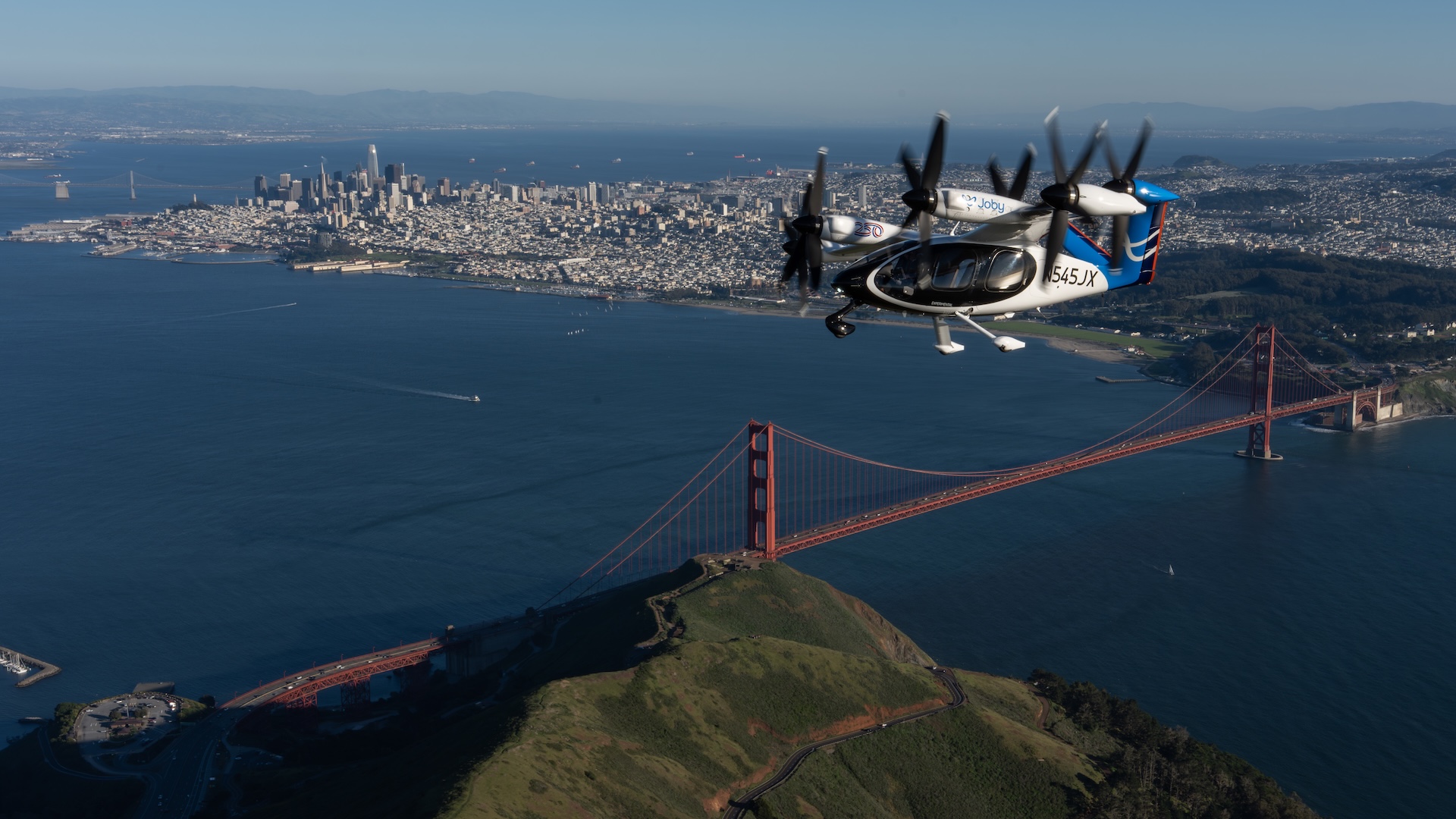
Joby Aviation has kick-started a nationwide tour of its flying taxi. The first flight saw its aircraft fly over the San Francisco Bay Area and around the Golden Gate Bridge.
The flight took place around the same time the FAA announced a nationwide pilot program aimed at finally making commercial air taxi services a reality.
Joby Aviation kickstarts nationwide eVTOL tour
The Joby air taxi is piloted, though the company eventually aims to automate its flight services. It will be capable of flying as many as four passengers on short, urban trips, reaching cruise speeds of roughly 200 mph. Its fixed wings feature six propellers and are capable of swiveling forward after takeoff for increased speed.
Joby Aviation’s nationwide tour, dubbed the “Electric Skies Tour”, will include demonstrations in several cities throughout the US.
In a press statement, the company stated: “With one of the world’s most recognizable skylines as a backdrop, the company showcased its operational readiness in a region defined by traffic congestion, demonstrating that the future of quiet, emissions-free flight, is not just a concept, but nearing commercial readiness.”
The San Francisco flight was conducted using a pre-production prototype, designated N545JX. According to a report by the San Francisco Chronicle, the N545JX aircraft “cruised along in virtual silence” as it flew across the bay. Separately, Joby revealed earlier this month that it had flown its first “FAA-conforming” air taxi.
“With an operational foundation built on thousands of test flights and more than 50,000 miles logged across its fleet, the company is now ready to scale its presence across the US,” the company said in its statement.
The Trump administration’s air taxi push
Joby Aviation also noted that it is among a handful of firms selected as partners in the White House’s recently announced eVTOL Integration Pilot Program (eIPP). The other companies selected are Archer Aviation, BETA Technologies, Electra, Wisk, Ampaire, Elroy Air, and Reliable Robotics.
“Here’s an opportunity for the industry to roll out in a similar way to how Waymo rolled out,” Archer Aviation CEO Adam Archer explained in a video on X after the eIPP announcement. “Rather than an all-or-nothing type certificate where you can go anywhere, or no type certificate where you can’t go anywhere… You can think about it as a few concentrated areas with very, very high margins of safety, allowing us to start very low-level operations, and then expand from there.”
According to Joby, eIPP gives it the opportunity to “begin early operations across 10 states: Arizona, Florida, Idaho, New Jersey, New York, North Carolina, Oklahoma, Oregon, Texas, and Utah.” The company added that the program also has the “potential to meaningfully accelerate the path to commercial service.”
If all goes to plan, Joby Aviation claims it will help realize a society where a daily commute can “take minutes, not hours.”
“Our technology provides an opportunity to build on the immense potential of this region while protecting it for the next generation,” said JoeBen Bevirt, founder and CEO of Joby. “By providing clean, quiet service with minimal infrastructure investment, we are making flight an everyday reality for the community.”

The San Francisco Giants didn’t make that “major” move in the offseason. They saved those for last offseason and last year’s trade deadline.
Still, San Francisco did plenty to position itself as a team that could be better than 81-81 last season. Not all moves are created equal. Not all moves work out the way the franchise hoped. The value of some of those moves have yet to be determined.
But, on their face, here are the moves that already look smart and already look, eh, dumb, going into opening day.
Smart
Signing Luis Arráez
The Venezuela native had a huge World Baseball Classic as his home country won the title for the first time. He had his second career multi-home run game in his WBC career. He returned to spring training and the bat kept cooking. He slashed .353/.389/.412.
While many envisioned him as a leadoff hitter due to his impressive ability to get contact and his three batting titles, San Francisco is toying with batting him later in the order. He’s one of the few contact hitters that could excel in that role, and he gives the lineup flexibility.
Signing Tyler Mahle and Adrian Houser
The Giants may get the best version of both pitchers. Before Sunday’s exhibition game in Sacramento, Mahle had thrown 10 scoreless innings in spring and showed no signs of the shoulder fatigue that limited him last season. Houser has thrown 11 innings and while he hasn’t been as effective, he looks like the innings-eater the Giants hoped they signed.
With the season-ending injury to Hayden Birdsong and the underperformance of the Carsons — Seymour and Whisenhunt — signing the two veterans to inexpensive deals looks smarter by the day.
Signing Harrison Bader
He’s day-to-day with a tight hamstring, but it’s a minor inconvenience this early in the campaign. San Francisco knew what they were getting when they signed him — a Gold Glove level center fielder with a resurgent bat who can make their entire outfield better. It allowed San Francisco to move Jung Hoo Lee to right field, which should improve his defensive numbers. San Francisco locked him into a cheap two-year deal. It should pay off handsomely.
Dumb
Not Signing Left-Handed Relief Help Sooner
San Francisco knew it was going to have some issues at left-handed relief. Erik Miller was going to need time to recover from a back issue. Sam Hentges won’t be ready after arthroscopic knee surgery. Then the Giants lost Reiver Sanmartin for three months to hip surgery. At one point the only healthy left-handed reliever in camp was Matt Gage.
San Francisco tried addressing it by signing Joey Lucchesi. But the Giants released him on Sunday after signing Ryan Borucki. But a bit more careful planning might have lessened San Francisco’s need to scramble this late in camp.
Not Adding Healthy Closing Experience
The Giants signed left-hander Jason Foley to bolster the bullpen. He had 28 saves for the Detroit Tigers in 2024. There was one problem. His recovery from shoulder surgery will keep him out of the lineup until the second half of the season.
That puts the pressure on Ryan Walker to not only be the closer but keep the job. He wants the pressure, he has said repeatedly in camp. He’s held the job before but not consistently. If he meets the moment, the Giants look smart for trusting him. If he can’t, San Francisco doesn’t have a healthy back-up plan until the All-Star break.

Fire department units were dispatched to the 3900 block of Mission Street, near College Avenue, to assist PG&E crews in “a possible gas odor or possible gas leak.”
SAN FRANCISCO – San Francisco authorities are investigating a possible gas leak in the St. Mary’s Park neighborhood on Saturday evening after a person died amid reports of a permeating odor.
Emergency crews called:
Fire department units were sent about 6:15 p.m. to the 3900 block of Mission Street, near College Avenue, to assist PG&E crews in investigating “a possible gas odor or possible gas leak,” the San Francisco Fire Department told KTVU.
“Upon entering the building, a civilian was discovered receiving medical attention but passed away on scene,” the fire department said.
The person’s identity was not released, but the San Francisco Police Department told KTVU that foul play was not suspected in their death.
However, the exact manner of their death was not immediately known.
What’s next:
The SFFD said it was investigating the scene, along with PG&E and the SFPD.
PG&E told KTVU that there were no gas leaks or “impacts from PG&E” located in the area, and that reports of a leak and odor came from outside the building where the victim died.

‘Confident’ Bencic takes out Anisimova, eyes Gauff next in Miami

Bruins Sign James Hagens to AHL Amateur Tryout Agreement | Boston Bruins

Married couple stars on stage at Denver Center for the Performing Arts’ “Dracula, a Comedy of Terrors”

Why the potential return of the Sonics to Seattle has never felt closer

Historic Tall Ship Faces Eviction in San Diego

Florida High School Football Rankings: Top 25 teams – Oct. 21

How old is Bo Nix? What to know about Oregon quarterback ahead of 2024 NFL Draft

Cleary's 21 help Le Moyne down Central Connecticut State 69-64 in OT

99th annual Pony Swim held in Virginia

Indiana Members Credit Union announced as new anchor tenant at Bottleworks District

See TSA Wait Times at Major U.S. Airports

Senate hopeful with deep Dem ties slapped with scathing complaint targeting alleged family payout ‘scheme’

How the Iran war is about to hit your wallet

Suspect in slaying of Loyola University student was in the country illegally, officials say

Video: Plane Collides With Vehicle at LaGuardia Airport
-

 Detroit, MI5 days ago
Drummer Brian Pastoria, longtime Detroit music advocate, dies at 68
-

 Oklahoma1 week ago
Family rallies around Oklahoma father after head-on crash
-

 Georgia1 week ago
How ICE plans for a detention warehouse pushed a Georgia town to fight back | CNN Politics
-
 Science1 week ago
Federal EPA moves to roll back recent limits on ethylene oxide, a carcinogen
-

 Alaska1 week ago
Police looking for man considered ‘armed and dangerous’
-

 Movie Reviews5 days ago
‘Youth’ Twitter review: Ken Karunaas impresses audiences; Suraj Venjaramoodu adds charm; music wins praise | – The Times of India
-
 Science1 week ago
Long COVID leaves thousands of L.A. county residents sick, broke and ignored
-

 Education1 week ago
Video: Turning Point USA Clubs Expand to High Schools Across America