San Francisco, CA
Experts: Muni tax likely to pass; regional transit measure a toss-up


Even as voters cite affordability as their top concern, San Franciscans may still be willing to raise their own taxes.
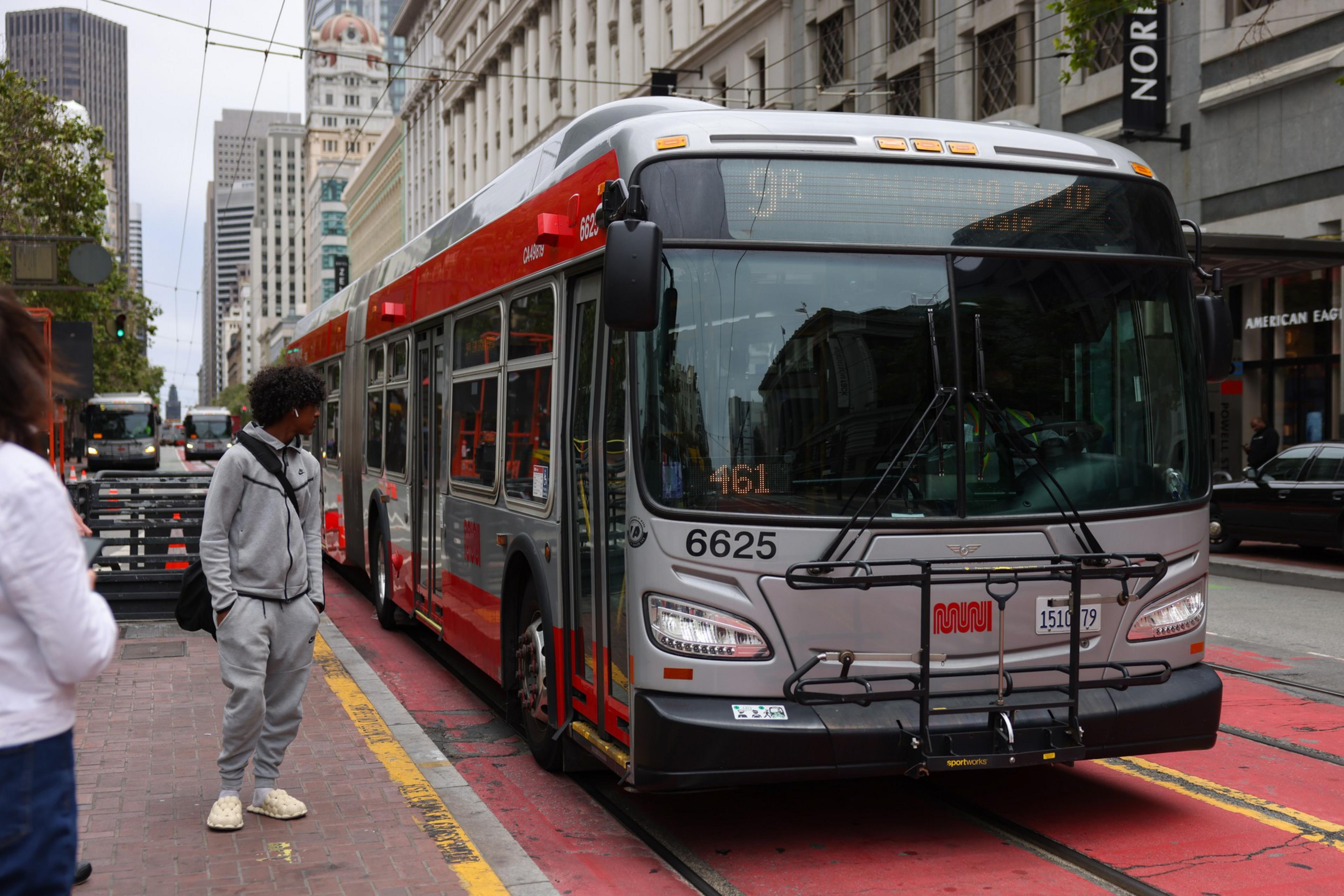
Political experts say a proposed $183 million parcel tax to fund Muni is likely to pass with ease, highlighting the city’s enduring support for public transit. But a separate regional sales tax measure to fund BART, Muni, and 10 other Bay Area transit agencies faces a far more uncertain path. Both measures, slated for the November ballot, require a simple majority to pass.
Essentially, the pundits say, San Francisco voters are so tax-happy and engaged that even with a measure-heavy ballot, they’ll likely support the two measures regardless of affordability concerns. According to campaign expert Jason Overman, San Francisco has better voter turnout for off-cycle elections than other U.S. cities, meaning tax opponents will be less likely to steer the results.
Combine that with well-founded fears that the demise of public transit would lead to tougher commutes and freeway congestion, and you have the makings of a victory at the ballot box.
“I don’t think a new tax [in San Francisco] has failed directly in years,” said political consultant Jim Ross.
However, few experts feel confident the regional tax measure will pass, as it must have the support of voters in five Bay Area counties. Contra Costa County, which is far less favorable to new taxes, was singled out by analysts.
Contra Costa County has only once passed a sales tax to fund transportation, Measure J in 2004, according to John Whitehurst, a partner at BMWL Public Affairs. Measure J had a much higher two-thirds majority threshold.
What experts are tracking as a signal for the transportation sales tax’s prospects is whether Contra Costa voters pass a sales tax (opens in new tab) of five-eighths of a cent in June.
“I think we’re gonna get some tea leaves here to read in June,” Whitehurst said.
What the Muni tax and regional measure have in common is that the consequences of degraded public transit are easy for voters across the socioeconomic spectrum to comprehend. Even if someone doesn’t use public transportation, worsening traffic on Bay Area freeways affects the people they rely on — like their children’s teachers or their employees.
“I think the transit stuff is much more visceral,” Overman said.
According to SF State political science professor Jason McDaniel, both efforts are bolstered by a widespread feeling among Democratic voters, who dominate the Bay Area, that turnout is key to taking back power from Republicans in Washington.
But McDaniel highlighted a latent risk of tax fatigue as public agencies continue to ask voters for funding. He pointed to a slice of affluent, liberal homeowners who generally back taxes for public services but may feel “cross‑pressured” by perceptions that government agencies and unions waste money.
“If I had to predict, I think these things are going to pass, but some of the support might be softer than what we’ve seen in past years,” McDaniel said.
Sonoma State political science professor David McCuan said he’s cautiously optimistic about the passage of both measures but predicts that the margin of success will be narrow. A high turnout in November could be key to the success of the regional measure.
“That puts the Bay Area regional measure in a place that is slightly better than a coin flip on the positive side,” he said. “But barely.”
McCuan noted that an effective campaign can shift voter support by roughly three to six percentage points in either direction.
On the parcel tax, that campaign appears to be in pole position. Mayor Daniel Lurie has made himself the face of the initiative, and it has broad-based support from the Board of Supervisors and a laundry list of labor groups. Early union support is a promising sign, as strong campaigns need funding and endorsements, and unions can help deliver both, McCuan said.
“All signs point to success, but there’s wiggle room within the margin of error,” he said.



SAN FRANCISCO (KRON) — San Francisco Supervisor Jackie Fielder hosted her first community listening session Thursday night since returning from a three-month medical leave.
Dozens of District 9 residents packed the Bernal Heights Neighborhood Center to welcome back Fielder and voice concerns about issues affecting their communities.
“We are thankful that you took time for yourself to equip yourself to be sitting here today,” one attendee told Fielder. “So I thank you and commend you for returning.”
Fielder returned to City Hall last month after taking a three-month medical leave.
“I’m just grateful for the outpouring of support that I had and glad to be back on the job,” Fielder said. “Mental health is really prevalent, and I’m not going to shy away from the fact that I had a mental health crisis. This is a challenging job, and I’m very privileged to be here.”
Fielder said she is hosting a series of town hall-style meetings to give residents an opportunity to voice their concerns.
“To me, the biggest issue locally is the homeless issue, and it’s citywide,” San Francisco resident Maggie Weis said.
Fielder was joined by members of the San Francisco Municipal Transportation Agency and San Francisco Police Department to answer questions about pedestrian safety, city budget cuts and other issues.
The supervisor said one of her priorities moving forward is expanding access to clean, well-maintained public restrooms.
“[We’re] still seeing a lot of feces around the district and city,” Fielder said. “Would love to see our city have more public bathrooms and be able to maintain them as well.”
The next listening session is scheduled for July 23 at 6 p.m. at La Fénix in the Mission.
Watch the full report from KRON4’s Sara Stinson in the video player at the top of the story.

(KRON) — A 32-year-old man has been missing in San Francisco for two days, police said. Gabriel Carreon was last seen at noon on July 7, when he left his home in the Castro neighborhood to go see a movie, the San Francisco Police Department said.
The following morning, a 911 caller told dispatchers that Carreon was missing.
Police described the missing man as Asian, 5’8’’ tall, and weighing 170 pounds. He has black hair dyed pink, and brown eyes.
Anyone who locates Carreon should call 911 and report his current location, police said. Anyone with information on his possible whereabouts should call the SFPD Missing Persons Unit Tip Line at 415-734-3070.

Sick of the TSA lines? Tired of playing musical chairs at the gate? Rather sit as far from your fellow airplane passengers for as long as possible, in the comfort of your own private, luxury airport terminal?
Soon you may get your wish. And San Francisco international airport wants to be your genie – for a fee.
The airport is hoping to build a brand-new terminal exclusively for passengers who pay a premium, gaining access to a luxurious airport experience complete with private security lines and valet service from terminal to tarmac. It will service commercial flights, not business or corporate jets, and the terminal will have its own Transportation Security Administration (TSA) lines as well as Customs and Border Protection (CBP) lines for international travel.
SFO is seeking bidders to take on the development, construction and operation of the private terminal, which is planned for a 75,000-sq-ft site located across the runway from all current public terminals. The airport will accept proposals between late September and early October, and is looking to award a contract by early December with hopes of opening the terminal in late 2028.
SFO’s interest in a luxury development comes from what airport spokesperson Doug Yakel called a “high level of demand” for “premium experiences” in travel, citing the popularity of existing credit card and premium lounges. A private terminal is essentially the next step up in exclusivity from those lounges – and the best chance at avoiding airport crowds entirely.
“Somebody that uses this product really wouldn’t see the other passengers they’re traveling with until they’re taken up the stairs of the jet bridge and onto the aircraft,” Yakel said.
Spending on “pay-to-play” luxury experiences at large is on the rise, according to a new report by Bain & Company and Altagamma. The airline industry has bought in, revamping lounge and onboard experiences with chef-designed menus and expanded premium seating for the highest-paying passengers.
Many see a market in San Francisco, where an AI-driven wealth boom is already agitating the local housing market, with homes sold at the fastest pace in five years and the single-family median home price clocking in at $2.2m.
Yakel said SFO felt now was the right time to enter the market of luxury travel.
“We see the level of interest that’s being invested onboard aircraft, inside terminals, around airports, and clearly this is something that other airports are rolling out,” Yakel said.
The price to pay for a private airport experience will be decided by whoever wins the bid for operations, and will be offered on a membership or per-use basis. The traffic experienced at public terminals likely won’t change, Yakel said.
Private terminals have become popular worldwide. London Heathrow and Paris-Charles de Gaulle airports in Europe have long operated luxury terminals, and São Paulo/Guarulhos international airport recently opened the first private terminal in Latin America.
If SFO is successful, it would become the next major American airport to open a luxury terminal. Los Angeles, Dallas Fort Worth, Miami and Hartsfield-Jackson Atlanta international airports all offer a private terminal through PS (formerly known as the Private Suite), a company owned by security firm Gavin de Becker and Associates. Multiple representatives from PS and Gavin de Becker and Associates attended a June conference hosted by SFO about the private terminal, and PS has said it hopes to open a private terminal at every major US airport by 2030.
Access to existing PS private terminals can cost passengers $1,295 for a one-time experience, or up to $4,850 for a yearly membership. Heathrow’s private terminal costs thousands of pounds per person.
-

 Idaho40 seconds ago
You Asked: Where is the 1976 Bicentennial Time Capsule for the State of Idaho?
-

 Illinois8 minutes ago
Illinois election board ‘reviewing’ threat of prosecution from DOJ on noncitizen voting
-

 Indiana11 minutes ago
Creole Chrome Looks for Graded Glory in Indiana Derby
-

 Iowa16 minutes ago
PETERSON: Pollard’s “outside the lines” mindset was exactly what Iowa State needed
-

 Kansas23 minutes ago
Kansas parents charged after child fatally shoots 5-year-old, 8-year-old
-

 Kentucky26 minutes ago
Affordable Care Act rates rate hikes could strain Kentucky families, WKAS warns
-

 Louisiana31 minutes ago
Moncus Park gets helping hand from 260 youth volunteers across Louisiana
-

 Maine38 minutes ago
Maine’s high court keeps transgender athlete referendum off 2026 ballot

