West
Questions grow about soldier’s Tesla Cybertruck attack at Trump Las Vegas hotel

NEWYou can now listen to Fox News articles!
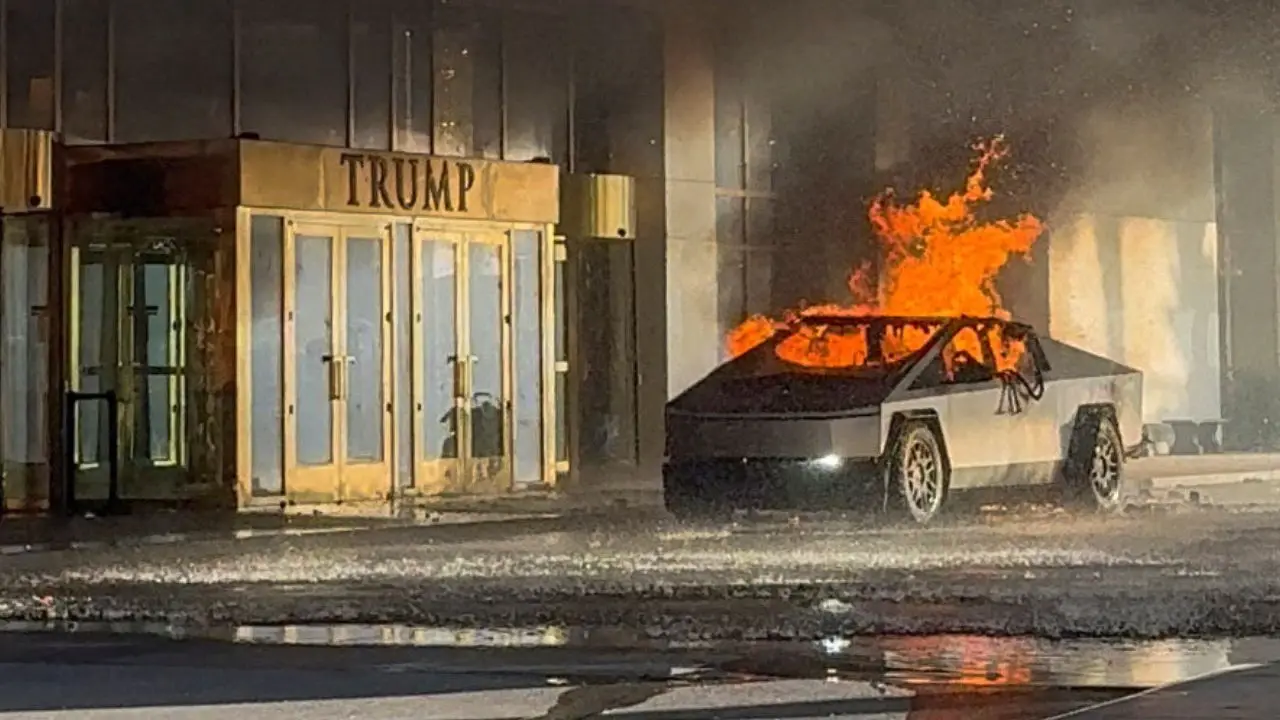
The mystery surrounding the motive for the Tesla Cybertruck attack outside the Trump International Hotel in Las Vegas on New Year’s Day only deepened after the final investigative report from local police provided few new details.
The 78-page “after-action” report released Monday by the Las Vegas Metropolitan Police Department (LVMPD), confirmed that Matthew Livelsberger, who died by suicide before the explosion, left a manifesto on his phone, which investigators recovered during forensic analysis.
The Department of War declared the manifesto classified, and the investigation was turned over to the federal government, the report said.
The report, seen by Fox News Digital, confirms that the Green Beret was on leave from his Special Forces unit and had rented a Tesla Cybertruck through the car-sharing platform Turo.
LOS ANGELES CITY HALL EVACUATED AFTER CAR DRIVES ONTO SIDEWALK IN FRONT OF BUILDING; DRIVER IN CUSTODY
Army Special Forces soldier Matthew Livelsberger detonated his vehicle outside Trump International Hotel on New Year’s Day. (Los Vegas Metropolitan Police Department)
He filled it with fireworks, gas cans and camping fuel, and drove it to the Trump International Hotel just after 8:40 a.m. on Jan. 1, 2025. There, the vehicle detonated, causing damage and injuring six people.
LVMPD and federal investigators described the incident as a premeditated vehicle-borne improvised explosive device (VBIED) attack “with the potential to cause mass casualties and extensive structural damage” but did not call it terrorism.
Investigators also reconstructed Livelsberger’s final days using phone data, bank records and surveillance footage.
VIDEO CAPTURES DEVASTATING AFTERMATH OF ST. LOUIS COUNTY HOME EXPLOSION THAT LEFT TEEN CRITICALLY INJURED
Matthew Livelsberger blew up a rented Cybertruck outside the Trump Las Vegas hotel. (Los Vegas Metropolitan Police Department)
Surveillance video showed Livelsberger pouring accelerant into the truck bed moments before detonation, an act LVMPD said reflected planning rather than impulse.
Counterterrorism investigators concluded he sought to make “a very big, very public statement,” suggesting the Las Vegas location was chosen for visibility and impact.
He also left behind a note claiming the attack was not terror-related, but a way for the soldier to “cleanse” his mind but criticized the “feckless leadership” of a U.S. that is “near collapse,” officials said.
FBI PITTSBURGH FIELD OFFICE TARGETED BY DRIVER IN ‘ACT OF TERROR,’ OFFICIAL SAYS
Federal investigators described the incident as a premeditated vehicle-borne improvised explosive device (VBIED) attack but did not call it terrorism. (Los Vegas Metropolitan Police Department)
“This was not a terrorist attack, it was a wake-up call,” Livelsberger wrote in the notes app on his phone.
“Americans only pay attention to spectacles and violence. What better way to get my point across than a stunt with fireworks and explosives,” Livelsberger wrote.
One of his messages was said to have gone to Shawn Ryan, an ex-Navy SEAL and CIA contractor.
CLICK HERE TO DOWNLOAD THE FOX NEWS APP
Fox News Digital has reached out to Las Vegas Metropolitan Police Department for comment.
Read the full article from Here



A 6-inch megalodon shark tooth was found by a Wyoming teen during a dive trip off Manasota Key, Florida earlier this week.
Sixteen-year-old Aiden Andrews and his father Brian were on a guided dive with Fossil Junkies, a local fossil-hunting tour company.
Captain John Kreatsoulas told FOX 13 Tampa Bay reporter Kimberly Kuizon that while finding small megalodon teeth isn’t uncommon, finding one that size is quite rare.
Video captured the moments when Aiden and his father celebrated underwater after making the remarkable discovery.
Popularized by Hollywood monster movies, the Carcharocles megalodon was the largest shark to have ever lived, according to the Smithsonian Institution.

Scientists believe the largest megalodon reached up to 60 feet in length and weighed up to 50 tons.
And as Andrews can attest — they possessed teeth the size of a human hand.
According to the Smithsonian, megalodon lived between 23 and 3.6 million years ago across all of Earth’s oceans.


Denver, Colo. (03/27/2026) – In front of another expected record-breaking crowd, the Washington Spirit is set to take on Denver Summit FC in the side’s inaugural home match at Empower Field at Mile High. With over 60,000 tickets already distributed, the match is poised to break the NWSL attendance record of 40,091 set last summer when the Spirit visited Bay FC at San Francisco’s Oracle Park. Kicking off at 2 p.m. EDT, the match will broadcast nationally on CBS.
The Spirit
Washington comes into this weekend’s fixture off a difficult 1-1 home draw with Utah Royals FC earlier this week. After scoring in the 18th minute, the Spirit nearly earned its first victory of 2026 but conceded an equalizer late and had to settle for a single point on the table. Washington’s goal was scored by midfielder Rebeca Bernal, the Mexican star’s first since transferring to the NWSL last year.
Saturday afternoon’s match will mark the first-ever meeting between the Spirit, one of the NWSL’s original clubs, and 2026 expansion side Denver Summit FC. Denver will be the 17th different opponent for Washington across its regular season history: the Spirit has played against 13 active clubs (all except expansion sides Denver and Boston) as well as defunct clubs the Boston Breakers, FC Kansas City and the Western New York Flash.
The Spirit has had success against expansion sides as of late, tallying 11 wins in 15 matches against NWSL clubs in their first season of competition since the start of the 2021 campaign. In 2024, the Spirit went a perfect 5-0-0 against Bay FC and Utah Royals FC, outscoring the teams 10-3 with a playoff win to boot. In 2022, Washington earned a 1-3-0 record against Angel City FC and San Diego Wave FC and, in 2021, the eventual NWSL champions went an impressive 5-1-0 against Kansas City and Racing Louisville FC.
This weekend’s matchup at Empower Field at Mile High, home of the NFL’s Denver Broncos, is set to shatter the NWSL’s single match attendance record with over 60,000 tickets already distributed. The Spirit has also been the visiting team for two of the league’s previous three record-setting attendances: 34,130 fans at Seattle’s Lumen Field when the Spirit took on the Reign and 40,091 in the stands at San Francisco’s historic Oracle Park to watch Washington play Bay FC.
Washington is in good standing in several attacking categories through three matches despite two draws and a loss. The Spirit remains first in the league in rate of possession at nearly 62% and top three in both shots and shots on target with 49 and 17, respectively. With just three goals through three matches, look for the Spirit attack to continue getting attempts on frame this weekend.
Following Saturday’s match, the Spirit will hit the road again next weekend for an away match against Bay FC in San Jose on Sunday, April 5. Washington’s next home match will be on Friday, April 24 at 8 p.m. EDT when the side hosts the defending Shield winner Kansas City Current at Audi Field. Information on tickets can be found HERE.
The Opponent
Denver Summit FC opened its inaugural season with three straight away matches, collecting a win, a loss and a draw to carry four points into its home opener this weekend. Summit FC dropped its first match to Bay FC 1-2 before drawing Orlando 1-1 and beating Gotham 2-0.
Summit FC is led in scoring by star German forward Melissa Kössler who has three goals in three matches, scoring once in each contest. With a goal tomorrow, the forward would join Alex Morgan as just the second player in league history to score in each of her first four matches with a club. Look for the Spirit defending third to place an emphasis on limiting chances to Kössler on Saturday afternoon.
Denver has only allowed one goal across its last 240 minutes of action after giving up two in the first 30 minutes of the side’s opener. The strong recent form of Summit FC’s defending third against the Spirit attacking third’s ability to generate chance after chance will be a point to watch this weekend.
Three former Spirit players are currently on the Summit FC roster as midfielders Meg Boade and Jordan Baggett and defender Camryn Biegalski signed with the side ahead of this season. Baggett spent four years with the Spirit after being drafted by the side in 2019 while Biegalski signed with Washington in 2021 and played three seasons, both winning the 2021 NWSL Championship with the team. Boade spent the first half of the 2025 season in DC as a short-term injury replacement, even scoring a goal for the Spirit.
Following tomorrow’s match, Denver will travel to Seattle to face Reign FC on Saturday, April 4.
All-Time Series History
This weekend’s match will be the first-ever meeting between the Spirit and Denver Summit FC.
About The Washington Spirit
The Washington Spirit is the premier professional women’s soccer team based in Washington, D.C. and plays at Audi Field in Buzzard Point. The Spirit was founded on November 21, 2012 and is an inaugural member of the National Women’s Soccer League (NWSL) the fastest growing sports league in the US. The club is home to some of the best players in the world who have won championships for both club and country. For more information about the Spirit, visit WashingtonSpirit.com and follow the club on Twitter, Instagram and Facebook.

In battleground Wisconsin, the 2026 elections are poised to bring a ‘changing of the guard’

Morrisey: Growth of Alcon in Cabell County is evidence of good times ahead for WV

Wyoming teen discovers rare and ancient megalodon shark tooth off Florida coast

Where Will the Cryptocurrency XRP Be in 10 Years? | The Motley Fool

New Funding Models Needed As Global Health Faces Growing Financial Strain – Health Policy Watch

Florida High School Football Rankings: Top 25 teams – Oct. 21

How old is Bo Nix? What to know about Oregon quarterback ahead of 2024 NFL Draft

Cleary's 21 help Le Moyne down Central Connecticut State 69-64 in OT

99th annual Pony Swim held in Virginia

Indiana Members Credit Union announced as new anchor tenant at Bottleworks District

Dem senators dodge crucial question on illegal alien accused of killing Chicago college student

EU Parliament unblocks key political hurdle in digital euro talks

Man arrested in plot to firebomb Palestinian activist’s home after undercover op

WATCH: Senate hearing goes silent after Angel Father confronts top Dem over daughter’s death

US diplomat Marco Rubio denounces settler violence, tolls in Hormuz strait
-

 Detroit, MI1 week ago
Drummer Brian Pastoria, longtime Detroit music advocate, dies at 68
-

 Movie Reviews1 week ago
‘Youth’ Twitter review: Ken Karunaas impresses audiences; Suraj Venjaramoodu adds charm; music wins praise | – The Times of India
-

 Sports7 days ago
IOC addresses execution of 19-year-old Iranian wrestler Saleh Mohammadi
-

 New Mexico5 days ago
Clovis shooting leaves one dead, four injured
-
 Business1 week ago
Disney’s new CEO says his focus is on storytelling and creativity
-

 Tennessee5 days ago
Tennessee Police Investigating Alleged Assault Involving ‘Reacher’ Star Alan Ritchson
-

 Technology6 days ago
YouTube job scam text: How to spot it fast
-

 Texas1 week ago
How to buy Houston vs. Texas A&M 2026 March Madness tickets