Oregon
Volunteers fill gaps in rural Oregon emergency medical care


An air ambulance lands as rural EMS volunteers and students train at the site of a simulated car wreck on April 12, 2025. The training covers how to create a safe helicopter landing zone and stay in contact with the flight crew on board.
Jennifer Baires / OPB
On New Year’s Day in 2023, Erik Kerr met up with a snowmobiling group near Crescent in south-central Oregon, intending to ride through the forest to the rim of Crater Lake.
But he never made it that day.
“I hit the tree dead between the skis,” Kerr said recently. “My torso went forward. My head missed the tree somehow. I could have easily broken my neck.”
Thrown off the snowmobile, Kerr landed in a snow drift, off trail and out of sight. He lay in the snow watching the other riders pass by unaware.
“My leg was snapped,” Kerr said. “I’m just freaking out. I’m like, ‘Great. Nobody’s going to see me.’”
But Kerr was luckier than most who find themselves injured in Oregon’s backcountry. Riding behind the group happened to be James Wilson, an EMT and the fire chief of Crescent. Wilson sprang into action.
“I came across him, did a quick patient assessment, saw that there was definitely a potential fracture going on there and a lot of pain,” he said.

First responders load Erik Kerr into an ambulance after a snowmobiling crash on Jan. 1, 2023.
Courtesy of Erik Kerr / Courtesy of Erik Kerr
Even with the good fortune of being found right away, Kerr waited over four hours to make it to a hospital bed in Bend. Thick fog in the region meant going by helicopter wasn’t an option.
Wilson said accidents like Kerr’s are common in his agency’s coverage area, and the calls for help are increasing.
From Crescent in Klamath County, Wilson’s EMS crew covers over 1,000 square miles. During busy holiday weekends, the population can surge to over 10,000 people.
“We’ve gone from an agency that was very small and with under 300 calls a year, five or six years ago, to where this year we’re on track to breaking 800 calls for service,” Wilson said.
Roughly 70% of Oregon’s ground ambulance service areas are in rural communities, according to the state’s Office of Rural Health.
Without a state-mandated tax base to fund local EMS, many rural agencies struggle to staff and maintain ground services, relying frequently on costly air resources and unpaid volunteers.
The level of medical care a volunteer EMS provider can offer varies greatly. Oftentimes they’re certified as EMTs and are only trained to provide basic care. Unlike paramedics, they can’t start an IV line, administer medication or intubate a patient. The years of schooling required to be a paramedic are demanding, and the associated costs are steep — around $20,000.
Crescent Fire volunteer Chris Jones (far right) washes an ambulance on May 30, 2025. Jones retired last year after 25 years as a firefighter and paramedic in La Pine. He says calls for help have increased past what rural agencies can handle.
Jennifer Baires / OPB
Hiring and retaining professional medics is another hurdle, Wilson said. Rural agencies typically offer smaller salaries than their urban counterparts. It’s a problem that Wilson said he faces in Crescent, and one that Oregon Office of Rural Health Director Robert Duehmig said is being felt statewide as older medics age out of the job.
“The population of existing EMTs is starting to retire out,” Duehmig said. “And some of the EMTs that are working are older, and that becomes a bigger danger to them trying to lift people and respond to those kinds of calls, particularly in bad weather.”
Duehmig said there are grants available to help support training for staff and volunteers at rural agencies. His office has a staff member dedicated to helping agencies find ways to increase their workforce and connect to resources. A bill under consideration in the Oregon Legislature now would raise the annual tax credit available to rural medical volunteers from $250 to $1,000.
Chris Jones volunteers for Crescent Fire, and understands firsthand the need for well-trained help. He spent 25 years as a professional paramedic before retiring in 2023.
“Rural areas need extra people,” Jones said. “I figured I have some extra time available, might as well volunteer.”
Responding to emergencies in isolated areas takes dedication, with or without a paycheck, he added.
“It’s a love for the job, a love for the rural community,” he said.
His son, Cruz Jones, also volunteers with Crescent Fire as a resident volunteer student. He’s working toward his paramedic certifications at Central Oregon Community College. By using a Federal Emergency Management Agency grant and its own funds, Crescent Fire is paying for his education. He even lives at the station and volunteers extra time to fill shifts.
The student-resident program is one way Crescent has been able to adequately staff its ambulances, Wilson said. Depending on the day and location, it can take up to four hours for a ground ambulance to arrive after a 911 call in rural Oregon.
Air ambulance operators said they are increasingly getting calls to transport patients from rural areas.
Paul Pearlmutter, a flight respiratory therapist with AirLink, prepares the air ambulance in Bend on May 30, 2025.
Jennifer Baires / OPB
Paul Pearlmutter is a flight respiratory therapist at AirLink Critical Care Transport, a medical flight company based in Bend. He’s flown with the private company for the last decade and said aside from inter-hospital transfers, the majority of its calls to scenes are in outlying areas. Pearlmutter said he’s noticed an increase in calls for patients who aren’t critically sick or injured.
“Sometimes they’re less critical but still need to get to Bend,” Pearlmutter said. “We will go fly just to help alleviate the stress on the [ground] EMS in that system.”
A helicopter ride can range widely from a few thousand dollars to over a hundred thousand dollars, according to AirLink representative Marta Jaroch.
One mother’s seven-minute helicopter ride to transport her premature baby between hospitals racked up $40,000 in bills, Jaroch said.
EMS leaders said they would like to avoid using costly air resources for less-critical patients. To help, some rural agencies east of the Cascades are working together to build up the volunteer base of trained first responders. Some of them, like North Lake County EMS in Christmas Valley, are entirely owned and operated by volunteers.
The view from an AirLink air ambulance as it flies near the company’s base in Bend on May 30, 2025.
Jennifer Baires / OPB
In April, sagebrush and juniper trees dotted the landscape around a turnout area on Highway 31 near Fort Rock Junction in Lake County. Two cars were parked with their front bumpers inches apart. Inside the vehicles, actors posed as if they’d just been in a wreck. A woman was draped over the steering wheel, another was lying against the passenger door frame and a child in the back was slumped over in a booster seat.
North Lake County EMS and AirLink set up this scene as part of a training for over a half a dozen rural EMS agencies across three counties. The actors were there to help first responders prepare for a mass-casualty event, said AirLink’s Jaroch.
“The EMTs are going to ask them questions and they’re going to say, ‘Well, I’m feeling nauseated. My neck hurts, my head hurts, or I’m having severe abdominal pain,’” she said.
Katie Lossing, an EMT student at Klamath Community College, leaned into the car window.
Erik Kerr successfully completes the trip to the rim of Crater Lake on May 10, 2025.
Courtesy of Erik Kerr / Courtesy of Erik Kerr
“Hey sweetheart, you with us?” Lossing asked the driver
“Pressure. My head hurts,” the woman replied.
After assessing the victims, the group convened to determine which patients were critical and required air transport.
It’s a scenario that volunteers need to be familiar with when working in rural areas, Jaroch said.
And their efforts are appreciated, especially by people like Erik Kerr — the snowmobiler who broke his leg two years ago.
He’s healed up now, and recently returned to the backcountry to finish his ride to Crater Lake.
Jennifer Baires is a freelance journalist based in Bend. She can be reached at jbaires@opb.org.
Editor’s note: OPB is a nonprofit, statewide news organization with a mission to tell stories for communities in all parts of Oregon and Southwest Washington. As part of that goal, we work with partner news organizations and freelancers to identify stories like this that might otherwise go untold. If you have an idea for a story, live in an area outside Portland and want to work with us, send your freelance pitches to ecureton@opb.org.


Summer is in full swing, and across the country, the songs of birds and the cheeps of baby chicks are filling the air. While birdwatching season is happening just about everywhere right now, the Pacific Northwest offers something truly special: the chance to see puffins along the Oregon Coast. If you’re wondering when, where and how to see puffins in Oregon, you’re in the right place.
Few wildlife sightings feel as magical as spotting a Tufted Puffin (Fratercula cirrhata) in the wild. These beloved seabirds return to the Oregon Coast each year during their breeding season, drawing birdwatchers, photographers and nature lovers hoping for a glimpse of their bright orange beaks, expressive faces and unmistakable charm. For many visitors, seeing puffins in their natural habitat is a heartwarming coastal experience that captures the spirit of the Pacific Northwest.
Because puffins are seasonal migratory birds that nest in specific coastal areas, timing and location are key. With a bit of planning—and a little luck—you can witness one of Oregon’s most iconic wildlife moments along its rugged coastline. Here are the best places to see puffins on the Oregon Coast.
What Are the Best Places to See Puffins in Oregon?
If you’re wondering where you can you see these cute creatures, there are three spots that are worth going to and are hailed as the best places to see puffins in Oregon.
Haystack Rock, Cannon Beach
Haystack Rock is a popular place where puffins nest in Oregon.Getty Images Big5 Studio
Few wildlife encounters feel as effortless as spotting puffins right from shore, and Haystack Rock at Cannon Beach is one of the rare places where that’s possible.
This towering sea stack isn’t just an Oregon landmark, it’s also a seasonal nesting site for Tufted Puffins, who return here each year to raise their young on the rocky ledges. From the beach, visitors can often catch glimpses of puffins flying to and from the rock or resting along its cliffs, especially during the warmer months when activity peaks.
Because it requires no boat or hike to access, Cannon Beach remains one of the most rewarding and beginner-friendly places to experience puffins in the wild.
Face Rock State Scenic Viewpoint (Bandon)

Image via Getty Images/Moelyn Photos
For a quieter, more immersive coastal experience, Face Rock in Bandon offers a different kind of puffin viewing.
Here, the focus shifts from crowds to coastline where Tufted Puffins and other seabirds nest along offshore rocks just beyond the shoreline. The setting is calmer than Cannon Beach, making it ideal for visitors who want to slow down and scan the horizon for wildlife activity.
Every Saturday and Sunday from now until July 26, Face Rock Wildlife Interpreters will host on-site sessions at Face Rock Wayside from 9 am to 11 am, where guests will get to look out for puffins nesting on Face Rock with the wildlife interpreters’ help. Whether you go puffin-peeping on your own or with a group, be sure to bring binoculars!
Three Arch Rocks National Wildlife Refuge

Image via Getty Images/Bob Stefko
If looking for something a little closer to Portland, Three Arch Rocks is home to the largest breeding colony of Tufted Puffins in Oregon. A trip to Three Arch Rocks National Wildlife Refuge is sure to be a treat for any lovers of the Pacific Northwest’s coastal wildlife.
Not only is it one of the top places in Oregon to spot nesting puffins over the summer, but it is also the only pupping site on the North Oregon coast for the federally-threatened Steller sea lion, one of two sea lion species native to Oregon. Incidentally, the Steller sea lion’s pupping season, which runs from mid-May to mid-July, coincides with the first half of the Tufted Puffin’s nesting season, so right now is the perfect time of year for a visit!
When Do Puffins Arrive on the Oregon Coast?
For a large part of the year, Tufted Puffins live far out at sea across the North Pacific Ocean (in fact, they can be found as far eastward as Japan). However, from right now through August, Tufted Puffins are making their way back to coastal islands along the Oregon coastline to create their nests and raise their young until they are strong enough to join them out at sea. Therefore, if you want to catch a glimpse of them, now’s the perfect time.
What’s the Best Time of Day to See Puffins in Oregon?
These birds don’t follow a predictable shoreline schedule, which is part of what makes spotting them such a rewarding experience. So when’s the best time to see puffins in Oregon? Throughout the day during the breeding season, they move between offshore feeding areas and nesting sites on rocky cliffs and sea stacks. However, early morning and late afternoon often offer the most consistent viewing opportunities, when bird activity around colonies tends to increase and lighting conditions make movement easier to spot from shore.
For visitors hoping to increase their chances, choosing calm, clear days can make distant movement easier to detect against the waves.
What Do Puffins Eat and Why Do They Come to Oregon?
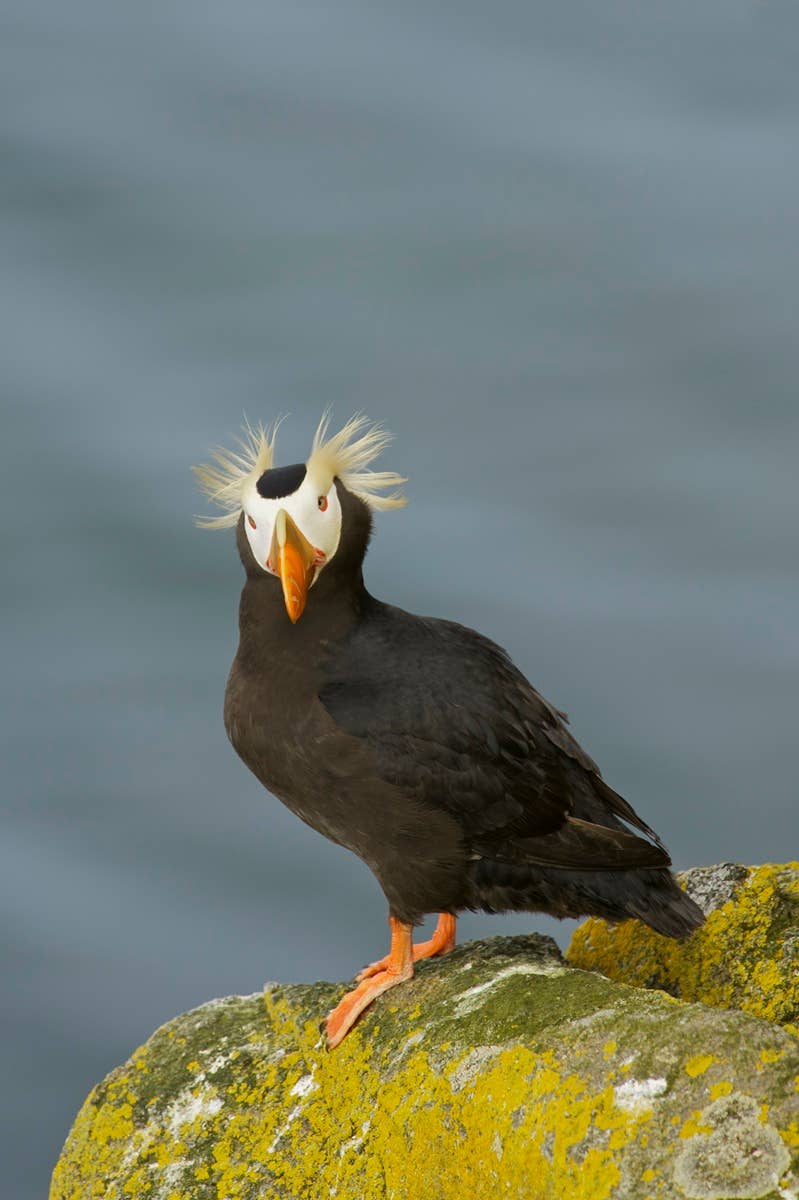
Tufted Puffins return to the Oregon Coast each summer.Getty Images Enrique Aguirre Aves
The presence of puffins along the Oregon Coast is closely tied to the health of the surrounding ocean ecosystem.
Oregon’s offshore waters provide an especially productive feeding environment thanks to cold currents that bring nutrients to the surface, supporting large fish populations. After all, Tufted Puffins rely on small schooling fish such as sand lance, anchovies and herring, which they catch by diving underwater and carry multiple fish back to feed both themselves and their chicks during the nesting season.
Combined with nearby rocky islands that offer protected nesting sites, the region creates an ideal seasonal habitat for breeding puffins and is what brings them back each year. It’s also why Oregon remains one of the most important puffin-viewing regions on the West Coast.
Tips for Spotting Puffins in Oregon
At one point, the Tufted Puffin’s distribution in North America stretched from northern California to British Columbia and the Aleutian Islands of Alaska. However, starting in the 1990s, the North American Tufted Puffin population plummeted in numbers, and now only a few thousand visit the Pacific Northwest every summer, including only a little over 500 puffins in Oregon. If you want the best odds at spotting these rare birds in Oregon, there are a few things you should keep in mind.
Puffins are easiest to spot when you know what to look for—and where to focus your attention. Bring binoculars and scan rocky cliffs and offshore waters, especially during calm mornings or late evenings when the sea is quieter. Watch for quick, low flights over the water or brief pops of movement near the surface as they dive for fish. Patience pays off, since puffins often appear suddenly and disappear just as quickly.
Why Puffin Sightings in Oregon is Special
Puffin sightings along the Oregon Coast are special because they’re both seasonal and fleeting. These seabirds spend most of their lives far offshore, only returning briefly to coastal nesting areas. That short window makes each sighting feel rare, especially when you catch them diving, flying, or gathering near rocky shorelines. Their bright beaks and energetic behavior make even a quick glimpse feel memorable.
Sources:

CURRY COUNTY, Ore. (KPTV) – A Texas man wanted for child sex crimes was arrested in Curry County on Tuesday afternoon.
The Curry County Sheriff’s Office says Kenneth Leatherwood of Bastrop, Texas, was arrested with the help of Oregon State Police and U.S. Marshals just after 12:30 p.m.
Leatherwood, who is accused of sex-related crimes involving a child in Texas, was reportedly found camping in a heavy wooded area near Lucas Lodge in Agness.
Investigators say Leatherwood has been on the run from Curry County law enforcement since June 16 after reports that he had been seen with a stolen car in the Agness area.
Leatherwood was also believed to have stolen weapons with him.
His dog was also found and returned to the suspect’s family in good shape, according to the sheriff’s office.
Copyright 2026 KPTV-KPDX. All rights reserved.

PORTLAND Ore. (KPTV) – Fireworks are on sale in Oregon until July 6, but state and local rules limit where they can be used and what types are allowed.
In Portland, fireworks use and sales are banned year-round.
Fireworks are also banned on beaches and in state and national parks.
Statewide, fireworks that fly into the air, explode, act unpredictably or move more than 12 feet horizontally are illegal. Banned fireworks include sky lanterns, missiles, rockets, Roman candles, firecrackers, cherry bombs and M-80s.
Fountains, sparklers, ground spinners and smoke devices are among the fireworks allowed under state rules.
Officials said people should not call 911 to report illegal fireworks. They said reports should go to the non-emergency line for the area.
First responders said there were 263 fires across Portland during last year’s fireworks season, and 27 were caused by fireworks.
For more details about fireworks regulation in Oregon, click here.
In Washington, fireworks sales legally begin Sunday and run through July 4.
Copyright 2026 KPTV-KPDX. All rights reserved.
-

 Nebraska14 seconds ago
UNMC teams with Central Nebraska Health Departments to assess needs, test water after March wildfires
-

 New Hampshire10 minutes ago
Masked men with baseball bats terrorize 12-year-old during NH home invasion
-

 North Carolina15 minutes ago
Henri Veesaar’s North Carolina exit proves to be costly beyond belief
-

 New Jersey15 minutes ago
8 Somerset County Cops Named In ‘Major Discipline’ Report Released By NJAG Office
-

 New Mexico22 minutes ago
Feds allowed millions of fentanyl pills to ‘walk’ on New Mexico streets: DEA Whistleblower
-

 North Dakota30 minutes ago
Finding a hero: Efforts to identify North Dakota soldier Irvin C. Ellingson’s remains took years
-

 Ohio37 minutes ago
Is Ohio at the Great American State Fair? Latest as some states opt out
-

 Oklahoma40 minutes ago
Woman hospitalized after house fire in northeast Oklahoma City

