West
On this day in history, June 5, 1968, presidential hopeful Robert F. Kennedy is fatally shot in Los Angeles

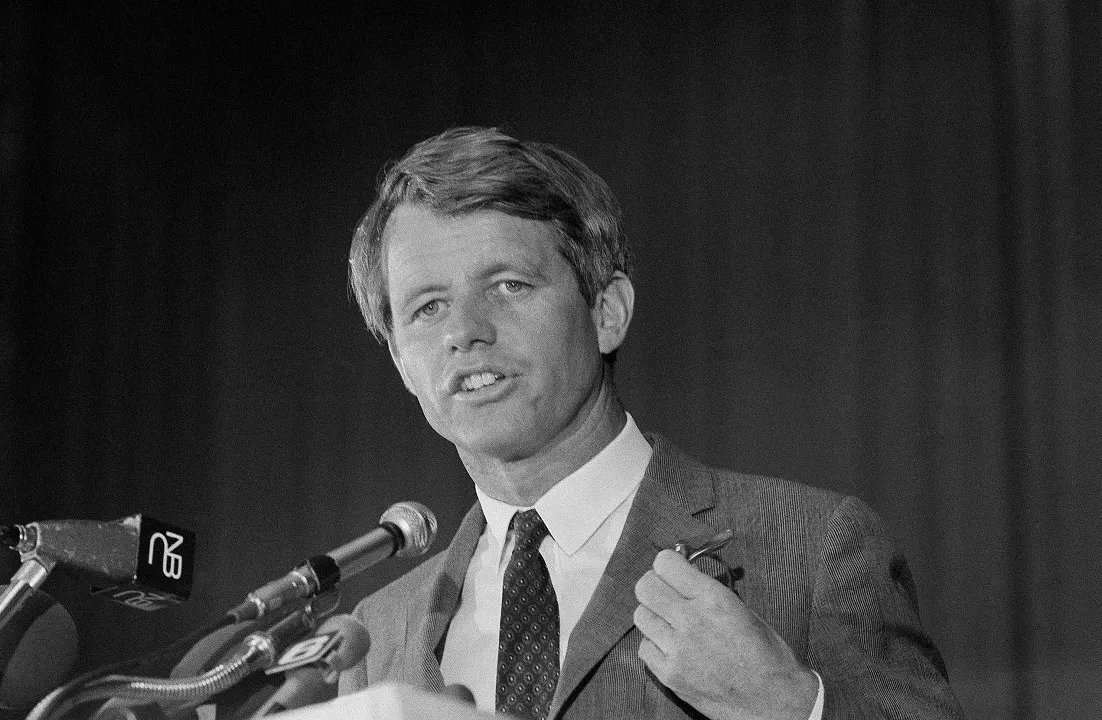
New York Sen. Robert F. Kennedy was on the presidential campaign trail as a Democratic candidate when he was fatally shot on this day in history, June 5, 1968, by an assassin at the Ambassador Hotel in Los Angeles, California.
The New York legislator, better known as Bobby, was 42 at the time of his death.
Moments before he was shot, Kennedy delivered a victory speech in front of supporters in the hotel’s Embassy Room ballroom, according to the Los Angeles Almanac. He had just won the California primary race.
ON THIS DAY IN HISTORY, JUNE 4, 1919, CONGRESS PASSES 19TH AMENDMENT GRANTING WOMEN THE RIGHT TO VOTE
The final words of Kennedy’s speech, given shortly after midnight on June 5 to a raucous crowd, were, “My thanks to all of you,” says the same source.
He added, “And now it’s on to Chicago, and let’s win there.”
In this May 9, 1968, file photo, Sen. Robert F. Kennedy, D-N.Y., speaks to the delegates of the United Auto Workers at a convention hall in Atlantic City, New Jersey. (AP Photo)
As Kennedy worked his way through the crowd, shaking hands and greeting well-wishers and hotel staff on his way to another room for a press conference, he was shot several times by Sirhan Sirhan, a Palestinian immigrant from Jordan, recounts the Los Angeles Almanac.
Robert Kennedy was pronounced dead a day later, on June 6, 1968, notes History.com.
“Just because we cannot see clearly the end of the road, that is no reason for not setting out on the essential journey.”
On April 23, 1969, Sirhan Sirhan was sentenced to the death penalty after being convicted in Kennedy’s assassination.
In 1972, Sirhan’s sentence was commuted to life in prison after California abolished the death penalty, according to History.com.
Sen. Robert F. Kennedy pictured on June 5, 1968, at the Ambassador Hotel in Los Angeles, California. (Getty Images)
The summer of 1968 was a tense time in America. The Vietnam War had created a restless populace at home as well as an outspoken anti-war movement.
“In the face of this unrest, President Lyndon B. Johnson decided not to seek a second term in the upcoming presidential election, and Robert Kennedy, John [Kennedy’s] younger brother and former U.S. attorney general, stepped into this breach and experienced a groundswell of support,” History.com says.
ON THIS DAY IN HISTORY, MAY 19, 1994, JACQUELINE KENNEDY ONASSIS, WORLDWIDE STYLE ICON, PASSES AWAY IN NYC
“At stake is not simply the leadership of our party and even our country,” Kennedy said in announcing his candidacy for the presidency on March 16, 1968, according to the University of Virginia. “It is our right to moral leadership of this planet.”
Robert Kennedy was born on Nov. 20, 1925, in Brookline, Massachusetts, a son of Joseph P. Kennedy and Rose Kennedy. He interrupted his studies at Harvard University in Massachusetts to serve in the U.S. Navy during World War II, but returned to the university and graduated in 1948, says Brittanica.com.
Pictured in center (left to right) are Ethel Kennedy and her husband, Sen. Robert F. Kennedy, before he was fatally shot on June 5, 1968, during his campaign stop at the Ambassador Hotel in Los Angeles, California. (Getty Images)
Kennedy earned a law degree from the University of Virginia School of Law in 1951, that university notes.
On June 17, 1950, Robert Kennedy married Ethel Skakel of Greenwich, Connecticut.
The couple had eleven children: Kathleen, Joseph, Robert Jr., David, Courtney, Michael, Kerry, Christopher, Max, Doug and Rory, according to the Robert F. Kennedy Human Rights organization.
After earning his law degree, Kennedy started his political career in Massachusetts the next year by managing his brother John F. Kennedy’s successful campaign for the U.S. Senate, notes the same source.
On March 16, 1968, Kennedy announced his candidacy for the Democratic presidential nomination.
After JFK won the election in 1961, Robert Kennedy was appointed attorney general in his cabinet, says History.com.
On Nov. 22, 1963, President John F. Kennedy was assassinated in Dallas, Texas. Robert Kennedy continued to serve as attorney general until he resigned in September 1964.
ON THIS DAY IN HISTORY, JUNE 2, 1953, QUEEN ELIZABETH II IS CROWNED AT LONDON’S WESTMINSTER ABBEY
Following President Kennedy’s assassination in November 1963, Robert Kennedy briefly served as attorney general under President Lyndon B. Johnson, History.com says.
A passionate communicator, Kennedy, in Poland in 1964 during the Cold War as attorney general, said, “Just because we cannot see clearly the end of the road, that is no reason for not setting out on the essential journey,” according to the University of Virginia’s website.
Senator-elect Robert F. Kennedy places a flower near the eternal flame on the grave of his brother, the late President John F. Kennedy, during a visit on the first anniversary of the assassination of President Kennedy. (Getty Images)
“In August of 1964, Bobby resigned and then ran for a seat in the U.S. Senate representing the State of New York. This was his first time running for public office in his own right,” the National Park Service says.
On March 16, 1968, Kennedy announced his candidacy for the Democratic presidential nomination. It was, in the words of Arthur Schlesinger, Jr., “an uproarious campaign, filled with enthusiasm and fun … It was also a campaign moving in its sweep and passion,” as the John F. Kennedy Presidential Library and Museum reports.
“His 1968 campaign brought hope to an American people troubled by discontent and violence at home and war in Vietnam,” the library also says.
“He won critical primaries in Indiana and Nebraska and spoke to enthusiastic crowds across the nation.”
ON THIS DAY IN HISTORY, MAY 30, 1868, FIRST DECORATION DAY IS HELD IN REMEMBRANCE OF THOSE LOST IN WAR
While giving a presidential campaign speech at a rally in Indianapolis, Indiana, on April 4, 1968, Kennedy learned of Dr. Martin Luther King’s assassination, California’s Stanford University reports.
Kennedy informed the largely Black audience of King’s death, cautioning them not to be “filled with hatred and distrust at the injustice of such an act, against all White people,” for “Martin Luther King dedicated his life to love and to justice for his fellow human beings, and he died because of that effort,” says the university’s website.
Above, a special White House conference with civil rights leaders. Posing in the Rose Garden from left to right: Martin Luther King Jr., leader of the Southern Christian Leadership Conference; Attorney General Robert Kennedy; Roy Wilkins, executive secretary of NAACP; and Vice President Lyndon B. Johnson. (Getty Images)
Kennedy’s legacy devoted to social activism and human rights continues today through the nonprofit “Robert F. Kennedy Human Rights,” says the National Park Service.
In January 2022, Gov. Gavin Newsom of California rejected releasing assassin Sirhan Sirhan from prison and back into society on a parole grant — more than a half-century after the 1968 slaying, according to the governor’s op-ed in the Los Angeles Times explaining his decision.
“Mr. Sirhan’s assassination of Sen. Kennedy is among the most notorious crimes in American history,” Newsom wrote in his decision.
The political aspirations of the Kennedy family continue today. Last year, Kennedy’s son, Robert F. Kennedy Jr., 70, an environmental lawyer, activist and vaccine critic, announced he was launching a Democrat challenge against Joe Biden, as Fox News Digital previously reported.
As of today, he is an independent presidential candidate in the 2024 race.
For more Lifestyle articles, visit www.foxnews.com/lifestyle.
Read the full article from Here

Alaska
The Alarming Prices Of Groceries In Rural Alaska — And Why They’re So Expensive – Tasting Table

Many households across America have been struggling with their grocery bills due to inflation that hit the global markets after the COVID-19 pandemic, but for families in Alaska, especially in rural communities, the prices of basic goods have reached alarming heights. Alongside inflation, the main issue for the climbing prices is Alaska’s distance from the rest of the U.S., which influences the cost of transport that’s required to deliver the supplies.
Given that Alaska is a non-contiguous state, any trucks delivering grocery stock have to first cross Canada before reaching Alaska, which requires a very valuable resource: time. According to Alaska Beacon, “It takes around 40 hours of nonstop driving to cover the more than 2,200 highway miles from Seattle to Fairbanks” on the Alaska Highway. That’s why a fairly small percentage of the state’s food comes in on the road. For the most part, groceries are shipped in on barges and are then flown to more remote areas, since “82% of the state’s communities are not reachable by road,” per Alaska Beacon. As such, even takeout in Alaska is sometimes delivered by plane.
Planes, trucks, and boats all cost money, but they are also all vulnerable to extreme weather conditions, which are not uncommon in Alaska. Sometimes local stores are unable to restock basic staples like bread and milk for several weeks, so Alaskans struggle with high food insecurity.
How much do groceries cost in Alaska?

Groceries in Alaska cost significantly more than in the rest of the U.S., but even within the state itself, the prices vary based on remoteness. You’ll find that prices of the same items can double or even triple, depending on how inaccessible a certain area is. The New Republic reported that prices in Unalakleet, a remote village that’s only accessible by plane, can be up to 80% higher than in Anchorage, Alaska’s most populated city. For example, the outlet cited Campbell’s Tomato Soup costing $1.69 in Anchorage and $4.25 in Unalakleet. Even more staggering is the price of apple juice: $3.29 in the city, $10.65 in the village. Such prices might make our jaw drop, but they’re a daily reality for many Alaskans.
As one resident shared on TikTok, butter in his local store costs $8 per pound — almost twice the national average. Fresh produce is even more expensive, with bananas going for $3 a pound, approximately five times the national average. It’s therefore not surprising that most of the people who live in Alaska have learned to rely on nature to survive.
Subsistence living has great importance for many communities. They hunt their own meat, forage for plants, and nurture their deep cultural connection to sourdough. For rural Alaskans, living off the land is a deep philosophy that embraces connection with nature and hones the survival knowledge that’s passed down through generations — including how to make Alaska’s traditional akutaq ice cream.

Fitter and Faster Swim Camps is the proud sponsor of SwimSwam’s College Recruiting Channel and all commitment news. For many, swimming in college is a lifelong dream that is pursued with dedication and determination. Fitter and Faster is proud to honor these athletes and those who supported them on their journey.
18-year-old Albane Cachot from Toulouse, France, has joined the Arizona State University women’s swimming and diving team mid-season. The Dauphins Toulouse OEC (the same club that produced Léon Marchand) product wasted no time adapting to short-course yards, winning the 50/100/200 free events in her first meet at the Mona Plummer Aquatic Center.
Cachot made a name for herself in 2024, when she won the 50 free (25.45), 100 free (54.65), 200 free (1:59.18), and 50 fly (26.57) at the French Junior Championships in April. Two months later, she finaled in all four events at the French Elite Championships, placing 10th in the 50 free (25.43), 5th in the 100 free (54.61), 4th in the 200 free (2:00.34), and 7th in the 50 fly (26.95).
In 2025, she represented France at both the European Junior Championships in Šamorín, Slovakia, and the World Aquatics Championships in Singapore. At Euro Juniors, she won gold in the women’s 100 free, clocking a lifetime-best 54.17. She also finished 7th in the 50 free (25.48) and 7th in the 200 free (2:00.46), and 5th in the 50 fly (26.51, a PB). Cachot swam on 3 of France’s relays at World Championships (women’s 4×100 free, mixed 4×100 free, and mixed 4×100 medley). She earned a bronze medal for her prelims role in France’s mixed 400 medley relay, and she joined Beryl Gastaldello, Marina Jehl, and Marie Wattel in the women’s 400 free relay final that placed 5th with a national record-breaking time of 3:34.62.
In her short-course yards debut on January 3 at the dual meet with Grand Canyon, Cachot put up a team-leading time in the 50 free (22.43). She ranks 3rd in the 200 free (1:46.38) behind Jordan Greber (1:45.14) and Grace Lindberg (1:45.43) and 4th in the 100 free (49.11) behind Greber (48.81), Shane Golland (48.98), and Gerda Szilagyi (49.05). Greber, Lindberg, and Golland achieved their times during the CSCAA Dual Challenges.
The CSCAA challenge meets was also where ASU notched their fastest relay times of the season so far. Without speculating as to what her flying start times might be, it is clear that even her flat start SCY times would have lowered the Sun Devils’ free relay times by a couple of tenths in the 4×50 and 4×100 and by 3 seconds in the 4×200. And her converted LCM times would have been of even greater value.
Best SCY times:
- 50 free – 22.43
- 100 free – 49.11
- 200 free – 1:46.38
Best LCM times (converted):
- 50 free – 25.31 (22.08)
- 100 free – 54.17 (47.36)
- 200 free – 1:59.18 (1:44.48)
- 50 fly – 26.51 (23.25)
Cachot is joining Arizona State’s class of 2029 with Alexia Sotomayor, Bella Scopel Tramontana, Cali Watts, Eleaunah Phillips, Jessie Carlson, Marley Lovick, and Ursula Ott. Avery Spade was also new this season, transferring in from Indiana.
If you have a commitment to report, please send an email with a photo (landscape, or horizontal, looks best) and a quote to [email protected].
About the Fitter and Faster Swim Tour
Fitter & Faster Swim Camps feature the most innovative teaching platforms for competitive swimmers of all levels. Camps are produced year-round throughout the USA and Canada. All camps are led by elite swimmers and coaches. Visit fitterandfaster.com to find or request a swim camp near you.

FFT SOCIAL
Instagram – @fitterandfasterswimtour
Facebook – @fitterandfastertour
Twitter – @fitterandfaster
FFT is a SwimSwam partner.
California
Why California is keeping this unusual solar plant running when both Trump and Biden wanted it closed

The electricity it makes is expensive, its technology has been superseded, and it’s incinerating thousands of birds mid-flight each year. The Trump administration wants to see this unusual power plant closed, and in a rare instance of alignment, the Biden administration did, too.
But the state of California is insisting the Ivanpah power plant in the Mojave Desert stay open for at least 13 more years. It’s an indication of just how much electricity artificial intelligence and data centers are demanding.
Ivanpah’s owners, which include NRG Energy, Google and BrightSource, had agreed with their main customer, Pacific Gas & Electric, to end their contract and largely close Ivanpah. But last month, the California Public Utilities Commission unanimously rejected that agreement, citing concerns about reliability of the grid to deliver electricity. The decision will effectively force two of Ivanpah’s three units to remain running rather than shutting down this year.
PG&E and the federal government had argued that closing would save ratepayers and taxpayers money compared with paying for Ivanpah’s electricity until 2039, when the contract expires. But some experts and stakeholders agreed with the state’s call, noting that the troubled power plant is still providing electricity at a moment when the state has little to spare.
“We’re seeing massive electricity demand, especially from the great need for data centers, and we’re seeing grid reliability issues, so all in all, I think this was a wise move,” said Dan Reicher, a senior scholar at Stanford. “Having said that, I think reasonable people can differ on this one — it’s a closer call.”
Ivanpah was the largest plant of its kind in the world when it opened to great fanfare in 2014. The 386-megawatt facility uses a vast array of about 170,000 mirrors to concentrate sunlight onto towers, creating heat that spins turbines to generate electricity. This is known as solar thermal, because it uses the heat of the sun.
But the plant has been plagued by problems nearly from the start. The mirror-and-tower technology that once seemed so promising was outpaced by flat photovoltaic solar panels, which soon proved cheaper and more efficient and became the industry standard.
Ivanpah has no on-site battery storage, which means it mainly makes power while the sun is shining, and it relies on natural gas to fire up its boilers each morning.
The plant also developed a reputation as a wildlife killer, with a 2016 report from The Times finding about 6,000 birds die each year after colliding with Ivanpah’s 40-story towers — or from instant incineration when they fly into its concentrated beams of sunlight.
Mirrors await the sun on opening day at the Ivanpah Solar Electric Generating System in the Ivanpah Valley near the California/Nevada border February 13, 2014.
(Mark Boster / Los Angeles Times)
Despite these issues, the CPUC determined the facility must stay online to help the state meet “tight electricity conditions” expected in the coming years, including surging demand from data centers and artificial intelligence, building and transportation electrification, and hydrogen production. Ivanpah qualifies as clean energy and California has committed to 100% clean energy by 2045.
The state’s most recent Integrated Resources Plan, which looks ahead at how it will meet energy needs, “would dictate that Ivanpah should remain online in light of the current uncertainty regarding reliability,” the CPUC wrote in its December resolution.
The five-member decision came despite PG&E’s assertion ratepayers will save money if it closes, a conclusion generally supported by an independent review.
It also came despite support for Ivanpah’s closure from both the Biden and Trump administrations, which rarely converge on the issue of energy. Construction of the $2.2-billion plant was backed by a $1.6-billion federal loan guarantee that has not yet been fully repaid.
How much remains on that loan has not been made public, but an internal audit reviewed by The Times indicates it may be as much as $780 million.
In the final weeks of his term, Biden’s Department of Energy helped negotiate terminating the contract between PG&E and Ivanpah’s owners. Trump’s Department of Energy — which has been adversarial toward renewables such as wind and solar — urged California to accept that deal.
“Continued operation of the Ivanpah Projects is not in the interest of California or its customers, nor is it in the interest of the United States and its taxpayers,” Gregory Beard, a senior advisor with the Energy Department’s Office of Energy Dominance Financing, wrote in a Nov. 24 letter to the CPUC.
Yet the California agency pointed to Trump’s policies among its reasons for keeping Ivanpah open. Trump’s tariffs on steel and aluminum will increase prices for new energy technologies and could delay the expansion of the nation’s energy grid, the agency said. Trump also ended tax credits for solar, wind and other renewable energy projects in a move that could reduce up to 300 gigawatts of nationwide build-out by 2035, the CPUC said.
In August, Trump’s Interior Department effectively halted wind and solar development on federal land in favor of nuclear, gas and coal. That decision could affect Ivanpah, which sits on nearly 3,500 acres managed by the Bureau of Land Management near the California-Nevada border.
These “shifting federal priorities” are creating uncertainty in the market, the CPUC noted in its resolution. California ratepayers have already paid in excess of $333 million for grid updates to support the Ivanpah project, and terminating its contracts “risks stranding sunk infrastructure costs,” it said.

The Ivanpah Solar Electric Generating System concentrated solar thermal plant in the Mojave Desert in 2023.
(Brian van der Brug/Los Angeles Times)
Stanford expert Reicher, who also served at the Energy Department under the Clinton administration and as director of climate change and energy initiatives at Google, said from an energy perspective, the decision is sound.
“I lean toward keeping it online, running it well and making improvements, particularly as we face an electricity shortage the likes of which we haven’t seen in decades,” he said.
Reicher noted that while concentrated solar has fallen out of favor in the U.S., it was seen as an attractive investment at the time. Some places are still building concentrated solar facilities, among them China, Mexico and Dubai, and it can have some advantages over photovoltaics, he said. For example, many new concentrated solar facilities have a higher capacity factor, meaning they can generate electricity more hours of the year.
Stakeholders such as Pat Hogan, president of CMB Ivanpah Asset Holdings and an early investor in the plant, also applauded the CPUC decision. While Ivanpah has never operated at its target of 940,000 megawatt-hours of clean energy per year, it is still providing electricity, he said. The plant produced about 726,000 MWh in 2024, the most recent year for which there are data, according to the California Energy Commission.
“It doesn’t operate at the optimum performance that was originally modeled, but it still generates electricity for 120,000 homes in California,” Hogan said.
Hogan said terminating the power purchase agreements would leave investors and taxpayers in the dust, benefiting the utility company and the plant owners. The plan would have converted a “partially performing federal loan into a near-total loss event,” he wrote in a formal complaint filed with the Energy Department’s Office of the Inspector General.
Others said solar photovoltaic and battery storage are the best, most cost-effective way to secure California’s energy future. The state has invested heavily in both, but Gov. Gavin Newsom’s administration and the CPUC should work to ensure more are brought online quickly, said Sean Gallagher, senior vice president of policy at the Solar Energy Industries Assn., a national trade group.
At the same time, bureaucrats in Washington, D.C., should work to stop the federal solar slowdown, which has placed an estimated 39% of California’s planned new capacity for the next five years in “permitting limbo,” Gallagher said.
“The CPUC’s decision highlights the precarious energy position California is in, with electricity prices and electricity demand rising at historically fast rates,” he said.
But Beard, of the Energy Department, criticized the agency decision as a “continuance of California’s bad policies that drive up energy bills.”
“California’s decision to keep this uneconomic and costly resource open is bad for taxpayers and worse for ratepayers,” Beard said in a statement to The Times.
He declined to say whether the federal government plans to appeal the decision, but said his office “has been working closely with the parties involved to ensure maximum repayment of U.S. taxpayer dollars while driving affordability through customer savings.”
For its part, PG&E said the company is now evaluating next steps.

Thousands of software-controlled heliostats concentrate the sunlight on a boiler mounted on a series of three towers at the Ivanpah power plant in 2014.
(Mark Boster / Los Angeles Times)
“Ending these agreements would have saved customers money compared to the cost of keeping them for the remainder of their terms,” spokesperson Jennifer Robison said in an email.
NRG spokesperson Erik Linden said Ivanpah’s ownership has continued to invest in the facility and “remains steadfast in its commitment to providing reliable renewable energy to the state of California.” The existing power purchase agreements remain in effect and the plant will operate under their terms for the duration of the agreements, he said.
It’s not the first time California has delayed the retirement of a power facility over concerns about system reliability. Last month, the California Coastal Commission struck a landmark deal with PG&E that will extend the life of the Diablo Canyon nuclear power plant in San Luis Obispo until at least 2030. It was originally slated to close last year.

Democrats go statewide in Texas House races

Nate Oats Rips Alabama Players for Being ‘Too Comfortable With Losing’

The Alarming Prices Of Groceries In Rural Alaska — And Why They’re So Expensive – Tasting Table

Arizona State Adds Mid-Season Game Changer: Euro Juniors Champion Albane Cachot

No. 20 Lady Vols Basketball vs. Arkansas: How to Watch, Prediction, More | Rocky Top Insider

Florida High School Football Rankings: Top 25 teams – Oct. 21

Cleary's 21 help Le Moyne down Central Connecticut State 69-64 in OT

How old is Bo Nix? What to know about Oregon quarterback ahead of 2024 NFL Draft

99th annual Pony Swim held in Virginia

Video: ‘It Didn’t Have to Happen This Way:’ U.Va. Faculty Call for Review of Police Response to Protests

Trump says Venezuela has begun releasing political prisoners ‘in a BIG WAY’

Somali minister says Israel plans to displace Palestinians to Somaliland

Slow-moving prisoner releases in Venezuela enter 3rd day after government announces goodwill effort

Video: Raising a Baby in Altadena’s Ashes

Trump signs order to protect Venezuela oil revenue held in US accounts
-

 Detroit, MI1 week ago
2 hospitalized after shooting on Lodge Freeway in Detroit
-

 Technology5 days ago
Power bank feature creep is out of control
-

 Dallas, TX2 days ago
Anti-ICE protest outside Dallas City Hall follows deadly shooting in Minneapolis
-

 Dallas, TX6 days ago
Defensive coordinator candidates who could improve Cowboys’ brutal secondary in 2026
-

 Delaware2 days ago
MERR responds to dead humpback whale washed up near Bethany Beach
-

 Iowa5 days ago
Pat McAfee praises Audi Crooks, plays hype song for Iowa State star
-

 Health7 days ago
Viral New Year reset routine is helping people adopt healthier habits
-

 Nebraska4 days ago
Oregon State LB transfer Dexter Foster commits to Nebraska