New Mexico
The New Mexico Oppenheimer Erases | Esssay


New Mexico is famously known as the “Land of Enchantment,” writes Latinx studies scholar Alhelí Harvey, and the name evokes a sense of remoteness, isolation, and emptiness. However, Harvey argues, it’s a tourist myth. Still from Oppenheimer. Courtesy of Universal Pictures.
Los Alamos, New Mexico’s tourism website quickly clues visitors into what the city considers its two principal assets. There’s the national laboratory, represented by an illustrated atom, and there are three national parks, represented in an illustrated leaf. Underneath these symbols is the slogan “where discoveries are made.”
In 2021, New Mexico attracted 7.2 billion in tourist dollars. Many visitors come for the leaf: Outdoor recreation added $2.3 billion to the state’s economy that year. Meanwhile, the atom—the state’s nuclear past and present—attracts a subset of tourists who come to visit Los Alamos National Laboratory, the Trinity test site, and the National Museum of Nuclear Science and History in Albuquerque. The most hardcore might also check out the Waste Isolation Pilot Plant in Carlsbad.
New Mexico is famously the “Land of Enchantment.” “Enchantment” is an abstract noun that evokes remoteness, isolation, and emptiness. It’s easy to see how environmental tourism seeks this out: It’s about sunset-chasing and finding peace in vast expanses of open desert. Nuclear tourism, meanwhile, is an extension of the military’s expansion into civilian life—the cultural arm of a national mission to continue making bombs. It consists of attractions that erase the deathly realities of nuclear events in favor of mythologies of noble actors doing difficult things for the sake of the U.S.’s democracy. But while these two types of tourism might seem opposed, in seeking enchantment, New Mexico’s visitors are oddly alike. In New Mexico, ogling nuclear weapons and enjoying nature are two sides of the same coin: Both activities conjure the state as a blank slate.
New Mexico began calling itself the “Land of Enchantment” in 1999, lifting its moniker from a 1906 travelogue about the Southwest. Author Lilian Whiting wrote that New Mexico was “a territory…whose ethnological interest” in the “remains of Cliff dwellers and of a people far antedating any authentic records, enchains the scientist,” and that its future “promises almost infinitely varied riches.”
Whiting saw New Mexico as the one of most “uncivilized localities” of the Southwest, replicating 20th-century attitudes that assumed Indigenous people were on the brink of vanishing. She described the region as unpopulated, but what she meant was that it hadn’t been settled by Anglo-Americans.
The contemporary earthy tourists that come to see White Sands, the Gila National Forest, or Shiprock caption their Instagram posts with similar language to Whiting’s. They’re exposed to the language and imagery of enchantment and emptiness by the state’s tourism campaign. Today, the slogan is “NM True,” but the vision it’s peddling is the same: star-studded vistas, mountains, forest, and sand dunes all empty and isolated. Vacancy—as an assumption that erases racialized communities—is central to enchantment.
There is no such thing as the frontier freedom that Oppenheimer thought New Mexico’s landscape promised.
The more complicated reality is that these seemingly empty destinations are products of multiple, contradictory layers of history: resource extraction, the seizure of land for national parks, and military land uses. Nowhere is this most apparent than at the seemingly empty sites visited by nuclear tourists.
In the 70 years since the Trinity site—where the Atomic Age’s first blast melted the sand in an explosion 1.5 times hotter than the surface of the sun on July 16, 1945—first held an open house, New Mexico has become ground zero for nuclear tourism. Army officials installed the obelisk of igneous rock marking Ground Zero in 1965. Today, it is a favorite spot for tourists to snap pictures. Officials designated the site and its grounds a National Historic Landmark in 1975.
In 1969, Congress established Albuquerque’s National Museum of Nuclear Science and History “as an intriguing place to learn the story of the Atomic Age, from early research of nuclear development through today’s peaceful uses of nuclear technology.” Initially staffed by Air Force personnel, the institution is a testament to Cold War efforts to sustain curiosity and enthusiasm around nuclear science.
In Los Alamos, the operational laboratories are closed to the public, there are lots of visitor opportunities—including, since Christopher Nolan’s film, downloadable maps of filming locations and local “Project Oppenheimer” themed experiences that involve drinks, shopping, and sightseeing. Soon, the Los Alamos location of the new Manhattan Project National Historical Park—comprised of three sites across the U.S. that played a significant part in developing the bomb—will open to the public. The weekend of Oppenheimer’s premiere, local news reported a “swell” of calls to the Museum of Nuclear History in Albuquerque and tourists “flocking” to Los Alamos.
Seeing the state as a giant playground for recreation and experimentation is not so different from conceiving of it as an amenity for private enjoyment. In both the nuclear and outdoors tourist economies, it pays to be empty. You can see this in Oppenheimer, much of whose plot turns on the title character’s lifelong yearning: “If only I could combine physics and New Mexico, then I’d truly be happy.”
What is he yearning for? Emptiness, it seems. Emptiness offers Oppenheimer freedom from harm, guilt, and accountability. At times, the film feels like an ad campaign for New Mexico’s nuclear tourism: the empty landscape is both a source for finding the secrets of the natural world and a key to a scientific revelation that functions as spiritual enlightenment. But there is no such thing as the frontier freedom that Oppenheimer thought New Mexico’s landscape promised.
Even attempts to dissuade viewers from romanticizing the events of the film reinforce emptiness. In New Mexico, a somber 15-second public service announcement from the Union of Concerned Scientists preceded screenings of Oppenheimer, reminding viewers that nuclear tests contributed to high rates of infant mortality, cancers, and the poisoning of soil and water. The PSA showed a landscape viewed from a passenger train. It evoked Oppenheimer’s ride to the town of Lamy in Nolan’s film, but also could have been Alamogordo, near the test site. The lack of specificity established the scenery as abandoned: modest discolored buildings, absence of people, the toll of a single bell in ambient natural sound.
The concerned scientists likely didn’t intend to glance over the people of New Mexico, but the PSA nevertheless reaffirmed the idea that the state is empty. Is this a result of the bomb’s devastation, or was it always the case? Who used to inhabit this space? Who still does?
Indigenous and Hispano New Mexicans who were present in the region long before Oppenheimer have been the most impacted by the lab. Many New Mexicans know “Downwinders”— residents of the rural Tularosa Valley downwind of the blast who have borne the brunt of the ecological, economic, and negative health outcomes from nuclear testing, but who have yet to receive any formal recognition or reparation from the U.S. government.
Despite those who profit from silence and emptiness, New Mexico is a land of testimony. This state is full of life and full of people who have dedicated their lives to holding each other close. Organizations like Tewa Women United, an all-volunteer organization founded in 1989 that seeks to create and foster spaces that center Indigenous women’s knowledge and health practices, speak to the specific ways the bomb has affected Indigenous communities in the state. The Institute of American Indian Arts in Santa Fe held an entire exhibition devoted to the topic in 2022, orienting viewers toward the global connections and hazardous histories that arise from the first blast of the Atomic Age in New Mexico’s desert.
Telling stories like these is what makes New Mexico a real place—not the empty “Land of Enchantment” packaged for tourists. When you visit, work towards listening, and you’ll begin to see past the vistas.


Enter your email and we’ll send a secure one-click link to sign in.
KRQE NEWS 13 is provided by Nexstar Media, Inc., and uses the My Nexstar sign-in, which works across our media network.
Learn more at nexstar.tv/privacy-policy.
KRQE NEWS 13 is provided by Nexstar Media, Inc., and uses the My Nexstar sign-in, which works across our media network.
Nexstar Media, Inc. is a leading, diversified media company that produces and distributes engaging local and national news, sports, and entertainment content across its television and digital platforms. The My Nexstar sign-in works across the Nexstar network—including The CW, NewsNation, The Hill, and more. Learn more at nexstar.tv/privacy-policy.
New Mexico
Think New Mexico Hosts Four 2026 Summer Leadership Interns To Assist In Researching And Developing Policy Proposals – Los Alamos Daily Post

Gathered for a luncheon Tuesday at La Plazuela at La Fonda Tuesday in Santa Fe, front row from left, Think New Mexico 2026 Summer Leadership Intern Viviana Ornelas, Board President Roberta Ramo and Intern Marly Fisher. Back row from left, Think New Mexico Field Director Noah Apodaca, Intern Ian Hernandez, Think New Mexico Board Secretary Liddie Martinez, Intern Awlen Salazar and Healthcare Reform Director Lauren Leland. Courtesy/TNM
 Gathered Tuesday at La Plazuela at La Fonda in Santa Fe, front row from left, Think New Mexico 2026 Summer Leadership Intern Viviana Ornelas, Board President Roberta Ramo and Intern Marly Fisher. Back row from left, Think New Mexico Intern Ian Hernandez, Think New Mexico Board Secretary Liddie Martinez and Intern Awlen Salazar. Courtesy/TNM
Think New Mexico News:
Each summer Think New Mexico offers four paid Leadership Internship positions to college or graduate students. Interns have the opportunity to meet with Think New Mexico board members and leaders in state government, as well as to assist Think New Mexico’s staff in researching and developing policy proposals.
The 2026 Summer Leadership Interns include:
Marly Fisher grew up in Albuquerque and graduated from Albuquerque Academy in 2023. As a senior in high school, she and three peers spearheaded a successful effort to pass a bill implementing period products in New Mexico’s public schools. She has since interned for Representatives Melanie Stansbury and Gabe Vasquez. Fisher is a senior in the dual degree program between Sciences Po Paris and Columbia, majoring in Political Philosophy and History, and serving as Senior Editor of the Columbia Political Review. She is passionate about improving education in New Mexico.
Ian Hernandez was born and raised in Santa Fe and graduated in the top 1% of his class from the MASTERS Program Early College Charter School. He was a 2023 recipient of the Davis New Mexico Scholarship, which allowed him to attend and graduate from the University of Denver this past June. Hernandez earned his B.A. in Socio-Legal Studies and History and hopes to begin law school in the fall of 2027. As an undergraduate, He interned with U.S. Sen. Michael Bennet (D-CO). He also worked as a teen journalist for the Santa Fe New Mexican, and as a teacher and tutor for Breakthrough Santa Fe. Hernandez hopes to use his education and life experiences to improve the lives of as many people living in New Mexico and the American Southwest as possible.
Viviana Ornelas is a Santa Fe native who graduated as Valedictorian of her Capital High School class. She received Davis and LANL scholarships to study at the University of Chicago, where she is earning a B.A. in Psychology and Public Policy with a minor in Education and Society. In high school, Viviana led a chapter of the New Mexico Dream Team. As an undergraduate student, she has worked as a research assistant in Dr. Levine’s Cognitive Development Lab where she helped conduct studies to understand the relationship between solving math word problems and spatial skills. Ornelas has also worked as a tutor for the Neighborhood Schools Program in Chicago and a teacher for Breakthrough Santa Fe. She hopes to return to New Mexico to pursue a career in education policy.
Awlen Salazar is a graduate of New Mexico State University (NMSU), where he earned a B.A. in Political Science with minors in Public Administration & Policy and Public Law. He is pursuing a Master of Public Policy at the University of New Mexico. Throughout his time at NMSU, Salazar was a part of the Associated Students of NMSU, where he held roles in the legislative and executive branches as public relations officer and as one of three standing committee chairs for the Senate. At the start of his senior year, Salazar re-chartered the NMSU College Democrats after the club’s two-year hiatus, and he served as President of the club until his graduation in May 2026. Since then, he continues to be involved in the Young Democrats of New Mexico, where he now serves as National Committee Representative. Off campus, Salazar worked closely with nonprofit sector leaders throughout Doña Ana County. In the summer of 2025, he interned for the Doña Ana County Resilience Leaders, where he helped advocate for policies to mitigate adverse childhood experiences (ACE’s) and expand access to affordable housing. Salazar also worked with NM Comunidades en Accion y De Fé (NM CAFé) as Social Media Associate.
Think New Mexico is New Mexico’s think tank – a results-oriented think tank whose mission is to improve the lives of all New Mexicans, especially those who lack a strong voice in the political process. It fulfills this mission by educating the public, the media, and policymakers about some of the most serious challenges facing New Mexico and by developing and advocating for enduring, effective, evidence-based solutions.
Its approach is to perform and publish sound, nonpartisan, independent research. Unlike many think tanks, Think New Mexico does not subscribe to any particular ideology. Instead, because New Mexico is at or near the bottom of so many national rankings, its focus is on promoting workable solutions that will lift all New Mexicans up.
Consistent with its nonpartisan approach, Think New Mexico’s board is composed of Democrats, Independents, and Republicans. They are statesmen and stateswomen, who have no agenda other than to see New Mexico succeed. They are also the brain trust of this think tank.
Think New Mexico began its operations Jan. 1, 1999. It is a tax-exempt organization under section 501(c)(3) of the Internal Revenue Code. In order to maintain its independence, Think New Mexico does not accept state government funding. However, contributions from individuals, businesses, and foundations are encouraged, appreciated, and tax-deductible.
As an independent, statewide, results-oriented think tank, Think New Mexico measures its success based on changes in law or policy that it helps to achieve.
Think New Mexico’s results include:
- Making full-day kindergarten accessible to every child in New Mexico;
- Repealing the state’s regressive tax on food and successfully defeating efforts to reimpose it;
- Creating a Strategic Water Reserve to protect and restore New Mexico’s rivers;
- Establishing New Mexico’s first state-supported Individual Development Accounts to alleviate the state’s persistent poverty;
- Redirecting millions of dollars a year out of the state lottery’s excessive operating costs and into college scholarships
- Reforming title insurance to reduce closing costs for homebuyers and homeowners who refinance their mortgages
- Winning passage of three constitutional amendments to professionalize and streamline New Mexico’s Public Regulation Commission
- Modernizing the state’s regulation of taxis, limos, shuttles, and moving companies
- Creating a one-stop online portal to facilitate business fees and filings
- Establishing a user-friendly health care transparency website where New Mexicans can find the cost and quality of common medical procedures at any hospital in the state
- Enacting the New Mexico Work and Save Act to make voluntary state-sponsored Individual Retirement Accounts accessible to New Mexicans who lack access to retirement savings through their jobs;
- Making the state’s infrastructure spending transparent by revealing the legislative sponsors of every capital project;
- Ending predatory lending by reducing the maximum annual interest rate on small loans from 175% to 36%;
- Repealing the tax on Social Security for middle and lower-income New Mexicans with incomes under $100,000 as individuals or $150,000 as married couples;
- Enhancing the training and transparency of local school boards;
- Leading a campaign to make financial literacy a high school graduation requirement, now in place in 46 districts reaching nearly 48% of New Mexico students; and
- Establishing a $2 billion permanent trust fund for Medicaid.
Think New Mexico is headquarters in the historic Greer House at 505 Don Gaspar in Santa Fe, at the corner of Paseo de Peralta and Don Gaspar, directly across the street from the state Capitol. To learn more, visit thinknewmexico.org.

-

 Los Angeles, Ca1 hour ago
LADWP begins long-term repairs after West Hollywood water main rupture
-

 Detroit, MI2 hours ago
Livestream: Mayor Sheffield, Detroit health chief to address wildfire smoke threat
-
 San Francisco, CA2 hours ago
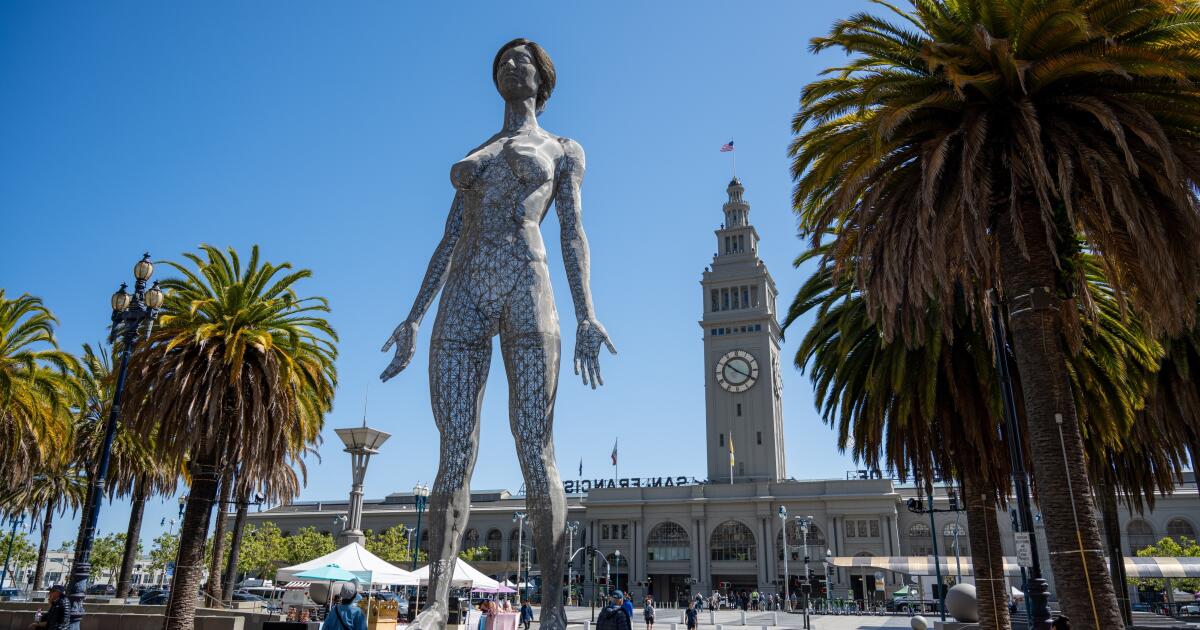
A sculpture of a giant naked woman goes on sale in San Francisco. Bring a crane
-

 Dallas, TX2 hours ago
No ‘straight answer’: Why Pioneer Cemetery is the latest battleground at City Hall
-

 Miami, FL2 hours ago
TSA hosts news conference ahead of World Cup third place match at Miami Stadium
-

 Boston, MA2 hours ago
ICE Boston arrests Barbados national during targeted operations in Attleboro
-

 Denver, CO2 hours ago
Denver Broncos training camp is 2 weeks away
-

 San Diego, CA3 hours ago
Daily Business Report: July 17, 2026, San Diego Metro Magazine

