West
New California bill named after Charlie Kirk, Melissa Hortman adds ‘political affiliation’ to hate crimes

NEWYou can now listen to Fox News articles!
A California bill introduced last week seeks to reduce political violence by adding political affiliation to the state’s protected characteristics in order to classify it as a hate crime.
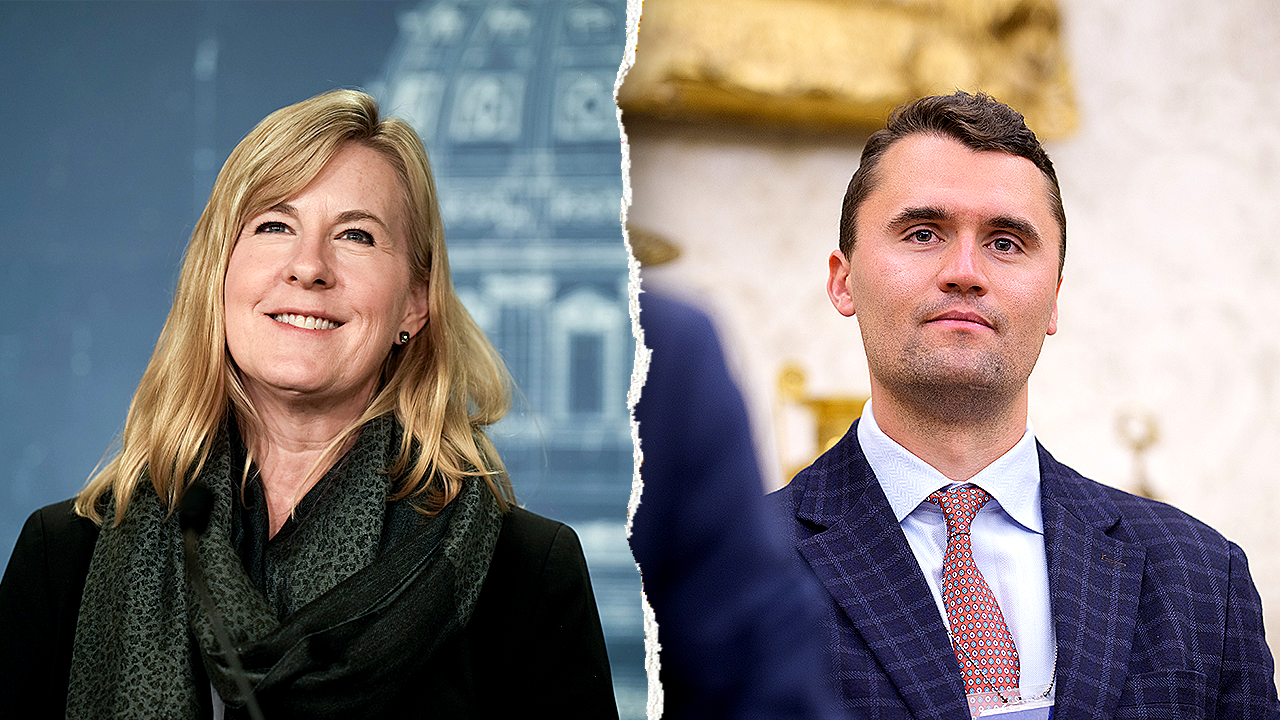
The bill, AB 1535, as first reported by the Orange County Register, is called the Hortman-Kirk Political Violence Prevention Act, and is named after former Minnesota Democratic Rep. Melissa Hortman and Turning Point USA founder Charlie Kirk, who were both murdered last year.
Under existing California law, hate crimes are criminal acts committed because of a victim’s actual or perceived characteristics such as race, religion, disability or sexual orientation.
AB 1535 would expand that definition to include political affiliation, defined as “the state of belonging to a political party, the endorsement of a political party or a platform of a political party, or the endorsement of a politician or a platform of a politician.”
Former Minnesota House Speaker Melissa Hortman and Turning Point USA co-founder Charlie Kirk were both killed in 2025. (Glen Stubbe/The Minnesota Star Tribune via Getty Images/Andrew Harnik/Getty Images)
WHY POLITICAL ASSASSINATION CASES AREN’T AUTOMATICALLY DEATH PENALTY ELIGIBLE
State Assemblymember Laurie Davies, a Republican from Laguna Niguel, introduced the bill, saying it is intended to promote a culture in which free speech is valued and protected.
“Our nation was founded on political freedoms. However, political violence is detrimental to our democracy and shouldn’t be tolerated,” Davies said. “Leaders are required to cool the temperature, not fan the flames. AB 1535 isn’t just about protecting Californians; it’s about a cultural reset. It’s a commitment to the idea that every Californian has the right to their political views without fear of being targeted by those who see them as an enemy rather than a neighbor.”
Under current state law, political affiliation is already a protected category in civil contexts such as employment or housing, but not within criminal hate crime statutes, according to Davies. By expanding the scope of an existing crime, the bill would impose a state-mandated local program.
NEARLY 40% OF YOUNG AMERICANS SAY POLITICAL VIOLENCE CAN BE JUSTIFIED IN CERTAIN SITUATIONS
Flowers and tributes to conservative influencer Charlie Kirk have filled Utah Valley University’s campus in the wake of his assassination on Wednesday, Sept. 10, 2025. (Fox News Digital/Deirdre Heavey)
ANTI-ICE AGITATORS SWARM VEHICLE OF CONSERVATIVE INFLUENCER NICK SORTOR
“This measure ensures that our justice system recognizes political violence for exactly what it is: a hate-motivated crime,” she said.
Hortman and her husband were fatally shot in a targeted attack at their home in Brooklyn Park, Minnesota, on June 14, 2025.
Kirk was gunned down while speaking at Utah Valley University on Sept. 10, 2025, at a speaking event for Turning Point.
A Luigi Mangione supporter stands outside Federal Court in Manhattan, N.Y., Jan. 9, 2026, where a suppression hearing is underway. (Rashid Umar Abbasi for Fox News Digital)
CLICK HERE TO DOWNLOAD THE FOX NEWS APP
A similar bill adding political affiliation as a protected characteristic in hate crime law was introduced in Washington in December.
Some law enforcement experts have warned that political violence is on the rise, citing high-profile attacks, including the assassination of United Healthcare CEO Brian Thompson and two assassination attempts against now-President Donald Trump in 2024.
Read the full article from Here



The Nuggets have made a habit of signing bench players with Colorado ties.
The latest homecoming they’ve arranged is for Alpha Diallo, who played a season of high school basketball at Denver West and is now signing a one-year, $1.4 million minimum contract with Denver in NBA free agency, a league source told The Denver Post on Sunday.
Diallo, 29, was named Defensive Player of the Year in the EuroLeague last season. This will be his first foray into the NBA after a five-year stint with AS Monaco. He recently committed to join Dubai Basketball on a multiyear deal, according to a report by the European media outlet BasketNews, but his contract included a clause granting his release if he left for the NBA by July 15.
The Nuggets have signed Diallo, Reggie Jackson (Palmer High School), David Roddy (Colorado State) and KJ Simpson (CU) to various deals in the last three years.
Born in New York, Diallo helped lead Denver West to the Colorado Class 4A Sweet 16 as a sophomore. He transferred to Lincoln High before his junior season, but he was ruled ineligible to compete for the entire school year due to what CHSAA deemed an implicit recruiting violation; Lincoln’s coach at the time had just coached Diallo in a summer tournament.
The eligibility fight with CHSAA eventually led Diallo to leave the state. He returned to the East Coast and played four years of college basketball at Providence, where he earned Second Team All-Big East honors twice.
Signing Diallo is the latest example of Denver’s attempt to prioritize defense and athleticism around Nikola Jokic. Last month, the Nuggets drafted Trevon Brazile and Bryce Hopkins in the second round, betting on defensive upside in both cases. They’ve also replaced backup center Jonas Valanciunas with the younger, bouncier Marvin Bagley III on a veteran minimum contract.
Denver tentatively has 12 players under contract on its 15-man roster for the 2026-27 season now: Nikola Jokic, Jamal Murray, Aaron Gordon, Cam Johnson, Christian Braun, Zeke Nnaji, Julian Strawther, DaRon Holmes II, Tyus Jones, Bagley, Brazile and Diallo. Restricted free agency negotiations have not yet been resolved with Peyton Watson and Spencer Jones.
Diallo will count for $2.45 million toward the luxury tax despite his $1.4 million salary, the minimum for NBA rookies. The accounting quirk exists so that owners aren’t incentivized to overlook more experienced free agents for tax purposes; the tax ramifications are equal for all minimum signings, regardless of NBA service time.
Want more Nuggets news? Sign up for the Nuggets Insider to get all our NBA analysis.

PORTLAND, Ore. (KATU) — Portlanders are being invited to help BIKETOWN mark its 10th birthday with what organizers hope will become a new world record: the largest electric bicycle party and ride.
The Portland Bureau of Transportation is organizing a GUINNESS WORLD RECORDS attempt on Sunday, July 19, aiming to beat the current record set in Seattle in 2018 with 405 e-bikes. PBOT is seeking the GUINNESS WORLD RECORDS title for the Largest Electric Bicycle Party and Ride.
Riders will gather at Salmon Springs, the fountain in Tom McCall Waterfront Park, starting at 8:30 a.m.
Check-in begins at 8:30 a.m., and the ride is scheduled to start at 9:30 a.m. from Southwest Naito Parkway and Southwest Salmon Street. PBOT said the date is “10-years-to-the-day since BIKETOWN service started with a maiden voyage group ride across the Willamette River.”
“I can’t wait to see all of Portland come out to celebrate the ways BIKETOWN has transformed our community,” PBOT Director Millicent Williams said. “Since 2016, BIKETOWN has introduced thousands of Portlanders to biking, and e-bikes in particular, and made biking more accessible for more people. By breaking this GUINNESS WORLD RECORDS title, we will remind everyone of Portland’s place at the front of the pack of leading bike cities across the nation.”
PBOT said the event is designed for massive participation and will follow a 2-mile loop that includes Tilikum Crossing, the Eastbank Esplanade and the Hawthorne Bridge, taking place mostly on the Waterfront and Eastbank Esplanade. Organizers said participants should expect a slow ride with some stops and are asked to stay on the route to be counted, while watching for pedestrians and other riders.
People riding personal e-bikes and pedal bikes are welcome, though PBOT said only e-bikes will be counted toward the record attempt. PBOT said registration is strongly encouraged to ensure riders are counted and that participants will need to provide their e-bike make and model. Riders are also encouraged to arrive early to check in and get a bib.
For people without an e-bike, PBOT said BIKETOWN will have bikes available to reserve on a first-come, first-served basis, with early registration recommended. Riders must be 16 or older to use BIKETOWN.
After the ride, PBOT said the event will conclude with a celebration featuring vendors, refreshments and remarks from City of Portland and BIKETOWN partners. PBOT said an official judge from Guinness World Records is expected to verify the attempt and confirm whether Portland set a new record.
PBOT also encouraged participants to head to the Portland Pride Parade and Festival afterward. The first 1,000 people who register for the ride will receive free entry to the Pride Festival, supported by BIKETOWN founding partner and title sponsor Nike.
PBOT said the event is possible with financial support from Nike, with additional support from Lyft and the City of Portland.
BIKETOWN launched July 19, 2016, with 1,000 bikes. PBOT said the system has deployed 3,000 electric pedal-assist bicycles serving a 50.5-square-mile service area, including portions of East Portland. BIKETOWN is a partnership between the City of Portland’s PBOT and Nike, and is operated by Lyft.

Jannik Sinner is starting to make a habit of responding to adversity in Paris with Wimbledon titles.
The top-ranked Sinner beat Alexander Zverev 6-7 (7), 7-6 (2), 6-3, 6-4 Sunday for his second consecutive title at the All England Club after his German opponent appeared bothered by a knee issue following a slip to the grass on a key point in the third set.
Sinner’s fifth Grand Slam title came in his first tournament since a second-round meltdown at the French Open, when he wilted in a Paris heat wave.
A year ago, Sinner beat Carlos Alcaraz in the final at the All England Club after wasting three match points against his rival in the Roland Garros final.
It was Sinner’s 10th straight victory over Zverev, who was coming off his first Grand Slam title at the French Open.
Linda Noskova beat Karolina Muchova in an all-Czech women’s final on Saturday for her first Grand Slam title.
Prince William joined his wife Kate and two of their children for the final in a star-studded Royal Box that also included actors Dustin Hoffman, Nicole Kidman and Ben Stiller.
Zverev slips
The top two seeds appeared perfectly matched until Zverev earned his first break point of the match at 3-3 in the third set — 2 hours and 42 minutes in. Sinner produced a drop shot and Zverev slipped and appeared to hyper-extend his right knee as he attempted to change directions behind the baseline.
Zverev grasped his knee in apparent discomfort and Sinner went around the net and helped his opponent up off the grass. Zverev quickly resumed playing but he appeared slightly hampered and slung his racket across the baseline in frustration when he missed a forehand and handed Sinner the first break of the match and a 5-3 lead in the third. Sinner then served it out.
Zverev had also lost 14 straight sets to Sinner and when he claimed the opening set of the final with a forehand winner up the line to conclude a tight tiebreaker, he let out a loud roar toward his box as he bent over in celebration.
Zverev continually cranked out serves at up to 139 mph (224 kph), while Sinner produced a series of well-placed aces at a slightly lower speed.
But Sinner began to read Zverev’s serve better in the second-set tiebreaker and Zverev started to miss forehands.
Paris meltdown
Amid stifling heat and humidity in Paris in late May, Sinner had his 30-match winning streak ended after coming within one game of a straight-set victory over Juan Manuel Cerundolo, who was ranked No. 56.
Conditions were cooler in southwest London for the final, with clear skies and a temperature of 82 degrees Fahrenheit (28 Celsius) but it was also breezy — which led to a series of shanked shots from both players.
Sinner went in for medical exams in Milan after the Paris defeat and didn’t play an official match again until he arrived at Wimbledon, where he twice had to come back from a set down in a five-set marathon against Miomir Kecmanovic in the first round.
Sinner then didn’t drop a set the rest of the way until the final, having dominated against Novak Djokovic in the semifinals.
Despite the defeat in the final, Zverev will leapfrog Alcaraz into the No. 2 spot in the rankings on Monday.
Alcaraz missed both the French Open and Wimbledon this year due to a right wrist injury.
Associated Press writer Mattias Karén contributed.
Wimbledon is keeping the World Cup off its official screens, even in the players’ lounge. Fans and players can still watch on their phones, but tournament TVs will stay focused on tennis.
-

 Dallas, TX4 minutes ago
3 unanswered questions before training camp: Dallas Cowboys edition
-

 Miami, FL10 minutes ago
“Love & Hip Hop: Atlanta” star Tommie Lee among 6 arrested during World Cup match in Miami, sheriff says
-

 Boston, MA16 minutes ago
‘More than just a cyclist’: Hundreds mourn Boston transit planner killed while biking – The Boston Globe
-

 Denver, CO22 minutes ago
Nuggets sign former Denver West basketball player Alpha Diallo out of EuroLeague
-

 Seattle, WA28 minutes ago
Portland aims to top Seattle’s 405 e-bikes with 2-mile Guinness record ride and party
-

 San Diego, CA34 minutes ago
Top-ranked Jannik Sinner beats Alexander Zverev to win Wimbledon again
-

 Milwaukee, WI40 minutes ago
MLB Draft 2026: Milwaukee Brewers Draft Signing Tracker
-
Atlanta, GA46 minutes ago
Atlanta officials ‘throw out homeless tents and medicine’ near World Cup spot


