Nevada
Union urges Mesquite police chief’s ouster


Many of the residents who packed Tuesday night’s Mesquite City Council meeting said they were “disappointed” by the police union’s complaints against the chief of their city’s police department.
While meeting attendees spilled out of the overflow rooms, a union leader told the mayor and council that the Mesquite Police Officers Association held a vote of “no confidence” in Chief MaQuade Chesley’s ability to run the Mesquite Police Department.
Andrew Regenbaum, who is executive director of the Nevada Association of Public Safety Officers, said a “strong majority” voted that they weren’t confident in Chesley’s leadership.
Nepotism and retaliatory behavior on the part of the chief, Regenbaum alleged, spurred the Mesquite association to hold the vote.
Regenbaum implored city leaders to act Tuesday night.
“I urge you to consider the significance of his actions and this vote of no confidence and take appropriate action,” Regenbaum said.
After Regenbaum spoke, dozens of residents lined up behind him to make their own comments. Many said they backed Chesley and expressed frustrations about what they said was the vagueness of Regenbaum’s statements.
One resident, Sue Hanks, said she “wanted the facts.”
“I want to know exactly what Chief Chesley has done to the detriment of our Mesquite community,” Hanks said.
Another, Jeffery Smith, who has worked as an officer with the department for years, said that the Mesquite Police Officers Association does not “speak for” him. For more than 30 minutes, residents came to the podium to share their disdain for the allegations. Several called it a “witch hunt.”
One called members of the MPOA “cry babies.”
“You better consider that he (Chesley) has done one heck of a job,” said Ron Richmond, a former Mesquite Police Department detective. “I started in 1996, and we never used to do this. (You) work and shut up. You’re not going to get everything you need.”
Chesley, who sat in the audience for the meeting, gave one of the final remarks of the forum. He said that his commitment to the department had never wavered. He also shared that since he became aware of the concerns that the union has with his leadership, he has created a five-year “plan for improvement.”
“The plan focuses on critical areas designed to enhance our internal operation and the service we provide to our community. Some of those areas are open communication and active listening,” Chesley said. “We want to make sure our officers are supported and that their wellness is maintained throughout their careers.”
Unlike one woman whom Mayor Allan Litman interrupted after exceeding the allotted three minutes, the council allowed Chesley’s remarks to go longer than the time limit. The crowd gave him a standing ovation after.
A handful of people dressed in MPOA T-shirts sat near the back of the chambers. One scoffed while Chesley spoke.
During their comments to the council, Mindy Hughes and Brent Horlacher, who had been sitting with the MPOA supporters, insisted that a thorough investigation be done. They said the police union should not be villainized.
“It is the union’s job to demand transparency and honesty from the government entity, as well as any citizen would expect,” Horlacher said. “That is the mission of MPOA. It’s not to hurt anyone. It’s not to talk bad about anyone. It’s not to ruin anybody’s life. It is, however, an essential function of the MPOA to seek truth and accountability from those elected and appointed by the city of Mesquite.”
In an interview after the meeting, Regenbaum told the Review-Journal that he could not discuss specific incidents but that Chesley had “weaponized internal affairs against people in the department who disagreed with him.” According to Regenbaum, the chief had also hired out-of-state friends and given them more favorable pay scales.
“It is not unusual that he (Chesley) would bring out all his supporters,” Regenbaum said. “What is important is that the MPOA rank and rile had the courage to do something of this magnitude.”
Contact Akiya Dillon at adillon@reviewjournal.com





How to Watch Nevada’s 2026 Lunar Eclipse
A total lunar eclipse will cross Nevada skies early Tuesday morning. Here’s when totality begins and where to watch.
A lunar eclipse will be in Nevada skies late Monday night — or, more accurately, early Tuesday morning, March 3.
The downside is the hour: you’ll have to be up very late or very early, depending on your perspective.
Unlike a solar eclipse, which occurs when the moon passes between the Earth and the sun, a lunar eclipse happens when Earth casts its shadow on the moon, creating a rusty red hue.
If you’re looking to see the lunar eclipse, here’s everything you need to know about viewing it in Nevada.
What eclipse is in 2026?
If you live in the U.S., you will be able to see the lunar eclipse starting at 12:44 a.m. PST Tuesday, March 3, 2026, according to NASA. During the night, you’ll see the moon in a reddish hue, or a blood moon.
Totality lasts for a little more than an hour before the moon begins to emerge from behind Earth’s shadow, according to the popular site timeanddate.com. As the moon moves into Earth’s shadow, also known as the umbra, it appears red-orange or a “ghostly copper color,” hence its name: blood moon, NASA says.
“During a lunar eclipse, the moon appears red or orange because any sunlight that’s not blocked by our planet is filtered through a thick slice of Earth’s atmosphere on its way to the lunar surface,” NASA says. “It’s as if all the world’s sunrises and sunsets are projected onto the moon.”
Countdown clock to the 2026 total lunar eclipse
If you live in the U.S., you will be able to see the eclipse starting at 12:44 a.m. PST Tuesday, March 3, 2026.
The entire eclipse will last about six hours. People in Nevada can see the lunar eclipse during the early morning hours of Tuesday, March 3, 2026. The total lunar eclipse will be visible in North America, South America, Eastern Europe, Asia, Australia and Antarctica.
Everything will be over by 6:23 a.m. PST on March 3, 2026. Below is a countdown clock for the 2026 total lunar eclipse.
Where are the best places to see the lunar eclipse near Reno?
Though the Biggest Little City has an abundance of light pollution, darker skies are less than an hour from Reno.
- Fort Churchill State Park: The park provides a dark night sky ideal for evening astronomical events among the ruins of Fort Churchill. Park entrance costs $5 for Nevada residents and $10 for nonresidents.
- Pyramid Lake: A popular spot for Renoites seeking a night of stargazing, the lake is less than an hour from The Biggest Little City. It offers beautiful natural wonders and dark skies that give a clear view of the lunar eclipse.
- Lake Tahoe: Multiple locations around the lake are excellent for stargazing that are less than an hour from Reno.
- Cold Springs or Hidden Valley still get light pollution from the Biggest Little City, but have clearer skies than the middle of town.
- Driving down the road on USA Parkway will likely also give you the dark skies to see the lunar eclipse without having to make a significant drive outside of town.
Carly Sauvageau with the Reno Gazette Journal contributed to this report.

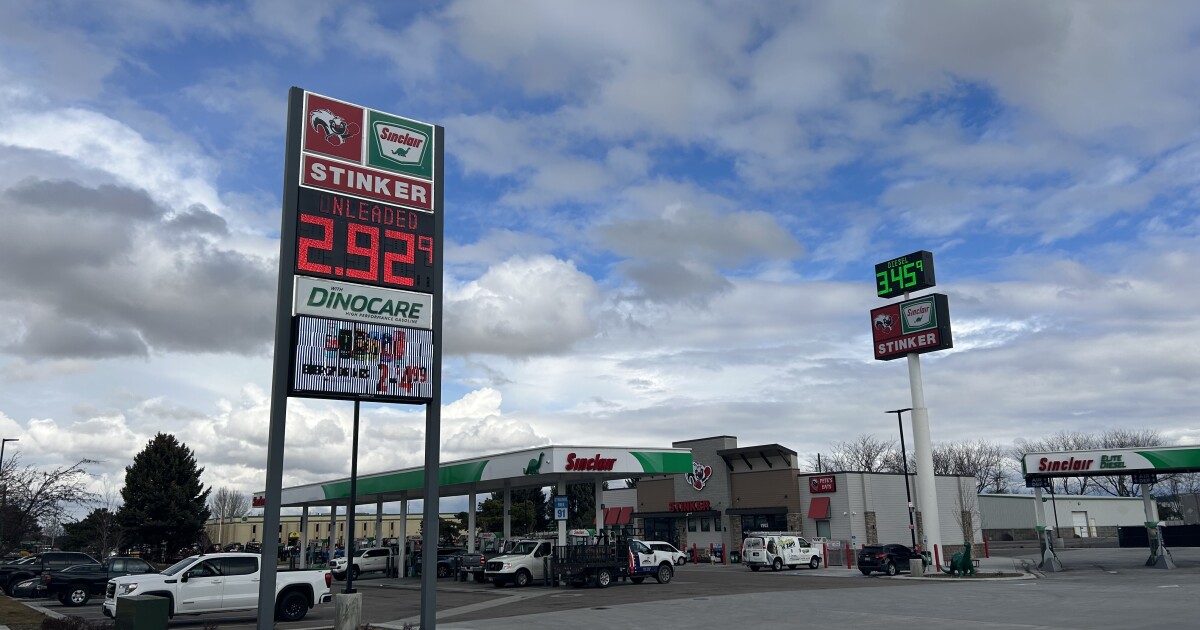
The United States and Israel launched targeted attacks on Iran on Saturday. The move brought new uncertainty into global energy markets, as northern Nevadans could be paying more at the pump in the coming weeks.
Following the strikes, oil prices increased. Brent crude, the international benchmark, jumped to roughly $73 a barrel, while the national benchmark, West Texas Intermediate, traded above $67.
Much of the concern centers around the Strait of Hormuz, a narrow waterway between Iran and Oman. which carries about a fifth of the world’s oil supplies.
Patrick de Haan, head of petroleum analysis with GasBuddy, a price tracking company, spoke on the current questions in the region.
“The known would reduce oil prices if there becomes clarity, but it’s the unknown that is stoking fears…. If there is some sort of clarity in the days ahead, whether from Iran, the United States, or Israel, on how long this would last. We’d be able to put potentially an end date for the potential impacts that we’re seeing,” said de Haan.
Experts say for every $5 to $10 increase in oil prices, drivers could pay 15 to 25 cents more per gallon.
According to Triple-A, the average price of a gallon of gas in Nevada on Sunday comes in at $3.70, which comes in above the national average of roughly $2.98.
Over at the Rainbow Market on Vassar Street, prices sat just below four dollars a gallon on Sunday. Reno resident Abran Reyes talked about gas prices potentially going up.
“Whether it’s to work, to maybe run errands, to do stuff that helps you, gas is essential…. That gas price really hits, especially in today’s economy, where gas prices are extraordinary…. I just hope everyone’s safe. I hope our soldiers and all of our troops can be okay,” said Reyes.

More than 10,000 people have enrolled in Nevada’s new public option health plans, which debuted last fall with the expectation that they would bring lower prices to the health insurance market.
Those preliminary numbers from the open enrollment period that ended in January are less than a third of what state officials had projected. Nevada is the third state so far to launch a public option plan, along with Colorado and Washington state. The idea is to offer lower-cost plans to consumers to expand health care access.
But researchers said plans like these are unlikely to fill the gaps left by sweeping federal changes, including the expiration of enhanced subsidies for plans bought on Affordable Care Act marketplaces.
The public option gained attention in the late 2000s when Congress considered but ultimately rejected creating a health plan funded and run by the government that would compete with private carriers in the market. The programs in Washington state, Colorado, and Nevada don’t go that far — they aren’t government-run but are private-public partnerships that compete with private insurance.
In recent years, states have considered creating public option plans to make health coverage more affordable and to reduce the number of uninsured people. Washington was the first state to launch a program, in 2021, and Colorado followed in 2023.
Washington and Colorado’s programs have run into challenges, including a lack of participation from clinicians, hospitals, and other care providers, as well as insurers’ inability to meet rate reduction benchmarks or lower premiums compared with other plans offered on the market.
Nevada law requires that the carriers of the public option plans — Battle Born State Plans, named after a state motto — lower premium costs compared with a benchmark “silver” plan in the marketplace by 15% over the next four years.
But that amount might not make much difference to consumers with rising premium payments from the loss of the ACA’s enhanced tax credits, said Keith Mueller, director of the Rural Policy Research Institute.
“That’s not a lot of money,” Mueller said.
Three of the eight insurers on the state’s exchange, Nevada Health Link, offered the state plans during the open enrollment period.
Insurance companies plan to meet the lower premium cost requirement in Nevada by cutting broker fees and commissions, which prompted opposition from insurance brokers in the state. In response, Nevada marketplace officials told state lawmakers in January that they will give a flat-fee reimbursement to brokers.
The public option has faced opposition among state leaders. In 2024, a state judge dismissed a lawsuit, brought by a Nevada state senator and a group that advocates for lower taxes, that challenged the public option law as unconstitutional. They have appealed to the state Supreme Court.
Federal Policy Impacts
Recent federal changes create more obstacles.
Nevada is consistently among the states with the largest populations of people who do not have health insurance coverage. Last year, nearly 95,000 people in the state received the enhanced ACA tax credits, averaging $465 in savings per month, according to KFF, a health information nonprofit that includes KFF Health News.
But the enhanced tax credits expired at the end of the year, and it appears unlikely that lawmakers will bring them back. Nationwide ACA enrollment has decreased by more than 1 million people so far this year, down from record-high enrollment of 24 million last year.
About 4 million people are expected to lose health coverage from the expiration of the tax credits, according to the Congressional Budget Office. An additional 3 million are projected to lose coverage because of other policy changes affecting the marketplace.
Justin Giovannelli, an associate research professor at the Center on Health Insurance Reforms at Georgetown University, said the changes to the ACA in the Republicans’ One Big Beautiful Bill Act, which President Donald Trump signed into law last summer, will make it more difficult for people to keep their coverage. These changes include more frequent enrollment paperwork to verify income and other personal information, a shortened enrollment window, and an end to automatic reenrollment.
In Nevada, the changes would amount to an estimated 100,000 people losing coverage, according to KFF.
“All of that makes getting coverage on Nevada Health Link harder and more expensive than it would be otherwise,” Giovannelli said.
State officials projected ahead of open enrollment that about 35,000 people would purchase the public option plans. Of the 104,000 people who had purchased a plan on the state marketplace as of mid-January, 10,762 had enrolled in one of the public option plans, according to Nevada Health Link.
Katie Charleson, communications officer for the state health exchange, said the original enrollment estimate was based on market conditions before the recent increases in customers’ premium costs. She said that the public option plans gave people facing higher costs more choices.
“We expect enrollment in Battle Born State Plans to grow over time as awareness increases and as Nevadans continue seeking quality coverage options that help reduce costs,” Charleson said.
According to KFF, nationally the enhanced subsidies saved enrollees an average of $705 annually in 2024, and enrollees would save an estimated $1,016 in premium payments on average in 2026 if the subsidies were still in place. Without the subsidies, people enrolled in the ACA marketplace could be seeing their premium costs more than double.
Insights From Washington and Colorado
Washington and Colorado are not planning to alter their programs due to the expiration of the tax credits, according to government officials in those states.
Other states that had recently considered creating public options have backtracked. Minnesota officials put off approving a public option in 2024, citing funding concerns. Proposals to create public options in Maine and New Mexico also sputtered.
Washington initially saw meager enrollment in its Cascade Select public option plans; only 1% of state marketplace enrollees chose a public option plan in 2021. But that changed after lawmakers required hospitals to contract with at least one public option plan by 2023. Last year the state reported that 94,000 customers enrolled, accounting for 30% of all customers on the state marketplace. The public option plans were the lowest-premium silver plans in 31 of Washington’s 39 counties in 2024.
A 2025 study found that since Colorado implemented its public option, called the Colorado Option, coverage through the ACA marketplace has become more affordable for enrollees who received subsidies but more expensive for enrollees who did not.
Colorado requires all insurers offering coverage through its marketplace to include a public option that follows state guidelines. The state set premium reduction targets of 5% a year for three years beginning in 2023. Starting this year, premium costs are not allowed to outpace medical inflation.
Though the insurers offering the public option did not meet the premium reduction targets, enrollment in the Colorado Option has increased every year it has been available. Last year, the state saw record enrollment in its marketplace, with 47% of customers purchasing a public option plan.
Giovannelli said states are continuing to try to make health insurance more affordable and accessible, even if federal changes reduce the impact of those efforts.
“States are reacting and trying to continue to do right by their residents,” Giovannelli said, “but you can’t plug all those gaps.”
Are you struggling to afford your health insurance? Have you decided to forgo coverage? Click here to contact KFF Health News and share your story.
KFF Health News is a national newsroom that produces in-depth journalism about health issues and is one of the core operating programs at KFF — an independent source of health policy research, polling, and journalism. Learn more about KFF.

Lawmakers again push to restore Shore Line East service to 2019 levels

Delaware Supreme Court upholds reforms to curb ‘DExit’ concerns

Florida High School Boys Basketball 2026 Playoff Brackets, Schedule (FHSAA) – March 2, 2026

Florida Continues Push to Beat Out Georgia for Top LB Recruit

Everyone Says Oahu’s Overcrowded. We Drove 20 Minutes Past Haleiwa And Found Beautiful Empty Beaches

Florida High School Football Rankings: Top 25 teams – Oct. 21

Cleary's 21 help Le Moyne down Central Connecticut State 69-64 in OT

How old is Bo Nix? What to know about Oregon quarterback ahead of 2024 NFL Draft

99th annual Pony Swim held in Virginia

Indiana Members Credit Union announced as new anchor tenant at Bottleworks District

Map: Earthquake Shakes Central California

Gas prices could jump as Middle East tensions threaten global oil supply

Pakistan calls troops, orders 3-day curfew as 24 killed in pro-Iran rallies

US says Kuwait accidentally shot down 3 American jets

House Republicans push Johnson to go to war with Senate over SAVE Act
-

 World5 days ago
Exclusive: DeepSeek withholds latest AI model from US chipmakers including Nvidia, sources say
-

 Massachusetts5 days ago
Mother and daughter injured in Taunton house explosion
-

 Denver, CO5 days ago
10 acres charred, 5 injured in Thornton grass fire, evacuation orders lifted
-

 Louisiana1 week ago
Wildfire near Gum Swamp Road in Livingston Parish now under control; more than 200 acres burned
-

 Technology1 week ago
YouTube TV billing scam emails are hitting inboxes
-

 Politics1 week ago
OpenAI didn’t contact police despite employees flagging mass shooter’s concerning chatbot interactions: REPORT
-

 Technology1 week ago
Stellantis is in a crisis of its own making
-

 News1 week ago
World reacts as US top court limits Trump’s tariff powers