Nevada
Report: Less Than 20 Percent of High School Students in Nevada Are Proficient in Math – Nevada Globe


In a recent study by Scholaroo, Nevada ranks 46th in the nation in education and the latest report card provided by the Nevada Department of Education (NVDOE) supports their findings. The report provides data on student performance, absenteeism, graduation and state-wide school quality.
Overall, less than 50 percent of all students are proficient in math and English. 32.6 percent of students demonstrated proficiency in math – a 1.3 percentage-point increase compared with the 2022-23 school year. In English, the statewide proficiency rate was 41.3 percent – up 0.3 percentage points from the previous year.
Breaking down the data by grade, third through eighth grade students showed gains in both math and English. For a second consecutive year, all grade levels and student groups made improvements in math proficiency.
Third graders had the highest level of math proficiency at 43.2 percent, followed by fourth graders at 39.8 percent, and fifth graders at 31.8 percent.
In English, students also made gains or proficiency levels remained steady for all student groups by race/ethnicity. Fifth graders demonstrated the highest level of proficiency at 45.3 percent, followed by fourth graders at 43.5 percent, and seventh graders at 42 percent. Students in grades three, six, seven, and eight experienced a decrease in proficiency in English compared with the previous year.
The largest gain in English proficiency was among Black students, with a 1.3 percentage-point increase. Overall, The largest gains by race/ethnicity were among Asian students (2.2 percentage-point increase), and Black students (2.1 percentage-point increase).
In Science, Nevada middle school students saw a 3.6 percentage-point gain in science compared with the 2022-23 school year. High school students showed a 0.1 percentage-point decrease, while elementary school students had a 5.2 percentage-point decrease.
“Are we there yet? Absolutely not. Do we know the road to success? We absolutely do and we need to make sure that we continue on that path at an accelerator rate. What that means is, meeting students where they are at, understanding their individual learning styles and being engaged,” said Superintendent of Public Education Jhone Ebert in a released statement.
Chronic absenteeism improved to 25.9 percent from 34.9 percent the previous year. Students are considered chronically absent when they miss 10 percent or more of school days.
“This 9 percent improvement in the chronic absenteeism rate is a major accomplishment that reflects concerted efforts across our education system and community to ensure that students are in class learning,” Ebert said.
Nevada’s high school graduation rate for the Class of 2023 decreased to 81.4 percent compared with 81.7 percent the previous year. Yet, less than 20 percent of high school students are proficient in math and only 45 percent are proficient in English.
Fuzzy math? The graduation numbers simply do not reflect the proficiency rates. We have contacted the NV DOE’s Public Information Officer for clarification on graduation data.

Ebert further credits Governor Joe Lombardo for providing a historic education budget and resources to improve education.
“The Governor introduced AB 400, which the legislatures passed, the governor signed to put 140 million dollars in for our youngest learners. Those from birth all the way up to age 6 are now receiving additional resources so they have a great start to their education.”
During the last legislative session, Lombardo signed a historic K-12 education budget, investing $12 billion over the next biennium, adding an additional $2.6 billon to the budget. Last September, Lombardo and State Superintendent John Ebert announced an “Acing Accountability” intiative. The initiative established accountability metrics related to the $2.6 billion investment in K-12 education. The metrics were designed to ensure that “resources are tied to performance.”
Despite the historic investment, an audit performed earlier this year found existing shortcomings, prompting the governor to promise additional education reforms, including advancing legislation to make it easier to remove a school superintendent and put a school district under state control.
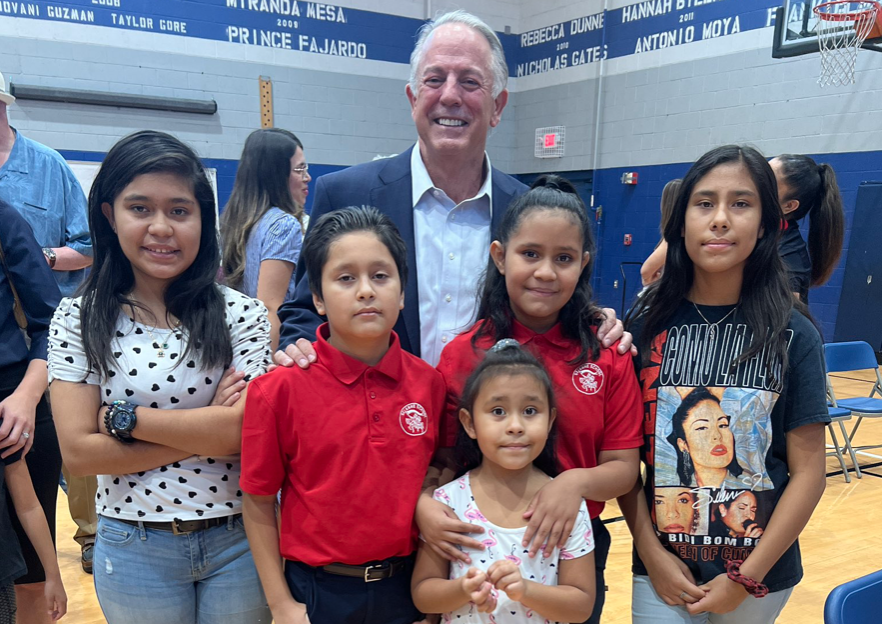
“In one of my first Executive Orders last year, I mandated an audit of Nevada’s 17 Public School Districts and the State Public Charter School Authority. I firmly believe that our unprecedented investment into K-12 education warrants unprecedented accountability and fiscal responsibility. The audit highlighted existing shortcomings within our education system, and my administration will use the audit’s findings to shape our Acing Accountability initiative and education reform in our state.”
As reported by The Globe, the battle for school choice took center stage during the last legislative session, but the Democratic majority stripped the funding necessary for Opportunity Scholarships forcing hundreds of low-income students into the state’s failing public school system.
In a unanimous vote, the Democratic majority on the Interim Finance Committee refused to approve Governor Lombardo’s proposed $3.4 million to protect hundreds of Opportunity Scholarships for low-income students. Republican members of the committee unanimously approved the funding
Following the vote, Governor Joe Lombardo released the following statement: “In an act of callous partisanship, today Democrats turned their backs on hundreds of low-income students that our traditional school system has failed or left behind. Forcibly removing hundreds of low-income students from their schools after the school year has already begun is devastating and simply incomprehensible. My administration grieves with the hundreds of students who will be crushed by Democrats removing them from their friends, teachers, and schools, and my administration remains more committed than ever to fighting for all Nevada students. Our fight continues.”
Valeria Gurr, Senior Fellow at School Choice Now, told The Globe, “The latest reports show what we already knew. Our students have been the victims of an educational system that is not serving them well — for decades. It’s not only that they are not proficient in math and reading, but that they are also stuck in overcrowded classrooms with lack of support that they need to become successful. Parents need more options, and they need them now.”
Editor’s note: In grade school, the average student-teacher ratio is 21:1. To view performance data for the state, school districts, and schools, visit the Nevada Report Card website at nevadareportcard.nv.gov.




LAS VEGAS (KLAS) – An earthquake struck in the northern part of Nevada on Monday, causing at least some “light” to “moderate” damage in some of the immediate surrounding areas, according to reports gathered by the United States Geological Survey (USGS).
The 5.7 magnitude earthquake struck shortly before 6:30 p.m. PST on Monday near Fallon, Nevada, about 12 miles southeast of Silver Springs, the USGS reported.
The area is just 40 miles northeast of the state capital, Carson City, and 400 miles northwest of Las Vegas.
Data gathered by the USGS shows reports of “light” to “moderate” damage observed around the epicenter of a 5.7 magnitude quake, along with “strong” to “very strong” shaking. The jolts were enough to shatter glass and scatter products along the floor of a grocery store in the town of Fallon, as seen in images shared with the Associated Press.
Trina Enloe told the news agency that she was sitting with one of her daughters as she did homework in their dining room when the quake hit.
“You could hear the rumbling just coming before it even got to us,” Enloe said. The shaking continued for about a minute, she added, during which some cast-iron candle holders were knocked over. Enloe didn’t see any cracks or damage in her home, though.
Those in Nevada with similar experiences are advised to contribute a report through the USGS’s “Felt Report” platform.
The Associated Press contributed to this report.

RENO, Nev. (KOLO) – An earthquake was felt across northern Nevada Monday night. The United State Geological Survey reports the magnitude at 5.5. It was centered about 12 miles southeast of Silver Springs. Several aftershocks were reported in the area, the largest measuring at magnitude-3.6.
People reported feeling the quake across northern Nevada and into California.
There are no reports of any damage so far.
Copyright 2026 KOLO. All rights reserved.

LAS VEGAS (KSNV) — The Nevada Supreme Court has upheld an interim suspension for Pahrump Justice of the Peace Michele Fiore as she faces an investigation into complaints of possible misconduct.
In a unanimous ruling filed Friday, the high court said Fiore’s challenge is moot because the Nevada Commission on Judicial Discipline is still investigating the complaints against her, and hasn’t imposed any official punishment or filed formal charges.
“We conclude Judge Fiore has not demonstrated the Commission abused its discretion in determining that an interim suspension was warranted,” the ruling states.
The Nevada Commission on Judicial Discipline suspended Fiore after a jury found her guilty in a 2024 federal trial on six counts of wire fraud and a count of conspiracy to commit wire fraud.
Prosecutors alleged that she solicited donations on the premise that they would go toward statues of two fallen Las Vegas police officers while she was a city councilwoman, but instead used the money on personal expenses, including plastic surgery and her daughter’s wedding.
Fiore, who denied the allegations, received a pardon from President Donald Trump last year. She filed for re-election in January.
The Judicial Discipline Commission kept her suspension in place with pay, writing that Trump’s pardon did not preclude it “from considering a judge’s ongoing conduct.”
Fiore filed a petition with the high court challenging the commission’s jurisdiction to discipline her for conduct from before she became a justice of the peace, though the commission says it “based the suspension on an allegation that Judge Fiore has engaged in misconduct during her time as a judicial officer,” according to the Supreme Court.
In a statement released Friday, Fiore said she was willing to wait for the commission’s investigation to play out.
“While we are disappointed the Supremes chose not to address those issues now, this is not the end of the fight, it is simply the next step,” Fiore’s statement reads.

Commercial Ships Transit Strait of Hormuz as U.S. Blockades Iran’s Ports

Two Detroit Pistons Facing Uncertain Roles in NBA Playoff Rotation

Meet the District 2 candidates: How should SFUSD students be assigned to schools?

Stephen Jones’ Comments Add Fuel To Dallas Cowboys NFL Draft Trade Rumors

Forward Brant Byers leaving Miami RedHawks for Penn State | Report

Florida High School Football Rankings: Top 25 teams – Oct. 21

How old is Bo Nix? What to know about Oregon quarterback ahead of 2024 NFL Draft

Cleary's 21 help Le Moyne down Central Connecticut State 69-64 in OT

99th annual Pony Swim held in Virginia

Indiana Members Credit Union announced as new anchor tenant at Bottleworks District
Commercial Ships Transit Strait of Hormuz as U.S. Blockades Iran’s Ports

Video: How Stephen Miller Is Adjusting Trump’s Immigration Agenda

Biden DOJ weaponized FACE Act against pro-life Americans, 882-report alleges

Mass drone warfare is Europe’s rising security threat
Man accused in Molotov cocktail attack of OpenAI CEO’s home charged with attempted murder
-

 Atlanta, GA1 week ago
1 teenage girl killed, another injured in shooting at Piedmont Park, police say
-

 Georgia1 week ago
Georgia House Special Runoff Election 2026 Live Results
-

 Arkansas4 days ago
Arkansas TV meteorologist Melinda Mayo retires after nearly four decades on air
-

 Pennsylvania1 week ago
Parents charged after toddler injured by wolf at Pennsylvania zoo
-
 Milwaukee, WI1 week ago
Potawatomi Casino Hotel evacuated after fire breaks out in rooftop HVAC system
-

 Austin, TX7 days ago
ABC Kite Fest Returns to Austin for Annual Celebration – Austin Today
-

 World1 week ago
Zelenskyy warns US-Iran war could divert critical aid from Ukraine
-

 Ohio7 hours ago
‘Little Rascals’ star Bug Hall arrested in Ohio