Nevada
Homelessness rates in Southern Nevada up 36% over past two years


LAS VEGAS (KTNV) — The number of people facing homelessness in Southern Nevada continues to grow.
On Wednesday, Clark County released the results of their annual census, which was carried out by volunteers on Jan. 25, 2024.
On any given night, 7,906 people in Clark County are experiencing homelessness. That’s a 20% jump compared to 2023 and a 36% jump compared to 2022.
Clark County
According to county data, the most impacted groups are women, African Americans, and those between 35 and 44 years old.
Clark County

County officials add that while individuals experiencing homelessness currently represent less than 1% of the overall population, the number of people and proportion relative to the total population have been rising.
Those trends “indicate a potential shift towards increased homelessness” and allow county officials to plan for the future, including putting proactive measures in place like adding additional shelter locations and adding affordable housing and permanent supportive housing programs.
How do we compare to other cities?
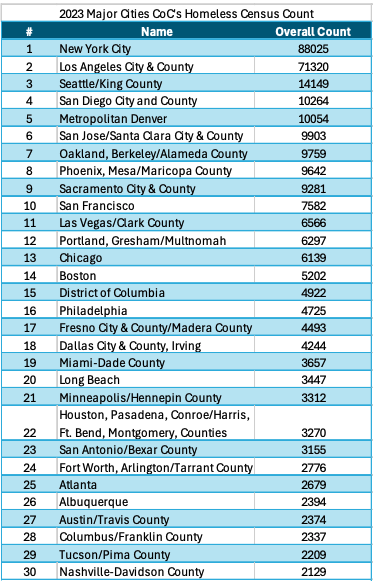
When looking at national data, Las Vegas is number 11 when it comes to the largest population of those experiencing homelessness on a single night.
(Note: Las Vegas numbers include those people in shelters as well as people on the street. Other major cities ranked lower on the list below only provided shelter-only counts. Based on shelter-only rates, Las Vegas would rank in the 20 to 25 range.)
Clark County
What is causing homeless rates to go up in Southern Nevada?
One of the biggest factors in the rise of homeless rates is housing affordability and income.
For example, between 2021 and 2022, median household prices surged by over 35%, according to Clark County. Officials add that income did increase but was “comparatively slower, growing at approximately half the rate of the surge in median household prices and Fair Market Rents.”
That tracks with data from the Princeton University Eviction Lab, which tracks housing and rent costs across the country.
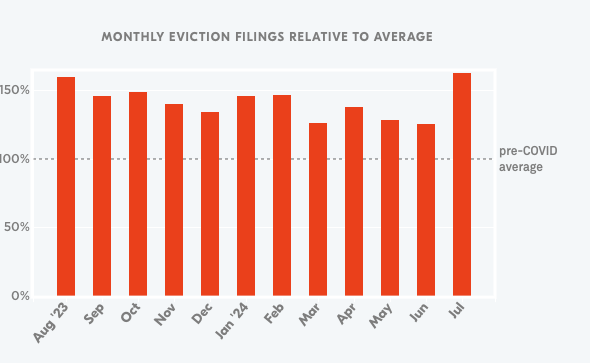
Over the past year, there have been 51,825 eviction filings in Las Vegas, which is up 42%, compared to an average year before the COVID-19 pandemic. Looking closer, there have been 4,983 eviction filings in just the last month, which is up 63%, compared to an average year before the COVID-19 pandemic.
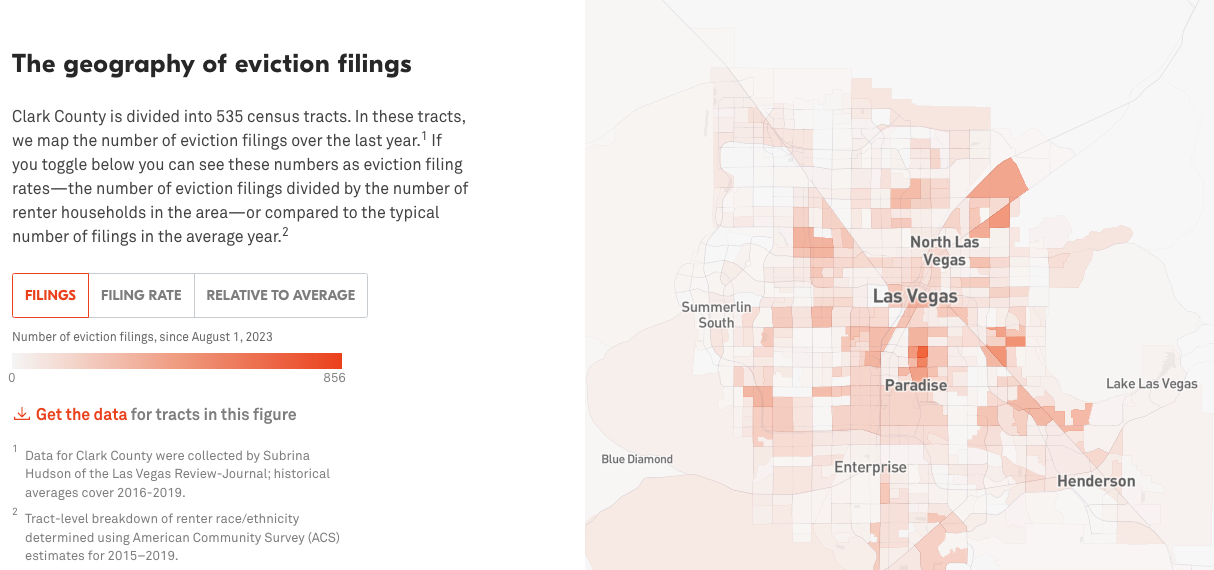
Many of those evictions are in the central or eastern part of the valley.
Princeton researchers say the data in Clark County is likely an undercount because those records “are only available with a delay”.
Princeton University Eviction Lab
Princeton University Eviction Lab
What are valley officials doing to help those experiencing homelessness?
In Clark County, there are 9,013 total beds for people experiencing homelessness. That number includes emergency shelters, transitional housing, permanent supportive housing, other than permanent housing, and rapid rehousing.
According to the 2024 census data, only 7,635 of those beds were used on any given night, or about 85%
Clark County has been looking for ways to add beds and last year, they opened the Clark County Navigation Center. A former Motel 6 was converted into temporary housing for up to 70 people. The Vintage Safari Motel was also converted into transitional housing.
WATCH: Vacant motel transformed into Betterment Community for homeless populations in Las Vegas
Vacant Las Vegas motel transforms into shelter for homeless Nevadans
In response to the 2023 homeless census, Clark County also added non-congregate shelter beds to help individuals find safer and more suitable accommodations and get more people off the street.
In May, Clark County commissioners approved over $66 million in funds to go towards constructing and rehabilitating affordable housing units for low to extremely low-income residents. That round of funding is going to nine projects, which will create 1,273 units.
The City of Las Vegas also has the Courtyard Homeless Resource Center, which has case managers to help people navigate the resources they need to get off the streets. That includes a computer lab, medical care, laundry room, showers, bathrooms, and a kennel for people’s animals.
The Courtyard also has a free Arrow shuttle that transports people to service providers such as the DMV, Nevada Job Connect, and the Goodwill Career Center.
Las Vegas also has a Multi-agency Outreach Resource Engagement, or MORE, team. They provide mobile intervention and outreach services to homeless individuals that live in encampments, the street, flood control tunnels, and outlying uninhabited areas around Las Vegas.
You can learn more about those resources here.
WATCH: Learn more about the MORE Team and the work they do in Las Vegas
13 Investigates: What’s being done to address homelessness in the Las Vegas Valley?









LAS VEGAS (FOX5) — As temperatures rise, FOX5 hears from more viewers dealing with air conditioning problems at home.
For tenants, those issues can quickly turn into questions about safety, repairs and what to do if a landlord doesn’t respond.
Nevada Legal Services said it also sees a spike in tenant complaints when it gets hotter.
Attorneys there said tenants do have rights, but warned that there are certain steps people should take — and others they should avoid — because making the wrong move in Nevada can lead to serious problems.
‘Pretty common, especially in the summer’
John Brogden, a senior attorney with Nevada Legal Services, said air conditioning issues are one of the most frequent problems he sees when the weather heats up.
“It’s pretty common, especially in the summer. We get a lot of air conditioning issues,” Brogden said.
MORE: No AC for 24 days: Las Vegas family reaches out to FOX5 for home warranty help
Brogden said extreme heat in Southern Nevada can put extra stress on homes and apartments, making repairs a common issue this time of year.
Two key categories: habitability vs. essential services
Brogden said Nevada law generally breaks these types of problems into two categories: habitability issues and essential services issues.
“There’s a lot of overlap in the language of the two statutes, but the way that I look at it is essential services,” Brogden said. “It’s something that, without it, that unit’s pretty much uninhabitable… like you would not want to live there.”
He said habitability issues can be problems that still affect a tenant’s ability to live safely in a unit, such as a slow leak coming through the wall.
The difference matters because it can change how a tenant should respond.
Withholding rent can be risky in Nevada
Brogden said one of the first things many people consider is withholding rent, but he warned that can be risky in Nevada.
“In which case, the landlord may or may not fix the issue and the person is out on the street for however long,” Brogden said. “The eviction process here is very quick. It’s not like California.”
For a habitability issue, Brogden said tenants may have to wait 14 days for a landlord to make a reasonable effort to fix the problem.
And if a tenant chooses to withhold rent, Brogden said it is not as simple as just not paying.
“If it’s a habitability issue, they are required to put that money into escrow with the court,” Brogden said. “At the time they file their answer and say, ‘Hey, this is the reason I withheld my rent.’ It’s not that I just don’t want to pay my rent. So, they have to, in good faith, give that money to the court.”
Essential services: 48-hour window (excluding weekends/holidays)
When it comes to an essential service, Brogden said landlords are generally required to take a reasonable step within 48 hours — not including holidays or weekends.
Other options may include paying for certain repairs and deducting the cost from rent or, in some cases, terminating the lease — which can be complicated.
What tenants should do first
Brogden said the first step in either case is to notify the landlord in writing, contacting them using the method outlined in the lease, if available.
He emphasized that every situation is different and whether something counts as a habitability issue or an essential services issue depends on the facts of the case.
Brogden said tenants should get legal advice — including through Nevada Legal Services — before taking action.
Nevada Legal Services warning: Don’t use AI for legal demands
Nevada Legal Services also warned tenants not to rely on AI chatbots to draft legal claims or demands to landlords.
Attorneys said they have been seeing more of that and that chatbots can misstate Nevada law, hurt a tenant’s credibility or create problems later in court.
Copyright 2026 KVVU. All rights reserved.

Anthony used staff time, government equipment to promote ‘Protect Women’s Sports’ task force

Trans athletes in college continues to be a hotly debated issue
The US Supreme Court has agreed to hear a case in its next term about transgender college athletes. That given the issue new political life.
A Nevada ethics panel fined Lt. Gov. Stavros Anthony $3,000 over use of state resources to promote a task force to keep trans athletes out of women’s sports.
Anthony, a Republican, is running for reelection.
The March 18 vote against Anthony was 3 to 2 by the Nevada Commission on Ethics.
In addition to the fine, he’s required to obtain ethics training within 60 days and develop a social media policy for his office.
Anthony created the “Task Force to Protect Women’s Sports” in late 2024 after the Nevada women’s volleyball team made national news by refusing to play San Jose State University for having a transgender player on its team.
“I decided I was very passionate about protecting female athletes,” he testified before the Nevada Legislature in February 2025. “I wanted to support the University of Nevada, Reno volleyball team who came out very courageously on their stand. That is why I created this task force.”
Anthony’s official government X account shared posts about task force events, and staff from the state’s Office of Small Business Advocacy — under Anthony’s authority — sent out emails about the task force. Anthony’s chief of staff testified the task force was not a function of the office.
The ethics commission’s vote served to “admonish the lieutenant governor for his actions in violation of the ethics law,” its motion said.
The Reno Gazette Journal contacted Anthony and his attorney, the ethics commission and Lindsey Harmon, a reproductive rights advocate who made the initial ethics complaint, for comment. None immediately responded.
Stavros Anthony’s defense of his actions
Anthony’s attorneys argued in legal filings that he did not violate any state laws “because there are no statutes, rules, regulations, policies or other authority prohibiting Mr. Anthony from advocating on political issues, supporting political causes, or from forming the Task Force.”
They added he had no financial interest in the task force, and that elected officials should be allowed to advocate for political positions.
“Under such a standard as urged by the Director (Ross Armstrong of the ethics commission), a public officer, for example, speaking at an official function or writing in official correspondence, stating that he or she is passionate about such issues as veterans’ rights or health care could be found to have violated ethics laws,” his attorneys wrote in a filing.
Ethics director’s argument against Anthony
Armstrong responded in a filing that the case was not about being able to advocate for causes one believes in.
“It’s about the undisputed use of specifically allocated taxpayer funds through staff, time, property and equipment on his significant personal interest rather than the government interests of the Office of the Lieutenant Governor and the Office of Small Business Advocacy,” Armstrong wrote. “Doing so violates the Ethics Law.”
He noted that Anthony’s government staff used state email systems to set up and coordinate efforts of the task force, promoted it on their government X feeds, and created talking points, press releases and other materials supporting it.
Armstrong added Anthony “used influence over subordinates to benefit the Task Force.”
Mark Robison is the state politics reporter for the Reno Gazette Journal, with occasional forays into other topics. Email comments to mrobison@rgj.com or comment on Mark’s Greater Reno Facebook page.

LAS VEGAS (FOX5) — Tax season is underway, but some Latino families in the Las Vegas area say they have questions and concerns before getting started — and trust is a central part of the conversation this year.
Organizers at Southern Nevada Tax Assistance say their goal is to help families file safely and correctly. But this year, they say they are seeing something different: hesitation.
Hesitation and distrust on the rise
Nonprofit organization Somos Votantes, which focuses on helping Latinos in the community, says it is hearing from more families who are unsure who they can trust when it comes to filing.
“That’s why Southern Nevada Tax Assistance — they’re a group of IRS-certified volunteers,” said Angel Lazcano.
Somos Votantes held a free filing event Wednesday to connect families with trusted, no-cost help. Volunteers said the stress of tax season is something many in the community have long felt.
“Personally, growing up, I’ve always heard how much, how stressful it is around this time of year, especially getting closer and closer to tax day,” one volunteer said.
Ghost preparers a recurring threat
That concern is not new. Connie Buckley, founder of Nevada Tax Assistance, said every year scammers known as ghost preparers target people who may not fully understand the filing process or whose first language may not be English.
“They create fraudulent tax returns. People don’t know what to expect on their taxes, so they don’t know that it’s wrong. And then two or three years later, the IRS sends them a letter that says something’s not right here,” Buckley said.
Fears about sharing personal information
For many Latino families, concerns this year go beyond scams, with some expressing fears about sharing personal information when filing.
Buckley addressed those concerns directly. “The recommendation always is — let me put it this way — when you get your tax forms from your employer, like the W-2s, the 1099s, those are also transmitted to the IRS. So the IRS knows that you made money and they are expecting to see your tax return to reconcile that,” she said.
Buckley also warned that choosing not to file can create larger problems. “If you owe taxes, there are a lot of penalties that they will assess against you, against what you owe. And now you’ve got yourself into an even bigger hole than you would have been in if you just filed your taxes when they were due,” she said.
Organizers say that no matter a person’s status, filing taxes remains important, and they want to make sure families can do it safely. Free tax filing help is available across the Las Vegas Valley for those who need it.
Copyright 2026 KVVU. All rights reserved.

Oklahoma vs Idaho predictions, picks, odds for NCAA Tournament First Round

Federal judge upholds Oregon gas tax argument submission deadline

Pennsylvania teenager composes performance for Pittsburgh Symphony Orchestra

Rhode Island’s Favorite Late Night Restaurant Picked In Poll

Washington beats South Dakota State 72-54 for 1st women’s NCAA Tournament win since 2017

Florida High School Football Rankings: Top 25 teams – Oct. 21

How old is Bo Nix? What to know about Oregon quarterback ahead of 2024 NFL Draft

Cleary's 21 help Le Moyne down Central Connecticut State 69-64 in OT

99th annual Pony Swim held in Virginia

Indiana Members Credit Union announced as new anchor tenant at Bottleworks District

Pritzker pushes prosecutions of Trump officials as part of Dem ‘Project 2029’ agenda

Iran’s Khamenei says enemy ‘defeated’ in written Nowruz message

Gold Trump coin moves forward after Treasury invokes rare authority

Meet the longtime biz partner of Ilhan Omar’s husband as questions swirl over her skyrocketing net worth

‘Nobody can blackmail us’: Leaders excoriate Orbán’s veto
-

 Detroit, MI2 days ago
Drummer Brian Pastoria, longtime Detroit music advocate, dies at 68
-

 Oklahoma6 days ago
Family rallies around Oklahoma father after head-on crash
-

 Nebraska1 week ago
Wildfire forces immediate evacuation order for Farnam residents
-

 Georgia4 days ago
How ICE plans for a detention warehouse pushed a Georgia town to fight back | CNN Politics
-

 Massachusetts1 week ago
Massachusetts community colleges to launch apprenticeship degree programs – The Boston Globe
-

 Alaska5 days ago
Police looking for man considered ‘armed and dangerous’
-

 Colorado1 week ago
‘It’s Not a Penalty’: Bednar Rips Officials For MacKinnon Ejection | Colorado Hockey Now
-

 Southwest1 week ago
Talarico reportedly knew Colbert interview wouldn’t air on TV before he left to film it