Nevada
California, Arizona and Nevada all agree: The Trump administration needs to fix a key Colorado River dam

Representatives of California, Arizona and Nevada are urging the Trump administration to take a different approach in confronting the problems of the water-starved Colorado River.
As Trump’s appointees inherit the task of writing new rules for dealing with the river’s chronic water shortages, the three states are raising several concerns they want to see addressed. One of their top asks: consider fixing or overhauling Glen Canyon Dam.
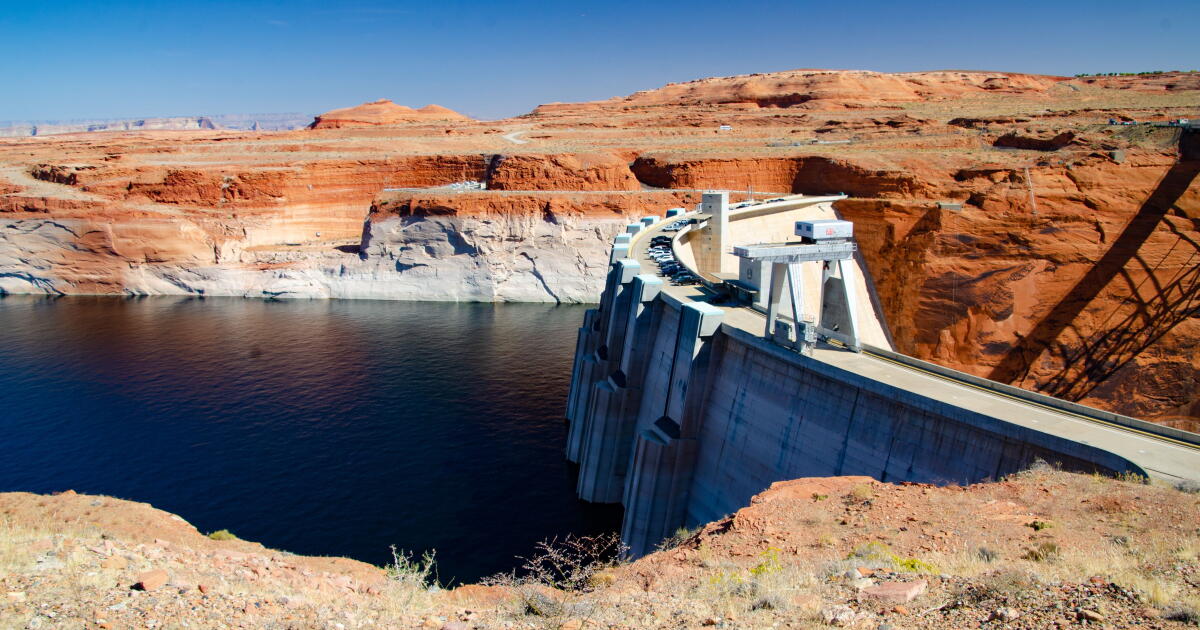
The infrastructure problems at the dam in northern Arizona have come into focus over the last few years. If the levels of Lake Powell continue to decline and reach critically low levels, water could be released only through four 8-foot-wide steel tubes, potentially limiting how much could pass downstream to the three states and Mexico.
Last year, federal officials discovered damage inside those four tubes that could severely restrict water flow when reservoir levels are low, raising risks the Southwest could face major shortages that were previously unforeseen.
“It’s a better situation to have the dam actually function without tripping us up and forcing massive reductions,” said JB Hamby, California’s Colorado River commissioner. Making fixes to Glen Canyon Dam, he said, “would prevent the need for draconian reductions.”
Hamby and officials representing the governors of Arizona and Nevada presented their concerns in a letter to the Trump administration last month.
They urged Secretary of the Interior Doug Burgum to scrap a report the Biden administration released in November outlining options for new water management rules, arguing that it failed to consider their proposals and would violate the 1922 Colorado River Compact, the foundational agreement that apportions the water.
For one thing, they said, the federal Bureau of Reclamation, which manages the river’s dams, “must evaluate the impacts of infrastructure repairs, modifications and enhancements at Glen Canyon Dam” as part of its analysis of options.
The Colorado River provides water for cities from Denver to Los Angeles, 30 Native tribes and farmlands from the Rocky Mountains to northern Mexico. California relies on Colorado River water to supply farmlands in the Imperial Valley and the Coachella Valley, as well as cities from Palm Springs to San Diego.
The river’s water has long been overused and its reservoirs have declined dramatically since 2000. The average flow of the river has shrunk about 20% in that time, and while drought is partly to blame, scientists have estimated that roughly half the decline in flow has been caused by global warming driven by the burning of fossil fuels and rising levels of greenhouse gases.
The water level of Lake Powell, the nation’s second-largest reservoir, now stands at 34% of capacity. The reservoir’s surface is currently 71 feet above a threshold at which water could no longer flow through the dam’s main intakes and would instead have to move through the low-level bypass tubes — called the river outlet works.
The dam’s managers said last year that they had spotted deterioration in these bypass tubes, and federal officials have said they are analyzing options for fixes — but have been doing this on a separate track from the writing of new rules for sharing shortages.
The three states’ representatives said in their Feb. 13 letter that failing to consider these “infrastructure limitations” as part of the new rules would violate the law.
“The prior administration’s approach to protecting the Lake Powell outlet works by reducing releases from Lake Powell — rather than making infrastructure repairs and improvements — is shortsighted,” they wrote. They said this approach would harm the three states “by slashing the water available to our farmers, communities, and economies.”
Lake Powell has shimmered between Glen Canyon’s reddish sandstone walls along the Arizona-Utah border since the dam was completed in the 1960s.
But Glen Canyon Dam has been controversial since its inception, with environmentalists arguing the reservoir was unnecessary and destroyed the canyon’s pristine ecosystem. In recent years, advocates of river restoration have called for reengineering the dam and gradually draining Lake Powell to store the water downstream in Lake Mead near Las Vegas.
Hamby said the dam was “built in not a great way.” He likened it to a defective gas tank in a car that would stop working if it was less than half full.
“You’ve got a couple options. You could either constantly gas up your car or you could just stop driving,” Hamby said. “But a better option is, go get your car fixed.”
The push by California for the federal government to take a different approach is occurring alongside persistent disagreements that have left two camps at an impasse. On one side are the states in the river’s lower basin — California, Arizona and Nevada — which have been deadlocked in negotiations with the states in the river’s upper basin: Colorado, Utah, Wyoming and New Mexico.
Those on both sides say they are willing to continue trying to reach a deal on how to apportion cutbacks in water use after 2026, when the current rules expire.
In their letter, Hamby, Tom Buschatzke of Arizona and John Entsminger of Nevada suggested that the potential water-supply bottleneck at Glen Canyon Dam could be “avoided by some combination of straightforward engineering fixes, moving water to Lake Powell from upstream reservoirs when necessary, and temporary reductions in upper basin use.”
They said they would strongly support a “collaborative, consensus-driven approach,” but they also suggested that without a consensus, ongoing disputes among the Colorado River Basin’s seven states might end in court battles.
In response to questions about the states’ letter, a spokesperson for Bureau of Reclamation said in an email that the agency is “actively engaging in dialogue with the Colorado River Basin partners as we work toward long-term operational agreements for the river after 2026.”
The three states stressed in the letter that the 1922 Colorado River Compact requires the upper basin states to deliver an annual average of 7.5 million acre-feet to California, Arizona and Nevada over any 10-year period. If water deliveries were to decrease below that required minimum, that would enable the lower basin states to make a so-called compact call and require the upper basin states to cut their water usage.
The letter mentioned a potential compact call 23 times. It said this outcome is “reasonably foreseeable” in the coming years if the states don’t reach an agreement, and that the implications must be considered in the federal government’s review of alternatives.
“Ultimately, having a strong federal role to motivate people to come together and come to a compromise is essential,” Hamby said, “in order to get us to a place where we sustainably manage the river and don’t end up in litigation.”
Environmentalists said they agree with California, Arizona and Nevada.
“What the letter really is trying to do is force the Bureau of Reclamation to rebuild those bypass tubes so that they will pass enough water,” said Gary Wockner, executive director of the Colorado nonprofit group Save The World’s Rivers. “There needs to be an infrastructure solution that allows water to get through or around that dam in order for the Colorado River Compact to not be violated.”
During the Biden administration, federal officials said they were studying the possibility of overhauling the dam. They discussed proposals such as penetrating through the dam’s concrete to make new lower-level intakes, or tunneling a shaft around either side of the dam, among other options.
The Bureau of Reclamation announced in September that the agency was spending $8.9 million relining the bypass tubes, where the original coal-tar coating was “showing normal signs of wear and tear” after more than 60 years of use. The agency said this maintenance work, expected to take about a year, will not prevent the risk of additional “cavitation” when reservoir levels are low — which refers to the formation and collapse of air bubbles in flowing water, and which can pit and tear into metal, damaging infrastructure. The agency said it was “working on reducing that risk” by developing interim procedures and carrying out “additional analyses.”
But the three states indicated in their letter they believe the government must do more to address what they see as problems in the dam’s design.
“The reason that they wrote this letter is because they see a very serious water delivery risk at Glen Canyon Dam,” said Eric Balken, executive director of the nonprofit Glen Canyon Institute.
“The writing is on the wall that something has to be done sooner than later,” he said. “If we want to actually fix this river system for the long term, we have to have a thorough debate about how to reengineer Glen Canyon Dam.”



Strip gaming executives can put their best spin on the numbers, but local tourism indicators remain a major concern. Casino operators seeking to draw more people through the door still have much work to do.
The Nevada Gaming Control Board released January gaming numbers Friday. The news was underwhelming. The state gaming win was down 6.6 percent from a year earlier. The Strip took the largest hit, an 11 percent drop. But the gloomy returns were spread throughout Clark County: Downtown Las Vegas was off 5.2 percent, Laughlin suffered a 3.3 percent decline and the Boulder Strip dipped by 7 percent.
For the current fiscal year, gaming tax collections are up a paltry
2.1 percent, below budget projections.
The red flags include more than gaming numbers. Recently released figures for 2025 reveal that visitation to Las Vegas fell nearly 8 percent from 2024, which represented the lowest total since the pandemic in 2021. Traffic at Reid International Airport fell more than 10 percent in December and was down 6 percent for the year. Strip occupancy rates fell 3 percent in 2025.
To be fair, this is not just a Las Vegas problem. International travel to the United States was down
4.8 percent in January, Forbes reported, the ninth straight month of decline. Travel from Europe fell 5.2 percent, and passenger counts from Asia fell 7.5 percent. Canadian tourism cratered by 22 percent.
No doubt that President Donald Trump’s blustery rhetoric has played a role in the decline, but there’s more at work. International tourism has been largely flat since Barack Obama’s last few years in office. But domestic travel has held relatively steady although it is “starting to cool,” according to the U.S. Travel Association. Las Vegas hasn’t been helped by high-profile complaints last year about exorbitant Strip prices for parking, bottled water and other staples. Casino operators responded by offering discounts, particularly for locals, and they’ll need to continue those policies into 2026.
The tourism downturn has ramifications for the state budget, which relies primarily on sales and gaming tax revenues to support spending plans. “Nevada’s employment and economic challenges reflect deep structural factors that extend beyond cyclical economic fluctuations,” noted a recent report by economic analyst John Restrepo. “The state’s extreme concentration in tourism and gaming creates unique vulnerabilities.”
The irony is that state and local politicians have been talking for the past half century about “diversifying” the state economy. In recent years, that effort has primarily consisted of handing out millions in tax breaks and other incentives to attract businesses to the state. A dispassionate observer might ask whether that approach has brought an adequate return on investment.


How to Watch Nevada’s 2026 Lunar Eclipse
A total lunar eclipse will cross Nevada skies early Tuesday morning. Here’s when totality begins and where to watch.
A lunar eclipse will be in Nevada skies late Monday night — or, more accurately, early Tuesday morning, March 3.
The downside is the hour: you’ll have to be up very late or very early, depending on your perspective.
Unlike a solar eclipse, which occurs when the moon passes between the Earth and the sun, a lunar eclipse happens when Earth casts its shadow on the moon, creating a rusty red hue.
If you’re looking to see the lunar eclipse, here’s everything you need to know about viewing it in Nevada.
What eclipse is in 2026?
If you live in the U.S., you will be able to see the lunar eclipse starting at 12:44 a.m. PST Tuesday, March 3, 2026, according to NASA. During the night, you’ll see the moon in a reddish hue, or a blood moon.
Totality lasts for a little more than an hour before the moon begins to emerge from behind Earth’s shadow, according to the popular site timeanddate.com. As the moon moves into Earth’s shadow, also known as the umbra, it appears red-orange or a “ghostly copper color,” hence its name: blood moon, NASA says.
“During a lunar eclipse, the moon appears red or orange because any sunlight that’s not blocked by our planet is filtered through a thick slice of Earth’s atmosphere on its way to the lunar surface,” NASA says. “It’s as if all the world’s sunrises and sunsets are projected onto the moon.”
Countdown clock to the 2026 total lunar eclipse
If you live in the U.S., you will be able to see the eclipse starting at 12:44 a.m. PST Tuesday, March 3, 2026.
The entire eclipse will last about six hours. People in Nevada can see the lunar eclipse during the early morning hours of Tuesday, March 3, 2026. The total lunar eclipse will be visible in North America, South America, Eastern Europe, Asia, Australia and Antarctica.
Everything will be over by 6:23 a.m. PST on March 3, 2026. Below is a countdown clock for the 2026 total lunar eclipse.
Where are the best places to see the lunar eclipse near Reno?
Though the Biggest Little City has an abundance of light pollution, darker skies are less than an hour from Reno.
- Fort Churchill State Park: The park provides a dark night sky ideal for evening astronomical events among the ruins of Fort Churchill. Park entrance costs $5 for Nevada residents and $10 for nonresidents.
- Pyramid Lake: A popular spot for Renoites seeking a night of stargazing, the lake is less than an hour from The Biggest Little City. It offers beautiful natural wonders and dark skies that give a clear view of the lunar eclipse.
- Lake Tahoe: Multiple locations around the lake are excellent for stargazing that are less than an hour from Reno.
- Cold Springs or Hidden Valley still get light pollution from the Biggest Little City, but have clearer skies than the middle of town.
- Driving down the road on USA Parkway will likely also give you the dark skies to see the lunar eclipse without having to make a significant drive outside of town.
Carly Sauvageau with the Reno Gazette Journal contributed to this report.

The United States and Israel launched targeted attacks on Iran on Saturday. The move brought new uncertainty into global energy markets, as northern Nevadans could be paying more at the pump in the coming weeks.
Following the strikes, oil prices increased. Brent crude, the international benchmark, jumped to roughly $73 a barrel, while the national benchmark, West Texas Intermediate, traded above $67.
Much of the concern centers around the Strait of Hormuz, a narrow waterway between Iran and Oman. which carries about a fifth of the world’s oil supplies.
Patrick de Haan, head of petroleum analysis with GasBuddy, a price tracking company, spoke on the current questions in the region.
“The known would reduce oil prices if there becomes clarity, but it’s the unknown that is stoking fears…. If there is some sort of clarity in the days ahead, whether from Iran, the United States, or Israel, on how long this would last. We’d be able to put potentially an end date for the potential impacts that we’re seeing,” said de Haan.
Experts say for every $5 to $10 increase in oil prices, drivers could pay 15 to 25 cents more per gallon.
According to Triple-A, the average price of a gallon of gas in Nevada on Sunday comes in at $3.70, which comes in above the national average of roughly $2.98.
Over at the Rainbow Market on Vassar Street, prices sat just below four dollars a gallon on Sunday. Reno resident Abran Reyes talked about gas prices potentially going up.
“Whether it’s to work, to maybe run errands, to do stuff that helps you, gas is essential…. That gas price really hits, especially in today’s economy, where gas prices are extraordinary…. I just hope everyone’s safe. I hope our soldiers and all of our troops can be okay,” said Reyes.

Millionaire philanthropist allegedly gunned down by worker in female wig; ambushes Maryland trooper: police

War in the Middle East: Iran’s broad retaliation in the Gulf • FRANCE 24 English

Bruce Campbell announces cancer diagnosis; ‘Fear not,’ he tells fans

Vigil held for 2-year-old girl killed in SF Mission Bay crash

Dallas Fed says ‘older, experienced workers’ likely have less cause for concern about AI job displacement

Florida High School Football Rankings: Top 25 teams – Oct. 21

Cleary's 21 help Le Moyne down Central Connecticut State 69-64 in OT

How old is Bo Nix? What to know about Oregon quarterback ahead of 2024 NFL Draft

99th annual Pony Swim held in Virginia

Indiana Members Credit Union announced as new anchor tenant at Bottleworks District
War in the Middle East: Iran’s broad retaliation in the Gulf • FRANCE 24 English

Trump sends official notification to Congress on strikes against Iran

Unexpected birth brings hope to near-extinct Amazon tribe

Supreme Court blocks redrawing of New York congressional map, dealing a win for GOP

Map: Earthquake Shakes Central California
-

 World5 days ago
Exclusive: DeepSeek withholds latest AI model from US chipmakers including Nvidia, sources say
-

 Massachusetts6 days ago
Mother and daughter injured in Taunton house explosion
-

 Denver, CO6 days ago
10 acres charred, 5 injured in Thornton grass fire, evacuation orders lifted
-

 Louisiana1 week ago
Wildfire near Gum Swamp Road in Livingston Parish now under control; more than 200 acres burned
-

 Politics1 week ago
OpenAI didn’t contact police despite employees flagging mass shooter’s concerning chatbot interactions: REPORT
-

 Technology1 week ago
Stellantis is in a crisis of its own making
-

 Oregon4 days ago
2026 OSAA Oregon Wrestling State Championship Results And Brackets – FloWrestling
-

 Technology1 week ago
Arturia’s FX Collection 6 adds two new effects and a $99 intro version