West
More blue cities using drones instead of police for some 911 calls, expert says: 'They can't get cops'

Quick, efficient and with a bird’s eye view of any scene, more police departments are embracing the use of drones to carry out law enforcement work, with some blue cities now even using them to respond to 911 calls.
Around 1,500 police departments across the country are currently using drones in some form, according to a report by the Electronic Frontier Foundation, a digital privacy group, with agencies deploying the technology for crowd control purposes, missing people searches, tracking fleeing suspects or mapping crime scenes.
Steep budget cuts and dwindling staff numbers in blue cities, in particular, make drones both an effective and cost-saving tool for police in Democratic strongholds.
COLORADO POLICE PLAN TO USE DRONES AS FIRST RESPONDERS, CALLING THE TECHNOLOGY ‘FUTURE OF LAW ENFORCEMENT’
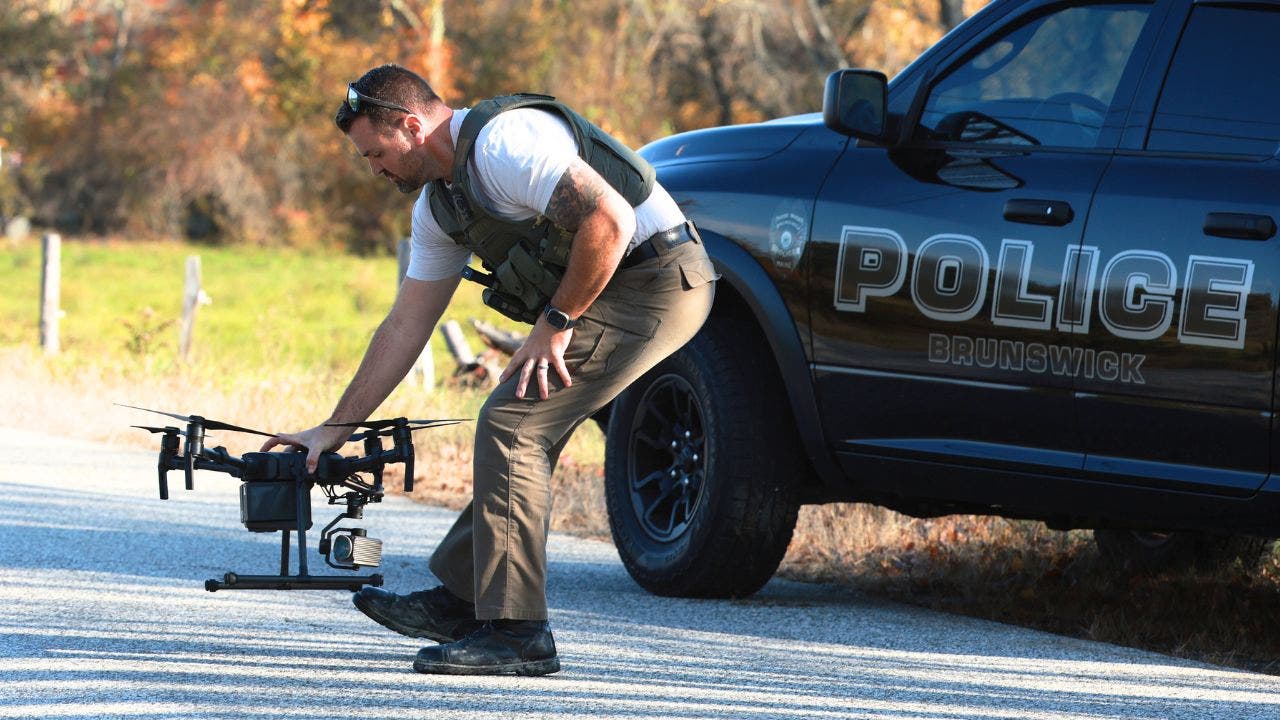
A law enforcement official sets up a drone during a manhunt for suspect Robert Card following a mass shooting on Oct. 27, 2023, in Monmouth, Maine. (Joe Raedle/Getty Images)
Today’s police drones are much bigger than regular drones commonly used for recreational purposes, with much longer battery lives and features such as thermal sensors, loudspeakers, spotlights or beacons.
Several law enforcement agencies in Colorado, including the Denver Police Department, which has seen cuts due to its migrant crisis, are making plans to start dispatching drones instead of officers to respond to 911 calls and at least 20 agencies in Colorado’s Front Range already use drone technology for certain tasks.
The city of Chula Vista, California, was one of the first cities to use drones for 911 calls and has deployed unmanned aircraft nearly 20,000 times since 2018 to respond to emergency incidents such as crimes in progress, fires, traffic accidents and reports of dangerous subjects.
The use of the technology meant that in nearly 4,300 of those cases, officers were not physically required to respond to a location as the situation was properly assessed from a control room. Police in Beverly Hills, Santa Monica, Burbank, Fremont and Hawthorne as well as the Los Angeles County Sheriff’s Department also use the innovative technology in the state.
“Some of the cities that are rolling them out are rolling them out because they have no choice, because they can’t get cops to take the job.”
Last year, Chicago lawmakers passed a bill that allows police to use drones during special events like parades, walks, races but not during protests or demonstrations.
Elsewhere, the NYPD told Fox News Digital that it is rolling out drones to respond to possible 911 calls of shootings in the Big Apple.
“Some of the cities that are rolling them out are rolling them out because they have no choice, because they can’t get cops to take the job,” former NYPD inspector Paul Mauro told Fox News Digital. The NYPD saw an exodus of police in the wake of the defund the police movements, progressive policing reforms and anti-cop rhetoric sparked by the killing of George Floyd in 2020.
“And I think now a lot of cities, blue cities in particular, are starting to realize, well, we’ve thrown the baby out with the bathwater. We need cops. You see it in places like Seattle where they had the CHOPS (Capitol Hill Organized Protest), where they had these police no-go zones and people died. There were murders and all kinds of robberies, so there’s a realization that, OK, we do need policing. The use of technology has always been part of policing.”
“But at the end of the day it’s helpful, and it will potentially take some weight off of police because a drone can get there quickly – especially in a congested area like Manhattan – it can tell you what’s going on and how many cops [you need]. Is it an emergency? Is it a verified shooting? Is somebody bleeding out in the street?”
BEVERLY HILLS POLICE DRONE CATCHES BURGLARY SUSPECT FALL OFF LADDER INTO POOL
More blue city police departments are embracing the use of drones to carry out police work, with some cities now even using them to respond to 911 calls. (Wally Skalij/Los Angeles Times via Getty Images)
Maryland has also witnessed progressive laws to reform policing and the Montgomery County Police Department (MPD) began rolling out its “Drone as First Responder” (DFR) program in October in the wake of rising crime and a staff vacancy rate of 43%, according to police officials.
Since October, the drone system has been deployed over 850 times with an average response time of just under 49 seconds, according to police data.
The system was used mostly for theft, about 33% of the time, with reports of suspicious persons next on the list accounting for 15% of responses. Police say the deployment of drones meant that patrol units were not needed in over 120 instances.
The MPD has hailed the system for apprehending criminal suspects and allowing the agency to be more efficient with police resources by providing real-time information to ground officers.
Meanwhile, the NYPD’s new drone program is being piloted to supplement its gunshot detection system known as ShotSpotter, which alerts police to a possible shooting. Under the new drone system, five police precincts are being trialed to have drones immediately deployed to the scene when such an alert goes off. The five precincts include three in Brooklyn, one in the Bronx, and one in Manhattan at the Central Park Precinct.
A drone pilot remotely based in the NYPD’s Joint Operations Center in Lower Manhattan activates a drone to fly to the location of the gunfire, an NYPD spokesperson told Fox Digital.
“Prior to police officers’ arrival on the scene, officers will see what the drone sees in real time via their smartphones,” the spokesperson said. “This emerging technology stands to enhance situational awareness as officers arrive at scenes, promote officer safety, and help NYPD leadership deploy resources in an effective and efficient manner.”
Springfield police officer Tony Del Castillo takes out a new drone for a test flight at the city fuel depot in Springfield, Oregon. (Imagn)
Drone technology is developing at a rapid rate with Amazon already using it to deliver packages to customers.
BRINC, a Seattle-based drone company, has launched a purpose-built 911 response drone that can deliver life-saving medical supplies to a scene, such as EpiPens, defibrillators, personal floatation devices (PFDs) and naloxone (Narcan), as well as assessing low-priority calls without the need to dispatch personnel.
“Undeniably, they are an assist,” Mauro said of police drones. “It’s a force multiplier in departments that just can’t get enough people to cover the ground. In dense urban areas, the drones can get there faster, and very rural areas where it could take a cop 20 minutes to get to the accident site or the scene of the call, a drone can get there very quickly and let you know what you’re getting into.”
However, Mauro said that deploying police drones opens up a host of other issues, including privacy and civil rights concerns. In a report last year, the American Civil Liberties Union (ACLU) recommended guardrails be put in place to make sure the technology does not “evolve into much broader surveillance programs.”
The report states that police departments should not be able to roll out surveillance technologies without the consent of the community it serves.
“Good policies, including on usage limits, transparency, and privacy, should not be left up to police departments, but should be given legal force by a city council or other legislative body as part of a vote to approve a DFR program.”
The American Civil Liberties Union has raised privacy and surveillance concerns about the technology. (KAREN BLEIER/AFP via Getty Images)
The ACLU has called for strict privacy rules, usage limits for where drones can be deployed and for police to provide clear information about where and when surveillance drones are being operated.
Mauro said police departments need to figure out how to properly manage public requests, the man hours fetching that type of information might take, and what footage needs to be saved or deleted. He said the same issues came to the fore with the rollout of police body cameras.
“The police departments are going to be a blizzard with subpoenas for that footage,” Mauro said regarding drones.
“And I think the real key … is that there has to be significant human interaction with the drone. The drone has to be very subordinate to somebody who’s controlling it, it has to be police in real time watching what’s going on and making decisions and controlling the drone.”
“So look, there are a lot of issues relative to electronic surveillance that go beyond drones, and when you’re talking about a government that implicates the Constitution and the Bill of Rights, and so that makes things that much more volatile and complicated. It’s just something that has to be watched very closely.”
Read the full article from Here


A vegetation fire was burning in northern Napa County Monday afternoon northeast of Angwin.
Cal Fire said the Hardin Fire began at about 2:40 p.m. in the area of Hardin Road and Pope Canyon Road, east of Chiles Pope Valley Road.
The fire had burned 55 acres as of 3 p.m.
A status report at 3:45 p.m. said that crews were making good progress on the fire and that there were no evacuation orders at this time.
As of 5:10 p.m. forward progress of the fire had been stopped, and containment was at 35%.
The cause was under investigation.
Denver, CO
Denver Country Club caddie earns full-ride Evans Scholarship, becomes first in family to attend college

DENVER — What started as a summer job has turned into a life-changing opportunity for Denver-area student Vanessa Olivar.
The 18-year-old Denver Country Club caddie has earned the prestigious Evans Scholarship, a full tuition and housing scholarship awarded by the Western Golf Association to caddies who demonstrate strong character, academic achievement, financial need and a strong caddie record.
Watch Bradey King’s story on how Olivar persevered to nab this scholarship in the video below.
Denver Country Club caddie earns full-ride Evans Scholarship
Olivar is one of 15 students from Colorado to receive the scholarship this year and will attend the University of Colorado Boulder this fall.
When she first heard about caddying through her high school’s assistant principal, Olivar said she wasn’t sure it was the right fit.
“I didn’t know anything about the game of golf,” she said. “At first, I was a little doubtful and nervous, but I thought it would be a great summer job. I quickly found out that it was more than just carrying a golfer’s bag.”
Over the past three years, Olivar learned the responsibilities that come with the job, from carrying clubs and providing yardages to building relationships with members and fellow caddies.
“I learned a strong work ethic, and the relationships that I built through caddying have really shaped who I am today,” she said.
Her dedication paid off when she received the news that she had earned the Evans Scholarship.
“I got that flag saying, ‘Congratulations,’ and I was so excited,” Olivar said. “Words couldn’t express how excited my family and I were for this great opportunity that I worked so hard for over three years.”
The scholarship carries even greater significance because Olivar will become the first person in her family to attend college.
“I’m a first-generation college student,” she said. “Coming from immigrant parents, I kind of had to navigate this world by myself.”
Her parents immigrated to the United States when they were 18, and Olivar said their sacrifices inspired her to pursue higher education.
“Being able to tell my parents they don’t have to pay for my college takes that weight off their shoulders, but also mine,” she said.
Western Golf Association officials say Olivar exemplifies the qualities the Evans Scholarship is designed to recognize.
“The scholarship is based upon four principles: Their caddie record, their academic record, their financial need, but really what’s most important is their character,” said Brian Wilkinson, the Western Golf Association Director at Denver Country Club. “Vanessa expresses the great character and leadership that we’re looking for in young women and men.”
At CU Boulder, Olivar plans to major in public health with a minor in business before pursuing dental school.
She said the opportunity has changed the trajectory of her future.
“I knew I wanted to go to college, and I wanted to have a further education,” Olivar said. “I just didn’t know how I was going to do that. I didn’t know caddying was eventually going to change that for me. It’s a scholarship that has changed my life forever.
Denver7
Denver7 | Your Voice: Get in touch with Bradey King
Denver7’s Bradey King reports on the entire sports landscape in Colorado, including Denver’s pro teams, but is always looking for stories off the field and in the non-professional ranks. If you’d like to get in touch with Bradey, fill out the form below to send her an email.

You easily could have missed it amid all of the attention around this year’s tournament, but in late December FIFA revealed the bids that they received from federations to host the 2031 and 2035 Women’s World Cups. The sole bid for 2031 was a joint proposal from the United States, Mexico, Costa Rica and Jamaica. Although a formal vote still needs to take place to approve the bid, this all but assures the USA of hosting the women’s tournament for the first time since 2003.
As part of the bid, 20 potential host cities were profiled, including Seattle, which was lauded for its long history with women’s soccer and support for collegiate and professional women’s sports.
Local organizers from the 2026 men’s World Cup have already started publicly talking about bringing the women’s tournament here, too.
Here’s what you need to know:
Seattle in strong position to be a 2031 Women’s World Cup host
Seattle is one of 20 U.S. cities profiled in joint bid with Mexico, Costa Rica and Jamaica.
Is the 2031 Women’s World Cup really coming to the United States?
While it’s not official until the FIFA Congress meets in November and votes on the bids, it appears to be a fait accompli at this point. With the tournament growing to 48 teams in 2031 and FIFA desiring to cycle each edition between different continents, no other bids were received for 2031. Similarly, a joint UK/Ireland bid is the sole proposal for 2035 and is expected to be approved at the same FIFA Congress meeting.
However, the vote was originally scheduled to occur at a FIFA meeting in April, but had to be delayed after the Trump administration refused to sign off on required guarantees while attempting to pressure FIFA and U.S. Soccer to adopt draconian anti-transgender athlete policies. Whether either side budges before November remains to be seen.
Why was Canada not included in this bid, unlike the 2026 Men’s World Cup?
Having recently hosted the 2015 Women’s World Cup on their own, Canada Soccer felt that the Concacaf bid would be received more favorably without their involvement, which opened the door to the USA and Mexico inviting smaller Concacaf nations to join them.
What does it mean that Seattle was profiled in the bid book?
The overall proposal lists 35 potential host cities and 49 venues, with a subset of 20 profiled more in-depth. Some of this likely reflects the reuse of content which was already available from the 2026 men’s World Cup bid book, and let’s be honest – it’s a lot easier to hype up the metronatural wonders of Seattle than somewhere like Birmingham or Salt Lake City.
The venues that are profiled were selected to represent “the diversity in geography, scale, and infrastructure readiness”, but all 49 venues will be given equal consideration when it comes time for FIFA to select host cities.

Why is Portland not in the bid?
That’s a good question! The minimum venue size for the women’s tournament is 20,000 and a number of stadiums of similar size to Providence Park are included. I expect that many of the smaller venues will be weeded out during the review process because FIFA wants that sweet, sweet ticket revenue, so perhaps they knew they’d be overshadowed by us.
How likely is Seattle to be selected?
The odds are good! For broadcast purposes, the tournament organizers will want to spread games across time zones and there are only a few West Coast cities in the proposal – Seattle, San Francisco/Bay Area, Los Angeles, and San Diego. Seattle also benefits from being geographically distinct, offering the potential to draw fans from the wider Pacific Northwest area, especially if Canada plays any games at Lumen Field. The rave reviews the stadium and city just received during the 2026 men’s tournament are also going to be a big net positive during the selection process.
Previous Women’s World Cup tournaments have typically included 6 to 10 host cities, but with the event doubling in size from 2019 (when 9 cities were chosen for 24 teams) and global media wanting matches spread out in more timeslots, there will be a need for more venues than ever before. The 2026 Men’s World Cup serves as a model, with 16 host cities for that 48-team tournament. Costa Rica and Jamaica will each have one venue and Mexico has six potential host cities, meaning the US will likely have at least eight host cities, if not more. It is also unlikely that multiple cities in close proximity would be selected – for example, no more than one of the three Florida candidates would likely be selected, if any; and likewise only one of Baltimore or Washington, D.C.
What will the atmosphere be like?
Much of what you’ve witnessed for the 2026 tournament will also feature in 2031. All of the fields will have natural grass surfaces. Host cities will have dedicated fan zones with supporting programming and watch parties, bars will host events, and you can expect a lot of traveling support bringing their own culture and stadium traditions to games.
Will this be another wild goose chase to get overpriced tickets?
Historically, the Women’s World Cup has been significantly more affordable and accessible than the men’s tournament. For example, packages with a ticket to both semifinals and the final in 2019 in France started at €50 (about US$60), and tickets to the 2023 final in Australia started at AUD $40 (about US$28), while group-stage games were even less expensive. The past five women’s finals have sold out, but there was ample time to get tickets in the lead-up to the games without submitting to a lottery to win a chance to wait in a second queue a month later for the possibility of buying a ticket that’s more expensive than your mortgage payment.
But the sport is growing quickly, with a huge influx of money and more sponsor and media attention around the globe, and more federations finally getting serious about investment and promotion for their women’s sides. The experience and demand in 2031 might look completely different from 2023. That said, even with higher demand and price inflation, tickets should not be remotely near the eye-watering dynamic prices being charged for the 2026 tournament, nor as difficult to obtain.
When will we know if Seattle is selected?
The first step won’t come until after the bid is formally approved this winter. Then there will likely be several rounds of review, with some candidate venues dropped after each round. The final venues for 2026 were selected about four years in advance, which means we might get an indication of Seattle’s status in late 2027. Until then, one of the biggest things you can do to help the cause is to continue showing up to other women’s soccer games happening in Seattle.
-

 Detroit, MI17 minutes ago
Brother Nature at Night: Jack’s backyard & kayaking the Huron River
-

 San Francisco, CA29 minutes ago
Hardin Fire in Napa County burns 55 acres near Pope Valley
-

 Dallas, TX35 minutes ago
Former Dallas ISD Superintendent Michael Hinojosa runs for Dallas Mayor
-

 Miami, FL41 minutes ago
South Florida mother arrested for leaving daughter chained to fence, police say
-

 Boston, MA47 minutes ago
Boston man charged after allegedly assaulting Burger King employee, punching customer
-
Denver, CO53 minutes ago
Denver Country Club caddie earns full-ride Evans Scholarship, becomes first in family to attend college
-

 Seattle, WA59 minutes ago
Seattle very much in running for another World Cup
-

 San Diego, CA1 hour ago
“Attack of the Killer Tomatoes” After Party for San Diego Comic-Con 2026

