Montana
University of Montana president job draws high interest • Daily Montanan


The search for a new University of Montana president has drawn more than 60 applicants, according to a spokesperson for the Office of the Commissioner of Higher Education.
“We do not have an exact count at this time, as several applications are still being completed and additional submissions are expected,” said spokesperson and Deputy Commissioner Galen Hollenbaugh in an email earlier this week.
In January, then-UM-President Seth Bodnar announced his resignation to pursue other public service. Wednesday, the final day of filing, he announced he was running as an independent for the U.S. Senate to try to unseat Republican incumbent Steve Daines.
Commissioner of Higher Education Clayton Christian earlier said that with the advice of AGB Search, a firm that’s helped the Montana University System conduct other executive searches, he would undertake an expedited process to appoint a new president.
Christian has been providing brief updates on a website dedicated to the search. Last week, he said he and AGB Search are reviewing applications, and the pool of candidates was “strong and diverse.”
The commissioner also announced he was convening a small working group to assist in the search, members who “represent a variety of perspectives to assist in vetting and narrowing this field of exceptional candidates.”
In an email this week, Hollenbaugh identified the members of the working group who are assisting Christian with application review as:
- Community member and former Regent Joyce Dombrouski
- Faculty Senate Chairperson Valerie Moody
- Staff Senate President Dominic Beccari
- Administration Representative John DeBoer (Vice President of Academic Affairs)
- ASUM (Associated Students of the University of Montana) President Buddy Wilson
Hollenbaugh declined to comment on the way the rest of the process would unfold or the role the working group members would play.
Christian earlier said he anticipated an appointment within one to three months, or as soon as early this month.



Independent U.S. Senate candidate Seth Bodnar is betting that Montana’s deeply rooted independent streak can propel him to Washington, launching a campaign that takes direct aim at what he calls a “dysfunctional” and “corrupt” two-party system dividing the country.
“National political leaders are not working to quell the fires of division in this country…They’re bringing that gasoline, they’re pouring it on that fire of division, they’re doing it deliberately, [and] they’re going it strategically,” the Senate hopeful told Newsweek in a Thursday interview. “An angry and a divided electorate is easier to control than an informed and a united electorate.”
The former Green Beret, Rhodes Scholar and University of Montana president, is attempting to assemble a coalition that has generally proved elusive in modern American politics: enough Democrats, Republicans and unaffiliated voters to win statewide while firmly rejecting the label of either major party.
Signaling that effort to cross the political divide, Bodnar touts his positions as keeping government at arm’s length from Montanans’ private lives and personal decisions. “The government has no business in our bedrooms, has no businesses in our doctor’s office, [and] no business at our gun cabinets either,” he said.
Despite support from prominent Montana Republicans and Democrats, as well as a significant fundraising advantage, the first polls of the general election suggest he still has a long way to go—and that his biggest obstacle may not be the Republican leading the race but the Democrat standing between them.
Bodnar rejects warnings that his candidacy could divide opposition to Republican nominee Kurt Alme and make it easier for the GOP to retain the open seat. “We’re not splitting any tickets, any votes,” he said. “What we’re doing is we’re building a coalition. We’re not splitting, we’re additive.”
Polls Show a Divided Opposition and a Republican Advantage
That argument is now confronting a difficult test.
Two public post-primary surveys have shown Alme ahead, with Democratic nominee Alani Bankhead in second place and Bodnar third. The results indicate that Bankhead continues to command most Democratic voters despite being dramatically outraised by Bodnar and despite prominent former Democratic officials throwing their support behind the independent.
The central question hanging over the contest is whether Bodnar can alter that alignment—or whether the divided field will allow Alme to win with a plurality, or even a slim majority.
A GrayHouse poll conducted June 23 and 24 found Alme at 41 percent, Bankhead at 25 percent and Bodnar at 17 percent. Libertarian Kyle Austin received 3 percent. Republican-sponsored polling from Public Opinion Strategies conducted from June 8 to 11 placed Alme at 44 percent, Bankhead at 25 percent and Bodnar at 20 percent. Prior to the primary, Tavern Research, found Alme at 49 percent, Bankhead at 26 percent and Bodnar at 24 percent.
The polls differ over Bodnar’s precise standing, but all point to the same immediate problem: Bankhead and Bodnar are splitting the voters most open to defeating the Republican. However, one bright spot for the independent was in the Tavern Research survey, which showed him tied with Alme at 50 percent in a hypothetical head-to-head race, while Alme led Bankhead 56 percent to 44 percent. But voters will not be choosing between two candidates unless the field changes.
Bankhead led Bodnar among Democrats by 60 percent to 28 percent in the GrayHouse survey and 59 percent to 32 percent in the Public Opinion Strategies poll. Tavern Research found an even wider divide, with Bankhead taking 78 percent of Democratic voters and Bodnar 20 percent.
The GrayHouse survey also showed that Bodnar led among self-identified independents with 30 percent, compared with 27 percent for Bankhead and 22 percent for Alme. But that fragmentation also illustrates his predicament; winning a plurality of independents is not enough if he cannot substantially consolidate Democrats while peeling away Republicans.
Bodnar disputed the idea that party affiliation will ultimately determine the contest. He said Montanans have repeatedly told him they are dissatisfied with their own party but even more hostile toward the alternative.
“I’ve had a lot of both Republicans and Democrats that have said something to the effect, ‘I hate my party, but I hate the other party a little bit more, and I’m glad that you’re giving me another option,’” he said.
The numbers nevertheless leave Republicans favored. Inside Elections moved the race from “Likely Republican” to “Solid Republican” after Bankhead vowed to remain in the contest. Its analysis concluded that Bodnar’s route was “severely limited” while a Democratic nominee continued drawing roughly a quarter of the vote. Similarly, Cook Political Report classifies the race as “solid Republican,” estimating the race a partisan voting index of R+10.
Bankhead Rejects Calls for Democrats to Clear the Field
Bankhead, an Air Force veteran and leadership consultant, emerged from a crowded Democratic primary after entering the final stretch with little money or statewide organization.
Her victory was aided by approximately $2.5 million in spending from a group that favored Bodnar and sought to prevent former state Representative Reilly Neill—an outspoken critic of the independent strategy—from winning the nomination. The apparent calculation was that Bankhead might be more willing than Neill to withdraw after the primary.
Bankhead has rejected that assumption. She has said she intends to remain the nominee and has instead called on Bodnar to leave the race and support her. Bodnar, however, said his campaign is not directed against Montana Democrats or Republicans.
“I’m running not against Montana Democrats or Montana Republicans,” he said. “I’m running against a dysfunctional, corrupt national system that’s left Montanans of both parties behind.”
He described the national parties as organizations that force senators to “put on a jersey” and prioritize their political team over their state.
Montana Republicans have seized on his Democratic support to argue the independent label is a disguise. Bodnar is backed by former Democratic senators Jon Tester and Max Baucus, and members of Tester’s former political operation are working on his campaign. He has also received donations through ActBlue, the fundraising platform used overwhelmingly by Democratic candidates and organizations.
Republicans have consequently labeled him “independent in name only,” portraying his campaign as an effort to escape the damaged Democratic brand while preserving its political coalition.
Bodnar counters that his endorsements cross ideological lines. His supporters include Marc Racicot, the former Republican governor who chaired the Republican National Committee (RNC) and President George W. Bush’s 2004 reelection campaign.
“We have two former heads of the Democratic Party that support this campaign, a former head of the Republican Party that supports this campaign,” Bodnar said, referring to prominent former party leaders supporting him. Adam Kinzinger, the former Republican congressman turned prominent Trump critic, has publicly endorsed Bodnar as well.
Tester, for his part, has argued the national Democratic brand became “poison” to his Montana campaigns and has encouraged Democrats to support Bodnar. Former Montana Democratic Party chair Nancy Keenan similarly wrote after the primary that there was no viable Democratic path to victory.
That assessment has angered some Democrats who believe party leaders and donors effectively abandoned the eventual nominee before voters had their say.

Bodnar Leads the Race for Campaign Cash
Bodnar’s strongest evidence that his candidacy is more than a protest campaign is his fundraising.
He had raised more than $2.1 million by mid-May, compared with approximately $1.2 million for Alme. Inside Elections reported that Bodnar had raised more than the other candidates combined, while Montana Free Press found he was the second-best-funded independent congressional candidate nationally, behind only Nebraska Senate candidate Dan Osborn.
Bankhead, by contrast, raised only about $17,000 through the middle of May before outside spending helped propel her through the primary. Her limited fundraising and organization raise doubts about whether she can mount a competitive statewide general-election campaign, even while polls show her ahead of Bodnar.
Bodnar said nearly 30,000 Montanans signed petitions supporting his ballot access and that more Montana residents donated to his campaign than to all his rivals combined, including during the primaries.
“We’re building a strong coalition to win in November,” he said.
His campaign’s financial advantage gives him an opportunity to introduce himself to Democratic voters who may currently default to Bankhead because she carries the party label. It could also allow him to target moderate Republicans dissatisfied with the status quo amid rising costs and other economic difficulties hitting Montana.
Daines’ Last-Minute Exit Reshaped the Race
The race became unexpectedly open in March when Republican Senator Steve Daines withdrew just before Montana’s filing deadline. Alme, a former U.S. attorney and Daines ally, filed shortly before the deadline closed. Daines then withdrew and endorsed him, leaving potential Republican rivals no time to enter.
The maneuver was criticized as an attempt to handpick a successor and shield Alme from a serious primary challenge. Even the Montana Republican Party declined to endorse in federal primaries and emphasized its support for a competitive process in which voters select their preferred candidates.
Alme nevertheless secured immediate backing from President Donald Trump, Daines, GOP Senator Tim Sheehy and Governor Greg Gianforte. He went on to win the Republican nomination and begins the general election as the favorite in a state Trump carried with 58 percent in 2024.
Recognizing the state’s current GOP-lean, Bodnar said he could cooperate with Trump and Republicans on border security, immigration reform and prescription drug prices. But he criticized the administration’s tariff policies and Iran war, arguing both have increased costs for Montana farmers and ranchers.
“I think this ever-changing tariff regime has been nonsensical,” he said. “I think it’s crushing Montana farmers.”
He also called the war “a strategic failure” and said higher diesel and fertilizer costs were placing additional pressure on agricultural producers.
Can an Independent Actually Win in Montana?
Recent history offers Bodnar encouragement and warning.
Osborn, an independent, received 46.5 percent against Republican Senator Deb Fischer in Nebraska in 2024, producing the state’s closest Senate race in 24 years. Democrats did not field a candidate, allowing Osborn to consolidate nearly all voters opposed to Fischer.
Evan McMullin followed a similar strategy against Republican Senator Mike Lee in Utah in 2022. Utah Democrats backed McMullin rather than nominate their own candidate, creating a direct Republican-versus-independent contest. McMullin still lost but made a normally uncompetitive state more closely contested.
Montana is different because Bankhead remains on the ballot. At the same time, the state has elected Democrats statewide as recently as 2018 for the Senate and 2016 for governor.
But Montana’s movement toward Republicans has been pronounced. Tester lost his 2024 reelection campaign to Sheehy by approximately 43,000 votes. Four years earlier, former Democratic Governor Steve Bullock lost a Senate challenge to Daines by more than 61,000 votes. Trump carried the state in 2016, 2020 and 2024—carrying a margin of about 20 points in the most recent presidential election.
Bodnar also faces an institutional question if he wins. Unlike independent Senators Bernie Sanders of Vermont and Angus King of Maine, who caucus with Democrats, Bodnar says he will not caucus with either party. That could complicate committee assignments, and analysts say it could reduce his effectiveness in the Senate.
Bodnar dismissed these concerns, saying he can negotiate for committee positions like any other senator. He argued that a closely divided chamber would enhance, rather than diminish, his influence.
“One independent voice has a lot of impact, has a lot of sway,” he said.
For now, however, his immediate challenge is not navigating the Senate. It is persuading Montanans that rejecting both parties is a viable governing strategy rather than a recipe for electing the Republican nominee.
“There’s an old saying: You can only ride for one brand,” Bodnar said. “I have one boss and one boss only, the people of this great state.”
Whether enough voters adopt that view—or whether Democrats ultimately consolidate around their nominee—will determine if Bodnar’s campaign becomes a breakthrough for independent politics or another example of how a divided opposition can strengthen the party already favored to win.

Newsweek‘s Q&A with Seth Bodnar on Montana Senate run
Your background includes military service, business leadership and leading the University of Montana. What best prepared you to serve in the Senate?
It’s really a combination of all three. The thing I’ve learned in each of those experiences is the importance of serving the people you’re leading. When you’re a military officer, you learn on day one that leaders eat last. If it’s time to eat and we run out of food, guess who doesn’t eat? The leader.
Similarly, at the University of Montana, my job was to support our faculty, staff and students in serving the state. My job was to enable other people to reach their full potential.
That’s the model of leadership we need in the U.S. Senate today—a model that places service before self. One of the challenges right now is that we have elected leaders who are focused on dividing us, distracting us and engaging in toxic partisan warfare while they enrich themselves. Nothing gets better for the people they’re supposed to be serving.
Why are you running as an independent?
I’m not running against Montana Democrats or Montana Republicans. I’m running against a dysfunctional, corrupt national system that’s left Montanans of both parties behind.
I think Montana needs a U.S. senator who answers to the people of this great state, not to a party leader in Washington. Most senators go to D.C., put on a jersey—a blue one with a D or a red one with an R—and that becomes the team they fight for. They do what their party tells them, whether it’s good for their state or not. Montana deserves a senator who does what’s right for this state, whether the party likes it or not.
Why do you think independent candidates are gaining traction across the country this year?
I think you see an American populace that is fed up with a system that’s not working for them. We see national political leaders who aren’t working to quell the fires of division in this country—they’re bringing the gasoline. They’re pouring it on that fire deliberately because an angry and divided electorate is easier to control than an informed and united electorate.
Americans are fed up. They’re fed up with housing costs that are out of control, with prices for gas and groceries soaring. They’re fed up with leaders who are going to Washington to enrich themselves, participating in insider trading and prediction markets. The lack of ethics and rampant corruption in Washington is enabled by a system that requires blind loyalty to your party and doesn’t hold leaders accountable.
Nearly half of Americans now identify as independents. When the majority of Americans don’t like either option they’re being given, that’s a market failure. We need more independent leadership, more options and more competition to drive better accountability in government.
What are the biggest issues facing Montana voters?
People are worried about whether they can still afford the Montana way of life. If you’re willing to show up and work hard, you ought to be able to afford to put a roof over your head. Many Montanans are struggling to find housing, and housing costs have soared more than 50 percent over the last five years.
They’re worried about healthcare. Rural hospitals are in crisis, and Medicaid changes are likely to result in about 30,000 Montanans losing their health care over the next year.
They’re concerned about public education. Some of our schools face teacher shortages of 30 to 40 percent. They also care deeply about protecting our public lands, which are our common ground—where everybody can hunt, fish and recreate.
In the Senate, I’d work to expand housing, protect rural hospitals, invest in public education and safeguard our public lands.
National issues like immigration and the conflict with Iran have become major campaign issues. Are they affecting Montana?
Absolutely. The war in Iran has been a tremendous foreign policy blunder, and it has driven up prices tremendously for Montana farmers and ranchers. Urea, which is a key component of fertilizer, has risen dramatically. Diesel prices have also gone up sharply. Those are input costs that make it harder and harder for family farmers and ranchers to make ends meet.
Farm bankruptcies last year were up 46 percent from the previous year, largely because nonsensical tariffs crushed export markets that took decades to build. Now you layer these huge spikes in costs on top of that, and we’re making it really hard for agricultural producers to succeed. We haven’t passed a Farm Bill since 2018.
Former Senator Jon Tester has endorsed you, but that’s also drawn criticism from some Democrats. What do you think people misunderstand about your campaign?
I don’t want to speak for Senator Tester, but I’m deeply grateful for his support. So is former Senator Max Baucus. So is former Republican Governor Marc Racicot. We have leaders from both parties supporting this campaign because they recognize the same problem I do—that a large number of Montanans aren’t well served by the current two-party system.
Montana Democrats deserve better than they’re getting from the national Democratic Party, and Montana Republicans deserve better than they’re getting from the national Republican Party. Montanans deserve an independent senator who works for them.
Democrats call you a spoiler. Republicans say you’re really a Democrat. What’s your response?
When you run an independent campaign, people call you a vote splitter or a spoiler. I’ll be frank with you—the toxic partisanship of the two-party system, that’s what’s spoiling this country.
We’re not splitting any votes. We’re building a coalition. We’re not splitting—we’re additive. We’re bringing together Democrats, Republicans, independents, Libertarians, Green Party members and people who believe there’s a better way. Independent is now the largest voting bloc in Montana, yet they haven’t really had an opportunity to vote for someone who represents them.
We’ve outraised everybody else in the race combined. More Montanans have donated to this campaign than all the other candidates combined, including in the primary. Nearly 30,000 Montanans signed their own personal declaration of independence from a broken political system that’s not working for them. We’re building a strong coalition to win in November.
You’ve said you won’t caucus with either party. Can an independent really be effective in today’s Senate?
You don’t have to go to lunch with either of these parties to still get committee assignments. I plan to negotiate the same way every other senator does.
In a very evenly divided Senate, one independent voice has a lot of impact and a lot of sway. I intend to work with other independent-minded senators to move common-sense legislation forward. The Senate is in desperate need of people who are willing to work across the aisle, who don’t believe either party has a monopoly on good ideas and who have the spine to stand up to either party when it puts forward things that don’t make sense.
Where would you work with President Trump—and where would you oppose him?
I think there are things we can work on together. I agree we need strong borders, but we also need comprehensive immigration reform with faster pathways for people to be here legally. We need to address skyrocketing prescription drug prices and healthcare costs.
What we need are folks who go to Congress who are actually looking for common ground. Our citizens aren’t looking for leaders whose sole focus is turning the guns on the other party. We need leaders who can band us together, turn the guns outward and help this country compete and win.
Where I’d disagree is on the ever-changing tariff regime, which has been crushing Montana farmers, and on the war in Iran, which I believe has been a strategic failure.
Where do you think you’ll frustrate both parties?
I want to work with both parties on housing, education and helping this country compete globally. But there are hard issues that neither party is addressing. The national debt is one of them. We now pay more in interest on the national debt than we do on national defense.
We need leaders in Congress who are willing to lean into those hard challenges, lock arms and build consensus to start addressing them.
If an undecided voter gave you 30 seconds, why are you the best person—not simply the least partisan person—to represent Montana?
There’s an old saying: you can only ride for one brand. I have one boss, and one boss only—the people of this great state. I don’t answer to a party leader in Washington, from either side. I answer to the voters of Montana. I want to work for them and do what’s right for this state.
Contact Newsweek editor for this story: Anthony Murray.


BUTTE — Butte’s annual Montana Folk Festival is drawing crowds to six stages set up across Uptown Butte, bringing art, food and music — along with some high temperatures.
WATCH: Heat can’t stop the Montana Folk Festival in Butte
Montana Folk Festival brings heat along with music, food, and art
Reggae artist Prezident Brown and his band iSound are among the performers taking the heat in stride. Brown said the dry mountain climate is nothing compared to what he’s used to back home.
“I can honestly say hundred degrees in Jamaica is a whole different story.”
When asked how he’s staying cool, Brown kept it simple.
“Yeah! I just do what I do. I drink water…orange juice!”
The Legendary Ingramettes, a gospel group from Virginia, are also finding Butte’s climate agreeable.
“We have a lot of humidity, and Butte does not. So, I’m enjoying the heat! The dry air!!”
MTN NEWS
With temperatures peaking around 90 degrees, food vendors are feeling the warmth more directly. Bozeman-based vendor Vickie Backus is working over a hot grill, serving pierogies, a food originating in Eastern Europe.
I ask her how she is keeping cool.
“You know? I’m not. I’m drinking lots of water. I have sunscreen on and I’m just leaning into it.”
Festival-goers wandering between the six stages are largely dressed for the heat — big hats, long sleeves, and sunglasses. At least one person is going barefoot —first-time festival attendee Sean Villere from Missoula says the pavement doesn’t phase him.
MTN NEWS
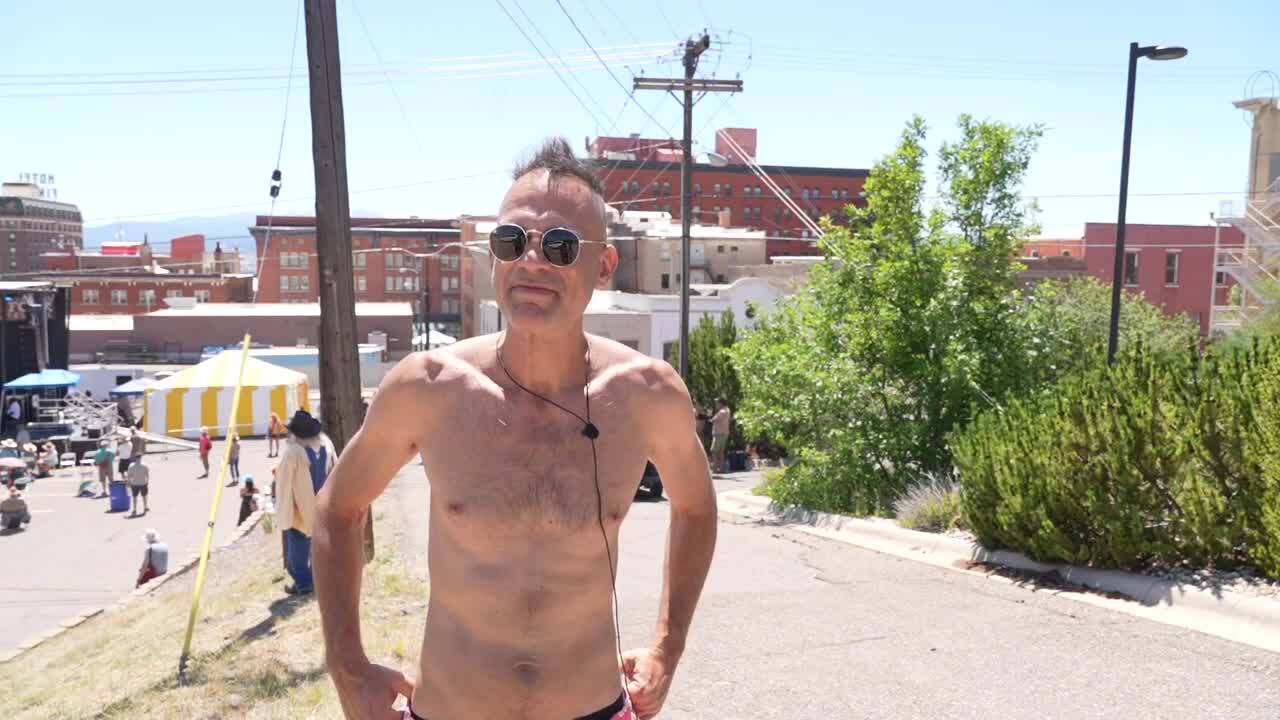
“It’s not that hot yet. I think it might get hotter, but it’s okay right now.”
Villere said he hasn’t worn shoes in a couple of years, including through two winters, and the callouses he’s built up protect his feet from the hot pavement.
Over the years, extreme weather has impacted festival attendance, but this year most people seem comfortable with the conditions.
This story was reported on-air by a journalist and has been converted to this platform with the assistance of AI. Our editorial team verifies all reporting on all platforms for fairness and accuracy.
-
 Kansas4 minutes ago
Keystone Pipeline system’s operator agrees to pay $26.9M penalty over major Kansas oil spill
-

 Kentucky10 minutes ago
Kentucky sheriff warns residents of rental scam circulating TikTok
-

 Louisiana16 minutes ago
DeRidder man found dead in Sabine River
-

 Maine19 minutes ago
The Maine Bureau of Highway Safety urges Mainers to drive to save lives
-

 Maryland24 minutes ago
Maryland lawmakers express condolences after sudden death of Sen. Lindsey Graham
-

 Michigan31 minutes ago
Michigan churches strengthen safety after recent attacks on houses of worship
-

 Massachusetts34 minutes ago
Fire spreads to 3 multi-family buildings in Lawrence, Massachusetts
-

 Minnesota39 minutes ago
Police seeking suspect in Eagan road rage shooting incident

