


Michelle Pfeiffer as Stacy Clyburn. “I wonder if they would do a theatrical release because it is so sweeping,” says the actress, who credits 1923 star Helen Mirren for helping her commit to the project.
Emerson Miller/Paramount+


Voters have waited with baited breaths for their ballot to arrive in their mailboxes. A caller this morning inspired me to this post about the ballots just mailed out…all three of them.
Credit: Travis Lee, TSM
A coworker agreed with this topic choice, then added, “My father-in-law called me last night, asking questions about the ballots.” I suppose it’s understandable. We expect something pretty clearcut and it’s not quite. For those new to voting, or anyone confused by what they received, let’s see if I can help.
The state of Montana does not document party affiliation for a resident when they register to vote. The voter cards mailed earlier do not list party. In the primary election, such as now in May, a voter is free to decide which party races they will vote in. So a Montanan can cast a ballot for either Democrat, Republican or Green. Others in the state have four ballots in their packet.
The most important sheet of paper in the ballot packet is the Voting Instructions. Follow these steps and your choices will be respected and counted.
While the steps are pretty straightforward, number 1 states “Choose ONE Ballot to Vote.”
Credit: Travis Lee, TSM
Translated: No, please don’t mark all three or four and send them in. Waste of your vote. The Elections office will not count them. A voter is free to choose the one party‘s races they care about and will participate in by voting.
Another caller this morning urged listeners to fill out their ballot and turn it in as soon as possible. Why? The only reason a voter should sent it in ASAP is if they will mail it. The Postal Service will need days for delivery. Like the Instructions clearly says at the top “a postmark is not accepted.” The best practice is to deliver in person. That being said, you have until June 4th to carefully think about your choices and fill out the ballot, then turn it in to the Elections Office or drop it in an official ballot box. As of the date of this article, you have time.
This is a risky question to ask. A radio guest suggested that if you absolutely don’t know who to vote for in a particular race, ask someone who follows all this political stuff and who can tell you who to vote for. I’m a little bothered by this advice because at first blush it seems like ceding control of your vote to another person. But then who do you ask? I will therefore add that you should ask someone who is knowledgeable and whom you trust, and they should give you concrete information or point you where to look for yourself. Answers like “Vote for him, he’s a (political view)” or “I met her, nice lady” is not nearly enough to make an informed choice.
Perhaps a better question is “Who do you recommend for this specific race, and why?”
Still, do your homework. An incumbent candidate has a voting record; look it up. How did they vote on key issues when it mattered most? What they say in news articles and on media should again be taken with salt. Politicians say all manner of things. Their social media may give some insight. Their votes and their actions are their true voice. And again, you have time.
The key message I have is that you should be in control of your vote. Don’t give your power to someone else with an unfilled ballot or have someone other than the Postal Service deliver it for you. That piece of paper, that ballot, is truly your power in these elections.
Gallery Credit: Michelle Heart
Safety Town 2024 Great Falls, Montana
Gallery Credit: Tammie Toren


[The story contains major spoilers from the season one finale of The Madison.]
The Madison has brought a new family to the Sheridan-verse. And after the conclusion of its first season, the story of the Clyburns is only just getting started.
The grief drama from Yellowstone hit-maker Taylor Sheridan introduced viewers to the Clyburns when it plucked them out of their New York City comforts and plopped them on an uncomfortable yet transformative six-episode tour through their grief in Montana.
The first season was given an unusual release, as it streamed in two parts over the last two weekends on Paramount+, like two mini-movies — which is how the story could be viewed. The second season has already been filmed and is in the can, awaiting an official release date from the streamer, and the cast, in conversations with The Hollywood Reporter here, makes it clear that Sheridan plans to continue.
“They’re hoping for season three,” star Michelle Pfeiffer tells THR.
No official announcements have been made, but Sheridan usually gets what he wants.
The Madison was a leap of faith for Pfeiffer when she signed on to play Clyburn matriarch Stacy. She didn’t have a script or much of a character description after leaving an early 2024 meeting with Sheridan at his Texas ranch when he pitched her the series in person — nor did she have a scene partner. Kurt Russell, who would eventually sign on to play her husband, Preston, was in production on his Apple series Monarch: Legacy of Monsters and wasn’t available when season one was set to begin in the fall. So Pfeiffer and Sheridan pitched to Paramount that they move forward with a second season, and that Russell film all of his season one scenes when they return one year later, in 2025, to make season two.
That meant Pfeiffer would film the entirety of season one without Russell, their scenes cut together in the edit. “I was not happy about that,” Pfeiffer recently told THR with a laugh. “It was touch and go if they were going to make [Kurt’s] schedule work. But Taylor was insisting it was going to happen, so I just decided, ‘OK, it’s Kurt.’ And because I know him, that was pretty easy to conjure up.”
Michelle Pfeiffer as Stacy Clyburn. “I wonder if they would do a theatrical release because it is so sweeping,” says the actress, who credits 1923 star Helen Mirren for helping her commit to the project.
Emerson Miller/Paramount+
The series proves to be a Pfeiffer vehicle as she steers her fractured, privileged and often out-of-touch family through their stages of grief after Preston’s sudden death. After Preston and his brother Paul, played by Matthew Fox, tragically die in a plane crash while at their Montana home to open the series, Preston’s children (played by Beau Garrett and Elle Chapman; with a son-in-law played by Patrick J. Adams) and grandchildren (played by 11-year-old Alaina Pollack and Amiah Miller) travel with Stacy to the cabin in the mountains that Preston loved his entire life, but a place that the rest of his family had never visited.
“That’s often how people die in airplanes, when an emotional factor makes their decision-making,” Fox, a pilot himself, tells THR. “He only gets his brother out there for a couple weeks a year. He’s flown him to this special place. It bothered me that Paul was a little nonchalant about the weather that was moving in, but I justified i that he’s just trying to give his brother the very best birthday gift he possibly could.”
After many hurdles for this fish-out-of-water family and self-proclaimed “city mouse” Stacy — ranging from outhouse attacks by hornets, elk dinners that nearly undo the family and many, many lessons in empathy and readjusting preconceptions — Stacey ends the first season deciding to live at the Montana home that has now been imprinted onto her soul. After burying her husband there and holding a memorial in New York City, she leaves the city without any word to her family and arrives at Preston’s final resting place in Montana. When she is found by cowboy Cade (Kevin Zegers), she tells her friendly neighbor that she could use a hand getting settled, as she plans to stay for a while.
The ending sets up The Madison to return the series to the mountains as the main setting for season two, and the cast told THR they all plan to follow — in some way, shape or form.
“The family unit of the Clyburns is what holds everyone together, and they’re all integral to that dynamic. So there are a lot of questions at the end of season one that will be answered when you get to season two,” Yellowstone veteran Christina Voros, who directed the entire series, tells THR. “When the script showed up in my inbox, I cried. It’s such a unique show for Taylor in a lot of ways, but it’s a very specific show for me as an East Coaster who met a cowboy [husband Jason Owen, also animal coordinator on the series] and fell in love and moved to Texas and discovered Montana through shooting Westerns for Taylor. There was so much in the DNA of the show that felt specifically like it was speaking to me. I’ve never had the opportunity to direct something that I felt so creatively attached to.”
What especially spoke to Voros was the storyline with Abby, Stacy’s older, divorced daughter — and mother to Bridgette (Miller) and younger sister Macy (Pollack) — who is played by Garrett. “It’s funny watching her conversations with Van,” Voros says of the sheriff played by Ben Schnetzer. “Some of those are conversations I had with Jason when I first met him.”

Ben Schnetzer as Van with Beau Garrett as Abigail (Abby). “Five [seasons] feels like a good number. However long it takes for the story to be told,” says Garrett, who has been riding horses her entire life, of her hopes for the series.
Emerson Miller/Paramount+
After finding a deep (and steamy) connection while in Montana, Abby heads back to New York City after a difficult conversation with Van that highlighted their seemingly impossible romance. But the door is left ajar after a finale phone call heading into season two. “Christina was able to bring a very deft touch and particular insight, which was hugely helpful,” says Schnetzer, who returns for season two. “It’s a love story between two people who have quite complicated and committed lives, but that only adds to the drama and the intrigue. At times it really takes fire, and at times they’re kind of pulled apart.
“I find Christina to be so enthralling, and her story to be so enthralling,” says Garrett of The Madison helmer and what’s in store for Abby and Van. “There’s a softness to Abby that happens in season two that didn’t have a place in season one that was really fun to explore, a happiness; a joy. A bit of life that maybe she had forgotten in herself.”
She adds, “I don’t think this family is going to let the matriarch be alone in Montana.”
Pfeiffer and Russell were officially on board when Voros was approached in 2024 by Sheridan to direct his next series. They were filming what would become the final episodes of Yellowstone, and Sheridan told his go-to director that he would have scripts for her soon. But the supporting cast wasn’t yet set when the scripts showed up in her inbox.
When the rest of the Clyburn family booked their auditions — which, for most of them, included screen tests in Wyoming — they questioned if the show was set in the Yellowstone-verse, since that’s how it was first announced. There was a group chat named “Clyburn & Co” (separate from a text chain that included their Oscar- and Emmy-nominated onscreen parents) that would churn with every script delivery. “We would text, ‘Episode five just dropped, guys!’ Everybody would race to read it, and then we’d all discuss,” shares Chapman.
Adams said it was then made clear that The Madison would no longer be existing in or connected to the world of the Duttons, and that this series would be “its own thing.”
He also had a personal connection to the story. “We lost my stepdad about three years ago now and part of that was that we inherited this cabin. So I was in a cabin with my family, much like the Clyburns, when this show came to me,” Adams shares with THR. “I was having a very similar experience of wondering how we take care of it when I got the audition. Then I got a message that Taylor was really into [my tape] and he wanted me in Wyoming. But I couldn’t go. I would have to strand my family to get down there. I thought that would be it, and then they came back and said I could just make another tape.”
Chapman recalls at the screen test in Wyoming hearing other actors auditioning for Russell saying, “’Thank God Patrick J. Adams isn’t here, because I heard he was testing.’ They thought he was out of the running,” she says with a smile.
Adams would go on to land the role of Russell, who serves as comedic relief and an unexpected ally to Stacy as she tries to enlighten her daughters about Montana. And Chapman booked the role of his wife, Stacy’s younger and most self-centered daughter Paige. “It was very surreal,” admits the 27-year-old of her first screen test, for Sheridan, no less. “I tested against nine other girls, most of which I had grown up watching. I was so nervous.”
Paige and Russell seem the least likely to book a return flight to Montana for season two, but the actors say more evolution is in store for all of the Clyburns, including their married characters.
“Both places exist at the same time [between Montana and New York],” says Adams of next season. “The bulk of the story is Montana-based. They find themselves there and, I’m not sure how much they want us talking about the specifics, but this show exists with these people in this space trying to figure out who they are, not only to themselves but to each other, and it’s sort of a deepening position.”
Miller, who plays oldest granddaughter Bridgette, sums up: “Season one is about the family reconnecting and learning how to survive both emotionally and physically. Season two is about them rebuilding after they’ve reconnected and finding their footing and their love for each other.”

Elle Chapman as Paige with Patrick J. Adams as husband Russell. “Part of the joy of this show is that these people are totally unprepared. We’re all deer in headlights,” says Adams. “These people certainly exist in New York. They exist in every city when you’re disconnected. Taylor is using New York and their position as a way to give contrast to what happens when any of us get in the car or drive out of a city and take a breath and touch grass and go, ‘What is this quiet, peaceful feeling? What is this conversation I can have with someone undistracted?’”
Emerson Miller/Paramount+
One person not returning for season two, however, is Fox. The Lost star also filmed the entirety of his scenes during season two production, since Russell was his scene partner, and the idea of a limited engagement was a draw for the actor.
“That’s one of my requirements these days,” he tells THR with a laugh, sharing that he still gets approached by people on airplanes who tell him he makes them nervous (because of Lost). “I’m at a point in my life where I’d rather pop in and do something interesting, but I don’t want to dedicate six years of my life to something [again]. Taylor is an an exceptional writer. When I read the scripts, it really hit me where it hurts, and also made me laugh.”
Fox, who grew up in Wyoming, says he “appreciated Taylor’s authenticity of the world. He offers a lot as a storyteller, not just on a dialogue level but there’s so much subtext. I don’t know how he does everything that he’s doing. It’s mind-boggling. I’ve worked on other series where there’s a creator and a writers room where a lot of people are involved, and he writes everything. It’s really kind of astounding.”
When making a rare public appearance to introduce The Madison at its recent New York City premiere, Sheridan acknowledged the labor of love that went into what he has described as his most intimate and personal series yet. “This is a very emotionally taxing project because it’s about grief and family and tearing apart and coming back together, so it demanded a lot and it demanded a lot of everyone,” he said. He then credited Voros for carrying out his vision. “I had to turn it over to one person to trust to execute my vision and take this on. I’m a big believer that when you find a talent that understands your voice, you need to surrender to that talent,” he said. “[Voros] exceeded even my wildest expectations.”
The first episode ended with a dedication to the late Robert Redford, which Voros says was Sheridan’s idea, and Redford’s A River Runs Through It was an inspiration — it’s even part of the plot when Stacy shows the movie to her daughters after Preston’s death. The series was filmed on location in Montana, with the cabin interiors filmed on a stage in Texas. The New York City scenes were filmed both on location and in Dallas’ Fort Worth area.
“This was a beautiful series to make,” says Voros. “It all starts with the writing. There’s a reason for those of us who are lucky enough to work on Taylor’s shows — the reason people gravitate to these stories is because of the characters and the language they are able to speak. He’s a rare voice in this industry.”

The Clyburn brothers played Matthew Fox (Paul) and Kurt Russell (Preston). “We’re both pilots, we both love to spend time outdoors and do things like fly fish,” says Fox of himself and Russell. “I read the scripts and they were really beautiful and moving and funny, and created imagery in my mind that felt familiar and like home. It just swept me in.”
Emerson Miller/Paramount+
Garrett thinks five seasons would be a nice number to follow the Clybun story through, though she admits “I don’t know where it goes, where it could go” beyond season two. But “grief is universal. Everyone has someone or something they’ve lost. That is relatable for anybody. Also, we all want to laugh, and this is also a really funny show. Grief is messy and funny,” she says.
“I think I speak for everyone when I say we would gladly shoot this show forever,” adds Adams. “I think we’ve found something kind of miraculously special here, so as long as it’s a story people want to hear, we’d be happy to tell it.”
Voros agrees, “Any time you get a show together with a cast like this you kind of want it to go forever. Having completed the second season, you just fall more and more in love with them as a family. It’s more complicated, emotionally, underneath.”
Season two will also bring about Pfeiffer and Russell’s first scenes actually filmed together, as Stacy and Preston’s love story will continue even after his death.
“You might see more of us in season two, together,” Pfeiffer briefly teases. Russell echoes only, “It’s in a different way.”
The pair are well trained on spoilers as they settle into their roles within the Sheridan-verse.
“I’ve spent a lot of time on the East Coast and I’ve spent a lot of time in the mountains. They all have something different to offer,” says Pfeiffer of relating to Stacy. “I love Montana. But I don’t know that I would live there. I am a city mouse.”
The Madison is now streaming all of season one on Paramount+. Read THR’s show coverage.
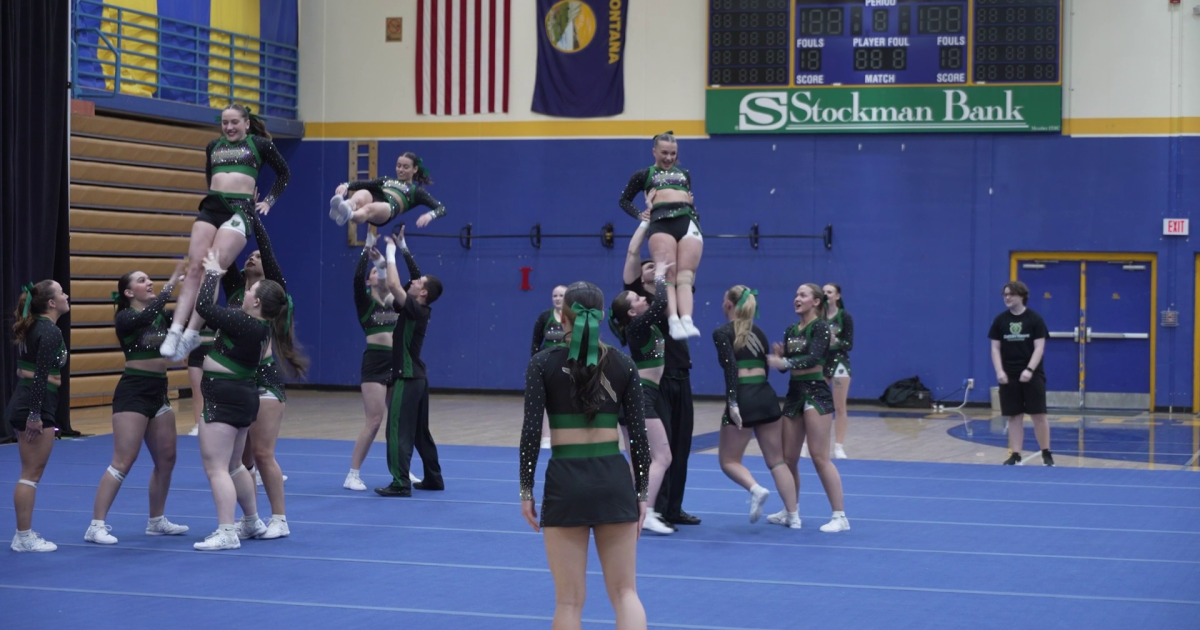
LEWISTOWN — 27 teams of cheerleaders from across Montana gathered at Fergus High School for Cheerfest.
Justin Robicheau reports – watch the video here:
Cheerleaders showcase talent at Cheerfest
“It’s the largest interscholastic cheerleading competition for Montana. We’re very excited that schools can come and show what they’ve been working all season for. This is our state, this is our divisional. So we’re very excited and can’t wait to see what Montana brings to the mat,” Cheerfest Director Rayna Phelps said.
Phelps said this year’s event is different from last year.
“We were really focusing on ways that we can really up this experience for cheerleaders and dancers across the state of Montana. This year, we included a backdrop, and lots of beautiful accents all throughout. We have a judging table, so it looks really nice,” Phelps said.
“There’s a high school mascot competition. Junior high team competition. There’s all classes of high schools. Class B, class A, double A, small group and large group. There’s dance solos, dance teams from across the state. And we have a college showcase,” Phelps said.
Glasgow High School senior Annika Smith said her school finished third in last year’s Cheerfest.
“I’m so excited. This last year we got third. So I’m really excited to come back and really go and try and get first. And it’s a little sad because it’ll be my last year, but I’m really excited to go out and give it my all,” Smith said.
MTN News
For Fergus High School senior Miriam Pavlovick, being surrounded by other cheerleaders from across the state is uplifting.
“It’s nice to see, like, a lot so many cheerleaders who enjoy the same thing. So much. And we just all come together and support one another,” Pavlovick said.
“Obviously when we go travel for basketball and state, like that, we’re cheering on our team. And this is a cool opportunity to show what cheerleaders can do and our stunting on all of our dancing and really get to show off a different side of cheerleading,” Smith said.
Registration for next year’s competition will open after Christmas.
MTN News





Drummer Brian Pastoria, longtime Detroit music advocate, dies at 68


Family rallies around Oklahoma father after head-on crash


Wildfire forces immediate evacuation order for Farnam residents


How ICE plans for a detention warehouse pushed a Georgia town to fight back | CNN Politics


Police looking for man considered ‘armed and dangerous’

Federal EPA moves to roll back recent limits on ethylene oxide, a carcinogen


‘Youth’ Twitter review: Ken Karunaas impresses audiences; Suraj Venjaramoodu adds charm; music wins praise | – The Times of India


Thousands march worldwide in solidarity with Palestine, Iran on al-Quds Day
