Montana
Montana presidential primary gives option for “no preference” votes

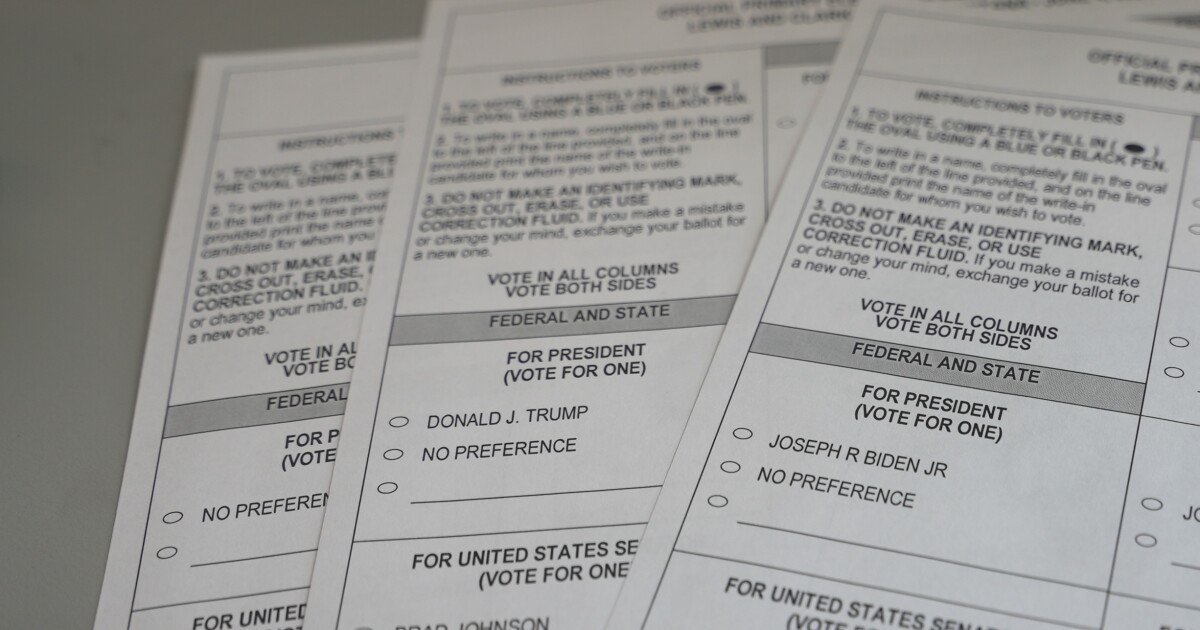
HELENA — Only two names are appearing on Montana’s presidential primary ballots this year: Joe Biden and Donald Trump. However, voters do have another option.
For 50 years, Montana law has required that voters in the state’s presidential primaries have a choice to vote “no preference” instead of for a candidate.
One group actively encouraging voters to support “no preference” is Montanans 4 Palestine, which has organized protests against Democratic and Republican politicians because of their stances on Israel’s war in Gaza. Several weeks ago, they announced they would campaign for a “no preference” vote in the Democratic primary as a way to protest the Biden administration, saying it hasn’t done enough to stand up against what they describe as a genocide.
“Ultimately, this is an expression of disgust with the president’s policies,” said co-founder Brendan Work.
Last weekend, Montanans 4 Palestine members were knocking on doors in Bozeman and Missoula to get out their message, and Work said they’ll be canvassing again this weekend. They’ve also distributed yard signs in several cities across the state.
Work said they’re making the case voting “no preference” is a low-risk way for people to show they’re unhappy with the administration.
“Biden has already won the nomination pretty much, and this vote is not like a vote for Trump,” he said. “So it’s a good way for people to express their feelings – and it’s easy to do: It’s right on the ballot; it says ‘Joe Biden,’ and ‘no preference.’ And that’s an easy choice for a lot of us.”
Jonathon Ambarian
Work estimates his group has around 300 members, and he says it’s grown significantly since the start of the war in Gaza. He said their initial goal is to get 5,000 “no preference” votes, which he said would demonstrate there’s a “pro-peace constituency” that leaders need to listen to, especially in the closely watched race for Montana’s U.S. Senate seat. Their higher target is to crack 15% of the Democratic primary vote, which would allow for the selection of “no-preference” delegates for the Democratic National Convention. Work said that would likely take 20,000 votes.
This campaign follows visible efforts to encourage “uncommitted” votes in Democratic primaries in a number of other states, including Michigan, Washington and Wisconsin. That vote has often ended up between about 8% and 15%, reaching as high as nearly 19% in Minnesota’s primary and 29% in Hawaii’s caucus. However, Biden has won the overwhelming majority of delegates – projected by national analysts to be more than 3,600, compared with just over 30 uncommitted delegates.
A spokesperson for Biden’s campaign released a statement to MTN Thursday.
“The President believes making your voice heard and participating in our democracy is fundamental to who we are as Americans,” they said. “He shares the goal for an end to the violence and a just, lasting peace in the Middle East. He’s working tirelessly to that end.”
2024 will be the first time in 40 years that neither the Republicans nor the Democrats have multiple candidates listed on their Montana primary ballot. In recent election cycles, the highest “no preference” vote totals have generally come when there’s only one candidate on the ballot – like in 2012, when “no preference” got 9.4% of the Democratic primary vote in Barack Obama’s reelection year, and in 2020, when Trump was the only Republican candidate and 6.2% of the vote was for “no preference.”
The largest share of “no preference” votes for both Republicans and Democrats in Montana came in 1992: 16.6% and 24%, respectively.
Montana “No Preference” Vote History:
1976:
Republicans: 2.2%, 1,996 votes
Democrats: 3.6%, 3,820 votes
1980:
Republicans: 3.8%, 3,014 votes
Democrats: 11.9%, 15,466 votes
1984:
Republicans: 7.5%, 5,378 votes
Democrats: 28,385 votes (Montana Democrats held a caucus and no candidates appeared on the primary ballot)
1988:
Republicans: 7.5%, 6,520 votes
Democrats: 3.6%, 4,083 votes
1992:
Republicans: 16.6%, 15,098 votes
Democrats: 24.0%, 28,164 votes
1996:
Republicans: 7.2%, 8,533 votes
Democrats: 10.0%, 9,176 votes
2000:
Republicans: 4.1%, 4,655 votes
Democrats: 22.1%, 19,447 votes
2004:
Republicans: 5.6%, 6,340 votes
Democrats: 7.4%, 6,899 votes
2008:
Republicans: 2.4%, 2,333 votes
Democrats: 2.4%, 4,358 votes
2012:
Republicans: 3.8%, 5,456 votes
Democrats: 9.4%, 8,270 votes
2016:
Republicans: 4.7%, 7,369 votes
Democrats: 4.2%, 5,415 votes
2020:
Republicans: 6.2%, 13,184 votes
Democrats: 2.8%, 4,250 votes



HEBGEN LAKE, Mont. — A man was rescued after nearly drowning while swimming in Rainbow Point, located 10 miles north of West Yellowstone.
The Gallatin County Sheriff’s Office, along with Hebgen Basin Rural EMS personnel and Montana Fish, Wildlife and Parks, responded to reports of a swimmer in distress.
Officials say bystanders saw a man become unresponsive while swimming roughly 100 yards off the shoreline.
They, along with a boating group, located the man, pulled him out of the water, and performed life-saving measures until first responders arrived.
The man was airlifted to Eastern Idaho Regional Medical Center. Officials say he is in critical condition.
The Gallatin County Sheriff’s Office released the following information:
The Montana Lottery offers multiple draw games for those aiming to win big.
Here’s a look at July 12, 2026, results for each game:
Winning Big Sky Bonus numbers from July 12 drawing
09-17-22-29, Bonus: 11
Check Big Sky Bonus payouts and previous drawings here.
Winning Millionaire for Life numbers from July 12 drawing
12-21-39-46-48, Bonus: 02
Check Millionaire for Life payouts and previous drawings here.
Feeling lucky? Explore the latest lottery news & results
When are the Montana Lottery drawings held?
- Powerball: 8:59 p.m. MT on Monday, Wednesday, and Saturday.
- Mega Millions: 9 p.m. MT on Tuesday and Friday.
- Lucky For Life: 8:38 p.m. MT daily.
- Lotto America: 9 p.m. MT on Monday, Wednesday and Saturday.
- Big Sky Bonus: 7:30 p.m. MT daily.
- Powerball Double Play: 8:59 p.m. MT on Monday, Wednesday, and Saturday.
- Montana Cash: 8 p.m. MT on Wednesday and Saturday.
- Millionaire for Life: 9:15 p.m. MT daily.
Missed a draw? Peek at the past week’s winning numbers.
This results page was generated automatically using information from TinBu and a template written and reviewed by a Great Falls Tribune editor. You can send feedback using this form.
-

 Politics5 minutes ago
Trump reveals who he’s eyeing to replace Lindsey Graham
-

 Health11 minutes ago
Notable figures who died from the same heart condition linked to Lindsey Graham’s death
-

 Sports17 minutes ago
Folarin Balogun admits that red-card reversal affected USA World Cup teammates: ‘A lot of outside noise’
-

 Technology23 minutes ago
Humanoid robots perform live surgery in world first
-
 Business29 minutes ago
A ‘next generation studio’ for YouTube creators
-
 Entertainment35 minutes ago
Finn Wolfhard is taking ‘control of the narrative’
-
 Lifestyle40 minutes ago
What are your most cherished memories of the 2026 World Cup in L.A.?
-
 Politics47 minutes ago
Commentary: Two Lorenzos from Mexico. One fulfilled his American dream. ICE killed the other

