Montana
Montana delegation backs bill to release wilderness study areas


Laura Lundquist
(Missoula Current) Most of Montana’s Congressional delegation is once again sponsoring a bill to remove three study areas from consideration as designated wilderness.
On Wednesday, Senators Steve Daines and Tim Sheehy and Rep. Troy Downing reintroduced Daines’ “Montana Sportsmen Conservation Act,” which would remove three wilderness study areas from wilderness consideration, releasing them to be managed as regular federal land. Rep. Ryan Zinke was not listed as a sponsor.
Two areas – the 11,580-acre Wales Creek and the 11,380-acre Hoodoo wilderness study areas managed by the U.S. Bureau of Land Management – are 40 to 50 miles east of Missoula in the Garnet Range north of Interstate 90. The third area, the much larger Middle Fork Judith wilderness study area, is around 81,000 acres managed by the U.S. Forest Service in the Little Belt Mountains southeast of Great Falls.
Daines previously introduced the Montana Sportsmen Conservation Act in 2023, but it was never heard in committee. Now, he’s bringing it forward again, and he explained his strangely titled bill in a press release Wednesday.
“As a lifelong sportsman, increasing access to Montana’s great outdoors is one of my top priorities. The ‘Montana Sportsmen Conservation Act’ promotes our outdoor way of life by returning restrictive WSA’s to general public land management, which will improve wildlife habitat restoration, reduce the risk of catastrophic wildfires, and unlock better access to public land,” Daines said in the release.
It should be noted that neither hunting nor fishing are prohibited in wilderness study areas. In the past, sportsmen’s organizations have opposed the wholesale elimination of wilderness study areas. However, some have indicated they are considering the Wales Creek and Hoodoo areas could serve as political sacrifices to save other areas.
The wildfire risk in the Hoodoo area was significantly reduced this summer after the Windy Rock Fire burned a majority of the area.
Daines first proposed a similar bill – the Protect Public Use of Public Lands Act – in 2018 to release five Forest Service wilderness study areas, including the Middle Fork Judith. Former Rep. Greg Gianforte joined him but increased the number of wilderness study areas on the chopping block to 29, including those under BLM management. Both politicians had based their legislation off feedback from a select group of conservative counties and user groups, including the Montana Stockgrowers Association and the Montana Snowmobile Association. Other organizations protested the bills and the lack of transparency during the process.
This most recent bill is supported by the Montana Logging Association, Montana Snowmobiles Association, Montana Outfitters and Guides Association, Montana Farm Bureau Federation, Great Falls Bicycle Club and the Judith Basin and Powell county commissioners.
In 1976, the BLM established 38 wilderness study areas in Montana, including the Wales Creek and Hoodoo areas. In 1977, the Montana Wilderness Study Act set nine Forest Service study areas aside for wilderness consideration, including the Middle Fork Judith. Federal evaluations of the areas conducted during the 1980s concluded some areas, including the three being considered in the bill, weren’t suitable for wilderness designation.
This year’s bill cites the 2020 BLM Missoula Office Resource Management Plan as justification for eliminating the Wales Creek and Hoodoo wilderness study areas. The plan said the two areas were unsuitable for wilderness designation.
However, the plan was not developed during “a 5-year collaborative process,” as the bill claims, but under the direction of the first Trump administration, which ignored a lot of public comments made during scoping. The three resource management plans for Missoula, Lewistown and Miles City were scheduled to be released to the public in late 2018, but they were delayed when the three offices were required to send the drafts to Washington, D.C., for review and revision. When they were returned and published in May 2019, all three draft plans heavily emphasized natural resources extraction.
A Pew Charitable Trust review of six BLM resource management plans drafted in 2019 found all “would fail to conserve lands that the agency’s own research has deemed worthy of protection; cut decades-old safeguards; minimally protect a fraction of 1% of the areas found to contain wilderness characteristics; and open vast swaths of public lands to energy and mineral development.”
Several Montana conservation organizations protested the Montana plans, including Wild Montana and Backcountry Hunters and Anglers. When the draft plans were finalized in early 2020, some changes had been made to cater to sportsmen, but resource extraction still dominated. The Missoula Office’s new objective was to “produce the greatest quantities of forest products from vegetation restoration activities.”
The 2020 plans created a new designation – backcountry conservation area – that allows resource extraction but prioritizes the long-term maintenance of big game populations for hunting. The Missoula plan proposes to manage its three wilderness study areas as wilderness unless Congress releases them. Then, if Daines’ bill passes, portions of the wilderness study areas would become backcountry conservation areas: a 6,100-acre Hoodoos BCA and a 2,365-acre Wales BCA, according to the plan. The remainder of each area is open to any and all uses.
During the 2025 Legislature, the Senate Energy, Technology, and Federal Relations Committee voted 9-4 against a resolution calling on Congress to remove protection from Montana’s wilderness study areas. More than 3,300 Montanans signed a petition opposing the bill and supporting local solutions for study area management.
Some anticipate that more roads will invade wilderness study areas once they’re no longer protected. Zach Angstead, Wild Montana federal policy director, said Daines has countered those claims by saying the areas will still be protected under the Roadless Rule. But now, the Trump administration is on the verge of repealing the Roadless Rule, so that level of protection could disappear. And Daines strongly supports repeal of the Roadless Rule, according to a Dec. 5 email from a Daines spokesperson to the Flathead Beacon.
“Sen. Daines’ push to remove (wilderness study area) protections and roll back the Roadless Rule show that this isn’t about better local management – it’s about opening Montana’s public lands up to large-scale development to benefit corporations, not Montanans,” Angstead said in a statement. “Managing (wilderness study areas) properly requires local collaborative solutions developed by the people who know these places best. The people and the legislature have made it clear that Daines needs to give up this unpopular crusade to undermine and dismantle public lands and start taking his cues from real people who have been working to shape the future of (wilderness study areas).”
Contact reporter Laura Lundquist at lundquist@missoulacurrent.com.




HELENA — On Monday, Montana Attorney General Austin Knudsen sent a letter to the City of Helena claiming the municipality is not in compliance with the state’s law banning “sanctuary cities.” The letter comes just under a month after the State of Montana launched an investigation into a city resolution on Helena Police policy and Helena’s involvement in federal immigration enforcement.
In the letter, Knudsen laid out the ways he believes the city’s resolution violated state law. The attorney general gave Helena 15 days to respond or reverse the policy. If the city does not comply, his office will pursue legal action.
“Helena’s resolution appears to contain blatant violations of this law,” wrote Knudsen.
MTN News
On January 26, 2026, the City of Helena adopted a resolution clarifying when and how the Helena Police Department will cooperate with federal immigration officials. The vote was 4 to 1. The Helena commission seats and the mayor are elected in non-partisan races.
In the letter, Knudsen alleges the resolution established “a broad sanctuary city policy” that seeks to protect every illegal immigrant, regardless of whether the individual had committed a serious crime or not. The state further claims the resolution gives illegal immigrants “special privileges” in plea deals and establishes a “free-for-all policy” where a police officer can request the unmasking of Department of Homeland Security and ICE officers.
Knudsen has requested that the City of Helena, in their response, specifically describe in detail how the resolution complies with Montana law, provide emails and correspondence from city staff and the commission regarding the resolution.
Helena City manager Alana Lake told MTN in a statement: “The City of Helena is aware of the issues being raised by the Attorney General’s Office and is reviewing the matter. While we cannot discuss the details of a potential legal issue, the City is committed to transparency and compliance with the law. The City takes these matters seriously and will continue to cooperate with the appropriate authorities while remaining focused on serving our community.”
MTN News 
Passed in 2021, Montana House Bill 200 prohibits a state agency or local government from implementing any policy that prevents employees or departments from communicating with federal agencies regarding immigration or citizenship status for lawful purposes. It also states governments must comply with immigration detainer requests if they are lawfully made.
HB 200 was backed by Republicans and passed with only Republican votes. Gov. Greg Gianforte signed the legislation into law on March 31, 2021.
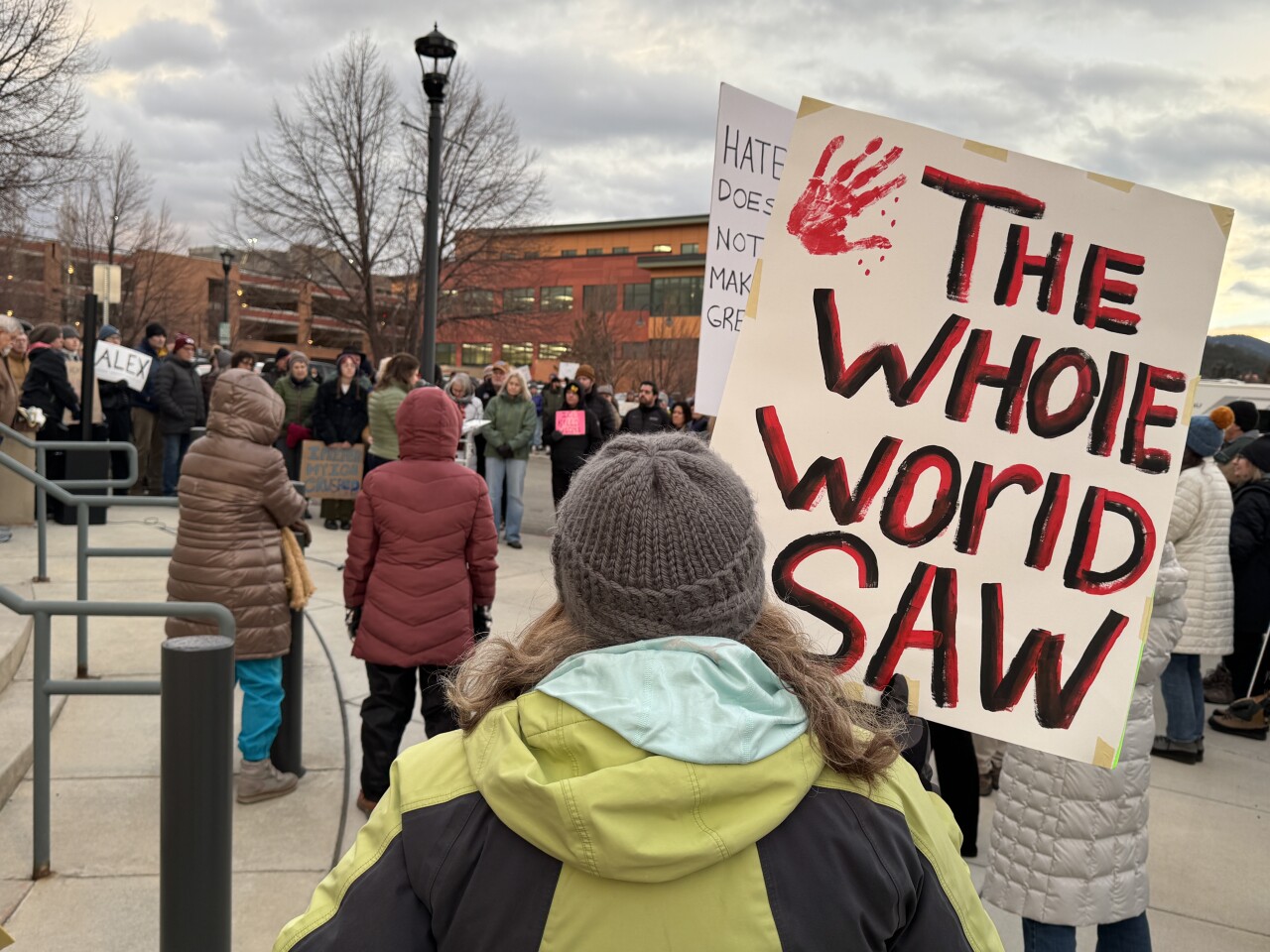
Passage of the resolution by the Helena City Commission has drawn ire from conservative voices in Montana politics and on the national level.
MTN News
The resolution said the commission supported the Helena Police Department avoiding “committing its resources to federal action for which it has no authority,” such as entering into an agreement with the federal government to directly enforce immigration laws. Under federal law, immigration enforcement is conducted by federal agencies under the Department of Homeland Security. However, under the Immigration and Nationality Act, state and local governments can voluntarily enter into 287 (g) agreements with the federal government that allow them to enforce immigration laws.
The commission further supported HPD’s policy not to stop, detain, or arrest a person solely on suspected violations of immigration law, including assisting other agencies in an arrest based solely on immigration law.
DEEPER LOOK: Helena has seen a growing debate over ICE and local police involvement
In the resolution, the commission also supported an HPD officer, using their own discretion, requesting the identification and unmasking of a Department of Homeland Security Officer if the HPD officer “feels it will not be interfering with the actions of federal officers exercising their jurisdiction.”
“This adversarial relationship by local law enforcement toward federal officers itself undermines public safety and forces immigration officers to fear for their safety when they are simply carrying out their lawful duties,” wrote Knudsen.
The resolution further supports the City of Helena’s policy not to consider immigration consequences in a plea agreement with a defendant.

Mack Carmack, MTN News
The commission also supports the City of Helena not disclosing any sensitive information about any person – including immigration status, sexual orientation, or social security number – except as required by law.
“This is a restriction that directly conflicts with Montana’s prohibition on sanctuary jurisdictions, specifically ‘sending to, receiving from, exchanging with, or maintaining for a federal, state, or local government entity information regarding a person’s citizenship or immigration status for a lawful purpose,’” the attorney general wrote.
If a government is found to be violating Montana’s law banning “sanctuary cities”, the state could fine them $10,000 every five days, prevent them from receiving new grants from the state, and have their projects with the state re-prioritized. A government in violation can avoid penalties by becoming compliant with the law within 14 days of being notified of the violation.
Read the full letter from the Montana Attorney General to the City of Helena:

Steve Pearce and the future of the BLM
By Benjamin Alva Polley EBS COLUMNIST
If you care about hunting elk in crisp October air, floating a clear-running river for cutthroat trout, or simply taking your kids camping beneath a sky unspoiled by drill rigs, you should be outraged that Steve Pearce was ever considered to run the Bureau of Land Management.
The BLM is the largest landlord in the West. It oversees nearly 245 million acres of public land—millions of those acres in and around Montana’s most cherished places. This land is the backbone of our elk and mule deer herds, our sage grouse leks, our pronghorn migration routes and our blue-ribbon trout streams. It’s also the stage on which Montana’s hunting, fishing and outdoor recreation economy plays out.
Putting someone with Steve Pearce’s environmental record in charge of that land is like handing your cabin keys to the arsonist who’s always hated it. In the four months since Pearce was first nominated, it emerged that, if confirmed, he and his wife would divest from more than 1,000 oil and gas leases in Oklahoma to address potential conflicts of interest. While some senators strongly support his “active forest management” approach, he still faces opposition from groups alarmed by his record on public land transfers. On March 4, the Senate Energy and Natural Resources Committee voted 11-9 to advance his nomination, despite concerns from conservation groups.
Pearce’s track record is no mystery. He has consistently sided with extractive industries at the expense of wildlife, habitat and public access. He has supported opening more public lands to oil and gas drilling, weakening bedrock environmental safeguards and undermining science-based management. His votes and public statements have signaled again and again that he sees wild country as an obstacle to be overcome, not a legacy to be stewarded.
For Montana, that posture is an existential threat. Our big-game herds rely on intact winter range and unfragmented migration corridors across BLM lands. Aggressive drilling, poorly planned roads and relaxed reclamation standards shred those habitats. Once you carve up a landscape with pads, pipelines and traffic, you don’t get solitude—or mature bull elk—back with the stroke of a pen.
Anglers should be just as alarmed. Headwater streams and riparian corridors on BLM ground are the life support system for native bull trout, cutthroat and wild trout. A BLM director hostile to environmental safeguards is far more likely to greenlight development that increases sediment, degrades water quality and depletes the cold, clean flows our rivers depend on.
If Pearce takes office, outdoor recreation—and the rural economies built around it—will not be spared. In Montana, hunting, fishing and outdoor recreation pump billions of dollars into local businesses, guiding operations, gear shops and main-street cafes. People travel here precisely because of the open space, healthy herds and functioning ecosystems that BLM lands help sustain. When those landscapes are sacrificed to short-term profit, we don’t just lose scenery; we lose jobs, identity and a way of life.
This is not a partisan issue, especially in Montana. Public lands are one of the few things we truly share: ranchers who graze allotments, tribal communities with cultural ties to these places, hunters and anglers who’ve long defended habitat, and families who just want a place to pitch a tent. A BLM director should be a careful, science-driven steward accountable to all Americans—not a politician with a history of dismissing environmental protections as red tape.
Montanans know what’s at stake. We’ve fought bad ideas before—land transfers, giveaway leases, rollbacks to bedrock conservation laws—and we’ve won when we stood together. Steve Pearce’s nomination should have been dead on arrival. The fact that he was even on the list tells us how vigilant we must remain.
Our outrage must translate into action: calling elected officials, packing public hearings, writing letters and voting as if our public lands are on the line. Truly, they are. The BLM needs a director who sees these landscapes the way Montanans do: as sacred ground, not a balance sheet.
Anything less is a betrayal of the wild inheritance we’re supposed to pass on.
Benjamin Alva Polley is a place-based storyteller. His words have been published in Rolling Stone, Esquire, Field & Stream, The Guardian, Men’s Journal, Outside, Popular Science, Sierra, and WWF, among other notable outlets, and are available on his website.
Montana
Californians caught using ‘Montana Loophole’ to dodge supercar sales tax — and Beverly Hills is the worst

California has launched a huge crackdown on criminals buying and registering supercars outside of the state to avoid eye-popping sales tax.
Fourteen people have been charged after $20 million worth of vehicles were sourced to the Big Sky State in what authorities are calling the “Montana Loophole.”
The cars include a $1.8 million McLaren Elva, a Porsche 918 Spyder and a $1.26 million Ferrari F12TDF, the attorney general’s office said.
In the Golden State base rate sales tax is 7.25%. For a Lamborghini or Ferrari that can reach up to $250,000 or higher, that can mean a tax bill over $18,000. In Montana it is zero.
The gang, from Alameda, Marin, Santa Clara and Sacramento, allegedly dodged more than $1.8 million in taxes since 2018.
They are accused of filing false records showing the supercars were bought in Montana but then drove and kept them in California.
The DMV has launched nearly 100 criminal investigations into similar schemes across California since 2023 and recovered $2.3 million. It says the schemes are costing over $10 million per year.
It says there are 601 fraudulently registered cars involved and the DMV and California Department of Tax and Fee Administration have reviewing all car sales made in Montana.
California AG Rob Bonta said: “When bad actors abuse legal loopholes and submit fraudulent documents to evade their obligations, the California Department of Justice will not stand idly by.
“Every dollar of unpaid taxes is a dollar taken from California’s roads, schools and the vital services our communities rely on.”
The AG’s office said Beverly Hills was the city with the most suspicious car sales, with 416 cases on its radar from the luxury enclave.
It also released a series of text messages from defendants in Marin County and Walnut Creek, which said: “Don’t want the state of California to know anything about this car.”
Another asked: “Before you deliver it to him can you please remove the dealer plate.” One more asked if those with Montana plates had issues, the reply was: “Not yet.”
Another defendant added: “70k saved — I can’t believe the registration lasts for five years — that’s crazy. Stupid California. Paid 3k to own a 600k car for 5 years — lol in Cali that’s like 75k for 5 years. Hella dumb.”
California DMV Director Steve Gordon said: “We encourage all Californians to do the right thing and register their vehicle here if they are operating it in California.”

See Where U.S. Sites Have Been Damaged in War With Iran

Goodbye, Late-Night Cravings! How To Curb Hunger and Make Weight Loss Easier

Out of work and with 2 teens, this mom may lose food stamps under Trump’s changes

How the spiraling Iran conflict could affect data centers and electricity costs

Rubio designates Afghanistan as ‘state sponsor of wrongful detention’: ‘Despicable tactics’

Florida High School Football Rankings: Top 25 teams – Oct. 21

Cleary's 21 help Le Moyne down Central Connecticut State 69-64 in OT

How old is Bo Nix? What to know about Oregon quarterback ahead of 2024 NFL Draft

99th annual Pony Swim held in Virginia

Indiana Members Credit Union announced as new anchor tenant at Bottleworks District

EXCLUSIVE: ICE says El Paso detention facility will stay open under new contractor after $1.2B deal scrapped

Von der Leyen ‘acting outside of competence,’ Araud tells Euronews

Wheelchair curler Steve Emt’s path from drunk driver to three-time Paralympian

Map: 2.3-Magnitude Earthquake Reported North of New York City

Trump stirs GOP primary drama with visit to Massie’s Kentucky home turf
-

 Wisconsin1 week ago
Setting sail on iceboats across a frozen lake in Wisconsin
-

 Massachusetts1 week ago
Massachusetts man awaits word from family in Iran after attacks
-

 Maryland1 week ago
AM showers Sunday in Maryland
-

 Pennsylvania6 days ago
Pa. man found guilty of raping teen girl who he took to Mexico
-

 Florida1 week ago
Florida man rescued after being stuck in shoulder-deep mud for days
-

 Detroit, MI5 days ago
U.S. Postal Service could run out of money within a year
-

 Miami, FL6 days ago
City of Miami celebrates reopening of Flagler Street as part of beautification project
-

 Sports6 days ago
Keith Olbermann under fire for calling Lou Holtz a ‘scumbag’ after legendary coach’s death