West
Large majority of illegal border crossings shift to Arizona and California, pivoting away from Texas

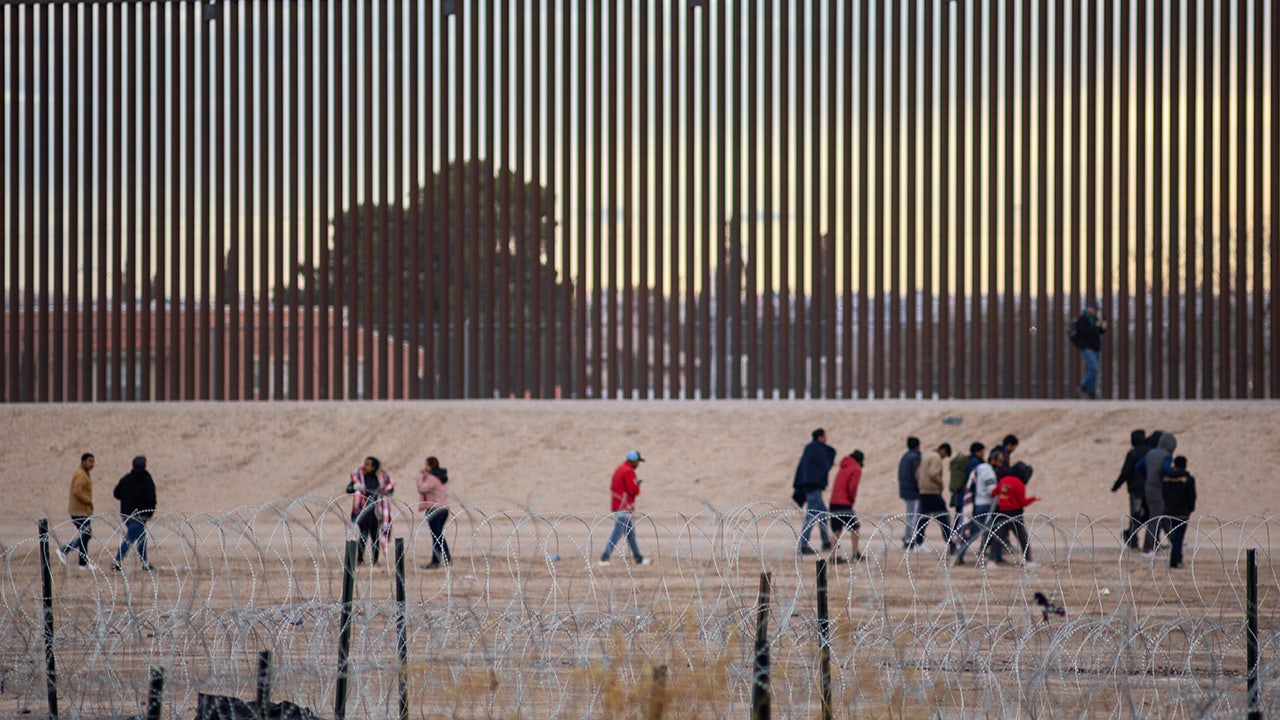
A large majority of illegal crossings at the southern border are now happening in Arizona and California, shifting away from Texas counties.
Sources with U.S. Customs and Border Protection told Fox News that over the last week of January, Border Patrol apprehended 32,809 illegal immigrants.
Per CBP sources, 23,576 of them – 71.8% – were in Arizona and California. Notably, the numbers in Texas’ Del Rio sector, which includes Eagle Pass, have fallen off a cliff. In December, the sector saw days of 3,000-4,000 illegal crossings per day. Over the last week, it has averaged around just 200.
The shift could be attributed to two reasons.
MAYORKAS, BLINKEN TO MEET WITH MEXICAN PRESIDENT TO TALK MIGRANT CRISIS AMID MASSIVE NUMBERS, NEW CARAVAN
Migrants attempt to cross the border into the U.S. despite heightened security measures, in Ciudad Juarez, Mexico, on Feb. 1, 2024. (David Peinado/Anadolu via Getty Images)
Texas has locked things down on their side of the border, and Mexico has increased enforcement against migrants arriving in the Mexican state of Coahuila following Secretary of State Antony Blinken’s visit to Mexico in December.
Mexico is now suddenly stopping migrants from boarding trains, and is removing migrants from their northern border down to their southern border following that meeting.
And the migrants who do cross there now find a very unwelcoming posture from the state of Texas with legions of soldiers, troopers and razor wire, as well as the threat of arrest. It is unknown what the U.S. offered Mexico in return for this cooperation.
Secretary of State Antony Blinken arrives at the Palacio Nacional in Mexico City, on Dec. 27, 2023, in hopes of tackling surging migration. (Rodrigo Oropeza/AFP via Getty Images)
According to the State Department, Blinken joined Secretary of Homeland Security Alejandro Mayorkas and White House Homeland Security Advisor Liz Sherwood-Randall at a meeting in Mexico City with Mexican President Andrés Manuel López Obrador to “discuss unprecedented irregular migration in the Western Hemisphere and identify ways Mexico and the United States will address border security challenges, including actions to enable the reopening of key ports of entry across our shared border.”
SUPREME COURT SIDES WITH BIDEN IN TEXAS BORDER RAZOR WIRE CASE; BORDER PATROL UNION BLASTS DECISION
Mexican President Andrés Manuel López Obrador attends a meeting with Secretary of State Antony Blinken, Secretary Alejandro Mayorkas and U.S. Ambassador Ken Salazar in Mexico City on Dec. 27, 2023. (Rodrigo Oropeza/AFP via Getty Images)
Blinken, according to the State Department readout, was to “reaffirm the United States’ commitment to the Los Angeles Declaration for Migration and Protection, and underscore the urgent need for lawful pathways and additional enforcement actions by partners throughout the region.”
However, the Mexican government enforcement has not happened in other areas of the border, and Border Patrol’s San Diego sector and Tucson, Arizona, sector are now seeing the most activity. For instance, on Wednesday, CBP sources told Fox News there were 5,240 Border Patrol apprehensions of illegal immigrants at the southern border. The sources said 3,854 of them – 73.5% – were in Arizona and California for that day.
The sources said none of the figures include CBP ports of entry/CBP One App or gotaways. The numbers represent only recorded Border Patrol apprehensions.
Workers set up a tent for processing asylum seekers along the U.S.-Mexico border fence on Jan. 30, 2024, in Jacumba Hot Springs, California. (Qian Weizhong/VCG via Getty Images)
Border security has taken center stage in numerous states and in Congress, where Republicans are conditioning aid to Ukraine on a border security deal, and pushing to impeach Mayorkas. President Biden has said that he would shut down the border if given the emergency authority to do so as part of a deal, but Republicans say the president already has the power to do it.
The Biden administration was handed a win by the Supreme Court last week in a decision allowing Border Patrol agents to cut concertina razor-wire that Texas had installed along the border near Eagle Pass while litigation continues. Part of the escalating standoff between the Biden administration and Texas over immigration enforcement, the Texas Military Department last month seized control of a city-owned Shelby Park in Eagle Pass, which had become one of the busiest spots for illegal crossings, and wouldn’t let federal agents enter.
Florida Gov. Ron DeSantis and South Dakota Gov. Kristi Noem offered to send personnel and other support to bolster Texas Gov. Greg Abbott’s security efforts at the U.S.-Mexico border.
The Associated Press contributed to this report.
Read the full article from Here


CHIMAYO, N.M. (KRQE) – A suspect is dead following a shooting involving the Rio Arriba County Sheriff’s Office in Chimayo on Highway 76. Deputies are said to be okay. New Mexico State Police is investigating the shooting.
KRQE News 13 will provide updates as they become available.
The Oregon Lottery offers several draw games for those aiming to win big.
Here’s a look at June 25, 2026, results for each game:
Winning Pick 4 numbers from June 25 drawing
1PM: 9-9-6-3
4PM: 5-1-5-7
7PM: 7-4-0-5
10PM: 9-1-2-4
Check Pick 4 payouts and previous drawings here.
Feeling lucky? Explore the latest lottery news & results
When are the Oregon Lottery drawings held?
- Powerball: 7:59 p.m. on Monday, Wednesday and Saturday.
- Mega Millions: 7:59 p.m. on Tuesday and Friday.
- Pick 4: 1 p.m., 4 p.m., 7 p.m. and 10 p.m. daily.
- Win for Life: 7:30 p.m. on Monday, Wednesday, and Saturday.
- Megabucks: 7:29 p.m. on Monday, Wednesday, and Saturday.
This results page was generated automatically using information from TinBu and a template written and reviewed by an Oregon editor. You can send feedback using this form.

SALT LAKE CITY (KUTV) — Earlier this month, 2News Investigates brought you a former inmate’s federal lawsuit alleging Utah Department of Corrections leaders failed to address reports of alleged sexual assault by correctional officers. Now, 2News Investigates examines another key claim in that lawsuit.
MORE: Federal lawsuit alleges Utah prison leaders covered up guards’ sexual assaults on inmates
The lawsuit alleges a mass cross-gender strip-search operation – women being viewed by men was intended to further silence female inmates.
Federal law generally prohibits cross-gender strip searches of female inmates except during emergencies or when conducted by medical personnel. UDC says that during body-search procedures, male correctional officers are not allowed in the immediate area and inmate privacy is maintained. Former inmates say that couldn’t be further from the truth.
Three former inmates agreed to speak with 2News Investigates but asked that their identities not be revealed.
“It was very traumatic.”
According to the lawsuit, on May 13, 2025, UDC carried out a large-scale operation known as a “reset” in women’s housing units at the Utah State Correctional Facility (USCF) in Salt Lake City.
Wendy: “They call it a reset. What do you call it?”
“A violation.”
“It’s like a rape.”
The lawsuit alleges UDC Deputy Warden Derick Zorn and Warden Sharon D’Amico directed the operation, along with more than a dozen members of the Critical Incident Response Team, or CIRT.
According to the plaintiffs, officers stormed dormitories, shouted profanities, and issued conflicting commands.
The women say and the lawsuit states they were ordered to pack their belongings into totes and change into state-issued uniforms in front of male CIRT officers. They were then marched to the Emerald Building for processing.
“It felt almost like we were at a concentration camp.”
The lawsuit alleges the women were required to undergo body scans and then strip completely naked. Plaintiffs claim they were ordered to lift their breasts, spread their buttocks, and cough while visible to male staff.
Women who were menstruating allegedly were instructed to remove menstrual products in full view of others.
“Just use one hand to remove it. Hold it up in front of you.”
“I felt really small and worthless.”
The lawsuit alleges some women were forced to hold soiled menstrual pads while performing physical maneuvers.
“I just did what I was told. I just wanted to get it over with.”
The plaintiffs also claim they were required to sit on toilets or squat to provide urine samples while completely naked and visible to male officers.
“It was humiliating. It was degrading.”
The lawsuit further alleges cell doors were left open, exposing naked women to other inmates and male staff.
An overhead observation booth with reflective glass overlooked the strip-search area. Plaintiffs say they observed movement inside and believed they were being watched from above.
The lawsuit alleges the female inmates were being watched from above during a mass strip search on May 13, 2025
“I could see in the overhead, the two-way mirror. There were multiple men walking around up there who had direct vision inside those cells.”
The lawsuit alleges Captain Jared Beers and Lieutenant Matthew Coombs were inside the booth and that Deputy Warden Derick Zorn observed women in various states of undress.
“I made eye contact with Officer Arroyo, and I also saw Deputy Zorn.”
“I knew if I could see the male officers, they could see me.”
One former inmate described the experience as state-sanctioned sexual violence.
“When that happens, and you’ve gone through the same kind of thing as a child, it’s very traumatic.”
The lawsuit alleges Warden D’Amico knew male officers were viewing naked female inmates and “ratified, condoned, and failed to stop it.”

An allegation in the lawsuit filed on May 15, 2026
“You’re pretty much a hostage.”
UDC Executive Director Jared Garcia declined repeated requests for an on-camera interview. A letter sent said:
“During the body search process in female living areas, male correctional officers are not allowed in the immediate area, and privacy is maintained. In general, resets are conducted routinely, according to UDC policy and under strict protocols designed to ensure safety while also preserving the privacy and dignity of incarcerated individuals.”
“The manner matters.”
Walter Mason represents the plaintiffs.
He told 2News Investigates, “The law protects inmates from being exposed to members of the opposite sex viewing their naked bodies unless there’s an emergency. Unless there’s what the law calls an exigent circumstance, the prison can take necessary actions to protect safety. There was no emergency. There was no exigency.”
UDC says the reset involved approximately 150 trained staff members and was conducted according to department policy.
UDC’s letter goes on to say:
“Every effort was made to treat belongings with care and document confiscated items appropriately. UDC stands by our methods and policies, which are intended to maintain the highest standards of integrity, safety, and efficiency during the reset process.”
Written response from the Utah Department of Corrections regarding 2News investigations
I asked UDC whether any exigent circumstances existed on May 13, 2025, during the reset operation.
The response:
“No exigent circumstances occurred on May 13, 2025.”
I also requested information about what items were confiscated. UDC said it could not provide a specific list.
Response to questions posed by 2News Investigates to UDC regarding mass strip search and if exigent circumstances existed that day
The lawsuit seeks a jury trial and accuses the defendants, all supervisors, of participating in a “coordinated effort to humiliate, mock, and psychologically degrade the plaintiffs … operating with a brazen and intentional disregard for clearly established law, fueled by an institutional custom of impunity.”
_____
-

 New Jersey3 minutes ago
1 injured after vehicle hits tree in West Deptford, NJ
-

 New Mexico6 minutes ago
1 dead following shooting involving Rio Arriba County Sheriff’s Office
-

 North Carolina11 minutes ago
Former Madison County chief deputy in North Carolina custody after Arizona arrest
-

 North Dakota18 minutes ago
North Dakota composer launches statewide virtual choir project
-

 Ohio21 minutes ago
UC Bearcats baseball playing Ohio State, Vanderbilt in Nashville in 2027
-

 Oklahoma26 minutes ago
Four arrested after 30 pounds of meth, dozens of animals seized from Oklahoma City home
-
Oregon33 minutes ago
Oregon Lottery Pick 4 results for June 25
-

 Pennsylvania36 minutes ago
Measles detected in two more counties in Pennsylvania as health department recommends early vaccination

