West
LA squatters take over luxury Hollywood Hills mansion, rent rooms to OnlyFans models: report

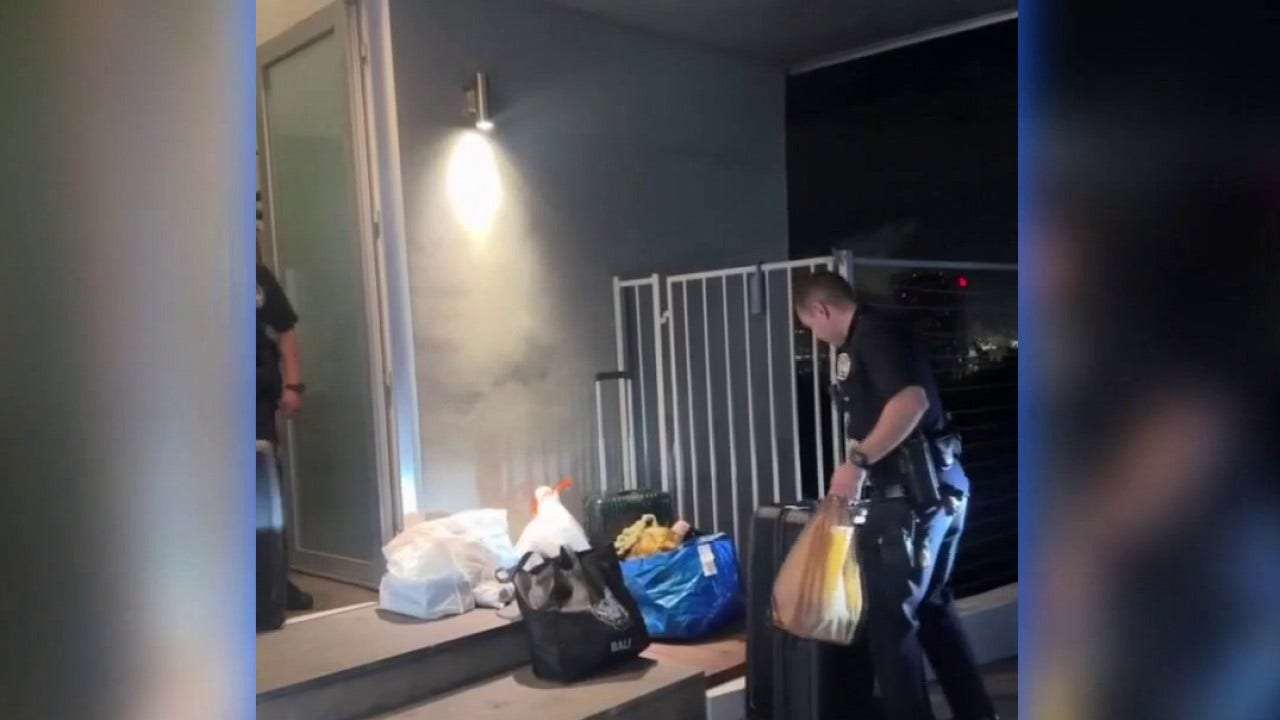
A squatter took over a luxury seven-bedroom Hollywood Hills home and created fake leases to rent out rooms to OnlyFans models, according to reports.
Real estate agents on the listing, Emily Randall Smith and her husband, told Fox 11 when they went to check in on the home in January, they noticed something strange.
“We walked up the property and the lock box was cut off. And there was a mailbox someone had ordered and put up. Like that was very weird, that was not here before,” Randall Smith told Fox 11.
The couple called the police when Randall Smith’s husband walked to the side of the house and spotted a man sleeping inside.
HANDYMAN-TURNED-SQUATTER HUNTER OUTLINES ‘NIGHTMARE SCENARIO’ WHEN MIGRANTS CATCH ON TO HOUSING LAWS
A luxurious seven-bedroom mansion in the Hollywood Hills was taken over by squatters where they even set up a business inside the home, Fox 11 reported. (FOX 11)
However, the couple said police were unable to get the man to leave, so they waited until he left on his own and called police again. That’s when they learned the squatter had allegedly written a fake lease allowing OnlyFans models to create their content in the house and rent rooms to them, according to the couple. They had also allegedly thrown wild parties.
“They knocked on the door and I guess some girl opened it, and she ended up being an OnlyFans model and I guess the guy who had broken into the house had started this whole business and was renting these rooms out to the girls,” Randall Smith said.
Police then escorted the woman, her dog and everyone’s belongings out of the house. But the Smiths were left with piles of filth to clean up.
Randall Smith claimed the squatters left human waste around the mansion, cut the cords to the security systems and even installed their own Wi-Fi.
No one was arrested that night in January, but Randall Smith hopes the person is caught.
GEORGIA REPUBLICANS TARGET ATLANTA SQUATTERS WITH HARD-HITTING BILL: ‘NO MORE FREE RIDES’
Police escorted a woman and her dog out of the property. Randall Smith tells Fox 11 that no one was arrested. (FOX 11)
A multi-million dollar home on the border of Beverly Hills was also taken over by squatters in January. Frustrated neighbors reported the group partying into all hours of the night.
California isn’t the only state seeing an increase in squatter problems.
Lawmakers in Georgia are taking aim at Atlanta’s squatting crisis with a proposed bill that would make the act a clear criminal offense as neighborhoods around the metro area continue to assess the situation with tied hands.
PENNSYLVANIA MAN PAYS RANSOM TO RECLAIM HOUSE FROM SQUATTERS: ‘THE CITY IS REWARDING CRIMINALS’
A home in Hollywood Hills was trashed by squatters, according to the LA PD. (Fox 11)
Approximately 1,200 homes have been taken over by squatters, according to the National Rental Home Council trade group, but with local law enforcement bound by tenant rights laws, homeowners have limited options to reclaim their property.
“Our country is so upside down in so many ways,” Flash Shelton previously told Fox News. “It’s not just squatters. There are a lot of issues that we need to deal with, and I don’t think we’re finding a way to deal with them.”
Shelton gained international fame last year after he posted a video showing how he turned the tables on squatters who had moved into his mother’s house in California while it was up for sale.
Fox News Digital reached out to the Los Angeles Police Department for more information on the incident at the Hollywood Hills mansion, but has not yet heard back.
Fox News’s Taylor Penley and Hannah Ray Lambert contributed to this report.
Read the full article from Here


PHOENIX — After years of negotiations, Arizona still doesn’t know what its long-term water future will look like, and now the federal government is preparing to step in.
States across the Colorado River Basin have failed to reach a deal on how to share the shrinking river after current operating rules expire in 2026. With no state-led agreement in place, federal officials are moving forward with their own plan, one that could bring steep cuts to Arizona’s water supply.
And for Arizonans, the clock is ticking to weigh in. Public comment remains open until March 2. To submit your comment on what the government should do, send your comments in email to crbpost2026@usbr.gov.
Additional information is available online. The project website can be accessed here, along with links to YouTube videos published by the government, recorded in January and February which walk through of the options available.
Many Arizona leaders have already offered their public comments, which are overwhelmingly negative.
“We were very disappointed with that document,” said Brenda Burman, the Central Arizona Project General Manager “If any of those alternatives were implemented, it would be very difficult, and perhaps devastating for Arizona.”
Arizona’s top Colorado River negotiator, Tom Buschatzke, echoed those concerns.
“None of those alternatives are very good for the state of Arizona,” Buschatzke said. “I’m not seeing how we’re going to break that stalemate.”
Congressman Juan Ciscomani also criticized the proposals, saying the impacts of Colorado River cuts extends into Pinal, and Pima counties.
“That’s not an acceptable solution for us,” Ciscomani said. “We want to play ball, but we want to make sure everyone across the board uses less and becomes more efficient.”
Some of the federal alternatives would reduce Arizona’s Colorado River supply by 40%, 50%, or in the most extreme case up to 70%.
Experts at ASU Kyl Center for Water Policy say part of the problem lies upstream.
“The reason for this current impasse is because the upper basin states have refused to take cuts in their Colorado River use,” said Sarah Porter, the center’s director.
Upper Basin states like Colorado and Utah rely on different water rules than Arizona and other Lower Basin states, complicating negotiations that have dragged on for years.
Arizona has already been living with cuts for several years. Since 2021, the state has faced an 18% reduction in Colorado River water deliveries due to a Tier 1 shortage declaration. Most of those cuts have fallen on Central Arizona Project users, including agriculture and some tribal communities.
Buschatzke argues that pushing Arizona into deeper reductions would violate long-standing Western water law.
“We will be protecting the state of Arizona,” he said. “And if that has to be litigation, it will be litigation.”
That means a lawsuit against the federal government, or upper basin states is now a real possibility if the final plan moves forward unchanged. The state legislature has put $3 million in a state fund for potential litigation on the Colorado River.
After the comment period closes, the federal government is required to review public feedback and issue a formal ‘Record of Decision’, likely sometime this summer. Advocacy groups say public feedback matters.
“I just encourage Arizonans to look at this document, understand what that means for your family, your businesses, and what it means for the future,” said Kyle Roerink of the Great Basin Water Network. “Then figure out if you want to advocate for one scenario over another.”
A new operating plan must be in place by October 1, setting the rules for how the Colorado River will be managed for years to come, and shaping Arizona’s water future in the process.
This story was reported on-air by a journalist and has been converted to this platform with the assistance of AI. Our editorial team verifies all reporting on all platforms for fairness and accuracy.

LOS ANGELES (KABC) — Worshippers across Los Angeles were met with an increased law enforcement presence on Sunday as police and sheriff’s deputies stepped up patrols outside mosques, synagogues and cultural landmarks following the strikes on Iran.
Local officials said there are no credible threats to Southern California, but the Los Angeles Police Department and the Los Angeles County Sheriff’s Department heightened visibility as a precaution to ensure communities stay safe.
More demonstrations tied to the attack on Iran are expected Sunday and Monday. Several protests were held across Southern California on Saturday.
READ MORE | Rallies for and against military action in Iran draw demonstrators across Southern California
While Iranian-Americans celebrated in Westwood, protesters gathered in downtown Los Angeles to oppose the Trump administration’s attacks against Iran.
While some groups gathered in downtown Los Angeles to protest the strikes, others assembled in Westwood to celebrate “the fall of the Ayotollah,” according to organizers.
Authorities said they will continue monitoring events as the region prepares for additional gatherings in the days ahead.
This is a developing story. This article will continue to be updated as more information becomes available.
Copyright © 2026 KABC Television, LLC. All rights reserved.
Colorado
Colorado lawmakers duel over data centers: Grant millions in tax breaks or regulate them without incentives?

Colorado lawmakers are deciding this year between two disparate approaches on data centers — one that aims to lure them to the Centennial State with millions of dollars in tax incentives and another that would implement some of the strictest statewide regulations in the country on the booming tech industry.
Either of the two competing bills would create the state’s first regulations specific to data centers. Sponsors of both bills say they hope to minimize environmental impacts from the power and water demands of the centers, while also ensuring that the cost of new infrastructure they need doesn’t wind up on residents’ electric bills.
Both bills are sponsored by Democrats but differ widely in what they’d do.
The bill supported by the data center industry — House Bill 1030 — would incentivize companies to comply with regulations in exchange for large tax breaks. The legislation would not regulate data centers whose owners forgo a tax break.
The other bill — Senate Bill 102 — would offer no incentives, instead imposing regulations on all large data center development across the state. It is supported by environmental and community groups.
“We want to make sure that as data centers come here, they come on our terms,” said Megan Kemp, the Colorado policy representative for Earthjustice’s Rocky Mountain office.
The bills have landed as debate over the future of data center regulation intensifies across the state. Data centers house the computer servers that function as the main infrastructure for the digital world. They crunch financial data, store patients’ health information, process online shopping, register sports betting and — increasingly — make possible the heavy data demands of artificial intelligence.
Several companies have begun construction on large data centers across the Front Range in recent years. A 160-megawatt hyperscale facility is under development in Aurora and could consume as much power as 176,000 homes once completed.
The construction of a 60-megawatt data center campus in north Denver has angered those who live by the site and prompted Denver city leaders last week to call for a moratorium on new data center development while they craft regulations for the industry. Larimer County and Logan County have enacted similar moratoriums.
Hundreds gathered Tuesday night at a community meeting about the northern Denver campus owned by CoreSite. Frustration in the crowd — which filled overflow rooms and the front lawn of the building that hosted the meeting — erupted as residents of the neighborhoods surrounding the center expressed concerns about how it would impact their air quality, power and water supplies.
Attendees said they did not know the data center was being built until they saw construction underway.
CoreSite leaders had planned to attend the meeting. But they pulled out of participating the day before because of safety concerns, company spokeswoman Megan Ruszkowski wrote in an email. She did not elaborate on the concerns. A Denver police spokesman said the department did not have any record of a police report filed by CoreSite in the days prior to the meeting.
CoreSite’s absence left officials from the city and utilities to answer the crowd’s questions and field their frustrations. City leaders told attendees that they had no say in whether the data center could be built because there are no city regulations specific to the industry.
“Data centers are proliferating quickly and we don’t know all the impacts,” said Danica Lee, the city’s director of public health investigations. “That’s why we need this moratorium.”
Promises of future regulation meant little to the residents of Elyria-Swansea, where the data center is scheduled to go online this summer. More than an hour into the meeting, a man took the microphone. He noted that so much of the conversation had focused on technicalities — but the information provided had not answered a question on many residents’ minds.
“How do we stop it now?” he asked, to a loud round of applause from the room.
Transformative opportunity?
Some in the state Capitol think more data centers would be beneficial for Colorado.
Supporters of the tax incentive bill in the legislature said luring the industry to Colorado would create high-paying jobs, help pay for electrical grid modernizations and strengthen local tax bases.
“This could be transformative for the state,” said Rep. Alex Valdez, a Denver Democrat who is one of HB-1030’s sponsors.
In exchange for complying with rules, data center companies would be exempted from sales and use taxes for 20 years for purchases related to the data center, like the expensive servers they must replace every few years. After two decades, the companies could apply for an extension to the exemption.
To earn the tax break, data center companies would have to meet requirements that include:
- Breaking ground on the data center within two years.
- Investing at least $250 million into the data center within five years.
- Creating full-time jobs with above-average wages, though the legislation doesn’t specify how many jobs would be required.
- Using a closed-loop water cooling system that minimizes water loss, or a cooling system that does not use water.
- Working to make sure the data center “will not cause unreasonable cost impacts to other utility ratepayers.”
- Consulting with the Colorado Department of Natural Resources about wildlife and water impacts.
While the bill would exempt data centers from sales tax on some purchases, they would still be on the hook for all other taxes, Valdez said, and would bring both temporary and permanent jobs. The bill does not specify how many permanent jobs must be created to qualify for the tax break.
Dozens of other states have enacted tax incentive programs for data centers. Such incentives are a key factor that companies weigh when deciding where to build, said Dan Diorio, the vice president of state policy for the Data Center Coalition, an industry group.
“Colorado is not competitive right now,” he said.
Figuring out the projected impact of the bill on the state’s finances gets complicated.
The legislature’s nonpartisan analysts estimated that the state would miss out on $92.5 million in sales tax revenue in the first three years, assuming a total of 17 data centers would qualify for the tax breaks in that time period.
But Valdez said that is revenue that the state otherwise wouldn’t see if the data centers weren’t built here. And the companies would still pay all other state and local taxes, he said.
“We see it as unrealized revenue, rather than a tax cut,” he said.
Some of that lost tax revenue would be offset by an increase in income taxes paid by low-income families, according to the bill’s fiscal note.
That’s because the projected decrease in sales tax revenue in the first year of the program would decrease the amount of money available for the state to provide its recently enacted Family Affordability Tax Credit. State law ties the amount available for the family tax credit to state revenue growth and whether the state collects money above a revenue cap set by the Taxpayer’s Bill of Rights. TABOR requires money above that level to be returned to taxpayers.
If the state doesn’t have excess revenue, it can’t fund that tax credit.
In the next fiscal year, which begins in July, data center companies would avoid paying $29 million in sales taxes, which would trigger a change in the family tax credit. Low-income families would be made to pay a total of $106 million more, the fiscal note estimates.
Bill sponsors are planning to address the fallout for the tax credit in forthcoming amendments, Valdez said.
“We’re not out to trigger any negative impacts to low-income families,” he said.

Baseline guardrails
Forgoing tax dollars during a state budget crisis is a hard sell to Rep. Kyle Brown, a Louisville Democrat sponsoring the regulatory bill. He and other supporters of SB-102 aren’t convinced tax incentives are necessary to bring data centers to the state.
Major construction projects are already underway, he said. In Denver, CoreSite chose not to pursue $9 million in tax breaks from the city but continued construction on its facility regardless.
“The point of our policy is (putting) reasonable, baseline guardrails on this development so it can be smart,” Brown said.
Brown last session co-sponsored a failed bill with Valdez that offered tax incentives to data centers. Since then, however, he’s seen other states that offer tax incentives express buyers’ remorse, he said.
Brown pointed to concerns in Virginia about rising electricity costs due to data center demand and a proposal by the governor of Illinois to suspend the state’s tax credit so that the impacts of the data center boom it sparked could be studied.
His bill this session — co-sponsored by Sen. Cathy Kipp, a Fort Collins Democrat — requires that data centers over 30 megawatts:
- Draw as much power as possible from newly sourced renewable energy by 2031.
- Pay for any additions or changes to the grid needed to serve the data center.
- Adhere to local rules about water efficiency.
- Limit the use of backup generators that consume fossil fuels; if such generators are necessary, they must be a certain type that limits emissions.
- Conduct an analysis of the data center’s impacts on local neighborhoods, engage in community outreach and sign a legally binding good-neighbor agreement if the community is disproportionately affected by pollution.
Owners of data centers would also need to report metrics annually to the Colorado Department of Public Health and Environment. They would cover the center’s annual electricity consumption, how much of that power came from renewable sources, the total number of hours backup generators were used and annual water use.
Utilities, too, would face additional requirements.
The legislation would ban utilities from offering discounted rates to large data centers. It also would prohibit them from supplying electricity to a data center if doing so would affect the utility’s ability to provide power to its other customers — or its ability to meet state emissions reduction goals.
Environmental groups supporting the bill say the state needs regulations to make sure the increased electrical demand generated by data centers doesn’t expand the state’s use of fossil fuels or slow the retirement of fossil fuel-powered plants.
If not done thoughtfully, the groups said, the increased electrical load could imperil the state’s climate goals.
“What we need to avoid is a race to attract data centers that turns into a race to the bottom,” said Alana Miller, the Colorado policy director for the Natural Resources Defense Council’s climate and energy program.
If the legislature enacts SB-102, it would implement the strictest data center regulations in the country and would ward off future data center development, Diorio said. He sees many of the rules as unattainable.
“It would make it nearly impossible to develop a data center in the state of Colorado,” he said.
Conversations between the sponsors of the two bills are underway, Valdez and Brown said. Both expressed hope that a consensus could be found between the two pieces of legislation.
Neither bill had been scheduled for a committee hearing.
Stay up-to-date with Colorado Politics by signing up for our weekly newsletter, The Spot.
Here’s how to give public comment on future Colorado River plans

Arkansas Bested by Mizzou on Sunday

More SoCal rallies for and against military action in Iran expected on Sunday and Monday

Colorado lawmakers duel over data centers: Grant millions in tax breaks or regulate them without incentives?

Two people shot in New Haven restaurant Saturday evening

Florida High School Football Rankings: Top 25 teams – Oct. 21

Cleary's 21 help Le Moyne down Central Connecticut State 69-64 in OT

How old is Bo Nix? What to know about Oregon quarterback ahead of 2024 NFL Draft

99th annual Pony Swim held in Virginia

Indiana Members Credit Union announced as new anchor tenant at Bottleworks District

Video: What the Texas Primary Battle Means for the Midterms

Dems’ potential 2028 hopefuls come out against US strikes on Iran

At least nine killed after Iranian strike on Israel’s Beit Shemesh

Mass shooting at Austin, Texas bar leaves at least 3 dead, 14 wounded, authorities say

Mamdani’s response to Trump’s Iran strike sparks conservative backlash: ‘Rooting for the ayatollah’
-

 World4 days ago
Exclusive: DeepSeek withholds latest AI model from US chipmakers including Nvidia, sources say
-

 Massachusetts4 days ago
Mother and daughter injured in Taunton house explosion
-

 Montana1 week ago
2026 MHSA Montana Wrestling State Championship Brackets And Results – FloWrestling
-

 Denver, CO4 days ago
10 acres charred, 5 injured in Thornton grass fire, evacuation orders lifted
-

 Louisiana7 days ago
Wildfire near Gum Swamp Road in Livingston Parish now under control; more than 200 acres burned
-

 Technology1 week ago
YouTube TV billing scam emails are hitting inboxes
-

 Technology1 week ago
Stellantis is in a crisis of its own making
-

 Politics1 week ago
OpenAI didn’t contact police despite employees flagging mass shooter’s concerning chatbot interactions: REPORT