West
Kidnapping, intimidation, murder: Accusations against Honolulu man provide glimpse into Hawaii's underworld

A U.S. prosecutor revealed a possible glimpse into Hawaii’s underworld on Monday as he outlined the crimes a Honolulu businessman is accused of orchestrating: the kidnapping of a 72-year-old accountant who owed a debt, the release of a toxic chemical into a rival’s nightclubs and the killing of his late son’s best friend, among them.
Michael Miske Jr. was arrested in 2020, along with seven people whom prosecutors described as associates. But following a series of guilty pleas by the others — including a plea deal signed by his half-brother on Saturday — the trial opened with Miske as the lone defendant.
“The defendant used fear, violence and intimidation to get what he wanted,” Assistant U.S. Attorney William Akina said in his opening statement. “What he wanted was money, control and revenge.”
HAWAII MAHUNT FOR FELON OUT ON BAIL ENDS IN FATAL POLICE SHOOTOUT
Miske’s attorney, Michael Kennedy, painted a completely different picture of his client.
Miske, 49, wasn’t a crime lord, but rather a “self-made man” who, despite growing up “on the wrong side of the tracks,” successfully built a family business called Kamaʻaina Termite and Pest Control, Kennedy said in his opening statement.
The company saved iconic Hawaii structures and “cultural treasures,” including outdoor theater Waikiki Shell, ʻIolani Palace and the Polynesian Cultural Center, Kennedy said. Miske even fumigated a Honolulu concert hall for free after the city couldn’t afford the $200,000 estimate, Kennedy said.
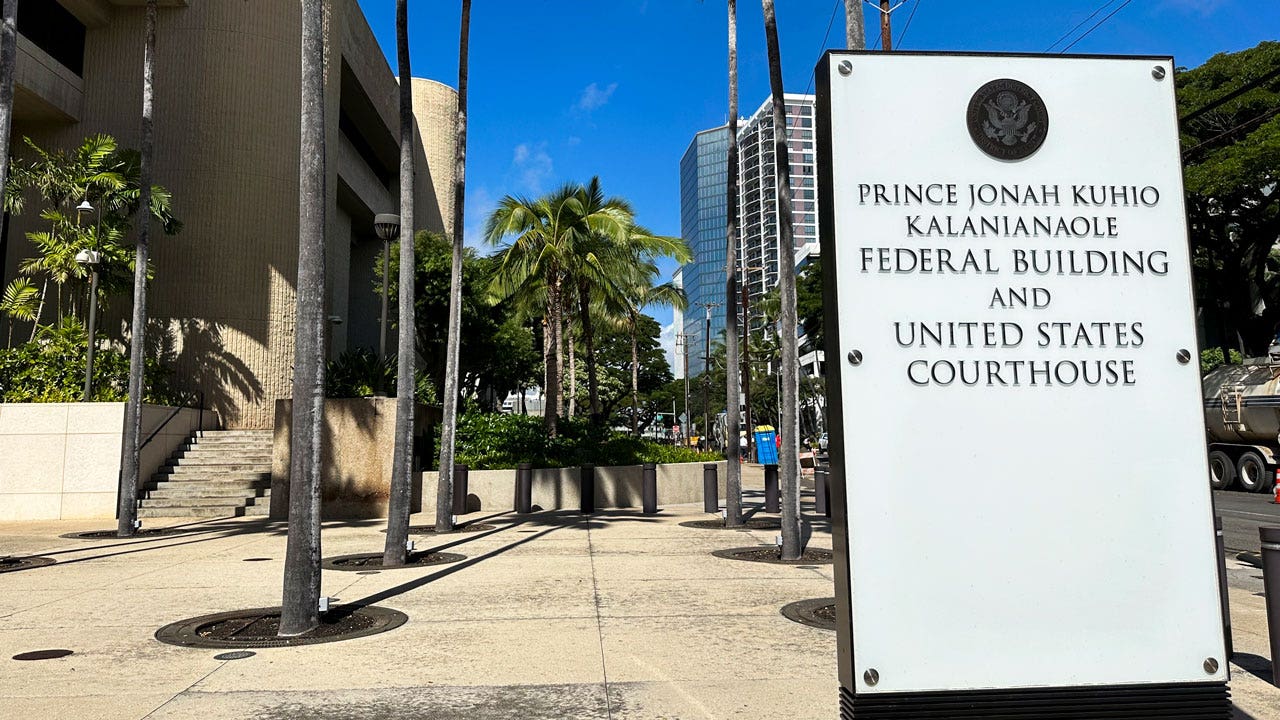
Seen here is a sign for the Prince Jonah Kuhio Kalanianaole Federal Building and Courthouse on Jan. 22, 2024, in Honolulu. The ongoing trial of Michael Miske Jr. could provide a peek into Hawaii’s criminal underworld. (AP Photo/Jennifer Kelleher)
Akina alleged that Miske also owned several nightclubs where disputes over bar tabs would be met with physical assault from his “thugs.” In addition, he made millions selling illegal commercial-grade aerial fireworks on the black market, Akina said.
The businessman also groomed people from his Waimanalo neighborhood to violently rob drug dealers and carry out other orders, the prosecutor said.
Akina said Miske ordered hits on people, and though many were never carried out, at least one was: the 2016 killing of Johnathan Fraser, best friend to Miske’s only son, Caleb. Miske had long thought Fraser was a bad influence on Caleb, and blamed Fraser when the friends got into a car crash in 2015 that led to Caleb’s death, Akina said.
HAWAII MAN ACCUSED OF ATTEMPTED MURDER STEALS CAR AT GUNPOINT, DIES AFTER FIREFIGHT WITH POLICE
“There could be only one price to pay for the death of the defendant’s son,” Akina said. “A life for a life.”
An indictment alleges that Miske purchased a boat to dump Fraser’s body into the ocean, though the body has never been found.
Kennedy told jurors on Monday that Miske didn’t blame Fraser for the crash and had nothing to do with his disappearance.
The people who will be testifying against Miske have something to gain from authorities, Kennedy said, referring to plea deals made by his alleged associates.
“Lies are going to rain down into this courtroom from that stand,” he said.
Testimony is scheduled to begin Tuesday.
Opening statements proceeded despite a motion filed Sunday night by Miske’s defense team. His attorneys argued that a new jury should be selected because Miske’s half-brother John Stancil pleaded guilty after a jury had been assembled and sworn and Miske’s daughter-in-law Delia Fabro Miske pleaded guilty after four days of jury selection.
Defense attorney Lynn Panagakos noted that Stancil pleaded guilty early Monday before the courthouse was even open to the public.
U.S. District Chief Judge Derrick Watson denied the motion.
Read the full article from Here


PORTLAND, Ore. — A New Jersey man was sentenced to federal prison last Friday for conspiring to distribute fentanyl, announced U.S. Attorney Scott E. Bradford for the District of Oregon.
Mark T. Eager, 34, was sentenced to 135 months in federal prison and five years of supervised release.
“This defendant showed a blatant disregard for human life by trafficking fentanyl across the United States,” said U.S. Attorney Bradford. “My office will continue to pursue those who profit from poisoning our communities, and we will use every available resource and partnership to combat fentanyl trafficking and keep Oregonians safe.”
“This investigation brought together law enforcement agencies from across the nation,” said Homeland Security Investigations (HSI) Seattle acting Special Agent in Charge April Miller. “Homeland Security Investigations special agents from Portland, Newark, and Houston contributed to the case, along with the Portland Police Bureau and HIDTA HIT officers, who were instrumental in identifying Eager. His 11-year sentence sends a clear message: no matter where you are in the country or the world, if you attempt to sell narcotics online to Americans, we will find you.”
“Fentanyl trafficking poses a grave threat to communities across the United States, and Homeland Security Investigations is committed to working with our partners to disrupt and dismantle the criminal networks responsible,” said HSI Houston Special Agent in Charge Lucia Cabral-DeArmas. “This case demonstrates the power of interagency collaboration under the Homeland Security Task Force initiative, leveraging resources from across the country to hold traffickers accountable and protect the American people. We will continue to pursue those who endanger lives through the distribution of dangerous synthetic opioids, and we remain steadfast in our mission to safeguard our communities from the violence and instability caused by transnational criminal organizations.”
“By following this offender’s digital trail, Homeland Security Investigations and our law enforcement partners nationwide executed federal search warrants, dismantled an active dark web fentanyl packaging operation and recovered deadly amounts of fentanyl, thousands of dollars in cryptocurrency, and a trove of electronic devices and packaging materials,” said HSI Newark Acting Special Agent in Charge Spiros Karabinas. “This case is a powerful example of how coordinated, data-driven investigations can disrupt dangerous networks and help protect our communities from lethal synthetic opioids.”
According to court documents, from November 2023 through June 2024, Eager and his co-conspirator sold fentanyl on the Dark Net and Telegram. Eager operated as the vendor WRSEH10 and marketed the fentanyl as “China White Synthetic Heroin.”
In June 2024, HSI agents executed search warrants on two residences associated with Eager in Kearny, New Jersey, and seized over 360 grams of powdered fentanyl, counterfeit M30 pills, drug ledgers, cellular phones, two computers, and drug packaging consistent with three deliveries that were sent to Oregon.
On September 4, 2024, a federal grand jury in Portland returned a four-count indictment charging Eager with conspiracy to distribute and possess with intent to distribute fentanyl and distribution of fentanyl.
On February 4, 2026, Eager pleaded guilty to conspiracy to distribute and possess with intent to distribute fentanyl.
HSI Portland and HSI Houston investigated this case with assistance from HSI Newark, the Portland Police Bureau (PPB) and the High Intensity Drug Trafficking Area (HIDTA) Interdiction Task Force (HIT). Assistant U.S. Attorney Scott Kerin prosecuted the case. The U.S. Attorney’s Office in New Jersey assisted the U.S. Attorney’s in Oregon in obtaining the search warrants that were executed in Kearny.

SALT LAKE CITY — Lucas Horns points over a fence on Main Street toward an empty lot with a blue shipping container on it, tucked between downtown Salt Lake City’s tallest buildings.
That container, he explains, will serve as a makeshift bar on Thursdays and Fridays through the remainder of summer, set up next to a live music stage and a space that will be dedicated to various lawn games for people of all ages. The Utah Museum of Contemporary Art will provide some art as part of an outdoor sculpture and food and drink venue combination aimed to liven up an otherwise dead space.
“Our hope is just to add to the ecosystem,” said Horns, program director for the Blocks, a joint venture between Salt Lake City and Salt Lake County to develop arts and culture programs within the downtown area.
The Blocks is launching what it calls the “Art Garten” in the lot of the old Utah Pantages Theater, 144 S. Main, beginning this week. It’s a free event that blends a beer garden with live music, art and games for all ages.
A DJ will be spinning hits from 5 p.m. to 8 p.m. on Thursday, while live music from the steps of the Eccles Theater across the street will fill the air during the same hours on Friday. A rotating list of DJs and live bands will fill in the space during the same hours twice a week for the next few months.
The event will include a rotating food truck lineup, along with cornhole, giant chess and other lawn games for people of all ages. The Blocks didn’t want to compete with bars and restaurants, so the hours hit around happy hour, while also being friendly for people with families, Horns said.
“We were interested in adding something new to downtown,” he told KSL. “There aren’t a lot of spaces where families can go, and the parents can grab a beer and hang out while their kids play lawn games. That’s kind of a rarity in Utah, and especially downtown, so I think we’re filling an important niche.”
At the same time, it livens up a piece of Main Street that’s been lifeless for years.
The Utah Pantages Theater was demolished in 2022, amid a last-second effort to preserve the century-old building. Salt Lake leaders approved a $0 sale of the building to international real estate firm Hines and local developer Joel LaSalle in 2019, setting the stage for a proposed 31-story residential high-rise on Main Street.
However, the project stalled with the market. “Unprecedented market changes,” such as record inflation, emerged at approximately the same time as the theater was demolished, making it difficult to secure financing for the project off the ground, a spokesperson for Hines told KSL in 2024.
The situation hasn’t changed much since then, leaving Main Street with a vacant lot blocked off by a large wooden board for years. Some of the lessons from “Open Streets” and other downtown activation events helped piece together an event to use the space while it remains vacant.
“We’re excited just to be able to do a pop-up park like that in that location on Main Street, with programming unlike anything else we’ve done on Main Street,” said Dee Brewer, director of the Salt Lake City Downtown Alliance. “I’m really excited to see how the public responds.”
Hines cleared the space for the event, which will continue on Thursdays and Fridays through the end of September. Horns and Brewer say they expect the venue to return next year and potentially longer, depending on how long the tower project remains on pause.
It may not be the perfect solution to a development holdup, but they believe it’s an upgrade from the current situation.
“A blank, empty wall is never good for walkability or for the urban environment,” Horns said.
The Key Takeaways for this article were generated with the assistance of large language models and reviewed by our editorial team. The article, itself, is solely human-written.

Beirut, Lebanon – On Tuesday, representatives from Lebanon and Israel met at the US Department of State in Washington, DC – the first session of a two-day round of negotiations that Lebanese negotiators hope will end an invasion of their country.
The negotiations, which started at 9am local time (13:00 GMT), come as Israel’s invasion of Lebanon pushes deeper than at any point since the year 2000 and as Hezbollah and Israel continue to trade attacks. Israel has killed 3,468 people in Lebanon since March 2, according to Lebanon’s Ministry of Public Health.
With the war raging on, what do Lebanon and Israel have to discuss and will the talks lead to an end of the Israeli assault?
Here’s everything you need to know.
What will Israel and Lebanon discuss?
Similar to past meetings, the two sides are ostensibly looking to come to some kind of deal following fighting between Israel and Hezbollah, with strong doubts it will be achieved.
Lebanon’s government is still pushing for a total ceasefire. However, as talks started, Israel was striking various parts of southern Lebanon. Lebanon is also trying to get Israel to withdraw from Lebanese territory in the south, so that more than 1.2 million displaced people can return home, and so the state can resume finding a way to disarm Hezbollah and rebuild areas devastated by Israeli attacks.
Israel is meanwhile looking to get assurances that Lebanon will disarm Hezbollah, a prospect analysts say Israel knows is complicated by the continuation of its military operations and occupation of swaths of southern Lebanon. Instead, Israel appears to be trying to fuel sectarian tensions inside Lebanon, leading to chaos and internal strife.
What has happened so far?
An initial meeting took place in April between Israel and Lebanon’s ambassadors to the United States. A second round took place in May with a larger delegation on both sides.
On Friday, a meeting took place with Lebanese and Israeli military representatives, while Hezbollah, the Iranian-backed Lebanese group, is not involved in the meetings.
Israel claimed the two sides found common ground in that they both wanted to see Hezbollah disarmed. Some Israeli officials suggested there may soon be trade agreements and an exchange of tourists between the two countries. Lebanon, however, said it preferred to find a deal closer to the 1949 armistice agreement between the two countries.
In the last meeting, Beirut reportedly outlined the damage done by Israeli attacks since the 2024 ceasefire agreement and presented detailed maps showing homes destroyed or razed by Israel.
Is there a chance for a ceasefire?
That remains to be seen, but for now, Israel’s Prime Minister Benjamin Netanyahu said his country’s military would continue attacking Lebanon.
On Monday, Netanyahu announced that attacks on Beirut’s southern suburbs would resume, despite a ceasefire. Apart from two targeted attacks, Israel has not struck the suburbs, known as Dahiyeh, since April.
Iran, which has attempted to include Lebanon in a wider ceasefire between themselves, on one side, and Israel and the US on the other, then intervened by threatening to attack northern Israel.
US President Donald Trump reportedly intervened to stop Israel’s attacks. He announced another ceasefire, after his previous announcement of one between Israel and Lebanon on April 16, after claiming he had gotten the approval of Netanyahu and spoken to Hezbollah.
“There will be no troops going to Beirut, and any troops that are on their way have already been turned back,” Trump announced on his social media platform, Truth Social.
But attacks from Israel and Hezbollah are continuing.
How do Lebanese people feel about the talks?
Not everyone is on the same page.
Some Lebanese support the talks and say they are the only option the state, which has little leverage, has. Among those who believe direct talks are the best way forward are Lebanon’s President Joseph Aoun and Prime Minister Nawaf Salam.
“There is no option other than negotiation,” Aoun said in a statement on Tuesday.
Others, however, oppose direct talks. Parliament Speaker Nabih Berri and his allies, Hezbollah, have said indirect talks are preferred and that negotiations cannot be conducted while attacks are ongoing.
How are Iran and the US connected?
Israel and the US attacked Iran on February 28, killing the country’s longtime leader Ayatollah Ali Khamenei.
Iran is Hezbollah’s primary benefactor, and two days after Khamenei’s assassination, Hezbollah fired six rockets towards Israel on 2 March.
Hezbollah’s response brought a huge response from Israel, who have crossed the Litani River – the supposed buzzer zone in southern Lebanon it had created – towards the Zahrani River.
Despite a 2024 ceasefire, Israel had never stopped attacking Lebanon, while Hezbollah had only responded once in December 2024.
Iran has attempted to include Lebanon in the ceasefire deal it has with the United States and Israel, who say this theatre is not part of the agreement.
Although Trump has now announced a ceasefire between Hezbollah and Israel twice, the invasion of southern Lebanon continues.
Are there other actors involved?
Gulf states have also intervened. Saudi Arabia has been working behind the scenes to get Lebanon’s leadership – Aoun, Salam and Berri – on the same page. Meanwhile, analysts say Saudi Arabia and Qatar engaged the Trump administration to stop an escalation in Lebanon.
-

 North Carolina7 minutes ago
The Real Reason North Carolina’s GOP Is Proposing the Most Radical Anti-Abortion Bill Yet
-

 North Dakota10 minutes ago
10 Small Towns In North Dakota Were Ranked Among US Favorites
-

 Ohio15 minutes ago
Central Ohio family sues Hilliard funeral home after mother mistakenly cremated
-
 Oklahoma22 minutes ago
Oklahoma AG files petition to block proposed smelting project in Inola
-

 Oregon25 minutes ago
New Jersey man sentenced in Oregon federal court for conspiring to distribute fentanyl
-

 Pennsylvania30 minutes ago
Digital News Publishers Launch Pennsylvania Independent News Association (PiNA) to Advocate for Local News Organizations – Saucon Source
-

 South-Carolina35 minutes ago
South Carolina store owner found not guilty of murder in fatal shooting of Black teen
-

 Rhode Island37 minutes ago
Flight restrictions over World Cup sites: Unpermitted drones could be destroyed if they fly in certain areas – The Boston Globe

