Hawaii
Watumull: The Indian family that built a business empire in Hawaii from scratch


 Flickr/East-West Center
In 1915, 29-year-old Indian entrepreneur Jhamandas Watumull arrived in Hawaii’s Honolulu island to set up a retail shop of his import business with his partner Dharamdas.
The two registered Watumull & Dharamdas as a business on Honolulu’s Hotel Street, selling exotic goods like silks, ivory crafts, brassware and other curios from the East.
Dharamdas died of cholera in 1916, prompting Jhamandas Watumull to send for his brother Gobindram to manage their Honolulu store while he took care of their business in Manila. Over the next several years, the brothers would travel between India and Hawaii as they solidified their business.
Today, the Watumull name is ubiquitous on the islands – from garment manufacturing and real estate to education and arts philanthropy, the family is inextricably linked with Hawaii’s rich history.
The first South Asians to move to the island from India, they are now one of its wealthiest families.
“Slowly, slowly, that’s how we did it,” Jhamandas told a local Hawaiian publication in 1973.
Born in pre-independent India, Jhamandas was the son of a brick contractor in Sindh province’s Hyderabad (now in Pakistan). The family was educated but not wealthy. After an accident paralysed his father, Jhamandas’ mother bought his passage to the Philippines where he began working in textile mills. In 1909, he began his own trading business in Manila with his partner Dharamdas.
His grandson JD Watumull says Jhamandas and Dharamdas moved to Hawaii after a drop in their Manila business after the US, which occupied Philippines at the time, curtailed ties with foreign businesses.
Their Hawaii business was renamed East India Store soon after Jhamandas’ brother Gobindram began managing it. In the following years, the business expanded into a major department store with branches in several parts of Asia as well as Hawaii, says SAADA, a digital archive of South Asian American history.

 Getty Images
In 1937, Gobindram built the Watumull Building in Honolulu’s Waikiki neighbourhood to house the company’s headquarters. According to SAADA, the multi-million-dollar business had expanded to 10 stores, an apartment house and assorted commercial developments by 1957.
The Star-Bulletin newspaper describes products at the store – linens, lingerie, brass and teak wood curios – as woven with “romance and mystery” that transported one “to distant lands and fascinating scenes”.
The Aloha shirts
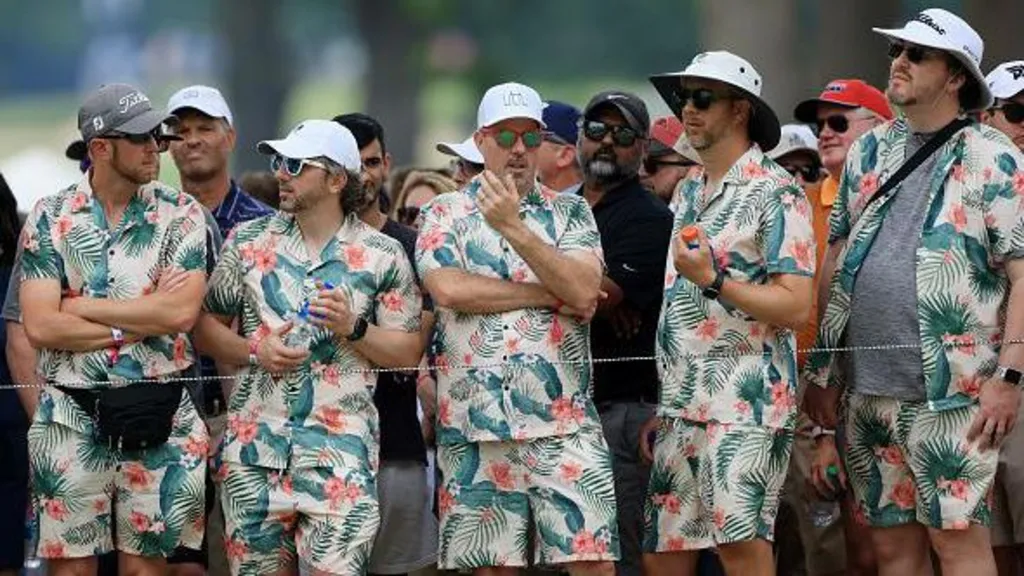
As Hawaii emerged as a popular destination for wealthy tourists in the 1930s, shirts in bold colours with island motifs called the ‘Aloha shirt’ became a sought-after souvenir.
According to Dale Hope, an expert in Hawaiian textile and patterns, the Watumull’s East India Store was one of the first on the island to carry designs with Hawaiian patterns.
The designs were first commissioned in 1936 by Gobindram from his artist sister-in-law Elsie Jensen.
“Instead of Mount Fuji, she’d have Diamond Head, instead of koi [she’d] have tropical fish, instead of cherry blossoms [she’d] have gardenias and hibiscus and all the things we know here,” Hope said.
The designs were sent to Japan where they were handblocked onto raw silk, Nancy Schiffer writes in the book Hawaiian Shirt Designs.
“These subtle floral patterns, modern and dynamic in concept, were the first Hawaiian designs to be produced commercially,” Schiffer notes.
“They were sold by the boat load and were exhibited as far away as London,” William Devenport says in the book Paradise of the Pacific.
Gobindram’s daughter Lila told Hope that the Watumull’s Waikiki store had American movie stars Loretta Young, Jack Benny, Lana Turner and Eddie “Rochester” Anderson coming to buy these shirts.
“More and more we are finding out that Watumull has become a synonym for Hawaiian fashions,” Gulab Watumull said in a 1966 interview in the Honolulu Star-Bulletin.
The Watumulls soon bought the Royal Hawaiian Manufacturing Company, where the first matching family aloha wear was created.
 Getty Images
Long road to citizenship
Despite their success, it would be decades before the Watumull brothers – Jhamandas and Gobindram – received US citizenship. Their early years in the country were marred by discrimination and difficult immigration laws, the Hawaii Business Magazine wrote.
In 1922, Gobindram married Ellen Jensen, an American, whose citizenship was stripped under the Cable Act for marrying an immigrant who was not eligible for US citizenship. Jensen would go on to work with the League of Women Voters to reform the law and regain citizenship in 1931.
Gobindram would become a citizen in 1946 when a law allowing Indians to gain citizenship through naturalisation was enacted.
His brother Jhamandas, meanwhile, continued to split much of his time between India and Hawaii.
During India’s 1947 partition, the Watumull family moved from Sindh to Bombay (now Mumbai), leaving much of their property behind, SAADA says.
Jhamandas’ son Gulab eventually arrived in Hawaii to work in the family business and become its head.
In 1955, the brothers split the business with Jhamandas and Gulab keeping its retail portion while Gobindram’s family took over its real estate section.
Jhamandas moved permanently to Hawaii In 1956, a few years after the death of his wife and one of their sons, and in 1961, became a US citizen.
 Getty Images
India connect
Over the years, the family remained invested in the welfare of India and its people. Gobindram was an active member of the Committee for India’s Freedom and often travelled to Washington to support the country’s case for independence, Elliot Robert Barkan writes in Making it in America.
Gobindram’s home in Los Angeles was “a Mecca for people concerned with Indian independence”, Sachindra Nath Pradhan notes in the book India in the United States.
The Watumull Foundation in 1946 sponsored a series of lectures by Dr S Radhakrishnan – who later served as India’s president – at American universities.
Gobindram’s wife Ellen was instrumental in bringing an international parenthood conference to Delhi in 1959, leading to the establishment of the country’s first birth control clinics.
The family’s philanthropy has and continues to include funding for educational institutions in Hawaii and in India, endowments for Honolulu-based art programmes and promoting Indian-Hawaiian exchange.
 Getty Images
Many of the Watumull brothers’ grandchildren now work in and around Hawaii.
In the past few years, as the family business shifted focus to real estate, the last Watumull retail store closed in 2020. The company thanked its customers “for years of good business and good memories”.
Watumull Properties purchased a 19,045 sq m (205,000 sq ft) marketplace in Hawaii last year. JD Watumull, the president of the company, said, “The Hawaiian Islands continue to be our family’s focus today and in the future.”
Follow BBC News India on Instagram, YouTube, Twitter and Facebook.


HONOLULU (HawaiiNewsNow) – A car rammed into Sunshine Market, off Lusitana Street, around 5:45 a.m., on Thursday, according to the Honolulu Fire Department.
Responding firefighters and police officers secured the area, helped the tow truck service remove the blue vehicle, and provided stabilization to the building.
HFD says the building owner requested the building to be sealed.
The scene was cleared by 9:46 a.m., and no one was injured.
Copyright 2026 Hawaii News Now. All rights reserved.
Hawaii
Concert in the Sky anchors Kauai’s July Fourth mix of celebration and care | Honolulu Star-Advertiser


On 18 March 1959, Hawaii was brought into the United States of America as the 50th state with the passing of the Hawaiian Admission act.
Five months later, on 21 August it was officially proclaimed the 50th state by President Eisenhower.
Former governor of Hawaii, John Waihe’e, tells Jen Dale his memories of statehood and why Hawaii’s history with America means it has become a divisive issue.
Eye-witness accounts brought to life by archive. Witness History is for those fascinated by and curious about the past. We take you to the events that have shaped our world through the eyes of the people who were there.
For nine minutes every day, we take you back in time and all over the world, to examine wars, coups, scientific discoveries, cultural moments and much more.
Recent episodes explore everything from how the Excel spreadsheet was developed, the creation of cartoon rabbit Miffy and how the sound barrier was broken.
We look at the lives of some of the most famous leaders, artists, scientists and personalities in history, including: the moment Reagan and Gorbachev met in Geneva, Haitian singer Emerante de Pradines’ life and Omar Sharif’s legendary movie entrance in Lawrence of Arabia.
You can learn all about fascinating and surprising stories, like the invention of a stent which has saved lives around the world; the birth of the G7; and the meeting of Maldives’ ministers underwater. We cover everything from World War Two and Cold War stories to Black History Month and our journeys into space.
(Photo: President Eisenhower signs the proclamation admitting Hawaii as the 50th state. Credit: Getty/Bettmann)
-

 Maine3 minutes ago
Magalloway Conservation Project in western Maine nearing completion
-
 Maryland6 minutes ago
Baltimore Gas and Electric seeks $8 monthly rate increase for Maryland customers
-

 Michigan11 minutes ago
Michigan lawmakers work through the night on ‘compromise’ budget
-

 Massachusetts18 minutes ago
Massachusetts city imposes curfew ahead of historic World Cup match
-
Minnesota21 minutes ago
Where to watch Minnesota Lynx vs New York Liberty on July 3: TV channel, start time and streaming
-

 Mississippi26 minutes ago
List of Jackson area events to celebrate July 4th before firework shows
-

 Missouri33 minutes ago
Most Missouri state and Columbia offices closed Friday; Columbia parking meters will not be enforced during Fourth of July weekend | 93.9 The Eagle
-

 Montana36 minutes ago
Dodging rocks and chasing memories on Montana’s Smith River

