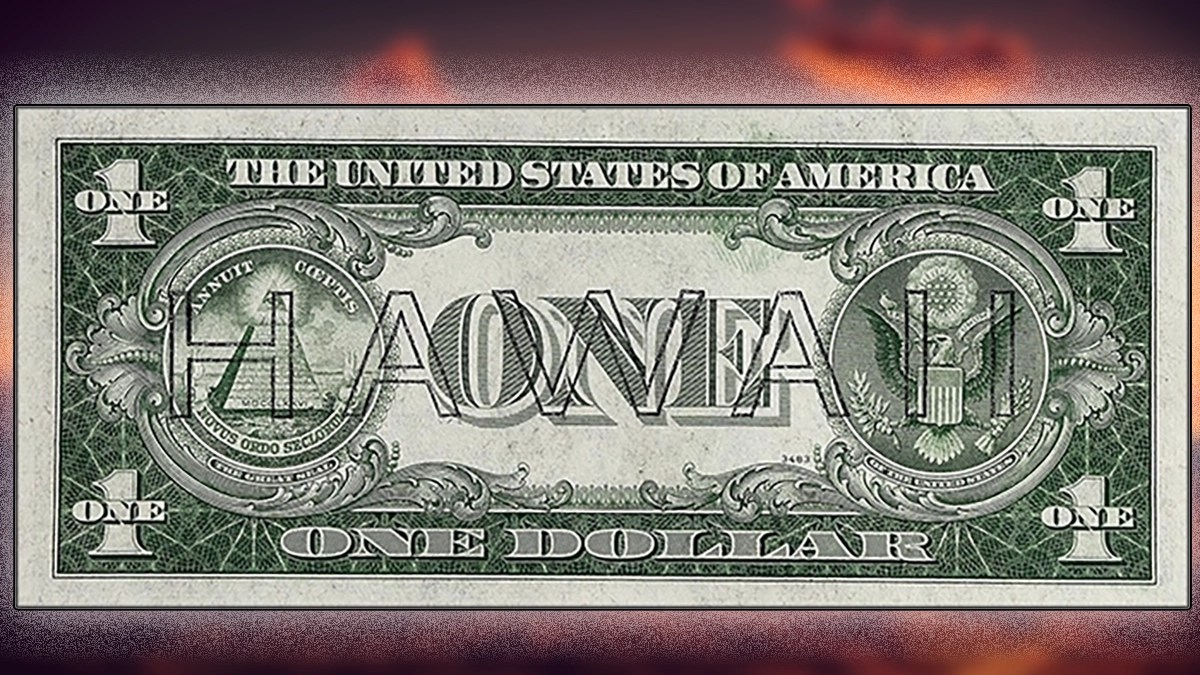
Hawaii Overprint Currency Notes (or Hawaii Wartime Notes; or United States Currency, Hawaiian Series; or Emmons Notes) were an emergency currency issued by the United States Treasury Department in the territory of Hawaii starting on June 25, 1942, and continuing until the lifting of currency restrictions on October 21, 1944.
The Attack on Pearl Harbor, Martial Law, and the Economic Defense
Following the Japanese attack on Pearl Harbor on December 7, 1941, the island territory of Hawaii was placed under martial law. Fearing an imminent invasion, Hawaiian Territorial Governor J.B. Poindexter, who had been appointed to the position on March 1, 1934 by President Franklin D. Roosevelt, ceded most of his administrative powers to the United States Army. The military government was installed by General Thomas H. Green of the U.S. Army Judge Advocate General’s Corps. Lieutenant General Walter Short appointed himself military governor and was relieved 10 days later. Replacing Short was Lieutenant General Delos C. Emmons.
Territorial Governor J.B. Poindexter. Image colorized by CoinWeek.
Martial law imposed severe restrictions on the islanders, such as the suspension of the civilian court system and the systemic discrimination and incarceration of ethnic Japanese residents – the latter carried out because the American government believed that people of Japanese ethnicity would side with the Japanese military during the war. It also brought about the adoption of a strict monetary policy on the islands.
A chief architect of the new currency policy was Lt. General Emmons, who issued the so-called “money order” on January 9, 1942. It forbade the withdrawal or possession of any more than $200 of the emergency issue by an individual in one month, or $500 for a business. The government also prohibited the export of these notes from Hawaii. Violators of these rules were subject to a fine up to $5,000 and up to five years imprisonment, enforced under the Uniform Court of Military Justice.
Hawaiian residents acted immediately, depositing their money in local banks en masse. Among the deposits were Treasury-issued Gold Certificates – no longer in use due to President Franklin D. Roosevelt’s executive orders of 1933. Some of the money was damaged, having been squirreled away in damp hiding places. To ensure total compliance, the Federal Government extended the deadline for redemption to August 1.
Advertisement
In short order, civilian and military authorities sought Treasury Department assistance, and entered into negotiations to produce a currency issue specifically made for circulation in Hawaii. The color brown was used for expediency’s sake and to allow for the immediate identification of the restricted use notes.
In early March 1942, a Treasury detail arrived on the island, bringing with them $20 million USD in the new notes in exchange for the $20 million in regular currency held by the local banks.
Hawaii Overprint Currency Note Regulations
On June 25, 1942, Governor Poindexter posted the following regulations concerning the new circulation of currency notes on the islands:
Regulations Relating to Currency
These regulations are issued under the authority vested in the governor of Hawaii pursuant to Executive Order Number 8389, as amended; Section 5 (b) of the Trading with the Enemy Act, as amended by Title III of the First War Powers Act, 1941. General Orders Number 118, Office of the Military Governor, June 25, 1942, and pursuant to all other authority vested in the undersigned governor of Hawaii.
Advertisement
Title I
(1) Effective at once, all United States currency now in circulation in the territory of Hawaii will be withdrawn from circulation and will be replaced with new United States currency prepared for the territory of Hawaii by the United States Treasury Department. The new currency will be the same in all respects as ordinary United States currency except that the word “Hawaii” will be overprinted in boldface type on each of the face of the note and the word “Hawaii” will be overprinted in large open-face type on the reverse side of the note. Such currency will be referred to in these regulations as “United States Currency, Hawaiian series.”
(2) All United States currency physically within the territory of Hawaii, except United States Currency, Hawaiian Series, shall be exchanged on or before July 15, 1942 for United States Currency, Hawaiian Series. Prior to July 15, 1942, any person in the territory of Hawaii may freely exchange United States currency in circulation for United States Currency, Hawaiian series, at any bank in the territory without charge.
(3) Effective July 15, 1942, the acquisition, disposition, holding, possession, transfer of, or other dealing, or with respect to, any United States currency except United States currency, Hawaiian series, with the Territory of Hawaii is hereby prohibited.
(4) Effective July 15, 1942, no person shall hold, or in any manner permit the holding of, United States currency of any series in any safe deposit box within the territory of Hawaii, and no person shall thereafter deposit, or in any manner permit the deposit of, any such currency in any safe deposit box within such territory.
Advertisement
(5) All United States currency hereafter brought into the territory of Hawaii shall be immediately delivered to such person as may be designated at the appropriate port of entry in Hawaii for exchange for United States currency, Hawaiian series, Such exchange will be made without charge.
(6) No United States currency, Hawaiian series, shall be exported or otherwise physically taken from the territory of Hawaii. Any person desiring to export or otherwise take United States currency from the territory of Hawaii may exchange United States currency, Hawaiian series, for other United States currency without cost by making appropriate application to such person as may be designated at the port of exportation or withdrawal from Hawaii and by complying with the procedure prescribed by such designated person in connection therewith.
(7) Banks within the territory of Hawaii and such other persons as may from time to time be specified shall, when so directed, file reports in triplicate on Form TFR-H25 with the special Treasury Custody committee as to the amount of United States currency of any series held by them in any capacity. Whenever the currency held by any bank or other person within the territory of Hawaii is deemed to be in excess of the currency needs of such bank or person, or in excess of that required under existing circumstances in the territory of Hawaii, such bank or person, upon the receipt of appropriate notice, shall forthwith deliver to the special Treasury Custody committee in Hawaii, or to a bank when so directed, such amounts of currency as may be prescribed and shall receive in lieu of such currency in equivalent dollar credit with such banking institution in the territory of Hawaii or within the continental United States as the delivering bank or person may specify. Currency delivered to the special Treasury Custody committee pursuant to this provision shall be received for the account of the United States.
Title II
(1) Exception to any of the provisions may be made by means of licenses, rulings, or otherwise, when it is considered that such exception is in accord with the purpose of these regulations and is necessary or desirable in order to avoid unusual hardship or is necessary or desirable in view of the needs of the military or naval forces of the United Nations. Applications for any such license may be filed with the office of the governor of Hawaii on Form TFR-H28, and the general procedure to be followed in handling applications for licenses will be that employed in the administration of Executive Order number 8389, as amended. Unless the contrary is expressly provided, no license shall be deemed to authorize any transaction prohibited by reason of the provisions of any law, proclamation, order, or regulation other than these regulations. The decision with respect to the granting, denial, or other disposition of any application for a license shall be final.
Advertisement
(2) Rulings, instructions, interpretations, or licenses may, from time to time, be made or issued to carry out the purposes of these regulations and reports required in addition to those specifically called for herein with respect to any property or transactions affected hereby.
(3) These regulations shall not be deemed to authorize any transaction prohibited by or pursuant to Executive Order number 8389, as amended, except such transactions as are necessarily incidental to the performance of acts specifically required by these regulations, and these regulations shall not be deemed to affect, alter, or limit General Orders number 51, Office of Military Governor, January 9, 1942.
(4) As used in these regulations: (a) The term “currency” shall not be deemed to include coins. (b) The term “person” means an individual, partnership, association, corporation, or other organization.
(5) These regulations and any rulings, licenses, instructions, or forms issued hereunder may be amended, modified, or revoked at any time.
Attention is directed to the penalties prescribed in General Orders number 118, and to those contained in Section 5 (b) of the Trading with the Enemy Act, as amended.
Advertisement
J.B. Poindexter
Governor Of Hawaii
Poindexter saw the new regulations as a way to economically defend the territory. The new Hawaii Overprint Currency Notes were issued as $1 Silver Certificates and $5, $10, and $20 Federal Reserve Notes. As Poindexter laid out, the notes featured overprinted design elements on the front and back; that design element, and the rules restricting their use and export, would limit their circulation to the Hawaiian islands. And in the event that the territory would be captured by the Imperial Japanese forces, the money in circulation on the island would immediately be rendered worthless to the enemy.
This did not, however, prevent the circulation of the notes, though initially conceived as for Hawaii only, from spreading to islands liberated by the United States in the Pacific Theater of the war.
In March 1944, the Federal Reserve Bulletin published this statement regarding the use Hawaiian notes in the Pacific theater:
Advertisement
The distinctive characteristics of the “Hawaiian dollar” are of equal value for offensive purposes as well as defensive. It is in the interests of our government to be able to identify easily the currency which is being used in areas of combat, in order to facilitate the isolation of this particular currency if it should fall into enemy hands.
It would have been possible of course, to achieve practically all of the advantages of the use of the “Hawaiian dollar” by the use of the yellow seal currency used in North Africa, Sicily, and Italy. It was felt, however, that since these Central Pacific islands have closer direct military and financial relations with Hawaii than with the mainland and since the “Hawaiian dollar” has all the advantages of the yellow seal currency, it was preferable to use the “Hawaiian dollar” in the Central Pacific operations.
End of Martial Law and the Issue of Hawaii Notes
With the war against Japan pushing further out into the Pacific, and agitation against military government on the rise in Hawaii, the Federal Government introduced a series of measures to relieve the situation.
On October 21, 1944, the Treasury Department announced the end of the Hawaii currency rules:
The Treasury Department today announced the revocation of the Hawaiian currency and securities regulations. This action brought to an end the financial ‘scorched earth’ program in Hawaii.
Advertisement
The special Hawaiian regulations which were revoked today were designed to prevent the enemy from making effective use of the financial resources of the islands in the event of a successful invasion. Under these regulations, the ordinary United States currency was withdrawn from circulation and a new series with the distinctive brown seal and the word “Hawaii” over-printed was issued. Securities were required to perforated with the letter “H.” Thus, in the event the islands were occupied, it would have been difficult for the enemy to have realized any gain from the easily identifiable currency and securities which were not destroyed.
The action taken today was in line with the treasury policy of relaxing wartime controls as soon as conditions permit. With the danger of invasion definitely removed, the precautionary measures prescribed by the regulations are no longer necessary and hereafter unperforated securities and ordinary United States currency may be marketed and circulated in Hawaii. It was emphasized, however, that the revocation of these regulations will not affect the validity of the perforated securities and the special currency issued under the “scorched earth” program.
On October 24, 1944, President Roosevelt followed up the Treasury’s announcement by signing Executive Order 9489, which ended martial law on the island but kept the territory under military control.
Series 1934, 1934A, and 1935A Hawaiian Issues
In total, the Treasury issued 65 Million Hawaii Overprint Currency Notes with a total face value of $400 million. The motes circulated primarily on the Hawaiian islands but later saw use across the Pacific Theater. The notes were issued by the San Francisco Federal Reserve Bank. The notes are issued as Series 1935A Silver Certificates ($1) and Series 1934 and 1934A for the $5, $10, and $20 Federal Reserve Notes. All denominations bear the facsimile signatures of Treasurer William A. Julian and Treasury Secretary Henry Morgenthau, Jr.
The currency notes have “HAWAII” printed on each end of the front, along with brown seals and seal numbers, and large overprinted HAWAII on the reverse. The Hawaii notes were exchanged for mainland issued currency at the port of entry and those arriving on the island were informed that the Hawaii notes were not permitted to leave the territory until the export restriction was lifted. The currency restrictions were lifted on October 21, 1944.
Advertisement
The two months following the end of the war, massive amounts of Hawaiian currency notes were redeemed. By November 5, 1945, some $200 million in face value of Hawaii notes had been burned at the Oahu Cemetery crematorium in Nuuanu Valley, Honolulu, and the Aiea Sugar Mill in Oahu. Notes redeemed on the U.S. mainland were also turned over to the Treasury Department, where they were also burned.
Nevertheless, not all of the notes were burned. With the lifting the currency restrictions, some of the notes circulated on the U.S. Mainland through the end of the 1940s and even throughout the ’50s. The United States Navy even paid overseas vendors in Hawaii notes through the 1960s.
Series 1935A Hawaii Overprint $1 Silver Certificate (Fr. 2300)
Series 1935A, Hawaii Issue, $1 Silver Certificate. Image: Stack’s Bowers.
The most plentiful of the Series 1935A Hawaii issues. Some 35,052,000 issued.
PCGS Banknote 68 PPQ #46473340: Stack’s Bowers, March 23, 2023, Lot 20564 – $2,280. S42591679C.
PMG 66 EPQ #2195445-003: “The Mid-Continent Collection”, Stack’s Bowers, March 23, 2023, Lot 20566 – $6,600. *87380270A
PCGS Currency 68 PPQ #80028398: Heritage Auctions, April 24, 2020, Lot 22106 – $18,600. *87372088A.
PMG 66 EPQ #1700709-002: Stack’s Bowers, March 30, 2017, Lot 10445 – $5,405. *87373594A.
Series 1934 and 1934A Hawaii Overprint $5 Federal Reserve Note (Fr. 2301)
Series 1935A, Hawaii Issue, $5 Federal Reserve Note. Image: Stack’s Bowers.
9,416,00 issued.
PCGS Currency 68 PPQ #80032984: Stack’s Bowers, March 1, 2019, Lot 9440 – $8,400. L12654459A. Mule.
PMG 67 EPQ #1148697-003: Stack’s Bowers, November 22, 2021, Lot 20201 – $7,200. L12766474A. Non-Mule.
PMG 66 EPQ #2195443-003: As PCGS Currency 65 PPQ #59064626. “The Jeffrey S. Jones Collection of Small Size Currency”, Heritage Auctions, April 28, 2017, Lot 21238 – $32,900. Heritage cataloger wondered why the note was not a 66; “The Mid-Continent Collection”, Stack’s Bowers, March 23, 2023, Lot 20568 – $52,800. L00186761*. Mule. Crossed to PMG with one point upgrade. Top pop, none finer.
PCGS Currency 66 PPQ #80490540: “The Greensboro Collection”, Heritage Auctions, January 11, 2013, Lot 17292 – $21,150. L00187194*. Mule.
PMG 64 EPQ #5012440-001: As PMG 64 EPQ #1079186-012. Heritage Auctions, April 18, 2008, Lot 14540 – $34,500. As PMGS 64 EPQ #5012440-001. Stack’s Bowers, August 16, 2019, Lot 11403 – $15,000. L00180689*. Mule. Regraded.
Series 1934A Hawaii Overprint $10 Federal Reserve Note
Series 1935A, Hawaii Issue, $10 Federal Reserve Note. Image: Stack’s Bowers.
10,424,000 issued.
PMG 67 EPQ #2011934-007: Stack’s Bowers, November 3, 2022, Lot 20281 – $5,520. L50804190B.
PCGS Currency 67 PPQ #80188674: Stack’s Bowers, March 30, 2017, Lot 10449 – $4,112.50. L68650080A.
PCGS Currency Gem New 65 #59039485: Heritage Auctions, January 10, 2014, Lot 17195 – $17,625; “The Mid-Continent Collection”, Stack’s Bowers, March 23, 2023, Lot 20570 – $10,200. L00964807*
PCGS Currency 64 PPQ #59064627: “The Jeffrey S. Jones Collection of Small Size Currency”, Heritage Auctions, April 28, 2007, Lot 21241 – $28,200. L00967775*
Series 1934 and Series 1934A Hawaii Overprint $20 Federal Reserve Note
Series 1935A, Hawaii Issue, $20 Federal Reserve Note. Image: Stack’s Bowers.
Approximately 950,000 issued.
PMG 67 EPQ #8063965-001: Heritage Auctions, January 10, 2020, Lot 22234 – $40,800. Mule. L30776884A.
PCGS Currency 67PPQ #80247345: Stack’s Bowers, September 7, 2009, Lot 1789 – $5,462.50. L69744872A.
PMG 66 EPQ #2195451-007: “The Mid-Continent Collection”, Stack’s Bowers, March 23, 2023, Lot 20571 – $4,080. L884742679A.
PMG 66 EPQ #5014617-001: Heritage Auctions, April 24, 2020, Lot 22107 – $13,800. L78340606A. Mule.
* * *
Sources
Banyai, Richard, “Hawaii Wartime Notes”, Numismatic Scrapbook Magazine, July 1974.
Aboard the Philippine navy ship BRP Miguel Malvar on Wednesday night, prominent members of Honolulu’s Filipino community rubbed shoulders with military personnel and diplomats as they wined and dined on its deck in Pearl Harbor before the ship set sail to join other warships participating in the biennial Rim of the Pacific exercise.
“This warm atmosphere, the smiles, enthusiastic conversations truly echo the spirit of Filipino hospitality, or bayanihan … central to Filipino psychology, which means we see ourselves in others,” said Vice Admiral Jose Ezpeleta, the Philippine navy’s top officer, as he addressed attendees at Filipino Community Night reception.
“These cherished Filipino values and rich heritage are primarily reflected and carried out by you, our Filipino community,” Ezpeleta said. “Serving as a final bridge that links the Philippines to the United States cultures and peoples, and beyond defense and security, these vibrant people-to-people ties clearly form part of the foundational cornerstone of the Philippines and the United States of America.”
But outside the base’s gates on Kamehameha Highway, about 20 protesters carried signs and shouted slogans condemning the Philippine military’s participation in RIMPAC. During the protest, part of the group went to the base’s Halawa Gate and stood outside it until base security officials asked that they step back and return to the road.
Advertisement
The group included members of the Ho‘opae Pono Peace Project, Anakbayan Hawaii, Democratic Socialist of Oahu, Hawaii Coalition for Human Rights in the Philippines, the Party for Socialism and Liberation, Social Medicine Hawaii, and the Filipino Artist Movement.
“Everyone here is here because they love someone and they know someone that’s been impacted by U.S. militarism across the world” said Silayan Camson, a member of Filipino Artists Movement. “We’re all united in that struggle. U.S. militarism is one of the number one polluters in the world, and it has also spread across not only in the Asia-Pacific, but also in the Middle East, and that impacts day-to-day working people here, not only here in Hawaii, but across the oceans into the Philippines.”
In a statement preced-ing the protest, the HICHRP said that “while mainstream media views RIMPAC as providing valuable opportunities for the Philippine Navy to enhance interoperability with its allies and partners, the Philippines continues to enter into military agreements with the U.S. at the expense of its people.
“Filipino citizens risk becoming collateral damage amidst increasing U.S. tensions with China,” the group said. “Recent events, including the massacre of 19 individuals, including two Filipino-Americans in Negros Occidental, highlight the dire human rights situation in the Philippines.”
The American citizens in question were Lyle Prijoles, 40, and Kai Dana-Rene Sorem, 26. Both had friends in Hawaii, who gathered with local activists to hold vigils after their deaths. They were among a group of activists and researchers taking part in a program put together by leftist organizers taking them into the countryside.
Advertisement
They were killed in a controversial operation by Philippine army troops hunting down members of the New People’s Army — the armed wing of the Communist Party of the Philippines — in the town of Toboso.
The Philippine military described it as an hours-long gun battle with rebels that wounded one soldier before they ultimately called in air support, while activists say indiscriminate strafing fire from the sky rained down on helpless civilians below. The NPA has confirmed that 10 of those killed in the incident were armed members of the group, but maintains the other nine were unarmed civilians.
“The U.S. has been assisting and aiding the Philippine military and its human rights abuses,” argued Camson, who told the Honolulu Star-Advertiser that Prijoles and Sorem were “learning about Filipino struggles in the Philippines, they were unjustly murdered by the Philippines military, and the Philippines military has continually neglected its people.”
Manila has sought to deepen military ties with countries around the region as it has been locked in a bitter dispute with Beijing over maritime territorial and navigation rights in the South China Sea, a busy waterway that nearly one-third of all global trade travels through.
Beijing claims nearly the entire sea as its exclusive territory over the objections of most neighboring countries and many others around the world who depend on goods flowing through it. In 2016 an international court ruled in favor of the Philippines and found that China’s claims have “no legal” basis.
Advertisement
China rejected the ruling and has built bases on disputed islands and reefs. The Chinese military also has harassed and sometimes attacked fishermen and other marine workers from the Philippines, including scientists trying to study the ecological impacts of operations in the area.
“The officers and sailors aboard this ship are more than members of our Armed Forces of the Philippines,” said Consul General Arman Talbo, the Philippines’ top diplomat in Hawaii. “They are our fellow Filipinos, our sons, our daughters, our brothers, our sisters, who have chosen a life of service. Their dedication helps safeguard our nation’s sovereignty, protect our people, and contribute to regional peace”
“The presence of this remarkable ship in Honolulu is the source of great pride for the Filipino community here in Hawaii,” Talbo said. “As one of the Philippine navy’s newest and most capable vessels, BRP Miguel Malvar reflects our nation’s steadfast commitment to modernizing its armed forces and strengthening its ability to secure peace, security, and stability in the Indo-Pacific.”
The U.S. military, for its part, has conducted frequent “freedom of navigation” operations through the region, increasingly in partnership with other countries, and frequently makes use of Subic Bay and other ports in the Philippines to support its operations.
While U.S. troops left permanent bases in the country in the 1990s after nationalist protests led to their eviction, training rotations by American forces and now those from other countries have increased amid tensions with China along with port calls by warships. Last year, President Donald Trump and Philippine President Ferdinand Marcos Jr. announced plans for Subic Bay to become a new arms manufacturing hub.
Advertisement
Camson argued that “Filipinos and the Philippine budget should be going toward people’s rights and education … The working conditions and working-class people of the Philippines are struggling while their leaders are busy participating in RIMPAC when they should be focusing on how to help Filipinos both in the U.S. and back in the Philippines.”
The Philippines is also among the most likely staging areas U.S. troops would use to respond to a Chinese invasion of Taiwan. The Philippine military’s top commander, Gen. Romeo Brawner, told his troops in the northern tip of the country last year to “start planning for actions in case there is an invasion of Taiwan.”
Brawner, an alumnus of the Daniel K. Inouye Asia-Pacific Center for Security Studies in Waikiki, asserted in his remarks that “if something happens to Taiwan, inevitably we will be involved. There are 250,000 (overseas Filipino workers) working in Taiwan, and we will have to rescue them.”
The Philippine navy also has sent ships, including the Malvar, to train as far away as India and Australia. Talbo said that he sees it as a source of pride that the Philippine navy can now regularly sail its ships across the vastness of the Pacific, arguing that years ago that would have been unthinkable.
Star-Advertiser photo editor George Lee contributed to this report.
July 10, 2026, 6:19 PM HST * Updated July 10, 6:20 PM
This story was updated at 6:19 p.m. July 10, 2026.
Hawai‘i Fire Department issued a wildfire warning and is responding to a brush fire in the Waikōloa area of South Kohala, with evacuations ordered for Buildings 4 and 5 of the Lofts in Waikōloa Village.
An evacuation shelter is open at Waikōloa Elementary School cafeteria, located at 68-1730 Hoʻokō St.
Advertisement
Waikōloa Road from Paniolo Avenue to Highway 190 is closed. Hawai’i Police Department advises motorists to avoid the area for at least the next 4 hours.
Only local traffic will be allowed on Waikōloa Road from Paniolo Avenue to Queen Ka‘ahumanu Highway.
More information will be provided as it becomes available. Hawai’i County Civil Defense is providing updates as conditions change.
This U.S. Geological Survey map shows the location of a magnitude 4.5 earthquake that struck off Hawaii island’s southwest coast Friday night.
Advertisement
Advertisement
A magnitude 4.5 earthquake struck off the southwest coast of Hawaii island Thursday night, according to the U.S. Geological Survey.
The epicenter of the quake, which hit at 8:17 p.m., was about 34 miles west-southwest of Captain Cook at a depth of about 24 miles below sea level, USGS officials said. It did not generate a tsunami threat to the islands, the Pacific Tsunami Warning Center said.
USGS said in a statement that the earthquake “was related to bending of the ocean crust and upper brittle mantle (the lithosphere) by the weight of the islands.” No impact to the Mauna Loa volcano nor the ongoing Kilauea eruption was expected.
The USGS self-reported “Did you feel it?” online survey for the earthquake generated well over 200 responses, mostly on the Big Island but including several from Oahu and Maui.