Hawaii
Hawaii baseball team attains walk-off victory over Cal Poly in series opener

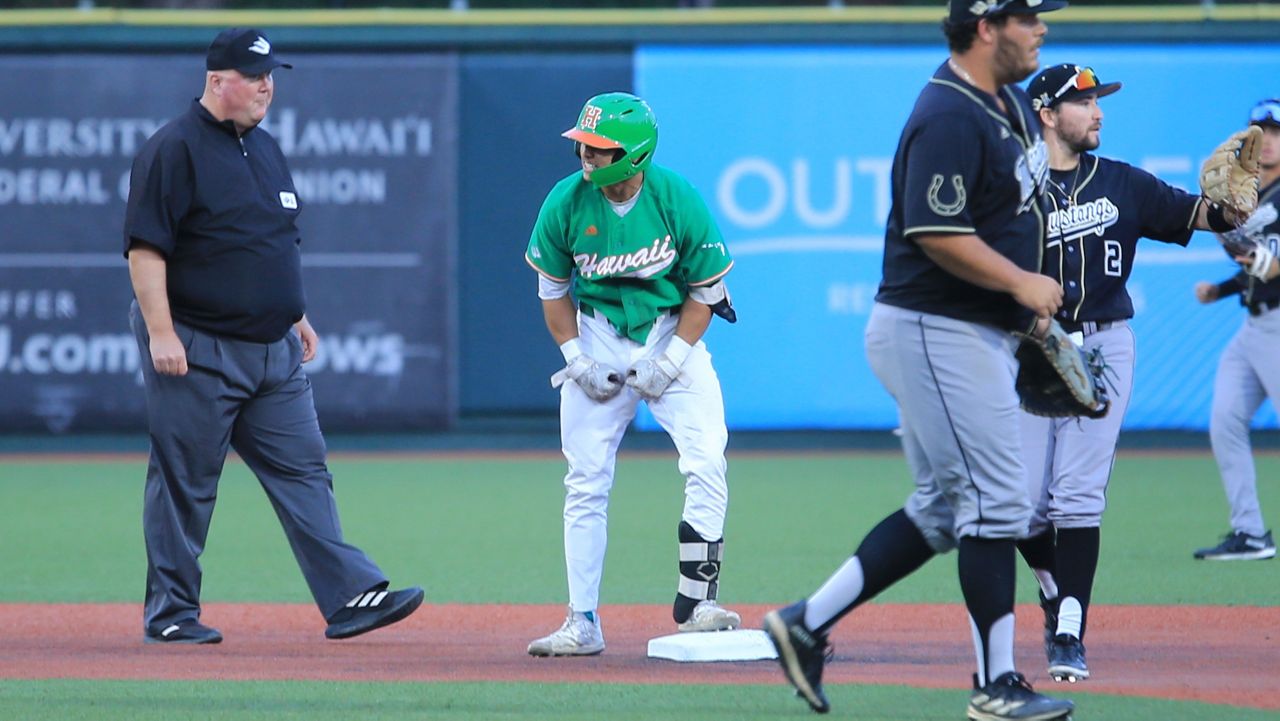
HONOLULU — Once again, the Hawaii baseball team’s Friday starter did not last very long.
This time it wasn’t a problem.
Some long relief from freshman Sebastian Gonzalez held Cal Poly down long enough for Austin Machado to lift a sacrifice fly to deep center, bringing home Naighel Ali‘i Calderon for the walk-off run in a 4-3 win over the Mustangs at Les Murakami Stadium.
Calderon, the speedy senior from Lanai City, Lanai, entered the game as a pinch hitter for Sean Rimmer in the bottom of the sixth. He led off the ninth with his first hit of the season, a single to right, and got to second on Jordan Donahue’s fielder’s choice bunt. He reached third on a wild pitch by Jacob Torres and Cal Poly issued an intentional walk to Dallas Duarte to load the bases. Machado, who was 3-for-4, lofted a ball on a 1-0 count off of Tanner Sagouspe.
It was the second walk-off win of the season for UH (21-14, 5-8 Big West), which improved from 10th to a tie for seventh with its first win in its last four BWC games. Cal Poly (21-15, 11-5) was knocked out of a first-place tie with UC Irvine.
Donahue went 2-for-4 and Dallas Duarte had two hits, including a first-inning double that allowed UH to take a 1-0 lead on Matthew Miura’s single that caromed off of Mustangs pitcher Jakob Right.
Donahue extended his hitting streak to 18 games, the fourth longest streak in program history, and the longest for UH since Neal Honma strung together 19 games between the 1997 and 1998 seasons.
After Cal Poly put together a three-run fourth inning, UH tied it on a two-run double down the right field line by freshman Elijah Ickes in the bottom of the frame.
Coach Rich Hill elected to swap out starter Harrison Bodendorf and go-to reliever Alex Giroux after just 1 2/3 and 1 1/3 scoreless innings, respectively, setting the table for Gonzalez.
Gonzalez, of Oakley, California, went five innings and has thrown 11 1/3 frames of relief over his last two appearances with nine strikeouts and two walks over that span.
Danny Veloz (5-1) worked around a two-out single in the ninth to pick up the win.
UH and Cal Poly will resume the series at 6:35 p.m. Saturday. Randy Abshier is expected to start for the ‘Bows.
Brian McInnis covers the state’s sports scene for Spectrum News Hawaii. He can be reached at brian.mcinnis@charter.com.



Three convicted sex offenders were arrested on Hawaii Island last week for allegedly failing to comply with sex offender registry requirements.
Multiple law-enforcement agencies conducted checks in Kona on registered sex offenders who had been identified as potentially out of compliance with the state’s Sex Offender Registry laws, according the Department of the Attorney General.
As a result of the three-day operation, several individuals were brought back into compliance, and three West Hawaii men were arrested for allegedly failing to comply with the requirements.
The three men who were arrested are Joseph Debus, 56, of Kailua-Kona, Garth Coleman, 53, of Holualoa and Alexsandr Skelcey, 34, of Kailua-Kona.
Debus was convicted of second-degree sex assault in Hawaii in 1993 and sentenced to five years probation with a year in jail. Coleman was sentenced to 20 years in prison for first-degree assault in 2000 after a jury trial in Hawaii. And Skelcey was convicted in Michigan in 2012 of assault with intent to commit sex assault.
“Sex offender registration requirements exist to protect our communities and ensure law enforcement knows where convicted offenders are living,” Tom Alipio, chief of the AG department’s Investigations Division, said in a press release. “Compliance operations like this send a clear message that we will actively monitor the registry, investigate violations and work closely with our law enforcement partners to hold offenders accountable when they fail to meet their legal obligations.”
HPD Chief Reed Mahuna said, “Operations like this allow us to verify that offenders are maintaining strict compliance with registration laws and those who aren’t will be addressed immediately. We will continue to leverage these multi-agency partnerships to keep our island communities safe,”
Members of the public can look up publicly available offender information and subscribe to notifications at sexoffenders.ehawaii.gov/coveredoffender/.
Anyone with information regarding a registered sex offender who may be violating registration requirements is encouraged to contact the Department of the Attorney General’s Investigation Division at (808) 586-1240 or their local law enforcement.

A brush in North Kona, near the Ulu Wini Apartments, has closed a portion of Hina Lani Street, between Route 190 and Ane Keokalole Highway.
According to Hawai‘i Island police, the road is expected to be closed for the next three hours and motorists are advised to avoid the area.
Hawai‘i Fire Assistant Chief Chris Carvalho confirmed at least two engines, two brush trucks, Chopper 2 and a medic vehicle responded to the blaze that started in some bushes.
No evacuations or injuries have been reported at this time.
At 11:09 a.m., an AlertWest camera, installed by Hawaiian Electric in wildfire-prone areas, showed smoke billowing above the Keahuolu Courthouse. As of 12:06 p.m., that smoke appears to have dissipated.
This is a developing story. More information will be provided as it becomes available.
Hawaii
Chinese communist party member arrested in Hawaii on visa fraud charge | Honolulu Star-Advertiser

-
 Virginia2 minutes ago
4 indicted in Virginia double homicide; second victim ID’d as grandmother of 6
-

 Washington9 minutes ago
Washington Commanders are retiring Hall of Famer John Riggins’ No. 44
-

 Wisconsin12 minutes ago
Wisconsin State Patrol rides with truck and bus drivers to spot violations in five areas
-

 West Virginia17 minutes ago
West Virginia town fires entire police force after chief resigns, sergeant alleges evidence room break-in
-

 Wyoming24 minutes ago
WHP: July 5 single-vehicle rollover north of Riverton resulted in one death, one injury
-

 Crypto27 minutes ago
British Airline Jet2 Shares Jump 9% After $536M Fuel Hedge Gain Offsets Middle East Travel Fears
-

 Finance32 minutes ago
Treasury Pick Queried on Iran War Fallout to Face Senate Finance
-

 Fitness39 minutes ago
Quote of the day by Cher: ‘Nothing lifts me out of a bad mood better than a hard workout on my…’ – motivating life lessons by Oscar-winning actress of Moonstruck and singer of Believe on exercise, mental health, fitness and how this daily habit can transform your mood and mindset

