Hawaii
A Deep Dive into Hawai‘i’s Shell Jewelry Industry – Hawaii Business Magazine


They adorn casual beachgoers, become treasured accessories for bridal parties and decorate the resplendent elite as they glide among guests at private dinners.
Hawaiʻi is a rich resource for this nascent business sector as demand builds across the Islands and across the globe. Exactly how big a business it has become is something of a mystery, though. State figures actually show the number of licensed sellers has declined in recent years, though officials admit that’s probably due to lack of awareness and noncompliance rather than reflecting reality.
“Shell jewelry has really only exploded in the last seven or eight years,” says Brooke Holt, founder and designer of 21 Degrees North Designs on Oʻahu. “Don’t get me wrong,” she adds, “I love shells. I love shell jewelry. That’s why I first wanted to make it, [but] I’m kind of over it at this point because it’s so oversaturated.”
When Holt started making shell jewelry in the mid-1990s, there weren’t many others creating newer styles of jewelry with Hawaiian shells outside of the revered tradition of Niʻihau shell lei. Now, jewelers selling shell designs are abundant, judging by the availability of choices online and in stores. Accessories such as sunrise shell necklaces, Hebrew cone earrings, and miter and Tahitian pearl bangles have become iconic staples of island style.
While the shell jewelry industry appears to be expanding in tandem with the popularity of this merchandise, it remains a largely under-documented domain, lacking the data necessary to quantify its true size and impact. Strict requirements of state regulations may actually be driving sellers to evade the mandates.
Technically, anyone taking marine life from Hawaiian waters for commercial purposes must hold a Commercial Marine License (CML), according to the state Department of Land and Natural Resources’ Division of Aquatic Resources (DAR). The license, which costs $100 for residents and $250 for non-residents annually, mandates strict monthly harvest reporting.
“It is important to note that because marine life is defined in the rule as including even parts of living organisms, this licensing requirement applies to the commercial collection of live specimens, empty shells, and even shell pieces,” says DAR Aquatic Biologist Bryan Ishida.
Regulation extends down the supply chain. Businesses that purchase marine life — including empty or fragmented shells — directly from CML licensees for commercial resale must obtain a Commercial Marine Dealer License (CMDL), which costs $100 per year and requires weekly reporting.
Ishida says these licensing fees “are vital to maintaining DAR’s objective of protecting aquatic resources for future generations.” By law, these proceeds are directed into the Commercial Fisheries Special Fund to bankroll research, monitoring and the staff that work in commercial fisheries management.
These reports also serve as an economic barometer. “CMDL reports, in particular, provide the ability to track even small changes to market demand, pricing and other trends,” Ishida explains.
However, the department admits licensing and reporting compliance in the shell sector is “likely quite low” compared to the seafood sector. According to their records, commercial participation peaked in 1977 with 44 shell collectors submitting reports; over the last decade, the number of CML holders reporting shell harvests has dwindled to ten or fewer annually.
This decline is primarily attributed to a lack of awareness. “DAR recognizes this and understands that increased outreach and non-enforcement measures are needed to raise compliance,” Ishida says, but the agency must prioritize using “their limited resources on the harvest of live aquatic life,” and most shells harvested for jewelry are thought to be empty shells.
Figaroa’s grandmother Loka Kenemaka Kaohelaulii (center) mentored him in the art of making Niʻihau shell lei, which she and her two companions are pictured wearing. Photo courtesy of Kealoha Figaroa
Honoring a Tradition
Shell jewelry has been an integral part of Hawaiian culture for centuries, with ample evidence indicating Niʻihau shell lei predate the arrival of Captain Cook in 1778. They are made of rare, tiny shells found off the rugged coast of the Forbidden Isle.
According to Kealoha Figaroa, founder of Niʻihau shell jewelry company Pūpū Creations, many of the shell species used to construct Niʻihau shell lei are found on other islands, but ones found on Niʻihau are prized because they “hold their luster” better. He guesses that this is because there’s comparatively less freshwater runoff into the ocean. “My family tells me on Niʻihau, the water is so pristine that you can see about 300 feet down into the bottom of the ocean,” he says. For his family, and many others from the island, the tradition of creating shell leis has been passed on for many generations.
Figaroa recalls memories from childhood spent at a table where elders would dump hundreds of shells for the children to organize. “All our grandparents… they would take all the kids, and they would tell us, ‘Okay, you need to sit here and sort these shells by color, by size, by all that.’ And of course, we hated it. But for the older people, it was very important for us to learn these things, so that when we do see these leis, we have much more appreciation for the leis.”
Once they had mastered the sorting process, the children would learn the delicate art of piercing the shells. Only after proving their proficiency in that skill were they allowed to begin stringing them together, starting with smaller pieces like earrings before eventually advancing to leis.
Still, Figaroa says that gathering shells from the beach is by far the most tedious part of the process. Figaroa explains that collecting a sufficient number of matching shells to create a high-quality, symmetrical lei requires immense patience. “It’s anywhere from two weeks all the way up to three years to make one lei,” he explains. The considerable time and craftsmanship required to create these intricate pieces are reflected in their price tag, which can reach upwards of tens of thousands of dollars.
Figaroa, who lives on Oʻahu, says his cousins frequently send him shells from Niʻihau to create the lei sold by his business, Pūpū Creations. “I allow space for my family members to also have some other items on sale so they can profit from it as well, and not just myself.” He says one reason he loves collaborating with his relatives is that “there’s different family members that have specific styles.”
One of his cousins, for example, specializes in delicate color gradients. And Figaroa, mentored by his grandmother, took after her in specializing in working with momi shells to create three-strand leis and the straight Kui Pololei style.

Jewelry and fashion designer Brooke Holt at work in her Mākaha studio. Photo by Aaron Yoshino
The Evolution of Shell Jewelry
Newer styles of Hawaiian shell jewelry have emerged in recent decades. They often feature cone shells, cowries, drupes and miters not typically found in the Niʻihau shell lei tradition.
One of the contemporary style shell jewelry makers on the scene is Anoʻipua Kaaloa, who started out as a shell collecting hobbyist. Kaaloa says the kinds of shells she finds differ based on whether or not she’s looking on the Windward Side or Leeward Side: On the east side, “I’ll find a lot of abbreviated cones, tumbled pink cones, the endemic Hawaiian golden yellow cones, strombs, Adam’s miters, lettered miters. Then on the other side of the island, I find so many cowries” and rarer shells to come by, “like marble cones, leopard cones.”
She says she saw other people making jewelry with their beach finds and thought, “That looks cool. I think I can do that with my shells.” Her business, ʻAnoʻipūpū Jewelry, sells everything from shell necklaces, earrings, bangles, belly button rings and keychains. She says her favorite pieces to make are resin earrings that contain a bunch of different micro shells because they are one of her more “unique” designs.
When she started selling her pieces in late 2024, Kaaloa says she was motivated to not only create “nice jewelry, but more affordable” merchandise, because a lot of the market is “really expensive.” When figuring out her price points, she says she considered “if I was to buy my own jewelry, what prices would I want to set?”
Like many other shell jewelry businesses, Kaaloa operates without a traditional brick-and-mortar storefront. Instead, she has built a loyal following through markets, appearing as a regular vendor at the Kakaʻako Farmers Market every Saturday and the Kailua Farmers Market on Sundays.
Despite having neither a physical shop nor an e-commerce website, Kaaloa found enough success at the markets that she was able to quit her former job in the food service industry and focus on running her business full-time a little over a year into opening ʻAnoʻipūpū Jewelry. “I’m grateful, that’s for sure,” she says.
Holt, founder and designer at 21 Degrees North Designs, makes jewelry from an array of materials, including coral, pearls, sandalwood beads, neon thread, lauhala, silver, gold and, of course, shells.
Having partially grown up in Mākaha, she’s been frequenting Oʻahu’s west side beaches in search of shells since the 1980s.
“I had different beaches for different shells,” Holt explains. “Some shells you can find up and down the coast, but others you can only find in very specific spots. I started then researching what types of shells grow in what types of reef situations.”
The daughter of a fashion designer mother and a glass blower father, Holt naturally felt inclined to do something creative with the shells she found, which led her to taking up jewelry making.
Holt finds that inspiration can strike from anywhere: “sometimes it’s a color, sometimes it’s a concept, sometimes it’s a place.” For instance, the design for one of her first pair of statement earrings began with a moment of observation while surfing.
Captivated by how “the water and the sun playing on the ripples gives it all those little dancing rings, I wanted to make earrings that represent that, so I made these concentric circle earrings. I like organic shapes and asymmetrical things.”
In an era of viral trends and mimicry, Holt says it’s important that her pieces stand out. That’s “the greatest compliment I can get, and I do hear it a lot at my markets. I want to be different. I don’t want to look like anyone else.”
One concern Holt has is the impact an increase in shelling has on the environment: “You want to encourage entrepreneurship, but again, we’re still perpetuating this culture of, take, take, take…. So, yeah, do we need to start having limits?”

Hawaiʻi’s most venomous cone shells (left to right): the banded marble cone (Conus bandanus), the textile cone (Conus textile), and the Hawaiian striated cone (Conus striatus). Photo: MarinelifePhotography.com
The Ethics of Shelling
It isn’t illegal to take live shells, but Ishida says “DAR requests that commercial collectors do so sparingly and only as demand requires as many species are quite rare” or little is known about their abundance. The agency strongly recommends collecting empty shells rather than live specimens.
“However, DAR asks commercial collectors to remember that shells, even when empty, contribute to the ecosystem, whether providing a home for a hermit crab or over years wearing down into sand and other seafloor substrate,” says Ishida.
For artisans like Figaroa, Kaaloa and Holt, the first rule of the reef is absolute: only take empty shells. They look for signs of life — like a visible body or a sealed operculum — whereas sand and rocks in the aperture indicate the shell is dead. “The only way shells can reproduce plentifully is if the reef system is healthy. If the reef is not healthy, you won’t get your shells,” Figaroa says.
Marine educator Keoki Stender, founder of MarinelifePhotography.com, warns that damage often happens through simple negligence, such as walking on reefs made of mussels and oysters at low tide: “If you trample it, you crush the shells. You kill hundreds at one time. You have to be mindful of what you’re stepping on.”
He also implores beachgoers to return things back to where they originally were when exploring the ocean and tide pools. For example, “If you leave the rock overturned, the sun’s going to fry everything [on the bottom], the fish are going to eat everything that is here and exposed, and then the life that was on the top of the rock is going to die [underneath], and the part of the reef where you turn the rock and put it onto the reef is going to kill everything on that part of the reef too,” he says.
Ishida reminds commercial collectors that as a natural resource, “empty shells are for everyone’s enjoyment. People who want to collect shells for their own personal collection, jewelry making for themselves, or just enjoying seeing them while diving should be able to do so. Accordingly, commercial collectors should think about their impact on not only the environment but others who may want to collect shells for non-commercial purposes.”

Keoki Stender pictured at his studio lab. Photo by Aaron Yoshino
Where Shells Come From and What to Look Out For
The shells used in jewelry come from animals in the mollusk phylum. To protect their vulnerable, soft bodies, many mollusks have evolved to build exoskeletons, a.k.a. shells, by secreting minerals through a specialized organ called the mantle.
Keoki Stender, a marine educator, photographer and founder of MarinelifePhotography.com, says that you can glean a great deal about a mollusk’s lifestyle by examining its shell. Cowries, for instance, are the heavy-duty tanks of the reef. Their domed, “bottom-heavy” shell is engineered for stability. “The ones that are most domic — a humpback, very domed, flat bottom — they would be more likely to be in a high surf environment,” Stender explains. Combined with a foot that provides powerful suction, the humpback cowries’ low center of gravity allows it to “handle the full force of breaking waves” without being swept away.
In contrast, he says, the streamlined, “tapered shape” of miters and augers allows them to easily crawl through sand in search of prey. And the elaborate, spiny architecture of murexes serves as a defense “designed so no one can bite them.”
The diversity of patterns, from the distinctive black markings on Hebrew cones to the vibrant ombré of sunrise shells, is produced by pigment-secreting cells in the mantle. These cells act much like an inkjet printer, depositing color at the growing edge of the shell.
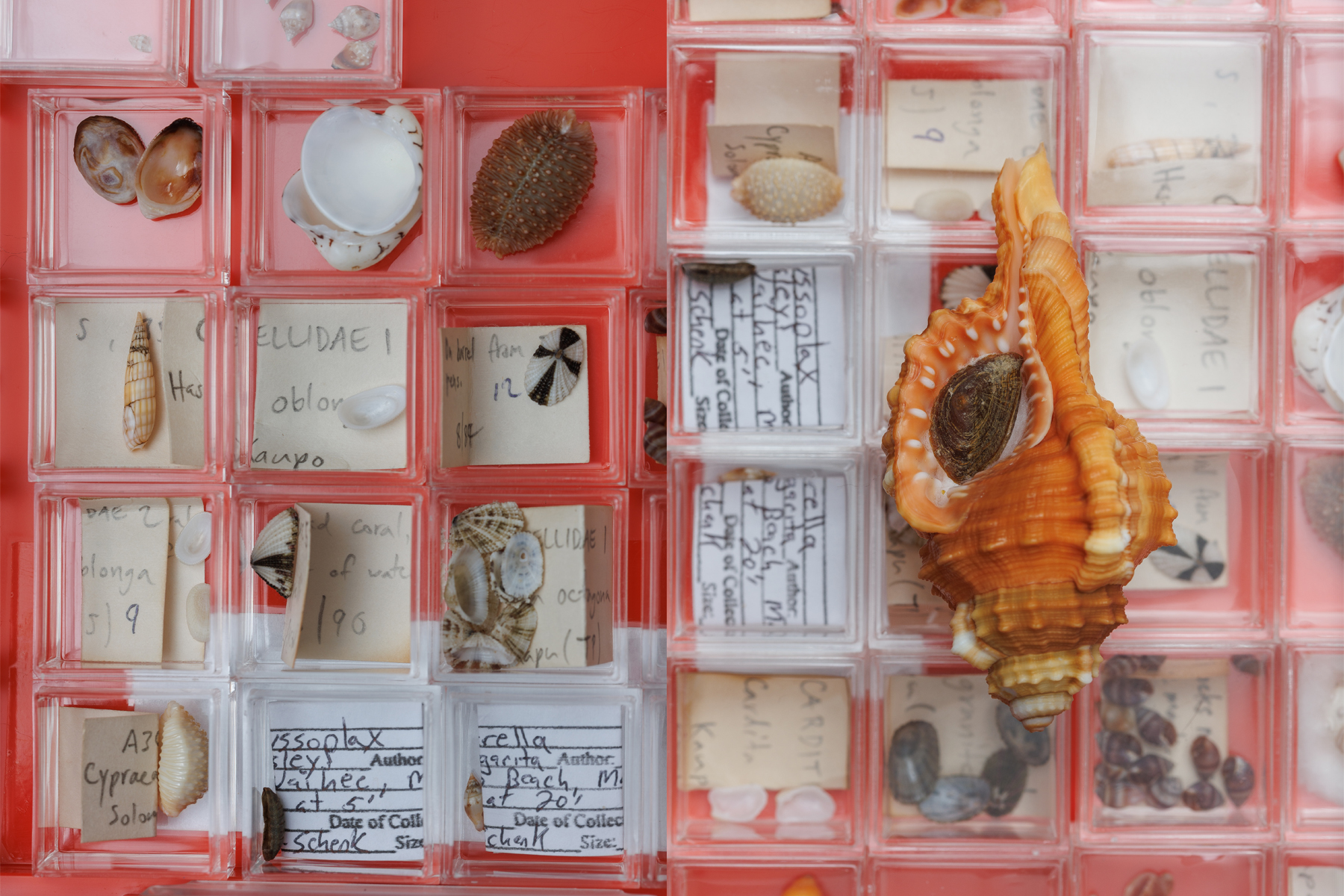
Some specimens in Stender’s extensive shell collection.
Cone snails are predators that hunt using a venomous harpoon-like tooth that shoots out the base of their shell. Their toxicity generally depends on that species’ diet. “The worm eaters are like a bee sting [to humans]. But if you’re allergic to bee sting, that can be really bad,” Stender warns. “The fish eaters are especially bad because if your prey is fast moving, you got to have a potent sting.”
Because specific cone snail species are among the most venomous animals on earth, being familiar with their patterns to discern which are dangerous is extremely important when handling. “The ones that have the worst sting are the tented pattern cones,” says Stender. In Hawaiʻi, textile, banded marble and striated cones possess a sting that is potentially fatal to humans.
Stender explains that lifespan varies significantly across species, noting a direct correlation between shell size and growth rate. “The bigger the shell, generally, the slower it grows,” he says, because the animal must extract a higher volume of minerals from both the water and its food to build its home. While Stender estimates that many micro-shell species live for only six months to a year, some larger mollusks — such as the leopard cone and tiger cowry — can live for a decade or longer.

Hawaii
Office of Hawaiian Affairs Responds to Senate Bill Involving Pōhakuloa – Big Island Video News

(BIVN) – The Office of Hawaiian Affairs (OHA) says it is in alignment with provisions in the Fiscal Year 2027 National Defense Authorization Act dealing with military-leased lands in Hawaiʻi, including the Pōhakuloa Training Area.
In a news release, OHA said it is encouraged by the bill’s “clear movement away from condemnation and toward negotiated solutions” for the approximately 19,700 acres of state lands at Pōhakuloa, and 450 acres at Kahuku. “The process outlined is consistent with OHA’s long-standing position opposing condemnation – whether forcible or ‘friendly’ – and insisting that lands held in public trust remain in the public trust and continue benefiting Native Hawaiians and future generations of Hawaiʻi’s people.”
The U.S. Senate Armed Services Committee recently passed the Fiscal Year 2027 National Defense Authorization Act, or NDAA. The bill is expected to advance to the full United States Senate for consideration by the end of July 2026, OHA says.
In a June 12th news release, U.S. Senator Mazie Hirono (D, Hawaiʻi) said she voted against the NDAA. Hirono is a senior member of the Senate Armed Services Committee (SASC) and Ranking Member of the Readiness and Management Support Subcommittee.
“I’m proud to have secured numerous provisions in the Senate’s FY27 NDAA that invest in military readiness, Hawaii, the Indo-Pacific Region, and our servicemembers and their families, while also holding the Army accountable on the military training land lease negotiations,” Hirono stated at the time. “However, I could not in good conscience vote to advance a bill that paves the way for an up to 40% increase in year-over-year Department of Defense spending, especially as this administration wages an illegal war in Iran with no plan or end in sight.”
Hirono said the bill “directs the Secretary of the Army to seek from the State of Hawaii, on terms acceptable to both the Army and the State, a renewal of expiring training land leases. As part of this, requires the Army to expeditiously resubmit their Environmental Impact Statements (EISs) for the leased lands and address deficiencies identified by the Hawaii Board of Land and Natural Resources.”
OHA noted Section 2864 of the NDAA also requires a report to Congress on the steps and proposals taken to advance lease renewals, within 60 days from the NDAA’s enactment.
“The Senate Armed Services Committee’s action reflects meaningful progress in acknowledging Hawaiʻi’s unique legal and cultural context,” stated OHA chair Kaialiʻi Kahele. “The removal of condemnation as an option and the requirement for renewed environmental review are consistent with what OHA has long advocated – that these lands must not be permanently alienated and that Hawaiʻi’s concerns must be fully addressed in good faith. Congress appears willing to respect Hawaiʻi’s laws and institutions. The opportunity before us now is to fully embrace the responsibilities and authorities those laws entrust to us. OHA will continue to ensure Native Hawaiian rights and public trust responsibilities remain central to any future decisions.”
OHA has been holding high-level meetings in Washington, D.C. concerning the military lease renewals.

OHA says it is also actively moving forward with a comprehensive Ka Paʻakai Analysis for Pōhakuloa Training Area. “The Board of Trustees has already approved a Permitted Interaction Group allocation of $60,000 to support this work, and OHA is finalizing a memorandum of understanding with DLNR to complete the work,” the Office stated. The analysis “will help create a more complete record of the cultural, historical, and community connections to these lands, providing decision makers with information necessary to evaluate potential impacts, identify appropriate protections, and fulfill their responsibilities under Hawaiʻi law.”
From the OHA news release:
OHA also notes that the NDAA contemplates the pursuit of future lease arrangements pursuant to Section 2667 of Title 10, United States Code. As discussions continue regarding potential lease terms, community benefit commitments, land-back and lease-back models, and other components of any future agreement, OHA believes those arrangements must remain consistent with Hawaiʻi’s environmental laws and public trust obligations. Any benefits derived from renewed use of these lands should reinforce the purposes of the public trust, protect traditional and customary Native Hawaiian practices, honor the history and significance of these lands, and preserve the value they were intended to provide for Native Hawaiian beneficiaries and future generations of Hawaiʻi’s people.

Forecast for Big Island Windward and Southeast
| Shores | Tonight | Saturday | ||
|---|---|---|---|---|
| Surf | Surf | |||
| PM | AM | AM | PM | |
| North Facing | 0-2 | 0-2 | 0-2 | 0-2 |
| East Facing | 1-3 | 1-3 | 1-3 | 1-3 |
| South Facing | 4-6 | 3-5 | 4-6 | 5-7 |
| Weather | Sunny until 6 PM, then partly cloudy. Scattered showers. |
|||||
|---|---|---|---|---|---|---|
| Low Temperature | In the lower 70s. | |||||
| Winds | Northeast winds 5 to 10 mph, becoming northwest after midnight. |
|||||
|
||||||
| Weather | Mostly sunny. Scattered showers. | |||||
|---|---|---|---|---|---|---|
| High Temperature | In the mid 80s. | |||||
| Winds | Northeast winds 5 to 10 mph. | |||||
|
||||||
| Sunrise | 5:42 AM HST. | |||||
| Sunset | 7:02 PM HST. | |||||
Forecast for Big Island Leeward
| Shores | Tonight | Saturday | ||
|---|---|---|---|---|
| Surf | Surf | |||
| PM | AM | AM | PM | |
| West Facing | 2-4 | 2-4 | 2-4 | 2-4 |
| South Facing | 4-6 | 3-5 | 3-5 | 4-6 |
| Weather | Mostly sunny until 6 PM, then mostly clear. Isolated showers. |
||||||||
|---|---|---|---|---|---|---|---|---|---|
| Low Temperature | In the upper 60s. | ||||||||
| Winds | Northwest winds around 5 mph, becoming southeast in the evening, then becoming light and variable after midnight. |
||||||||
|
|||||||||
| Weather | Sunny. Isolated showers. | ||||||||
|---|---|---|---|---|---|---|---|---|---|
| High Temperature | In the upper 80s. | ||||||||
| Winds | West winds around 5 mph. | ||||||||
|
|||||||||
| Sunrise | 5:46 AM HST. | ||||||||
| Sunset | 7:06 PM HST. | ||||||||
A small, medium period south swell will continue to steadily fade into Saturday, allowing surf along south and west-facing shores to drop a notch. A series of small, medium to long period south and southeast swells will fill in Saturday into the first half of next week, which will boost surf heights back near seasonal averages.
Tiny surf will prevail along north-facing shores through most of the coming week as only some limited short-period energy reaches the islands from the north. Trade winds remain lighter than normal through the weekend, keeping surf along east-facing shores below average. East shore surf will begin to trend up early next week as trade winds increase upstream and across the region.
NORTH EAST
am pm
Surf: Minimal (ankle high or less) surf.
Conditions: Semi choppy with ESE winds 5-10mph in the morning increasing to 10-15mph in the afternoon.
NORTH WEST
am pm
Surf: Minimal (ankle high or less) surf.
Conditions: Clean in the morning with ESE winds less than 5mph. Bumpy/semi bumpy conditions for the afternoon with the winds shifting W 5-10mph.
WEST
am pm
Surf: Minimal (ankle high or less) surf.
Conditions: Light sideshore texture in the morning with NNW winds 5-10mph. Bumpy/semi bumpy conditions for the afternoon with the winds shifting to the WNW.
SOUTH EAST
am pm
Surf: Minimal (ankle high or less) surf.
Conditions: Sideshore texture/chop with NE winds 10-15mph.
Data Courtesy of NOAA.gov and SwellInfo.com

The honor of introducing former President Barack Obama at the grand opening of his new presidential library in Chicago Thursday went to Dr. Kaiwipunikauikawēkiu Punihei Lipe of Hawaii.
Hawaii News Now reports that Lipe participated in the inaugural cohort of the Asia-Pacific Leaders Program in 2019 and is currently the principal at Kamehameha Schools Kapālama.
“Where I come from, to introduce someone means we have pilina, a connection. If this man walked into my home, my children would call him uncle because we are both keiki o ka ʻāina, children of Hawaii,” she said in her remarks.
She told those in attendance that the former president and herself are both “children of Hawaii.” Obama lived on the island and attended Punahou School and lived in Hawaii for eight years until his graduation from high school.
Lipe said being children of Hawaii carries with it a “sacred responsibility to care for those who we may never meet.”
She made reference to the resilient Hawaiian shrub, the Like a’ali’i.
“The a’ali’i thrives by being deeply rooted, resilient through storm and drought, and fiercely responsive. That is what ‘yes, we can’ means to my indigenous heart. It demands that we remain unshakably rooted in truth, resilient through trial, and so responsive that just as this plant yields its leaves for medicine, its blooms for beauty, and its timber for protection, we become the healing, the vibrance, and the shelter needed by our communities and by grandmother earth.”
Our Summer Membership Drive is underway. Make a recurring monthly donation of at least $10/month or a donation of any amount and receive an invite for a live Q&A with actor Chris Pang of the new Hulu series, The Season. Help us get to our goal of $10,000 and 10 new monthly recurring members. We’ve raised $2605 so far, 26% of our goal with 10 days to go and need 9 more recurring monthly members. Please donate here.
AsAmNews is published by the non-profit Asian American Media Inc and supported by our readers along with the Robert Wood Johnson Foundation, AARP, The Henri and Tomoye Takahashi Charitable Foundation, The Asian American Foundation & Koo and Patricia Yuen of the Yuen Foundation.
Be sure to take advantage of our free subscription and follow us on Instagram, Bluesky, Facebook, X, Tiktok and YouTube.
-

 Vermont6 minutes ago
Vermont Governor Signs Bill To Double Legal Marijuana Possession Limit And Allow Interstate Commerce – Marijuana Moment
-

 Virginia9 minutes ago
Virginia Union University Juneteenth concert celebrates faith, unity with community
-

 Washington14 minutes ago
Multiple arrests made as Trump tries to blame Reflecting Pool woes on vandalism
-

 Wisconsin21 minutes ago
Northeast Wisconsin high schoolers jam in 2026 ‘Rockonsin’ contest at Summerfest
-

 West Virginia23 minutes ago
West Virginia Celtic Festival draws thousands to Randolph County
-

 Wyoming29 minutes ago
Legend Of Vietnam War Gun Truck ‘Uncle Meat’ Lives On At Wyoming Museum
-

 Crypto36 minutes ago
Cryptocurrency News: Pepeto Nears Exchange Listing while the Cardano Price Prediction Could Flip After Hoskinson’s June Move
-

 Finance38 minutes ago
Robinhood Is Becoming a Full-Service Financial Platform. Is the Stock a Buy? | The Motley Fool

