West
Fresno restaurant reopens after anti-Asian pressure forces closure

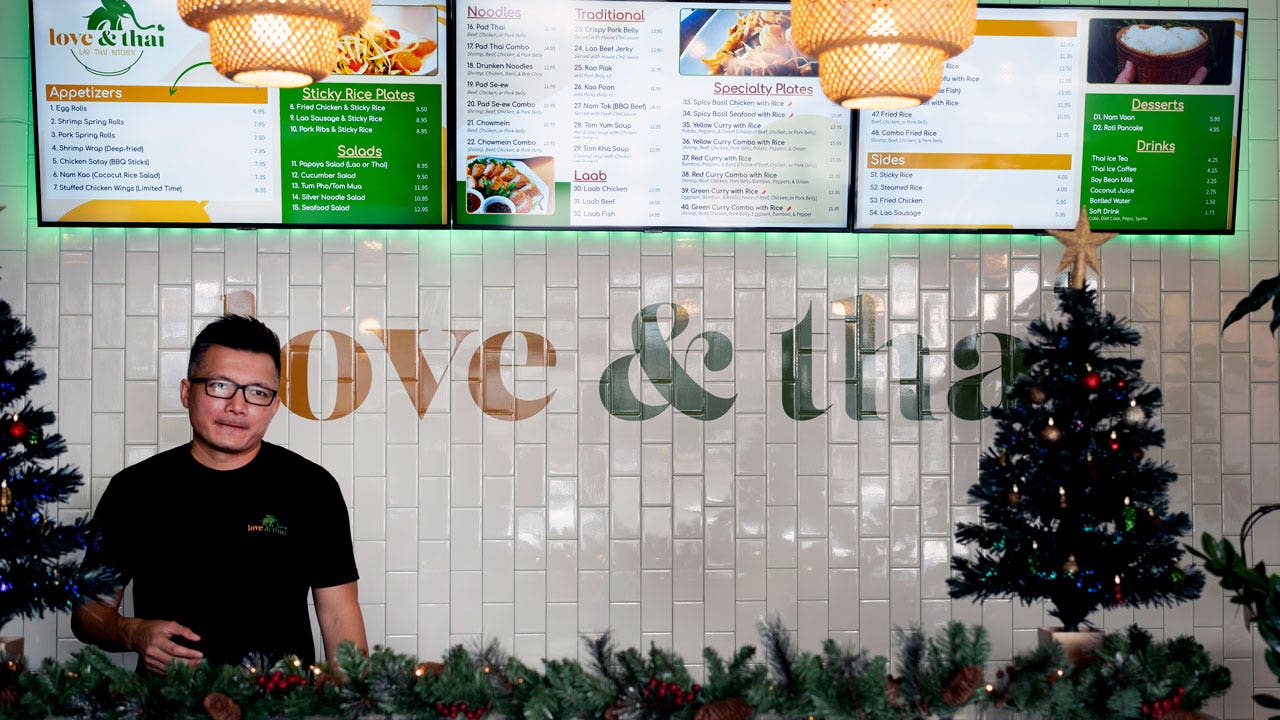
David Rasavong’s cultural pride is evident all throughout his restaurant.
It’s on the wall of family portraits and where a stunning mural depicts his family’s journey from Laos to California. It’s on the menu filled with Lao and Thai dishes like the crispy coconut rice salad of Nam Khao and the stir-fried rice noodles of Pad See Ew.
And it’s in the fact that Love & Thai in Fresno, California, restaurant is open at all. A baseless accusation grounded in a racist stereotype about Asian food using dog meat brought a six-month barrage of harassment so heated that Rasavong, 41, closed down its previous location over fears for his family’s safety.
ASIAN-AMERICAN FAMILIES WORRY RACE STILL A ‘HIDDEN FACTOR’ IN COLLEGE ADMISSIONS AFTER SUPREME COURT DECISION
His earlier restaurant had itself only been open for seven months when a so-called animal welfare crusader in May implied on social media that a pitbull tied up at an unconnected home next door was going to be served on the menu.
A day after the initial commentary, vitriolic statements, voicemails and calls rained down. Rasavong’s body still tenses up when recounting, in particular, a call from an elderly woman.
“She was so disgusted by me and yelling and screaming, and the only thing I can remember hearing her say at the end was ‘Go back to the country you came from you dog-eating mother-effer,’” Rasavong recently told The Associated Press.
David Rasavong is seen here at his restaurant “Love & Thai” in Fresno, Calif., on Dec. 20, 2023. (AP Photo/Richard Vogel)
Within days, he closed that restaurant because it no longer felt safe between the harassment and people loitering in the parking lot outside of business hours.
The false accusation tapped into a longstanding slur against Asian cuisines and cultures that has persisted in the U.S. for over 150 years, dating back to the xenophobia that grew in the U.S. after Chinese immigrants started arriving in more visible numbers in the 1800s and other Asian communities followed. It’s also one that Asian American communities are fighting against.
It may be astonishing to some that a claim rooted in a racist stereotype took down a family’s restaurant three years after “Stop Asian Hate” became a rallying cry. But for many Asian Americans and Pacific Islanders, it’s something they’ve heard before as an insult or under the guise of a “joke,” along with other negative reactions to the actual foods of their cultures. In December, a comedian received some backlash for dressing like a UPS delivery driver and walking into an Asian restaurant with caged puppies for a social media video.
There is hope though that more people will learn to tell truth from trope. Since the pandemic first fueled anti-Asian hostilities, AAPI communities themselves have tried to take control of the narrative that Asian food is “dirty,” “weird” yet “exotic.” Furthermore, the appetite to learn about food from the Asian diaspora has only grown across traditional and new media.
Still, there were moments where Rasavong felt like nobody, even media, was on his side. He said a few reporters approached him assuming the claims were true.
But he soon received tons of community support, and the closure ended up being a new beginning.
A shopping center property manager offered him the chance to take over a suite vacated by another restaurant. Nkundwe P. van Wort-Kasyanju, a graphic designer in the Netherlands, and Los Angeles-based interior designer Danny Gonzales proffered their services for free. Hana Luna Her, a local artist, painted the mural. By the Nov. 3 grand opening of the new space, Love & Thai definitely felt the love. The place was bustling all day, Rasavong said, and the city presented a proclamation.
Rasavong is holding onto the belief that he went through this whole saga for a reason.
“There’s a journey that we’re supposed to go on,” said Rasavong, who declined to say if he’ll pursue legal action. “Don’t get me wrong. People need to realize this business is not easy … But you know, we believe in what we’re doing and so far so good.”
In actuality, consuming dog meat is something that has happened in various parts of the world for centuries, where they weren’t seen as domesticated family pets, said Robert Ku, author of “Dubious Gastronomy: The Cultural Politics of Eating Asian in the USA.” Greeks and Romans referenced it. The French also ate dog meat during World War II.
But when Chinese immigrants came to the U.S., it was linked to them as part of “the myths that the Chinese were these bizarre people who had bizarre diets,” Ku said. “It was one of the attractions of actually going to Chinese restaurants back in the day because it came with ‘danger.’”
As other Asian immigrant groups came, the stereotype spread to include them.
“This is a real just blurring of the Asian identity where it doesn’t matter if you’re Thai or Korean or Vietnamese or Cambodian. You’re all the same,” Ku said.
Along with the false allegation of eating dog meat, Asian Americans and Pacific Islanders over the generations have often faced disgust and worse from others when they’ve brought their cultures’ foods from home to public spaces like school or work.
They’re taking steps to fight back, like in 2021, when San Francisco-Bay Area-based writers Diann Leo-Omineto, Anthony Shu and Shirley Huey self-published “Lunchbox Moments,” a compilation of over two dozen personal essays and illustrations that raised $6,000 for charity.
The project became “a powerful thing for all of us,” Leo-Omineto said.
“We tried to show it’s not always about being in relation to being American or being white or assimilated,” she said. “You can have moments of joy, too…I hope that it opened people’s minds a little bit more — or made them want to try new foods.”
It’s actually been a big year in publishing and food media for Asian cuisine. Publishers Weekly dedicated a feature in August entirely to Chinese and Taiwanese food after observing nine new cookbooks on the subjects were coming out this year. Several of the authors grew up outside of Asia. The titles range from “Vegan Chinese Food,” to “Kung Food” and “A Very Chinese Cookbook” from America’s Test Kitchen. Also, children’s book author Grace Lin released “Chinese Menu,” which relays folklore behind favorite Chinese American dishes. They all share personal anecdotes and readers often seem drawn to “personality-driven” cookbooks, said Carolyn Juris, features editor.
“It’s not just about the recipes. It’s about the stories behind them and I think people respond to that,” Juris said.
Like any other culture, Asian cultures encompass many different regional cuisines and nuances. With the growing Asian diaspora, it’s not strange that so many cookbooks can be mined and “publishers are savvy enough to know that there is a market for these books,” Juris added.
Back at Love & Thai, Rasavong is busy filling online orders for a waiting third-party delivery driver. He is optimistic about keeping up business now that the initial hoopla around his restaurant renaissance has calmed down. Rasavong also hopes his situation will remind others to think before they speak.
“People say these jokes and they think it’s just fun and just light-hearted,” he said. “There are certain things that you shouldn’t say that really do cross a line.”
Read the full article from Here


GILLETTE, Wyo. — As the Aug. 18 primary election approaches, County 17 is introducing candidate questionnaires to help voters make informed decisions at the ballot box.
Every candidate in the primary field was sent the same three questions and given a limit of 500 words, which could be distributed among their answers as they saw fit. To ensure a fair and direct line to the community, all responses are published exactly as submitted, without edits or alterations.
Candidates were asked:
- What are the most crucial challenges your constituents are facing?
- If elected, how will you address these challenges?
- What qualities or qualifications do you possess that have prepared you to meet these challenges?
Questionnaires are being published on a rolling basis online through Aug. 11. They will be accessible via the County 17 Election Tracker.
Scott Smith (R), Wyoming state treasurer
What are the most crucial challenges your constituents are facing?
Everywhere I go many Wyoming citizens are concerned that our government is selling out our state lands to the highest bidder for crony capitalism. Some are concerned about Data Centers, Commercial Wind Generators, or nuclear waste storage. The biggest concern is the resources these outfits are taking, secondly, they are concerned about health issues related to living nearby, and lastly they are concerned with cost associated with these projects being passed onto the taxpayer.
If elected, how will you address these challenges?
One of the things that many people don’t know is that the State Treasurer sits on the State Land and Investment Board. (SLIB) The same issues that concern our citizens are the same reasons that I have decided to run for this office. The SLIB has voted to lease state lands to a hydrogen plant in Converse County that would take eight gallons of our valuable water to produce one gallon of hydrogen jet fuel using wind and solar generation to power the plant. These same elected officials have sold off $100 million of our state lands to the federal government. I believe that some things are not for sale. As Treasurer you can count on me to count the cost and listen to the people in the public testimony. If we are going to accept some of these projects the citizens need to have the benefit, like lower utility costs.
What qualities/qualifications do you possess that have prepared you to meet these challenges?
My bachelor’s degree is in Business Administration with an emphasis in management and marketing. I will be a leader in the state treasurer’s office that creates a positive work environment that will allow our investment team to create higher returns on the people’s money that the state invests. I would like to work with the legislature to use these interest earnings to buy down the people’s property taxes to alleviate part of the burden inflation has caused on the average citizen. My day job, I work as a bookkeeper and work with numbers day in and day out and have corrected some inefficiencies to help small businesses become more profitable. I plan to do that within the state office and make those profits available to the legislature to reduce the tax burden for the people. I have also served in the Wyoming House of Representatives for Goshen County and I have served on the Appropriations Committee and I am familiar with the massive state budget.
Related

A jury in San Francisco returned to a packed courtroom Thursday morning to tell a judge that it was deadlocked on two counts in the case against seven pro-Palestinian protesters who shut down traffic on the Golden Gate Bridge in 2024 to denounce U.S. aid to Israel in the Israel-Hamas war.
The jury indicated that it could likely reach a decision on one of the deadlocked counts, but the other it could not. San Francisco Superior Court Judge Teresa Caffese asked the jury to resume deliberations on one of the two deadlocked counts.
“Why don’t I send you back, and then we’ll go from there,” Caffese said.
Six of the protesters who chained themselves together on vehicles on the bridge and a protester who was designated to communicate with authorities are each facing eight to nine charges of felony conspiracy and false imprisonment.
The seven defendants sat in the courtroom with anticipation for a verdict, wearing keffiyehs around their necks. Dozens of their supporters packed the courtroom to the brim.
The jury reached unanimous decisions on the rest of the counts. It did not indicate which two counts it was deadlocked on.
Supporters of the seven protesters said that a verdict on the rest of the counts is expected to be read out sometime Thursday.

The Fourth of July weekend is one of the biggest celebrations of the summer, and Denver is delivering a packed lineup of events for every kind of adventurer. Whether you’re looking to watch fireworks light up the Colorado sky, catch a live concert at Red Rocks, enjoy rooftop parties, indulge in seasonal food and drinks or explore the city’s thriving arts and culture scene, there’s no shortage of ways to celebrate Independence Day.
Here’s your guide to the best music, food, fireworks, nightlife, arts, and cultural events happening across Denver this Fourth of July weekend.
Follow @303magazine on Instagram
Read: Best Rooftops to Watch 4th of July Fireworks + Sip Cocktails in Denver
Read: The Ultimate 4th of July Outdoor Colorado Music Guide
FASHION EVENTS

Denver Fashion Week Fall 2026 Second Model Auditions
Where: TBA
Cost: $10+
The Lowdown:
Following overwhelming demand from aspiring models across Colorado, Denver Fashion Week (DFW) has announced a second round of model auditions for its upcoming Fall/Winter 2026 runway season.
MUSIC EVENTS
Read: The Ultimate 4th of July Outdoor Colorado Music Guide


Gillian Grogan and EMMA ROSE
Where: Skylark Lounge – 140 S. Broadway
Cost: $18+
The Lowdown:

Zeds Dead with Sippy, Baauer, Holly, HYDRAULIX & LUMBERJVCK
Where: Red Rocks Amphitheatre – 18300 W Alameda Pkwy, Morrison
Cost: $205+
The Lowdown:

Flobots
Where: Levitt Pavilion Denver – 1380 W Florida Ave
Cost: $0+
The Lowdown:

Don Toliver with SahBabii, SoFaygo, Chase B
Where: Ball Arena – 1000 Chopper Cir
Cost: $105+
The Lowdown:
FOOD EVENTS
Read: Best Rooftops to Watch 4th of July Fireworks + Sip Cocktails in Denver

Dumpling Love: Dim Sum Party
Where: Stir Cooking School Highlands – 3215 Zuni St.
Cost: $120 per person
The Lowdown:
Join the dumpling party and learn how to make pork bao buns, shrimp shumai, pan-fried gyoza, and crab cheese rangoons. All classes include a full bar with beer, wine, and house-curated cocktails for purchase.

Stars, Stripes, and Deck Nights
Where: Woodie Fisher Kitchen & Bar – 1999 Chestnut Pl.
Cost: Free
The Lowdown:
Celebrate America’s 250th with our festive Bomb Pop Drinks, featuring real Bomb Pops and High Noon buckets!

4th of July Rooftop Fiesta at Cimera
Where: The Source Hotel – 3330 Brighton Blvd.
Cost: $60+
The Lowdown:
The experience is an open rooftop gathering featuring live-fire cooking, craft cocktails, and skyline views throughout the evening. Guests will enjoy Peruvian street skewers, duck & chorizo paella, and ceviche prepared live on-site.

Farmers Market Central Park
Where: Central Park – 29th Ave & Roslyn
Cost: Free
The Lowdown:
Local vendors provide Colorado-grown produce, tasty baked goods, specialty meats, gourmet food items and more!
LIFESTYLE EVENTS

Mystic Magnolias; A Southern Gothic Cabaret
Where: Colorado Sake Co – 3559 Larimer St
Cost: $25+
The Lowdown:
Saunter yourself out to The Mystic Magnolias, a Burlesque AND Drag Show with chilling charm and dripping in Southern Gothic atmosphere.

America 250 | Colorado 150 Drone Show presented by Visit Denver
Where: DPAC/Denver Performing Arts Complex – 1400 Curtis St.
Cost: Free
The Lowdown:
Following Sunset Cinema’s showing of National Treasure on July 3rd at Sculpture Park, stay to enjoy the 4th of July Drone Show! This special event will be brought to you by Visit Denver, celebrating American 250 | Colorado 150, including an appearance by Mayor Mike Johnston.

Beat The Bomb Summer Mission: America250 Edition
Where: Beat The Bomb – 3863 Steele St, Unit 1273
Cost: $39+
The Lowdown:
Beat The Bomb announces the limited-time-only Summer Mission: America250 Edition – celebrating America’s 250th with five new games, a collectible beach towel, and a red, white, and blue Paint Blast!

Independence Day Concert with Denver Municipal Band (Cheesman Park)
Where: Cheesman Park – 1900 E. 11th Ave.
Cost: Free
The Lowdown:
Price:Free
Join the Denver Municipal Band’s Concert Band for an Independence Day concert at Cheesman Park Pavilion with special guest Denver District 10 City Councilmember Chris Hinds narrating Aaron Copland’s Lincoln Portrait.
Follow @303magazine on Instagram
Whether you’re dancing at a concert, enjoying a garden dinner, cheering on your favorite soccer team or exploring a new exhibition, Denver offers plenty of ways to fill your 4th of July weekend calendar. Gather your friends, support local businesses, and discover something new around the city.
-

 Wisconsin2 minutes ago
Swatting call caused temporary lockdown at Rice Lake, Wisconsin health clinic
-

 West Virginia14 minutes ago
‘We cannot wait’: West Virginia Dems call for special session to address school funding
-

 Wyoming17 minutes ago
Election Q&A: Scott Smith for Wyoming state treasurer
-

 Crypto22 minutes ago
Senate Urged to Vote on CLARITY Act Before August Recess as Lawmakers Return July 13
-

 Finance29 minutes ago
New questions about Trump’s taxes after financial disclosure release
-

 Fitness32 minutes ago
Our Editors Found the Best Fitness Deals—Save Nearly 50% on Home Gym Equipment
-

 Movie Reviews44 minutes ago
Film Review: “looky loo: PART II” – MediaMikes
-

 World46 minutes ago
US Resumes Dollar Transfers to Iraq, NYT Reports

