West
FBI arrests man in Las Vegas for allegedly extorting Instagram users after he gloated on podcast

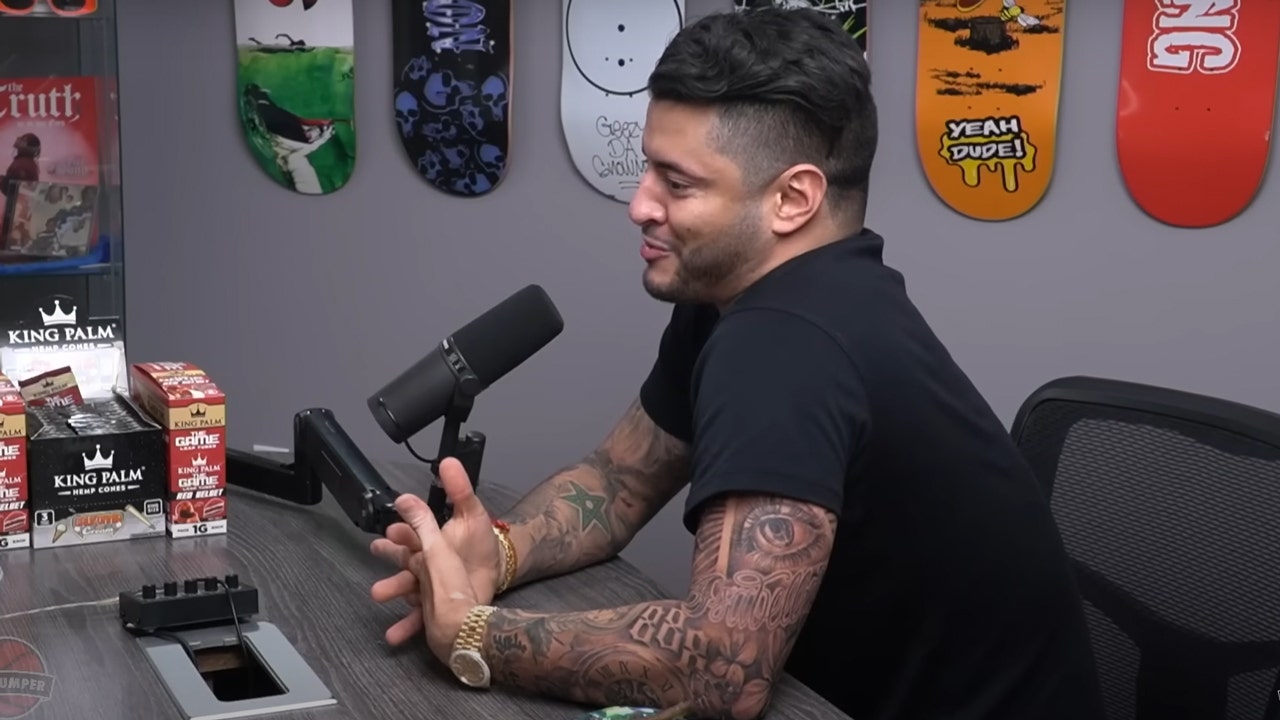
The FBI arrested a boastful social media scamming suspect last week after the Moroccan national allegedly bragged about his extortion scheme in a tell-all podcast interview that launched the investigation against him.
Idriss Qibaa – previously known as “Dani” or “Unlocked” – was arrested at his Las Vegas home and is facing federal charges related to two criminal felony counts filed by the U.S. Attorney’s Office in Nevada.
He allegedly violated interstate communications laws for violent threats he relayed through text messages to two victims and members of their families, according to a criminal complaint obtained by Fox News Digital.
“I just couldn’t believe I was in the same room with someone who could do that,” No Jumper podcast host Adam Grandmaison, better known as Adam22, told Fox News Digital. “It’s for sure far more sinister than I ever could have imagined.”
DOG OWNER SAYS PET ACCIDENTALLY ATE MARIJUANA WHILE OUT FOR A WALK: ‘COULD HAVE DIED’
Idriss Qibaa is pictured on Adam Grandmaison’s No Jumper podcast, where he told the host that he made $600,000 per month from over 200 victims. (No Jumper )
Qibaa ran a website called Unlocked4Life.com, which was still active as of Monday. He promised to unlock clients’ social media accounts. But by his own admission, Qibaa was the one locking down the accounts to extort people out of thousands to get their access back.
He also offered to artificially inflate users’ views or followers for a cost, to gather personal information on others for customers and to get other users banned on customers’ behalf.
In his interview with Grandmaison, Qibaa said he “has over 200 people who pay him monthly to maintain access to their accounts, claiming he makes more than $600,000,” according to the criminal complaint filed in Nevada’s district court.
When asked on the podcast why he would detail his illegal business model publicly, Qibaa said, “You guys can kill me; that’s the only option.”
KANSAS RAID TIED TO 98-YEAR-OLD’S DEATH IN FIRST AMENDMENT SHOWDOWN TO RESULT IN CRIMINAL CHARGES
Adam Grandmaison, also known as Adam22, appears alongside Idriss Qibaa in the January podcast that alerted authorities to his alleged illegal activities. (No Jumper )
“I wanted people to really understand what’s going on. … Nobody’s talked about it, nobody’s done an interview on it. … I was like, f— it,” Qibaa said in the January interview. “For me, if they want to come and take my account over, this this and that, you can’t take somebody out like me. It’s like cockroaches.”
The brazen hour-long interview tipped off the feds, according to their criminal complaint. Investigators tracked down a slew of victims – including a realtor, dentists, businessman, journalist and influencer, according the complaint – and quickly realized that the alleged extortionist was going further than just targeting their social media accounts.
Allegedly, Qibaa destroyed victims’ property and threatened to harm and kill them and their loved ones.
In one instance, according to the criminal complaint, Qibaa “made threats to shoot or injure [one victim’s] daughter, fiancé, dog, business partners and their families.”
US MURDER FUGITIVE ‘EL DIABLO’ FOUND WORKING AS MEXICAN POLICE OFFICER 20 YEARS LATER
Adam Grandmaison, also known as Adam22, hosts the “No Jumper” hip-hop podcast. (Adam Grandmaison/No Jumper)
Another target had her Instagram account locked and then was informed that a California dentist who previously treated the victim’s last employer had allegedly hired Qibaa to do so.
She was contacted by someone called “Unlocked” who would pepper her with more than 2,000 SMS messages, ultimately threatening to “blast out” her Social Security number if she didn’t pay $20,000.
In another case, he went to a victim’s house, grabbed a rock out of the driveway and smashed the windshields of a white Bentley and white Mercedes-Benz in an incident caught on security footage, the documents state.
Grandmaison told Fox News Digital he was glad that his interview with the alleged extortionist was “in any way useful to getting [Qibaa] off the streets.”
Grandmaison, who has interviewed singers and rappers like Usher and XXXtentacion, said he’s spoken with all walks of life in the underground world for his podcast, including “dudes who were hit men, serious drug traffickers, pimps and prostitutes.”
But his interview with Qibaa, who went by “Dani” or “Unlocked,” stood out, according to a criminal complaint.
“Usually when you have a conversation with a rapper who is involved in some kind of illegal behavior, there is a constant elephant in the room, that this is stuff that should not be discussed on camera,” the podcast host said. “If they do try to say something, they would say it in a coded way.
“But this dude just blew my mind by being seemingly willing to discuss everything that his business consists of. You’re thinking, ‘Why would you want to share this?’”
“I was pretty baffled that he was willing to divulge so much of this s—,” he continued.
Grandmaison said that after the January interview, Qibaa began to threaten him, too.
“This has never happened to me before until I got into communication with this guy,” the host said. “He threatened to release my emails, he said he could stop my car while I was driving it … everything that he threatened me with was stuff that I knew was not possible.”
Although he was not a citizen, Qibaa lived in the U.S. legally, according to the complaint against him.
“On multiple occasions through different means, Qibaa has stated if he feels any law enforcement pressure or is arrested and makes bail, he will flee back to Morocco and ‘live like a king,’” the FBI said.
Qibaa’s attorney could not immediately be reached for comment.
Read the full article from Here

(BIVN) – YAS Fest, aka the Youth Art Series Festival, is returning to Kalākaua Park in Downtown Hilo.
The East Hawaiʻi Cultural Center is hosting the event on Saturday, March 14th from 10 a.m. to 2 p.m. “Keiki and their families will be treated to an exciting array of performances, craft and information booths, and art activities,” a press release promoted.
From event organizers:
YAS Fest brings together local organizations dedicated to providing arts opportunities to keiki and teens from around Hawaiʻi Island. By spotlighting their activities, YAS Fest celebrates the importance of arts education for everyone.
Booths include the Hilo High School Art Club, Hawaiʻi Handweavers’ Hui, Friends of the Palace Theatre, and over a dozen more.
Headlining the performers is HAAStile (a teen rock band from Hawaiʻi Academy of Arts and Sciences, directed by Trever Veilleux). Audiences will also enjoy performances by Big Wave Dance Academy, Aloha Teen Theatre, N2 Dance, Hawaii’s Volcano Circus, Prince Dance Institute, and Kona Dance and Performing Arts.
YAS Fest is made possible by support from County Council District 2 and Coldwell Banker Island Properties. EHCC also thanks KTA Super Stores, Kelsey Ito, and Lō‘ihi Studios for their contributions.
Says YAS Fest organizer Kellie Miyazu, who is EHCC’s Youth Education Director, “Last year we had around 300 visitors to the first YAS Fest. There was a lot of nice feedback from visitors, and also from the organizations who were able to network with each other and the community. We’re expecting an even more successful festival this year.”
Visitors are also encouraged to stop by the EHCC patio across the street to learn more about EHCC’s vision for the year and how community support helps keep EHCC’s unique gallery and keiki programs accessible to all.
For more information, visit EHCC online at ehcc.org, call 961-5711, or visit EHCC at 141 Kalakaua Street. Current gallery and office hours are from 10 a.m. to 4 p.m. Wednesday and Thursday, and Friday noon to 6 p.m.

HELENA — You probably have goals and plans for 2026—the Montana Department of Agriculture does too.
“We’re really focusing on innovative agricultural practices,” Montana Department of Agriculture director Jillien Streit said.
It’s no secret that agriculture—farming and ranching—is not easy. There are long days, planning, monitoring crops and livestock, and other challenges beyond farmers’ and ranchers’ control.
(WATCH: Montana Department of Agriculture focusing on innovation in 2026)
Montana Department of Agriculture focusing on innovation in 2026
“We have very low commodity prices across the board,” Streit said. “We still have very high input prices across the board, and we have really high prices when it comes to our equipment, and so, it’s a really tough year.”
But innovation, including new practices, partnerships and technology use, can help navigate some of those challenges.
“We can’t make more time and we can’t make more land, so we need to start putting together innovative practices that help us maximize what our time and land can do,” Streit said.
Practices range from using technology like autonomous tractors and virtual fencing—allowing rangers to contain and move cattle right from their phones—to regenerative farming and ranching.
“It is bringing cattle back into farming operations to be able to work with cover cropping practices to invigorate the soil for new soil health benefits,” Streit said.
The Montana Department of Agriculture is working to help producers learn, share, and collaborate on new ideas to work in their operations.
The department will share stories of practices that work from farms and ranches across the state. Also, within the next year or so, Streit said the department is hoping to roll out technology to help producers collaborate.
“(It’s) providing a communication platform where people can get together and really help each other out by utilizing each other’s assets,” she said.
While not easy, agriculture is still one of Montana’s largest industries, and Streit said innovating and sharing ideas across the state can keep it going long into the future.

More than 10,000 people have enrolled in Nevada’s new public option health plans, which debuted last fall with the expectation that they would bring lower prices to the health insurance market.
Those preliminary numbers from the open enrollment period that ended in January are less than a third of what state officials had projected. Nevada is the third state so far to launch a public option plan, along with Colorado and Washington state. The idea is to offer lower-cost plans to consumers to expand health care access.
But researchers said plans like these are unlikely to fill the gaps left by sweeping federal changes, including the expiration of enhanced subsidies for plans bought on Affordable Care Act marketplaces.
The public option gained attention in the late 2000s when Congress considered but ultimately rejected creating a health plan funded and run by the government that would compete with private carriers in the market. The programs in Washington state, Colorado, and Nevada don’t go that far — they aren’t government-run but are private-public partnerships that compete with private insurance.
In recent years, states have considered creating public option plans to make health coverage more affordable and to reduce the number of uninsured people. Washington was the first state to launch a program, in 2021, and Colorado followed in 2023.
Washington and Colorado’s programs have run into challenges, including a lack of participation from clinicians, hospitals, and other care providers, as well as insurers’ inability to meet rate reduction benchmarks or lower premiums compared with other plans offered on the market.
Nevada law requires that the carriers of the public option plans — Battle Born State Plans, named after a state motto — lower premium costs compared with a benchmark “silver” plan in the marketplace by 15% over the next four years.
But that amount might not make much difference to consumers with rising premium payments from the loss of the ACA’s enhanced tax credits, said Keith Mueller, director of the Rural Policy Research Institute.
“That’s not a lot of money,” Mueller said.
Three of the eight insurers on the state’s exchange, Nevada Health Link, offered the state plans during the open enrollment period.
Insurance companies plan to meet the lower premium cost requirement in Nevada by cutting broker fees and commissions, which prompted opposition from insurance brokers in the state. In response, Nevada marketplace officials told state lawmakers in January that they will give a flat-fee reimbursement to brokers.
The public option has faced opposition among state leaders. In 2024, a state judge dismissed a lawsuit, brought by a Nevada state senator and a group that advocates for lower taxes, that challenged the public option law as unconstitutional. They have appealed to the state Supreme Court.
Federal Policy Impacts
Recent federal changes create more obstacles.
Nevada is consistently among the states with the largest populations of people who do not have health insurance coverage. Last year, nearly 95,000 people in the state received the enhanced ACA tax credits, averaging $465 in savings per month, according to KFF, a health information nonprofit that includes KFF Health News.
But the enhanced tax credits expired at the end of the year, and it appears unlikely that lawmakers will bring them back. Nationwide ACA enrollment has decreased by more than 1 million people so far this year, down from record-high enrollment of 24 million last year.
About 4 million people are expected to lose health coverage from the expiration of the tax credits, according to the Congressional Budget Office. An additional 3 million are projected to lose coverage because of other policy changes affecting the marketplace.
Justin Giovannelli, an associate research professor at the Center on Health Insurance Reforms at Georgetown University, said the changes to the ACA in the Republicans’ One Big Beautiful Bill Act, which President Donald Trump signed into law last summer, will make it more difficult for people to keep their coverage. These changes include more frequent enrollment paperwork to verify income and other personal information, a shortened enrollment window, and an end to automatic reenrollment.
In Nevada, the changes would amount to an estimated 100,000 people losing coverage, according to KFF.
“All of that makes getting coverage on Nevada Health Link harder and more expensive than it would be otherwise,” Giovannelli said.
State officials projected ahead of open enrollment that about 35,000 people would purchase the public option plans. Of the 104,000 people who had purchased a plan on the state marketplace as of mid-January, 10,762 had enrolled in one of the public option plans, according to Nevada Health Link.
Katie Charleson, communications officer for the state health exchange, said the original enrollment estimate was based on market conditions before the recent increases in customers’ premium costs. She said that the public option plans gave people facing higher costs more choices.
“We expect enrollment in Battle Born State Plans to grow over time as awareness increases and as Nevadans continue seeking quality coverage options that help reduce costs,” Charleson said.
According to KFF, nationally the enhanced subsidies saved enrollees an average of $705 annually in 2024, and enrollees would save an estimated $1,016 in premium payments on average in 2026 if the subsidies were still in place. Without the subsidies, people enrolled in the ACA marketplace could be seeing their premium costs more than double.
Insights From Washington and Colorado
Washington and Colorado are not planning to alter their programs due to the expiration of the tax credits, according to government officials in those states.
Other states that had recently considered creating public options have backtracked. Minnesota officials put off approving a public option in 2024, citing funding concerns. Proposals to create public options in Maine and New Mexico also sputtered.
Washington initially saw meager enrollment in its Cascade Select public option plans; only 1% of state marketplace enrollees chose a public option plan in 2021. But that changed after lawmakers required hospitals to contract with at least one public option plan by 2023. Last year the state reported that 94,000 customers enrolled, accounting for 30% of all customers on the state marketplace. The public option plans were the lowest-premium silver plans in 31 of Washington’s 39 counties in 2024.
A 2025 study found that since Colorado implemented its public option, called the Colorado Option, coverage through the ACA marketplace has become more affordable for enrollees who received subsidies but more expensive for enrollees who did not.
Colorado requires all insurers offering coverage through its marketplace to include a public option that follows state guidelines. The state set premium reduction targets of 5% a year for three years beginning in 2023. Starting this year, premium costs are not allowed to outpace medical inflation.
Though the insurers offering the public option did not meet the premium reduction targets, enrollment in the Colorado Option has increased every year it has been available. Last year, the state saw record enrollment in its marketplace, with 47% of customers purchasing a public option plan.
Giovannelli said states are continuing to try to make health insurance more affordable and accessible, even if federal changes reduce the impact of those efforts.
“States are reacting and trying to continue to do right by their residents,” Giovannelli said, “but you can’t plug all those gaps.”
Are you struggling to afford your health insurance? Have you decided to forgo coverage? Click here to contact KFF Health News and share your story.
KFF Health News is a national newsroom that produces in-depth journalism about health issues and is one of the core operating programs at KFF — an independent source of health policy research, polling, and journalism. Learn more about KFF.

When will Delaware warm up? After snow, ice Tuesday, temps will rise

This Week in South Florida Full Episode: March 1, 2026

Man accused of raping University of Georgia student, police say
YAS Fest Returns To Kalākaua Park, March 14th

Firefighter faces arson charges after Illinois wildfire burns hundreds of acres

Florida High School Football Rankings: Top 25 teams – Oct. 21

Cleary's 21 help Le Moyne down Central Connecticut State 69-64 in OT

How old is Bo Nix? What to know about Oregon quarterback ahead of 2024 NFL Draft

99th annual Pony Swim held in Virginia

Indiana Members Credit Union announced as new anchor tenant at Bottleworks District

Video: What the Texas Primary Battle Means for the Midterms

Dems’ potential 2028 hopefuls come out against US strikes on Iran

At least nine killed after Iranian strike on Israel’s Beit Shemesh

Mass shooting at Austin, Texas bar leaves at least 3 dead, 14 wounded, authorities say

Mamdani’s response to Trump’s Iran strike sparks conservative backlash: ‘Rooting for the ayatollah’
-

 World4 days ago
Exclusive: DeepSeek withholds latest AI model from US chipmakers including Nvidia, sources say
-

 Massachusetts4 days ago
Mother and daughter injured in Taunton house explosion
-

 Montana1 week ago
2026 MHSA Montana Wrestling State Championship Brackets And Results – FloWrestling
-

 Denver, CO4 days ago
10 acres charred, 5 injured in Thornton grass fire, evacuation orders lifted
-

 Louisiana7 days ago
Wildfire near Gum Swamp Road in Livingston Parish now under control; more than 200 acres burned
-

 Technology1 week ago
YouTube TV billing scam emails are hitting inboxes
-

 Technology1 week ago
Stellantis is in a crisis of its own making
-

 Politics1 week ago
OpenAI didn’t contact police despite employees flagging mass shooter’s concerning chatbot interactions: REPORT