West
Famed LA prosecutor asks judge to force woke boss George Gascon to answer questions under oath

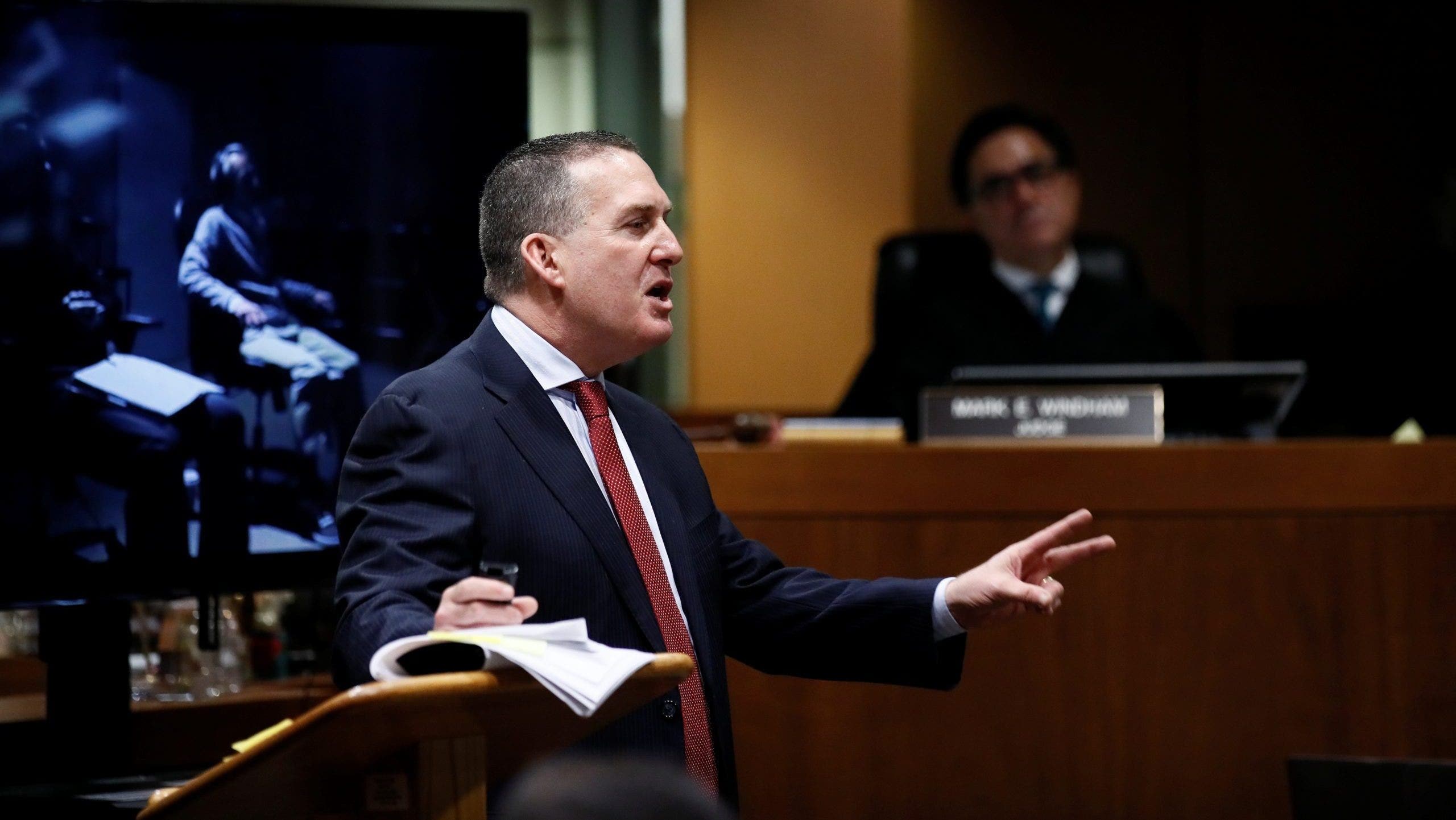
FIRST ON FOX: A prominent Los Angeles prosecutor suing the county in a whistleblower retaliation lawsuit is asking a judge to force his boss, District Attorney George Gascon, to sit for a deposition under oath.
John Lewin, who prosecuted real estate heir-turned-killer Robert Durst, says he was demoted from a prestigious position handling cold case trials to a mere “calendar deputy” after he questioned the legality of some of his boss’s policies.
Now a motion to compel comes after Lewin’s lawyers say Gascon refused to show up for previously scheduled depositions.
LA PROSECUTOR SAYS BOSS GASCON SENT POLICE TO INTIMIDATE HER AT HOME AFTER BLOWING WHISTLE ON SOFT-ON-CRIME MEMO
Deputy District Attorney John Lewin makes opening statements in the Robert Durst murder trial in Los Angeles on March 4, 2020. (Etienne Laurent/Pool via Reuters)
“At the time of my demotion, nobody in my chain of command was aware of it,” Lewin told Fox News Digital. “It came from the highest levels of the office. I very much look forward to George Gascon and his administration being forced to sit under oath where they’re going to have to answer questions.”
If the order is granted, it could be the first time Gascon is deposed under oath in one of more than a dozen lawsuits subordinates have filed against him.
He was ordered to sit in one other lawsuit, but the trial kicked off before he had a chance, and he took the witness stand instead, according to Robert Glassman, one of Lewin’s attorneys. It ended in a $1.5 million judgment for Deputy District Attorney Shawn Randolph.
LOS ANGELES COUNTY JURY AWARDS $1.5M TO PROSECUTOR SUING DA GEORGE GASCON FOR RETALIATION
Lewin filed the retaliation lawsuit after he says he was demoted for writing to his superiors about the apparent unlawfulness of a series of “special directives” Gascon issued after taking office in 2020.
“It’s just a blatant act of retaliation. You have arguably the top prosecutor in the county, he is indispensable to the office, and you remove him from an elite unit and put him out in a satellite court running calendar,” Glassman told Fox News Digital. “And this is the same guy who has been vocal from day one about Gascon’s policies and how they’re not in the best interest of the office and how they’re illegal.”
Los Angeles County District Attorney George Gascon (Brian van der Brug/Los Angeles Times via Getty Images/File)
Lewin, in a series of lengthy emails, described why he believed the directives violated state law, and in February 2021, a Los Angeles judge agreed, issuing an injunction against policies that prevented deputy district attorneys from filing “strike” offenses under California’s “three strikes” law.
ROMANIAN MOB IS COMING FOR YOUR DEBIT CARDS WITH ATM-STYLE SKIMMERS NOW AT SELF-CHECKOUTS: AUTHORITIES WARN
“John specifically requested that if his interpretation of the illegality of the policy was incorrect, that he be directed to the legal authority which supported the District Attorney’s order,” his lawyers wrote. “There was no response to this email.”
A hearing on Lewin’s motion has been scheduled for September.
Deputy District Attorney John Lewin presents opening arguments in the murder trial of New York real estate heir Robert Durst on March 5, 2020, in Los Angeles. (Robyn Beck/AFP via Getty Images)
It’s been a struggle since his demotion, his lawyer said, but the veteran deputy district attorney remains dedicated to doing the best job he can for the citizens of Los Angeles County.
“They took something away from him that he is so passionate about,” Glassman said. “It’s his life. As with anyone in public service, they’re not doing it for the money.”
Lewin, described in court filings as “one of the most celebrated and accomplished prosecutors in Los Angeles,” recently cut a leave short to come back to prosecute the cold case murder and rape suspect Charles Wright, who was a teacher in Inglewood. Jury selection for the trial is currently underway.
“He possesses a special skill set that, quite frankly, other prosecutors don’t have,” Glassman told Fox News Digital. “That’s OK, but they know their limitations, and they know they need John. So, they had to call him out of leave to help prosecute this complicated case because he’s the right man for the job.”
Lewin and another prominent Los Angeles prosecutor, John McKinney, both said they were demoted from the Major Crimes Division in September 2022 after voicing disagreement with Gascon’s policies. By the time Randolph won her lawsuit in 2023, at least 17 retaliation lawsuits had been filed.
McKinney also won high-profile convictions, prosecuting Eric Holder, who murdered Grammy-winning rapper Nipsey Hussle.
Gascon’s office did not immediately respond to a request for comment on the latest filing.
Read the full article from Here


For most food manufacturers, it makes more financial sense to bake, brew, cook or create their product somewhere where the square footage is a little less expensive, like a business park, and to sell it where the rent – and the foot traffic – is higher.
Kent Beidel, who owns a string of mountain-town ice cream parlors called Sundae, did the opposite when he opened his newest and, by far, his biggest location in downtown Denver.
“We wanted to be right in front of people and hear them say, ‘Oh my god, they make the ice cream right here,’” he explained. “It’s backward … it’s hard. But it’s unique, and it’s really cool.”
Sundae opened in early June in a 5,100-square-foot space that includes a retail shop, a waffle cone-making “theater” where people can watch the staff turn out fresh cones, a pint-mixing classroom and a commercial kitchen – visible to customers on three sides through glass windows – that could one day supply multiple stores around Denver.
Beidel is betting those attributes will help the business stand apart from the competition in Denver, where there are already several big names making and selling scoops in multiple locations.
But that’s not the only gamble he took. Sundae is located on Sixteenth Street, the 44-year-old pedestrian mall that has become both a symbol of the city’s urban decay since the pandemic and a beacon of hope for its future after a $175 million renovation.
“Sixteenth Street is interesting,” said Beidel, who has watched it change over the past year since he first signed his lease at 1600 Glenarm Place. “It’s coming back. It still has a way to go, but we are seeing momentum start to build. Even in the last month, the foot traffic and the feeling downtown has perked up. … We are getting great feedback.”
To help, the Denver Downtown Development Authority — as part of a much larger business incentive plan — loaned Sundae $750,000. “It’s a loan,” he said. “We have to pay it back. … But we couldn’t have done this location without that support.”
Beidel has been in the food business for 22 years. Before ice cream, he was the founder of Loaded Joe’s, a restaurant and coffee shop staple in Vail. But in 2016, he sold Loaded Joe’s and took over two former Marble Slab Creamery locations in Vail and Edwards, rebranding them as Sundae. In 2020, he opened a third shop in Glenwood Springs.
“That was our first chance to build from scratch and decide what it should look like,” he explained, adding that Glenwood, which includes a kitchen, eventually began making ice cream for Sundae’s next two locations in Basalt and Snowmass.
To make the ice cream, Beidel said he employs five pastry chefs to create recipes. So, rather than using cheesecake flavoring, for instance, for cheesecake ice cream, Sundae uses all the same ingredients you would use to make real cheesecake.
The cheesecake, by the way, is among Beidel’s favorite flavors, but Salted Cookies & Cream and Caramelized Banana are two of the most popular with customers. Classic chocolate, vanilla, and strawberry are also top sellers – “and always will be,” he added.
Next month, Beidel hopes to open the classroom, where people can learn how to make ice cream and then whip up some of their own flavors to take home. And down the road, he plans to open more locations.
But in the meantime, he’s focused on downtown. “Let’s say Denver does really become vibrant again. We have a great product and a great following in the mountains. So, it’s just a matter of time down here.”
Subscribe to our new food newsletter, Stuffed, to get Denver food and drink news sent straight to your inbox.


SEATTLE – High pressure continues early this week, leading to more sunshine and warmer afternoon temperatures. Skies will be sunny, warm and dry through the middle of the week.
High pressure continues early this week, leading to more sunshine and warmer afternoon temperatures.
What’s next:
Highs today in the low to mid 80s for parts of western Washington, with highs in central and eastern Washington getting close to 100 degrees. The coast and northern interior will remain in the 70s with mostly sunny skies.
Highs today in the low to mid 80s for parts of western Washington.
Fire Risk Levels
The Fire Risk Levels this week will continue to elevate as we see warming temperatures and increased chance of thunderstorms. East of the cascades is already dry and warm, so the increased chance of new fire starts will be something to watch with the storms.
The Fire Risk Levels this week will continue to elevate as we see warming temperatures and increased chance of thunderstorms. (FOX 13 Seattle)
Looking Ahead:
Temperatures will continue to warm for western Washington through midweek, before we see another low pressure system swing inland Thursday. This low will increase changes of showers and isolated thunderstorms on Thursday, and temperatures will be back to normal for this time of year. This cool down is short-lived as high pressure builds again and highs warm back up into the 80s by the weekend.
Temperatures will continue to warm for western Washington through midweek, before we see another low pressure system swing in Thursday.
MORE NEWS FROM FOX 13 SEATTLE
Seismologists track 100 earthquakes of magnitude 4.5 or greater
6-year-old Bellingham, WA boy dies from injuries after beach driftwood accident
Grandmother thwarts Pike Place kidnapping, Seattle police make arrest
‘Transfer Fire’ near Lake Chelan, WA hospital prompts evacuation notices
Here’s where WA wildfires are currently burning
Seattle office vacancy crisis shifts tax burden onto homeowners
Thurston County, WA couple desperate to find dog after Rover sitter vanishes
Husband of pregnant wife killed in Seattle sues King County homeless authority
To get the best local news, weather and sports in Seattle for free, sign up for the daily FOX Seattle Newsletter.
Download the free FOX LOCAL app for mobile in the Apple App Store or Google Play Store for live Seattle news, top stories, weather updates and more local and national news.
The Source: Information in this story came from the FOX 13 Seattle Weather Team and the National Weather Service.

Arraignment of Amos Lane in District Court
Utqiagvik (formerly Barrow), Alaska
August 6, 1993
Article continues after advertisement
When I pushed open the heavy gray doors of the courtroom, heads turned toward me as though it were a wedding, but nobody smiled. I wished I weren’t dragging a suitcase, but I’d come straight from the airport because my office said arraignment had already begun. I stashed the suitcase in a back corner and headed up the aisle.
The courtroom usually sat empty on a Friday morning, and usually was as quiet as a church, which it resembled with its pinstriped gray carpeting and blond wood spectator pews. Instead of an altar, we had a judge’s bench and jury box. Today the place was standing room only, and it buzzed with the murmurs of impatient spectators.
“Amos Lane is his name,” Liz, our office manager, had said when she phoned me in South Carolina in the middle of my first vacation in three years. “They’re holding him on misdemeanors now, but they think he killed the Ipalook sisters.”
“The Ipalook sisters!”
Fred Ipalook Elementary School in Utqiagvik was named for the family patriarch, the first Inupiaq (formerly called Eskimo) school principal.
“Both of them strangled, one raped,” Liz said.
I was standing in my parents’ kitchen, looking through the magnolia trees blooming on their lawn, trying to register what Liz was saying.
“Listen…I know you haven’t been out in a while,” she went on. “Do you want me to have Anchorage send somebody up temporary?”
It took me a while to answer.
“No, I’ll come. It’s my territory.”
My parents’ friends had asked me why I went so far away to defend people who might be dangerous. I had two explanations. The first involved money, the second was hard to explain, so I usually tried to change the subject.
The first was that my daughter was in law school and my son had just started college. Financial aid departments were generous to a widow like me, with meager resources, but the schools were still expensive. I learned that oil-rich Alaska provided good salaries for public defenders, especially if you were willing to go to a bush office, so I sold the old farmhouse near Olympia, Washington, that had been our family home for eleven years; managed to get through the Alaska bar exam; and moved to Arctic Alaska.
The second answer was that the midnight sun and the polar night and the white owls and white bears and white foxes of the Arctic fascinated me. Especially the white owls.
Public Safety officers filled the back pews. Their presence tended to put pressure on the magistrate to set a high bail. I knew it would be part of my job today to remind the court and the prosecutor that we were only here on misdemeanors. My new client might be a suspect in these shocking murders but had not been charged with them. No one had.
I spotted Ed Ellingsworth, local lead detective, his cadaverous frame drooping over a corner of a pew. A young female reporter sat beside him, plump and giggly. I rather liked the way she never spelled the district attorney’s name right. The name was Slusser, but she always wrote Slusher. She also garbled some Inupiat words, and used k, q, and g interchangeably, but so did a lot of people. The language is not yet entirely standardized, but then, neither is English. At least she had learned that Inupiat was a noun and Inupiaq an adjective.
Words that still confused me were the names of the area. When I first arrived, I was told that historic areas in the middle of town were referred to as “Ukpeagvik,” with a “p,” and that the name meant “place where the snowy owls gather.” How lovely, I thought—both the name and the glorious creatures themselves. At the time, the town was called Barrow, a proper British name, but then the townspeople voted to return to the ancient name of Utqiagvik, or “place where roots are dug.” No doubt both names are accurate, and the difference between them perhaps neither the reporter nor I will ever fully understand, but I preferred the owls.
Two entire middle pews were occupied by members of the Ipalook family, looking stricken and exhausted. There were also many spectators who came to court out of boredom. Utqiagvik didn’t have a movie theater. In the front row, there was a group of young women in summer parkas, some with babies folded inside their front zippers.
A faint, comforting scent of seal cooking oil pervaded the room.
My new client, Amos Lane—it would have to be him—sat alone in handcuffs at the defense table, bearing the angry stares at his back. All I could see was that he was a Native man with long black hair and muscular shoulders wearing an orange jumpsuit, and that he needed some company. I passed through the pony gate in the bar and took my place beside him.
His eyes flicked sideways over me, and I saw in his glance that he lumped public defenders together with bailiffs, clerks, police, DAs, judges, and everyone else who put him and kept him in jail.
“You’re Amos Lane? My name’s Rebecca Wright. I’m the public defender for the North Slope Borough. Let’s see what we’ve got.”
Alaska is divided into boroughs rather than counties. The North Slope Borough, an area the size of Wyoming, occupies the northern tier of the state. The Inupiat control the North Slope Borough financially and politically. While many teachers, doctors, and lawyers are taniks, non-Natives, they serve at the pleasure of Native authorities—and may be, and have been, asked to leave if they don’t serve well.
Without a word, Amos passed me the mess of papers in front of him. There were two misdemeanor complaints filed yesterday, and a petition for misdemeanor probation revocation filed instanter. Now.
The first complaint declared Lane was the subject of a citizen’s arrest by one Harold Killbear, whom he had assaulted.
He whispered, “That’s bullshit. The guy was beating up his girlfriend and I stopped him, is all. I got witnesses.”
I shrugged.
What struck me about the complaint was the “citizen’s arrest” part. It signified that no law enforcement officer had witnessed Lane committing any crime. To arrest on a misdemeanor, according to Alaska law, an officer actually had to see the offense happening. Otherwise, the defendant could only be summoned to come into court at a later time. But Killbear could file his own complaint and ask for assistance in taking anyone into custody right away.
I recalled that Killbear himself had appeared in court some weeks previously on a charge of DUI. I wondered, if I ever made it so far as my office this morning, whether I would find that the case against Killbear had been opportunely dismissed.
I felt my hackles rising. It was bad enough for Lane to sit alone in a courtroom of people who wanted somebody, anybody, to be jailed for a serious crime, without Public Safety piling on fake charges. I wished I’d had a chance to read over the file or even just talk to him before the hearing. The initial stages of a case of this magnitude had to be done right.
And I would have liked to tell Mr. Lane my initial reaction to the Killbear complaint, but we couldn’t afford to appear to furtively conspire in front of the crowd. Utqiagvik was so small that each and every person in the courtroom was a potential juror.
“I’ve heard of you,” Lane muttered.
He didn’t say whether what he’d heard was good or bad.
I gave him a polite smile. “I’ve heard of you, too,” I said, “all the way to South Carolina.” Lane started to inquire what I had heard, but I held up a hand and focused on the next charge.
In this complaint, Johnny Aveoganna accused Lane of stealing some ivory from his home. Uh-huh. I knew Aveoganna. He was a talented and prolific carver of ivory, a friendly and generous man, and a heavy drinker. He sold a lot of ivory. I had bought from him myself, a classic polar bear carved from part of a walrus tusk, and a smaller gull and a seal of fossilized ivory. He also gave away a lot of his work, especially to friends who dropped by for a drink.
If Public Safety had found some ivory signed by Aveoganna in Lane’s possession, he could be accused of stealing it. At trial Aveoganna could explain the ivory was a gift. Even if Amos had, in fact, stolen the ivory, the easygoing Johnny might call it a gift, just for old times’ sake.
On the other hand, Aveoganna’s ivory was not the tourist-trinket kind that sold cheaply in Anchorage. Its real value could kick the charge up from misdemeanor into felony if Public Safety decided they really wanted Lane and couldn’t find anything else with which to hold him, at least until the grand jury met to indict someone in the murder case. Hopefully, as an ultimate last resort, an Utqiagvik trial jury of people who knew Aveoganna as Lane and I did, and Fairbanks didn’t, would make short work of the charge.
“Mr. Lane, are you on any kind of parole or probation status?”
“No. I maxed out.”
Only the hardcore went the route of serving every day of their suspended time, the time that would be held over their heads when they were released to parole. That Lane had served every day told me that he didn’t want anybody, anywhere, having a leash on him.
I picked up the remaining papers, a misdemeanor probation revocation petition, with two fingers and looked at him inquisitively.
“That was just this stupid fight write-up I caught right before I got out. The guy lied. They were going to charge it as a felony, but then we copped this deal and I pled to it as a misdemeanor. They did it mostly so they could release me into alcohol treatment instead of the street.”
My head had begun to ache. What he was saying could be true. A lot of inmate squabbles, or misunderstandings by guards, led to empty charges. On the other hand, his previous record might show that he was a dangerous drunk who tended to get violent, and that whatever parole or probation officer had tried to guide him into treatment was doing the right thing.
Beyond those considerations, I grew puzzled that nowhere in this stack of paper was there any reference to the deaths of the two sisters. I had missed a birthday celebration and flown 3,800 miles to represent Amos Lane. If Liz was right and this guy was a suspect in the case, so far no one had come up with any evidence against him. Liz was Inupiaq herself, and she and her extended family members always knew what had happened, who was accused, and who was probably guilty.
Unlike Public Safety, I might add.
I studied his face. “Mr. Lane, I don’t recall seeing you in court before. You’re not from Utqiagvik, are you.”
It was not a question.
“No way,” he said. “I’m from Point Hope.”
Utqiagvik was on the northern edge of Alaska and was in fact the northernmost community in the United States. Point Hope was home to a few hundred people on the western rim, so remote it made Utqiagvik seem like a world hub. The people of Point Hope had once successfully resisted the federal government’s plan of detonating a thermonuclear device to create a harbor on their coast.
Good for them.
Point Hope is also one of the oldest continually inhabited communities on the North American continent. Inupiat have lived there 2,500 years.
***
Excerpted from Sisters of the Midnight Sun: A Murder in Arctic Alaska. By Rebecca Wright Stevens. Copyright 2026. Reprinted with permission. All rights reserved.
-

 Dallas, TX5 minutes ago
Top 10 Dallas Cowboys of 2026: Rashan Gary is Complete EDGE Dallas Needed
-

 Miami, FL11 minutes ago
Girl, 12, shot while sitting in parked car in northwest Miami-Dade, deputies say
-

 Boston, MA17 minutes ago
GBH Daily: Come sail away
-

 Denver, CO23 minutes ago
New ice cream shop with a ‘waffle theater’ bets big on downtown Denver
-

 Seattle, WA29 minutes ago
Seattle weather: Sunny skies and warmer temperatures Tuesday
-

 Milwaukee, WI41 minutes ago
Milwaukee cooling centers, heat advisory tips; what to know
-

 Atlanta, GA47 minutes ago
Warnock, Dickens talk about new housing legislation
-

 Indianapolis, IN59 minutes ago
Indiana heat index to hit 100 as hot, dry pattern holds | July 14, 2026

