West
False alarm triggers brief rescue operation aboard Carnival Radiance off Mexico coast

NEWYou can now listen to Fox News articles!
A rescue operation was temporarily underway Thursday after a Carnival Cruise Line ship received an alert about a potential overboard situation, which later turned out to be a false alarm.
The crew of the Carnival Radiance was responding to a potential overboard alert near the waters off Ensenada, Mexico after some guests reported hearing a splash in the water, the cruise line said.
“The ship returned to the area where there was a potential sighting of an individual to conduct a rescue operation,” the cruise line told Fox News Digital. “In the meantime, the crew completed a full guest and crew headcount as is our standard safety protocol and all guests and crew have been accounted for.
CRUISE SHIP DEATH MYSTERY: CHEERLEADER’S FINAL POSTS HINT AT HEARTBREAK AND RESILIENCE AS DAD BREAKS SILENCE
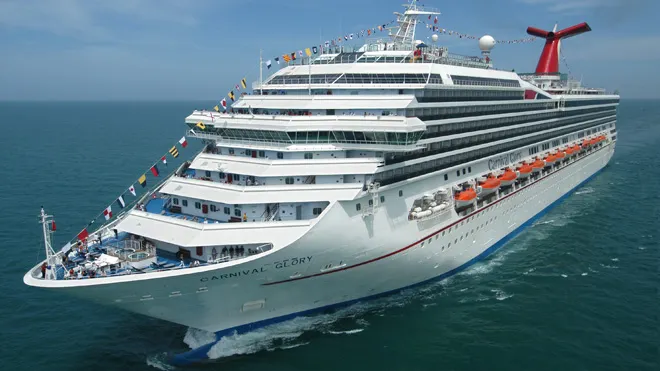
The Carnival Glory, pictured, cruises off the coast of Florida. The Carnival Radiance was responding to a potential overboard situation Thursday in the waters off the Pacific coast of Mexico. (Andy Newman/Carnival Cruise Lines)
“The splash could have very well been a whale but there is no way to confirm that. In any case, all on board are accounted for and the ship will resume its itinerary,” the statement continued.
The Radiance sails from Long Beach, California, to Ensenada, about 75 miles south of the southern border near San Diego.
Fox News Digital has reached out to the U.S. Coast Guard.
FBI INVESTIGATING PASSENGER DEATH ABOARD CARNIVAL CRUISE SHIP AFTER RETURN TO MIAMI
The cruiser Carnival Magic in Dubrovnik May 20, 2020. (AFP via Getty Images)
Earlier this month, a Carnival passenger was found dead on a Carnival ship.
Anna Kepner, a varsity cheerleader who wanted to join the Navy after graduating from high school and eventually become a K-9 police officer, was found dead Nov. 7 while the ship was in the Gulf of America.
Anna Kepner’s family said she had dreams of joining the military. (Instagram/Anna Kepner)
CLICK HERE TO DOWNLOAD THE FOX NEWS APP
“The ship returned to PortMiami (the Port of Miami) as planned on Saturday morning, Nov. 8, and the FBI has advised that there is no related threat to safety aboard as it sails its current voyage,” a Carnival spokesperson previously told Fox News Digital.
Read the full article from Here



The Oregon Supreme Court on Thursday declined to review the Oregon Court of Appeals’ decision upholding Multnomah County’s ban on flavored tobacco and nicotine products.
Legal challenges have so far delayed the ordinance from taking effect since it was passed four years ago. It was not immediately clear when the ban would go into effect.
“Flavors are one of Big Tobacco’s biggest tricks to hook the next generation of Oregonians on their deadly products,” Christina Bodamer, who leads the Western states region of the American Heart Association, said following the court’s decision.
The Board of County Commissioners originally approved the ordinance banning flavored tobacco and nicotine products in December 2022 to take effect Jan. 1, 2024. But the ordinance hit a roadblock: a court challenge by the 21+ Tobacco and Vapor Retail Association of Oregon, e-cigarette retailer No Moke Daddy LLC, and vape shop owner Paul Bates.
It has been working its way through the state court system since. The Multnomah County Circuit Court upheld the ban in September 2023. The state Court of Appeals continued the pause on implementation February 2024, before upholding the ban in an April 2025 decision. The Supreme Court’s denial of review marks the end of the saga.
The Supreme Court rejected a challenge to a similar restriction in Washington County in May. That now sets up both ordinances to go into effect, which will together ban flavored tobacco and nicotine for one-third of Oregonians. A similar ban failed in the Oregon Legislature in 2025, dying in committee.
Tobacco use is the top cause of preventable death and disease in Oregon, according to the Oregon Health Authority. More than 8,000 Oregonians die from tobacco use each year.
Supporters of the ban argue that flavored tobacco acts as a gateway for underage use. According to Flavors Hook Oregon Kids, a coalition of more than 60 organizations that support the ban, 81% of Oregonian kids who’ve used tobacco started with flavored products. And flavored products are much more popular among kids and young adults than older adults, OHA says.
Richard Burke, executive director of the 21+ Tobacco and Vapor Retail Association of Oregon, tells WW the group is disappointed that the Supreme Court did not take up the case. He argues that banning flavored tobacco “has effectively granted a monopoly to the black market,” where flavored products are often laced with more dangerous substances.
“We agree with the goal of keeping these products out of the hands of minors,” Burke says. “But this is an overcorrection that will result in unintended consequences as has been shown by attempts to institute flavor bans in other parts of the country.”
Willamette Week’s reporting has real-life impact that changes laws, forces action by civic leaders, and drives compromised politicians from public office.
Support WW.

President Donald Trump sharply reduced the size of two national monuments in Utah, undoing protections established by his Democratic predecessors on public lands that are sacred among many Native Americans.
Bears Ears and Grand Staircase-Escalante national monuments in southern Utah have ancient cliff dwellings, petroglyphs and scenic canyons, as well as coal and uranium deposits that state officials want made available for development.
Trump, a Republican, issued proclamations Monday under the Antiquities Act to reduce their size by about 90% each. He took similar actions during his first term, but those were reversed by President Joe Biden, a Democrat.
The latest move comes as Trump and other Republicans have drastically reshaped the management of vast taxpayer-owned lands concentrated in Western states. Trump administration officials and congressional Republicans have sought to expand drilling, mining and logging on public lands, while removing protections for imperiled species and rolling back rules for conservation.
“They took the land from the people quite honestly,” Trump said at a signing event at the White House Monday. “We’re giving it back.”
President Bill Clinton, a Democrat, established Grand Staircase-Escalante National Monument in 1996, and President Barack Obama, also a Democrat, created Bears Ears National Monument in 2016 under the Antiquities Act. The 1906 law gives presidents the powers to protect sites considered historic, archaeologically significant or culturally important.
Davina Smith-Idjesa, a citizen of the Navajo Nation and co-chair of the Bears Ears Inter-Tribal Coalition, said tribal leaders had braced for a reduction since Trump was elected to a second term. She said it was “heartbreaking” and accused federal officials of sidestepping their legal responsibility to consult with tribal nations that would be impacted.
“From a Navajo perspective, Bears Ears is not simply a piece of federal public land,” Smith-Idjesa said. “This is a living cultural site that holds our histories, our ceremonies, our traditional foods and medicines and our ancestors’ footprints.”
‘Big day for Utah’
Utah officials had long fought against the monument designations and argued that the state should be in charge of controlling its own lands. Trump in his first term reduced their size, calling their creation a “massive land grab.” Combined they spanned more than 3.2 million acres (13 million hectares), an area nearly the size of Connecticut.
Trump reduced them Monday to less than 303,000 acres (123,000 hectares) combined.
That’s a greater reduction than his first term, when he left Grand Staircase Escalante at 1 million acres (405,000 hectares) and Bears Ears at 213,000 acres (86,000 hectares).
“This is a big day for Utah,” Utah Gov. Spencer Cox as he stood next to Trump at the White House. “These monument designations are supposed to be the smallest area as possible to protect the antiquities.”
Bears Ears was the first national monument created at the request of tribal nations that consider the land sacred. The landscape contains ancestral villages, ceremonial and burial sites and features in some tribes’ creation and migration stories. Its designation honored five tribes in the region — Navajo, Hopi, Zuni, Ute Mountain Ute and Uintah-Ouray Ute.
Home to hundreds of thousands of objects of cultural and scientific significance, Bears Ears is jointly managed by an agreement between tribal nations and federal agencies.
Rick Bowmer/AP Photo
Rick Bowmer/AP Photo Newspaper Rock, featuring a rock panel of petroglyphs in the Indian Creek Area, is seen near Monticello, Utah, on July 14, 2016.
Grand Staircase-Escalante consists of cliffs, canyons, natural arches and archaeological sites, including rock paintings. It holds large coal reserves, while the Bears Ears area has uranium.
The national monument designation provides sweeping protections not just for significant geological features or artifacts but also for the surrounding landscape, banning drilling, mining and new construction nearby. Proponents of Trump’s move to downsize say the protective boundaries stretch too far and hinder mining for critical minerals.
Trump asserted Monday that people can not hunt, fish or “virtually not even walk” on the monuments. That’s false: Hunting, fishing, camping and other recreation are permitted under state and federal regulations, said Steve Bloch, legal director for the Southern Utah Wilderness Alliance, a conservation group.
Biden designated or expanded more than a dozen monuments and had a goal to conserve at least 30% of U.S. lands and waters by 2030.
Trump’s policies are largely the opposite: He wants to tap into the natural resource wealth of federal lands that total more than 100,000 square miles (260,000 square kilometers) and offshore areas under federal control, such as in the Gulf of Mexico and off Alaska.
That’s drawn backlash from Democrats who warn of the wholesale disposal of treasured landscapes for commercial gain.
“Today’s executive action is another chapter in this administration’s war on the West,” Democratic Sen. Martin Heinrich of New Mexico said Monday. He added that Trump was “turning the Antiquities Act on its head.”
Land sale proposals fell flat
Trump Interior Secretary Doug Burgum said last year that federal officials would review and consider redrawing monument boundaries as part of a push to expand U.S. energy production.
Trump in his current term has used proclamations to lift commercial fishing prohibitions within expansive marine monuments in areas of the Pacific Ocean and in the Atlantic Ocean off the New England coast. Those monuments were created by Democratic and Republican administrations. The effort to boost the fishing industry, which has been challenged in court, marks a dramatic shift in federal policy by prioritizing commercial interests over efforts to allow the fish supply to increase.
Some Republicans have tried to sell or transfer federal lands to states or other entities. Those efforts have largely fallen flat: A push by some GOP lawmakers in the House to sell public lands ran into bipartisan opposition, while another proposal by Sen. Mike Lee of Utah to sell more than 3,200 square miles (8,300 square kilometers) of federal lands was removed from Republicans’ big tax and spending bill.
The U.S. Supreme Court last year turned back a lawsuit from Utah officials who sought to wrest control of vast areas of public land within the state from the federal government.
__
Hannah Schoenbaum reported from Salt Lake City.
-

 New Hampshire11 minutes ago
Thousands Of Sunflowers Hit Peak Bloom For Limited Time At Coppal House Farm In Lee
-

 New Jersey17 minutes ago
NJ fines Sen. Wimberly $24K after use of donations for hotels, airfare
-

 New Mexico23 minutes ago
New Mexico wants to get orphaned wells plugged — but did contractors get the word?
-

 North Carolina29 minutes ago
North Carolina attempted murder suspect arrested in Myrtle Beach
-

 North Dakota35 minutes ago
Families allege babies were switched at Grafton hospital
-

 Ohio41 minutes ago
9 indicted for allegedly being part of human trafficking ring in Ohio
-

 Oklahoma47 minutes ago
Oklahoma senator renews push for new agency that focuses on child welfare services
-

 Oregon53 minutes ago
Oregon Supreme Court Rejects Appeal of Multnomah County’s Flavored Tobacco Vape Ban

