West
Ex-SJSU trans athlete makes disputed claims about female teammate’s eating disorder and academic setback

NEWYou can now listen to Fox News articles!
EXCLUSIVE: Prominent transgender athlete Blaire Fleming has made allegations about former teammate Brooke Slusser’s lifestyle and academics. Slusser has disputed the allegations.
Last Sunday, on the one-year anniversary of their final college volleyball game together for San Jose State, a conference championship loss, Slusser told Fox News Digital she developed an eating disorder, which led to anorexia and the loss of her menstrual cycle.
Slusser said the ailments stemmed from the emotional distress suffered during her final season with Fleming in 2024. Slusser waged multiple lawsuits after discovering Fleming was transgender and that the two had shared changing spaces and bedrooms during their first season together in 2023.
Slusser also fled the San Jose State campus and later dropped her classes in her final semester this past spring. She said constant in-person harassment by students who opposed her stance made her feel “unsafe” there. She and her family said she is still working on finishing her degree.
Fleming responded to Fox News Digital’s social media inquiry for a response to Slusser’s revelations.
Blaire Fleming of the San Jose State Spartans during the third set against the Air Force Falcons on Oct. 19, 2024 in Colorado Springs, Colorado. (Andrew Wevers/Getty Images)
“She’s been anorexic and struggled with food since I’ve known her[,] aka since 2023. She literally would weigh herself 2-3x a day and keep track of it on her whiteboard in her room…. So I really don’t care or feel bad for her. And she didn’t drop her classes[,] she failed out[,] hope that helps!” Fleming wrote. “Now please stop hitting me up.”
Slusser has provided a statement to Fox News Digital disputing Fleming’s allegations.
“These statements are just not true. I have always lived a very healthy lifestyle. Before these events took place[,] I was very disciplined in fueling myself for athletics and [kept] track to make sure I was where I need to be[,] to be the best athlete. It wasn’t until all the craziness started that my healthy lifestyle turned very unhealthy into not eating the amount I should,” Slusser said.
“As for school[,] I decided to stay home after fall 2024 to better myself and heal. So no[,] I did not return to San Jose and enroll myself in more courses at an institution that didn’t have my best interest.”
Former SJSU volleyball star Brooke Slusser and her parents Paul and Kim Slusser at a game on Sept. 8, which Kim claims is “the last fond memory we have of her playing.” (Courtesy of Kim Slusser)
Fox News Digital’s initial inquiry to Fleming began with a reference to Slusser’s response to Fleming’s claim of being “suicidal” during the 2024 season, reported in a New York Times Magazine profile in April. The outlet also reported that Fleming cried “almost every night,” during the scandal.
Slusser said of Fleming’s suicidal thoughts, “If that’s what [Fleming] was going through, that’s terrible.”
Fleming previously said that Slusser “needs to get a life.” That statement came in response to claims by former SJSU assistant volleyball coach Melissa Batie-Smoose about Fleming getting special treatment by head coach Todd Kress.
“Brooke Slusser and Melissa need to get a life,” Fleming told Fox News Digital on Oct. 1.
Slusser responded, “I have a great life.”
Who is Blaire Fleming?
Fleming, a biological male, was born in 2002 at Offutt Air Force Base in Nebraska, just south of Omaha, per the athlete’s SJSU Athletics profile. But Fleming grew up in Virginia.
According to The New York Times, Fleming discovered transgenderism in the 8th grade. Then, at 14 years old, Fleming reportedly worked with a doctor and therapist to “socially and medically” transition.
Fleming played girls’ volleyball at John Champe High School. At a listed height of 6-foot-1, Fleming is four inches taller than the average women’s college volleyball recruit of 5-foot-9, according to NCSA College Recruiting.
In November 2018, Fleming posted a highlight reel for college recruiters on the high school sports social media site Hudl. Most of the clips show the same type of play over and over again — Fleming leaping high above the net and slamming the ball down, as trap music blared in the background.
As a senior, Fleming led John Champe to a historic 19-win season in 2019, was named first-team all-district and set the school’s single-season record for kills in a season, per Fleming’s SJSU profile page.
Fleming’s college career began at Coastal Carolina during the COVID-affected 2020 season.
After a 9-1 regular season, Coastal Carolina reached the Sun Belt Conference championship game against Texas State, but lost in five sets.
Fleming transferred to SJSU ahead of the 2022 season.
How did it get to this point between Slusser and Fleming?
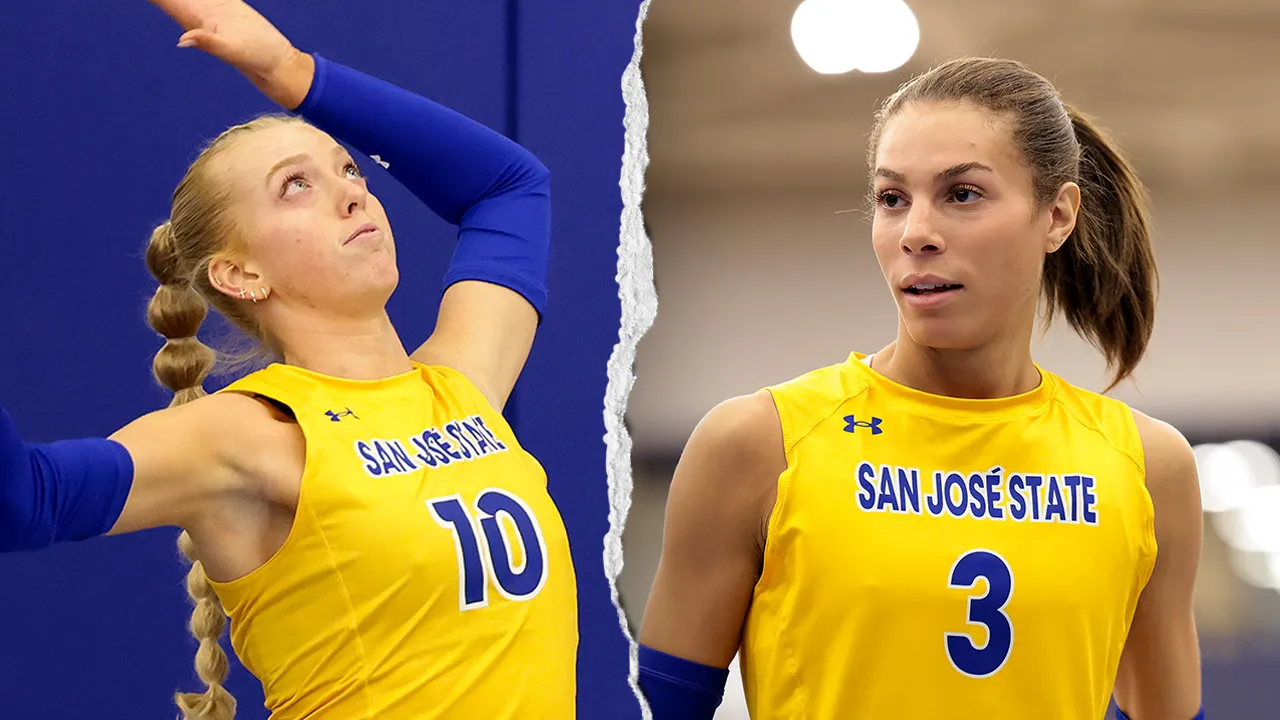
Brooke Slusser #10 and Blaire Fleming #3 of the San Jose State Spartans call a play against the Air Force Falcons on Oct. 19, 2024, in Colorado Springs, Colorado. (Andrew Wevers/Getty Images)
Slusser transferred to SJSU for the 2023 season – one year after Fleming did. Slusser has alleged in her lawsuits against the NCAA and Mountain West Conference that she was never told Fleming’s birth sex, and that the two regularly shared hotel rooms on away trips.
Slusser and Batie-Smoose, who is leading her own lawsuit against the university, have told Fox News Digital that Fleming allegedly requested to be roomed with Slusser, and was allegedly granted that request by team leadership.
“Blaire wanted to room with Brooke Slusser, and that’s who Blaire felt comfortable with, so Blaire gets what Blaire wants,” Batie-Smoose said.
Fox News Digital has previously reached out to Fleming and SJSU for a response to these allegations.
Slusser has alleged in her lawsuits against the NCAA and Mountain West that Fleming confessed to being transgender during a conversation over ice cream with another teammate in April 2024.
Slusser then joined Riley Gaines’ lawsuit against the NCAA in September 2024. What followed was a series of forfeits by opposing teams. Each forfeit compounded growing attention in an election-season media cycle, putting SJSU’s volleyball players and their opponents under a massive political spotlight.
President Donald Trump even mentioned the scandal on his campaign trail in October of that year, during a Fox News Channel all-woman town hall event.
Police protection was assigned to the team on a regular basis.
Slusser has alleged in her lawsuit against the Mountain West, which was filed in November, that she was allegedly informed by teammates of an alleged conversation Fleming had with an opposing player, discussing a plan to have Slusser spiked in the face during a match. Batie-Smoose reported those same allegations in a Title IX complaint against the school, and was later suspended and did not have her contract renewed in January.
The Mountain West commissioned a third-party investigation into the allegations against Fleming, and determined that sufficient evidence could not be found to assign discipline.
Fox News Digital has reported extensively on the conditions of that investigation and its handling, prompting critical responses by the White House, U.S. Department of Justice and members of congress.
EX-SJSU STAR BROOKE SLUSSER MAKES NEW ALLEGATIONS ABOUT PROBE INTO TRANS TEAMMATE’S ALLEGED PLOT TO HARM HER
In the waning weeks of the 2024 regular season, Slusser and 10 other plaintiffs in her lawsuit against the Mountain West filed a request for preliminary injunction to have Fleming be ruled ineligible to continue playing, and to have the forfeits to SJSU reversed. Federal judge Kato Crews, appointed by former President Joe Biden, denied the request, keeping Slusser and Fleming on the court together for practice and games.
Slusser and Fleming were ultimately named to the Mountain West all-conference team, as SJSU’s only honorees.
They finished the season with a 14-7 record, aided by six conference forfeits, then advanced to the Mountain West championship game after Boise State forfeited in the divisional round.
But they lost in the title game to Colorado State, three sets to one. The loss ensured that the Spartans wouldn’t take their scandal into the NCAA tournament.
Slusser left campus shortly after that at the insistence of her parents. According to The New York Times, Fleming also resumed classes remotely the following semester from Virginia.
Slusser said she came close to returning to play NCAA beach volleyball this past spring, and even had discussions with coaches at other schools about recruitment. But she ultimately decided not to, and moved to North Carolina, where she has served as a youth volleyball coach.
CLICK HERE TO DOWNLOAD THE FOX NEWS APP
Slusser and her family say she has recovered from her anorexia, and is working on finishing her degree. She aspires to start her own business in dietetics.
Fleming appeared to celebrate graduation from SJSU in a post on her Instagram Stories in May.
The U.S. Department of Education is currently investigating the university for potential Title IX violations.
Follow Fox News Digital’s sports coverage on X, and subscribe to the Fox News Sports Huddle newsletter.
Read the full article from Here



Denver, Colo. (03/27/2026) – In front of another expected record-breaking crowd, the Washington Spirit is set to take on Denver Summit FC in the side’s inaugural home match at Empower Field at Mile High. With over 60,000 tickets already distributed, the match is poised to break the NWSL attendance record of 40,091 set last summer when the Spirit visited Bay FC at San Francisco’s Oracle Park. Kicking off at 2 p.m. EDT, the match will broadcast nationally on CBS.
The Spirit
Washington comes into this weekend’s fixture off a difficult 1-1 home draw with Utah Royals FC earlier this week. After scoring in the 18th minute, the Spirit nearly earned its first victory of 2026 but conceded an equalizer late and had to settle for a single point on the table. Washington’s goal was scored by midfielder Rebeca Bernal, the Mexican star’s first since transferring to the NWSL last year.
Saturday afternoon’s match will mark the first-ever meeting between the Spirit, one of the NWSL’s original clubs, and 2026 expansion side Denver Summit FC. Denver will be the 17th different opponent for Washington across its regular season history: the Spirit has played against 13 active clubs (all except expansion sides Denver and Boston) as well as defunct clubs the Boston Breakers, FC Kansas City and the Western New York Flash.
The Spirit has had success against expansion sides as of late, tallying 11 wins in 15 matches against NWSL clubs in their first season of competition since the start of the 2021 campaign. In 2024, the Spirit went a perfect 5-0-0 against Bay FC and Utah Royals FC, outscoring the teams 10-3 with a playoff win to boot. In 2022, Washington earned a 1-3-0 record against Angel City FC and San Diego Wave FC and, in 2021, the eventual NWSL champions went an impressive 5-1-0 against Kansas City and Racing Louisville FC.
This weekend’s matchup at Empower Field at Mile High, home of the NFL’s Denver Broncos, is set to shatter the NWSL’s single match attendance record with over 60,000 tickets already distributed. The Spirit has also been the visiting team for two of the league’s previous three record-setting attendances: 34,130 fans at Seattle’s Lumen Field when the Spirit took on the Reign and 40,091 in the stands at San Francisco’s historic Oracle Park to watch Washington play Bay FC.
Washington is in good standing in several attacking categories through three matches despite two draws and a loss. The Spirit remains first in the league in rate of possession at nearly 62% and top three in both shots and shots on target with 49 and 17, respectively. With just three goals through three matches, look for the Spirit attack to continue getting attempts on frame this weekend.
Following Saturday’s match, the Spirit will hit the road again next weekend for an away match against Bay FC in San Jose on Sunday, April 5. Washington’s next home match will be on Friday, April 24 at 8 p.m. EDT when the side hosts the defending Shield winner Kansas City Current at Audi Field. Information on tickets can be found HERE.
The Opponent
Denver Summit FC opened its inaugural season with three straight away matches, collecting a win, a loss and a draw to carry four points into its home opener this weekend. Summit FC dropped its first match to Bay FC 1-2 before drawing Orlando 1-1 and beating Gotham 2-0.
Summit FC is led in scoring by star German forward Melissa Kössler who has three goals in three matches, scoring once in each contest. With a goal tomorrow, the forward would join Alex Morgan as just the second player in league history to score in each of her first four matches with a club. Look for the Spirit defending third to place an emphasis on limiting chances to Kössler on Saturday afternoon.
Denver has only allowed one goal across its last 240 minutes of action after giving up two in the first 30 minutes of the side’s opener. The strong recent form of Summit FC’s defending third against the Spirit attacking third’s ability to generate chance after chance will be a point to watch this weekend.
Three former Spirit players are currently on the Summit FC roster as midfielders Meg Boade and Jordan Baggett and defender Camryn Biegalski signed with the side ahead of this season. Baggett spent four years with the Spirit after being drafted by the side in 2019 while Biegalski signed with Washington in 2021 and played three seasons, both winning the 2021 NWSL Championship with the team. Boade spent the first half of the 2025 season in DC as a short-term injury replacement, even scoring a goal for the Spirit.
Following tomorrow’s match, Denver will travel to Seattle to face Reign FC on Saturday, April 4.
All-Time Series History
This weekend’s match will be the first-ever meeting between the Spirit and Denver Summit FC.
About The Washington Spirit
The Washington Spirit is the premier professional women’s soccer team based in Washington, D.C. and plays at Audi Field in Buzzard Point. The Spirit was founded on November 21, 2012 and is an inaugural member of the National Women’s Soccer League (NWSL) the fastest growing sports league in the US. The club is home to some of the best players in the world who have won championships for both club and country. For more information about the Spirit, visit WashingtonSpirit.com and follow the club on Twitter, Instagram and Facebook.

The Seattle Seahawks are hiring former UW Huskies offensive coordinator Jimmie Dougherty as an offensive assistant, NFL Network’s Tom Pelissero reported Friday.
What Bump makes of Seahawks’ visit with RB Najee Harris
This will be the first NFL job for the 47-year-old Dougherty, who has spent the past 24 seasons coaching at the college level. He was with the Huskies during the 2024 and 2025 seasons, serving as the team’s passing game coordinator and quarterbacks coach in 2024 and offensive coordinator and quarterbacks coach in 2025. Dougherty was not the play-caller for UW under head coach Jedd Fisch.
Dougherty left his position at UW in February.
Dougherty also coached at UW from 2009-2012 as wide receivers coach and passing game coordinator under Steve Sarkisian.
Dougherty’s previous college stops include Illinois Wesleyan, San Diego, San Jose State, Michigan, UCLA and Arizona. While at Michigan as an offensive assistant in 2016, he coached alongside Seahawks special teams coordinator Jay Harbaugh and under then-head coach Jim Harbaugh. Seahawks head coach Mike Macdonald coached under Jim and alongside Jay when he was Michigan’s defensive coordinator in 2021.
Dougherty played quarterback in college at the University of Missouri from 1997-2001 and was the starter in 1999.
More on the Seattle Seahawks
• Who will be Seahawks’ top draft pick? Six prospects to know
• Seattle Seahawks to kick off 2026 NFL season on a Wednesday
• Salk: Two concerns for Seahawks after the huge JSN extension
• Seahawks keep key part of offense with JSN’s record-setting extension
• GM explains why Seahawks re-signed WR Jake Bobo


Video: We Analyzed the Deadly Crash at LaGuardia

PWHL players bond with women’s hockey pioneers at Detroit clinic | NHL.com

Fielder may resign from Board of Supervisors, possibly over illegal leak

Dallas Mayor Eric Johnson says he trusts latest City Hall repair estimates

As Ultra Music Festival kicks off, Miami residents living nearby are expressing concerns about traffic, noise

Florida High School Football Rankings: Top 25 teams – Oct. 21

How old is Bo Nix? What to know about Oregon quarterback ahead of 2024 NFL Draft

Cleary's 21 help Le Moyne down Central Connecticut State 69-64 in OT

99th annual Pony Swim held in Virginia

Indiana Members Credit Union announced as new anchor tenant at Bottleworks District

WATCH: Senate hearing goes silent after Angel Father confronts top Dem over daughter’s death

US diplomat Marco Rubio denounces settler violence, tolls in Hormuz strait

Iran-linked hackers have breached FBI Director Kash Patel’s personal emails | CNN Politics

Live: CPAC 2026 Day 2

Savannah Guthrie is returning to ‘Today’ show
-

 Detroit, MI1 week ago
Drummer Brian Pastoria, longtime Detroit music advocate, dies at 68
-

 Movie Reviews1 week ago
‘Youth’ Twitter review: Ken Karunaas impresses audiences; Suraj Venjaramoodu adds charm; music wins praise | – The Times of India
-

 Sports6 days ago
IOC addresses execution of 19-year-old Iranian wrestler Saleh Mohammadi
-

 New Mexico5 days ago
Clovis shooting leaves one dead, four injured
-
 Business1 week ago
Disney’s new CEO says his focus is on storytelling and creativity
-

 Technology5 days ago
YouTube job scam text: How to spot it fast
-

 Tennessee4 days ago
Tennessee Police Investigating Alleged Assault Involving ‘Reacher’ Star Alan Ritchson
-

 Texas1 week ago
How to buy Houston vs. Texas A&M 2026 March Madness tickets