Denver, CO
Guatemala becoming tourism hot spot for young travelers


Adventurous travelers seeking beauty and budget thrills should look no further than Guatemala: a friendly country that remains largely unexplored by many Americans, but can be reached in as little as six hours from Denver.
A question I fielded several times before my late February trip: Why Guatemala?
My partner and I have made a habit of planning at least one international trip each year. Actually, I’ll shoulder most of the blame — nothing scratches my travel itch like a new passport stamp. But because we’re early-career professionals, with limited stockpiles of paid time off and inevitable bills, a month-long vacation to Southeast Asia or Eastern Europe is out of the question (for now).
Last summer, I found myself in a rabbit hole of research: Panama, Aruba, Curaçao. Slowly, the pieces fell together for Guatemala.
Compared to my other potential destinations, Denver International Airport offers inexpensive connecting flights to Guatemala City that take a minimum of around six hours of travel time. I started to hear about this friend or that roommate who had visited — or even temporarily moved to — the Central American country over the past few years and couldn’t get enough of it.
Social media platform TikTok features videos of jet-setters of every creed successfully journeying through the tourist destinations of Antigua and Lake Atitlán, offering tips on how to navigate the nation. By August, our accommodations were booked.
Both sets of our parents initially balked at the idea. My dad had previously flown to Guatemala City on business, and was confined within the limits of Central America’s largest metropolis. Like others in the baby boomer and Generation X demographics, much of what they’d grown up hearing about the country was related to its conditions during the Guatemalan Civil War, which lasted 36 years.
However, over the past decade, the nation’s tourism industry has consistently grown — minus a setback during the COVID-19 pandemic, according to data-gathering platform Statista. And I was hearing piqued interest from millennials and zoomers about making the trip south. At the Cherry Creek Shopping Center days before my trip, a clerk peppered me with questions about my itinerary as she considered doing the same.
After my editors gave me the green light to briefly chase a story on the ground, the trip became both work and play — four days off, two days on. I took the necessary precautions learned on my last reporting trip to Peru in the pre-COVID era: monitor travel advisories with the U.S. State Department, submit my itinerary to the agency’s Smart Traveler Enrollment Program and set an appointment with a travel clinic to get relevant vaccines.
With interviews set and bags packed, we hopped on our 6 a.m. American Airlines flight, then stopped briefly at the Dallas Fort Worth International Airport, before touching down in the early afternoon at La Aurora International Airport in Guatemala City. On the flight, our seat neighbor — a Guatemalan who planned to visit her family for a long weekend before heading back to the U.S. — excitedly shared her recommendations, then led us through the winding halls of the airport to customs and immigration.
Guatemala’s cash economy
After a quick and easy process, we were set to embark into a new country — and learned lessons pretty quickly. We brought cash because Guatemala is a cash-reliant economy, particularly outside of its capital city. The airport provides several opportunities to exchange dollars for quetzales, with $1 worth about 8 quetzales, as of mid-April. It’s best to fork over the added exchange fee there and avoid the inconvenience of hunting for a bank like we did later.
More than three million people reside in the city’s urban area, which is made up of 21 zones — some of which tourists are advised against visiting. We stayed one night in Zone 4, which a travel blog calls “the upcoming hipster area.” Zones 9 and 10 come highly recommended, too. We felt safe and relaxed in the neighborhood around our Airbnb — a unit in a modern apartment complex, with its own private patio.
Our plans for that first day were ambitious: see the National Palace of Culture, stop by the city’s market and eat dinner at steakhouse Hacienda Real Zona 10. Instead, we took in the sunset views on the rooftop of restaurant Los Tres Tiempos in the city’s historical district, cocktails and croquetas de pache — mozzarella croquettes made of Guatemalan potato dough — in hand, before turning in. But if you’re short on time or not a big city person, then you can skip visiting the capital like most tourists do.
Disclaimer: I’m not sure what it would be like to travel through Guatemala without a Spanish speaker by my side. Spanish and even some Mayan dialects take precedence over English throughout the country. Because that’s my partner’s first language, I didn’t have to put my rudimentary skills to the test. However, I encountered plenty of Europeans and North Americans who managed to make it from Point A to Point B.

Antigua
The next morning started with the one-hour drive west to the colonial city of Antigua. Visitors have several options for transportation. Uber is available, and we used it for a short ride in Guatemala City, but I’d read enough mixed reviews for me to largely opt against it. The bravest — and stingiest — of travelers sometimes ride the chicken buses: decorated buses that serve as public transportation. However, I’d also seen a litany of online grievances, as the buses can often run unreliably and feel crowded, with the risk of pickpockets.
Instead, we used private cars and shared shuttle services to travel from town to town, which are affordable by American standards. Viator Travel served as a trusty resource for finding highly-reviewed drivers, who often arrived early and provided a smooth ride.
Our two nights in Antigua left us wishing for more time. There, activities abound — sightseeing at the famous Santa Catalina Arch and Central Park, bartering at the massive Mercado Central and eating so many piping-hot tortillas. My go-to breakfast for days in a row: plantains, refried beans, farmer’s cheese and eggs soaked in salsa, scooped into tortillas and washed down with that famous Guatemalan coffee.

Antigua is the place to buy souvenirs. I scored a Mayan cookbook, plus trinkets for my family like handmade worry dolls: tiny dolls that you tuck under your pillow to whisk away your stresses as you dream. It’s also the spot for nightlife, with several dozen bars and restaurants concentrated in a walkable area that’s both spotless and safe.
Speaking of walking, follow our lead and bring a duffle or weekend bag, instead of a suitcase. Otherwise, navigating the cobblestone roads can quickly turn into the bane of your existence. And wear comfortable sneakers. We walked almost 9 miles one day, but that’s the best way to find hole-in-the-wall joints like restaurant Cafeteria La Concepcion, which is where I tried the traditional dish of pepián de pollo, a Guatemalan chicken stew.
Depending on the timing of your trip, you could also experience a local festival. I was delighted to realize that we visited ahead of Semana Santa, or Holy Week, with Guatemala considered a deeply Christian country. Street vendors sell cheap delicacies, such as empanadas de leche, or sweet cream empanadas. Antigua residents wake up every Sunday during Lent and create alfombras — intricately designed “carpets” made of flower petals and sawdust dyed in every color — on the streets before the evening’s religious procession. Then, just hours later, the temporary creations are stepped on and swept up.
From Antigua, you can admire the surrounding peaks of towering volcanoes, and tour operators like OX Expeditions take hikers on excursions to Pacaya, Acatenango and Agua volcanoes. We signed up for an easy sunset hike up to Pacaya and its lava fields. The other two are known as longer, more intense endeavors. I would strongly advise any hiking hopefuls to cough up the money and join a group because robberies of solo tourists are common along the trails.
Lake Atitlán
My first work day was spent reporting in Jocotenango, a town on the outskirts of Antigua, with the team at the nonprofit Education for the Children Foundation. They run the School of Hope, a free private school for disadvantaged students. I chatted with pupils and teachers during the school day. Then, U.S. executive director Sara Miller drove me around town and up to La Vista Hermosa, a shantytown of homes built illegally on the hillside where about 150 of the school’s families reside.
As a journalist, I’m grateful to have spent those hours getting the perspective that tourists often don’t see, but, for that reason, I won’t highlight Jocotenango as a place that visitors need on their itineraries. Then, we hopped in a shared shuttle — a small van that fits 10 passengers — for the three-hour ride to Lake Atitlán. If you get car sick, then it is absolutely necessary to bring non-drowsy motion sickness medicine to survive the winding roads.
Lake Atitlán is often referred to as “the Lake Como of Latin America,” referencing the Italian lake in the Alps’ foothills. It’s also held sacred by the nation’s Mayan population — Guatemala’s largest Indigenous group. Outside of Guatemala City, Native people in their traditional garb are a common sight. A Mayan woman typically wears a corte (skirt), huipil (blouse) and faja (belt), and you come across shops selling the clothing in different colors and patterns.

Upon arriving at the lake, you’re typically dropped off in Panajachel — one of almost a dozen towns and villages sitting on the water’s edge. There, I spent my final day of reporting at the headquarters of nonprofit Friendship Bridge, which works with Indigenous women entrepreneurs to provide loans, business training and more.
Nicknamed Pana, the town is accessible by car, but several of the most popular destinations can only be reached by boat. Before departing Pana for other lakeside locations, stock up on sunscreen, beer or any other desirable products because the small stores in the remote villages offer limited stock.
Public and private lanchas, or boats, float at the main dock to ferry locals and tourists across the lake. Beeline for the cheap public option, which costs 10 to 25 quetzales, or you could be swindled by a private captain into paying hundreds of quetzales for your own boat. It’s a longer wait as the water taxi loads up on passengers, but it’s worthwhile for your wallet.
The lake is a place to relax, swim and hop from village to village, which is exactly what my partner and I did on our last day of vacation. Boats are ever reliable on the lake, and you can flag one down at the nearest dock. But I wanted to try out a tuk-tuk — a doorless, three-wheeled vehicle, manned by a driver, who can transport you between towns. I highly recommend the very Guatemalan experience.
Our favorite village: San Juan La Laguna, which bursts with art, restaurants and merchants. Our least favorite: San Marcos La Laguna — a hippie haven, known for its yoga retreats and meditation centers. However, it felt very gentrified to me.
We didn’t get the chance to visit Santa Catarina Palopó, where the houses are painted in eye-popping colors. Cerro Tzankujil Nature Reserve has a prime spot for cliff jumping into the lake, which I’d add to my list when we return.
And that’s “when,” not “if,” because I’d happily fly back to Guatemala for a much longer trip in the future. Not only did I feel welcome and safe during my travels, but I also experienced an adventure that I won’t soon forget.
IF YOU GO
Where to eat:
Los Tres Tiempos, 6ta. Avenida “A” 10-13 Zona 01, Azotea Del Edificio Centro Vivo, Cuidad de Guatemala: A chic rooftop restaurant, this is the ideal spot to watch the sun set in Guatemala City’s historical district. Enjoy 360-degree views of the Central American metropolis on the outdoor patio.
Cafeteria La Concepcion, H75F+5C4, Antigua: This unpretentious, hole-in-the-wall restaurant offers a limited menu for low prices, with top-tier Guatemalan food like pepián de pollo.
Restaurante 7 Caldos, 3a Calle Oriente 24, Antigua: Enter through the cobblestone street into an open-air restaurant where you can watch as your tortillas are made fresh. The expansive menu, which includes cocktails, is sure to satisfy most cravings.
Café 22, 6a Calle Poniente 8, Antigua: This small café feels like your own private courtyard. Stop by for a cup of Guatemalan espresso and lunch.
Casa Troccoli, H758+773, 5a Avenida Norte, Antigua: With its romantic architecture and expansive garden, date night should go smoothly at Casa Troccoli. Its red sangria is a great way to cool off, so check it out for a quick drink or a meal.
Subscribe to our weekly newsletter, In The Know, to get entertainment news sent straight to your inbox.



Denver, CO
Victor Marx wins GOP primary for Colorado governor, defeating veteran lawmaker after unorthodox campaign

Victor Marx, a first-time candidate and nonprofit leader with a controversial personal history that’s drawn intense scrutiny, has edged out his more establishment opponent and will be Colorado Republicans’ gubernatorial nominee in November.
The Associated Press called the race for Marx late Thursday afternoon, nearly nine days after polls closed. He led the runner-up, state Sen. Barb Kirkmeyer, 39.9% to 39.4%, with 99% of ballots counted, according to the AP.
Marx had taken his first narrow lead over Kirkmeyer the day after the June 30 primary, and though the race remained close, he never lost the advantage. While outstanding deficient and overseas ballots helped delay a final call on the race, those votes only served to expand Marx’s margin. He led by 2,524 votes at 5:30 p.m. Thursday, out of about 522,000 ballots cast.
State Rep. Scott Bottoms was a distant third, with 20.8% of the vote.
A veteran lawmaker and former Weld County commissioner, Kirkmeyer had jumped to an early advantage on the strength of early ballot returns. But as votes returned on Election Day began to filter in, her lead thinned and collapsed. Within 48 hours of polls closing, and with few ballots left to count in Kirkmeyer’s Front Range strongholds, her path to retake the lead had all but vanished.
Marx will next face Democratic Attorney General Phil Weiser in November. No Republican has been elected to the governor’s office in more than 20 years. Four months out, Weiser appears to be heavily favored to continue Democrats’ electoral dominance.
In an email to supporters after the race was called, Marx said he was humbled to be the nominee and that the victory was “the starting line.”
“My team and I have put together this special message that I want every Coloradan to hear — Republicans, independents, unaffiliated voters, and Democrats who are open to a better way,” he said. “Because what we’re building now is bigger than a primary victory.”
In a video, he appealed to Coloradans who are frustrated with the status quo and don’t think things can change — citing his victory as proof they can.
“Now Phil Weiser, he’s a smart fella — but he represents the current system, because he is part of it,” Marx said. “And that current system has made Colorado more expensive, less safe and harder for regular families to trust government.”
In a separate statement, Kirkmeyer said she was proud of the race that she had run and the “clear vision” she had laid out for the Republican Party here.
“While we came up short in what appears to be the closest Republican gubernatorial primary in Colorado history, I’m grateful for every voter who placed their trust in us,” she wrote.
Echoing the pledge she’d made before Election Day, she pointedly did not endorse Marx. She said only that she hoped voters “choose the path that is best for Colorado” in November.
Kirkmeyer also threw a final jab at Marx, who declined in late May to tell 9News how many people he’d killed as an adult.
Kirkmeyer wrote that, “for the record, I still haven’t killed anyone.”
First-time candidate shrugged off questions
Marx’s primary win is a remarkable result for the embattled Colorado GOP and for Marx, a former Marine, martial arts instructor and nonprofit leader whose extensive and much-scrutinized personal history had drawn national headlines. It’s also attracted sharp criticism from other Republicans.
In his video, Marx appealed to Republican primary voters, saying there was room in his campaign for those who supported his opponents.
Marx had entered the fray last fall with no political profile and no experience as a political candidate. But by the time voters began receiving ballots last month, he’d ridden an atypical — if thoroughly modern — campaign to fundraising dominance and front-runner status.
Kirkmeyer’s support largely flowed from northern Front Range counties, nudging her ahead initially. But Marx picked up bigger margins among Election Day voters — meaning those more conservative voters skeptical of mail-in balloting.
He also won ruby-red El Paso County while racking up smaller wins in rural counties and grabbing enough in the Front Range to edge Kirkmeyer.
Map: Where did the votes come from in the Colorado primary races for governor?
In a pitch reminiscent of President Donald Trump, the arch-dealmaker, Marx has cast himself as a solutions-focused negotiator disinterested in partisan squabbles. In 2003, he founded All Things Possible Ministries, a Christian nonprofit that has provided stuffed animals and trauma support to people. It has also done work in conflict areas in Syria and Iraq, where Marx primarily worked away from the front lines as a funder and facilitator.
By 2024, the nonprofit’s annual revenue had surpassed $7.5 million, and Marx has said the group — from which he has resigned — now primarily works to help law enforcement.
Despite his outsider status, Marx was considered the likely winner in the weeks before Election Day. His narrow victory, then, came as something of a surprise, and, on election night, he speculated that Bottoms — a conservative pastor from Colorado Springs — had pulled votes from him. In El Paso County, Bottoms earned more than 20,000 votes, or 24% of the county’s Republican total.
Though Marx out-raised and out-spent both Kirkmeyer and Bottoms, it was Kirkmeyer who had been perceived as the expected nominee when she entered the race last year. Marx had never run for office before, and the stories he’s told about his life — that he’d killed a man at age 7, been involved in “high-risk humanitarian” operations across the globe and could free people from demonic possession — drew intense scrutiny and national punchlines.
But he repeatedly shrugged off questions about his background and said he stood by all that he had said and written.
Through his personality-heavy, direct-to-voter campaign, he encouraged Colorado Republicans to shrug it off, too. He spent heavily on direct mailers, which provided a boost to both his fundraising and name recognition.
Marx eschewed policy discussions and skipped nearly every debate. When he did participate in one, he spent part of the event leaning on the lectern, with his dog at his feet. Rather than deliver a closing statement, he prayed.

Campaigning his own way
Though he leaned into his outsider status, the aw-shucks appeal belied a careful campaign shaped by Marx’s emergence from a political environment forged by Trump: He skipped one debate after a moderator pressed him about his background, and he held a rally instead; his campaign later highlighted how many more people attended the rally than the debate.
His media operation was led by a former Turning Points USA staffer, and his campaign touted its social media posts’ views at Marx’s watch party last week. He was comfortable as a podcast guest, regularly released videos of himself and repeatedly assured voters that he was no politician.
Though Marx had little backing — or trust — from institutional Republican forces, the PAC that supported his campaign was established by a former senior official from Gov. Bill Owens’ administration. Marx also was endorsed by U.S. Rep. Lauren Boebert, the most nationally visible Colorado Republican.
His approach proved to be enough for Colorado Republicans to back him. But his next task will be far harder.
In November, he will face a surging Weiser, who last week dismantled U.S. Sen. Michael Bennet on his way to the Democratic nomination. Weiser proved an adept fundraiser and campaigner with statewide appeal, and he will look to lead a restless Democratic base that elected progressive candidates up and down the ballot.
In a statement Thursday, Weiser said Marx’s “views and style are far out of step with Coloradans, and his nomination for governor is a threat to our state’s values and our future.”
Republicans’ last statewide win was in a University of Colorado at-large regent’s race in 2016. The state GOP has had four elected party chairs since the last Republican gubernatorial bid in 2022, which ended with a culture war-focused Heidi Ganahl — who had won that at-large regent seat — losing by nearly 20 percentage points to Gov. Jared Polis.
Simultaneously, Marx may also have to contend with an independent candidacy from Greg Lopez, a former Republican congressman and gubernatorial candidate who is gathering signatures to make the fall ballot.
Stay up-to-date with Colorado Politics by signing up for our weekly newsletter, The Spot.

If you use Santa Fe Drive as a part of your daily commute, you will notice full closures this weekend on a popular section, from Florida Avenue to Evans Avenue, for the installation of a pedestrian bridge.
Once the 370-foot pedestrian bridge is completed, it will connect the east and west portions of Denver’s Overland neighborhood. This bridge will be used by pedestrians and bicyclists.
The Denver Department of Transportation and Infrastructure says this closure is needed to keep the traveling public safe. Large cranes will be used to set the two spans in place. Each one weighs about 215,000 pounds and is 180 feet long.
Once the bridge is completed in 2027, it will create a safer connection for pedestrians and bicyclists. It will link neighborhoods to trails, transit, parks, and local businesses without requiring residents to cross heavy traffic.
“Our neighborhood is quartered by transportation routes, so having a safe pedestrian bridge that can take people from one side to the other is an amazing development that neighbors have been asking for for years,” Jenn Greiving, President, Overland Park Neighborhood Association, said.
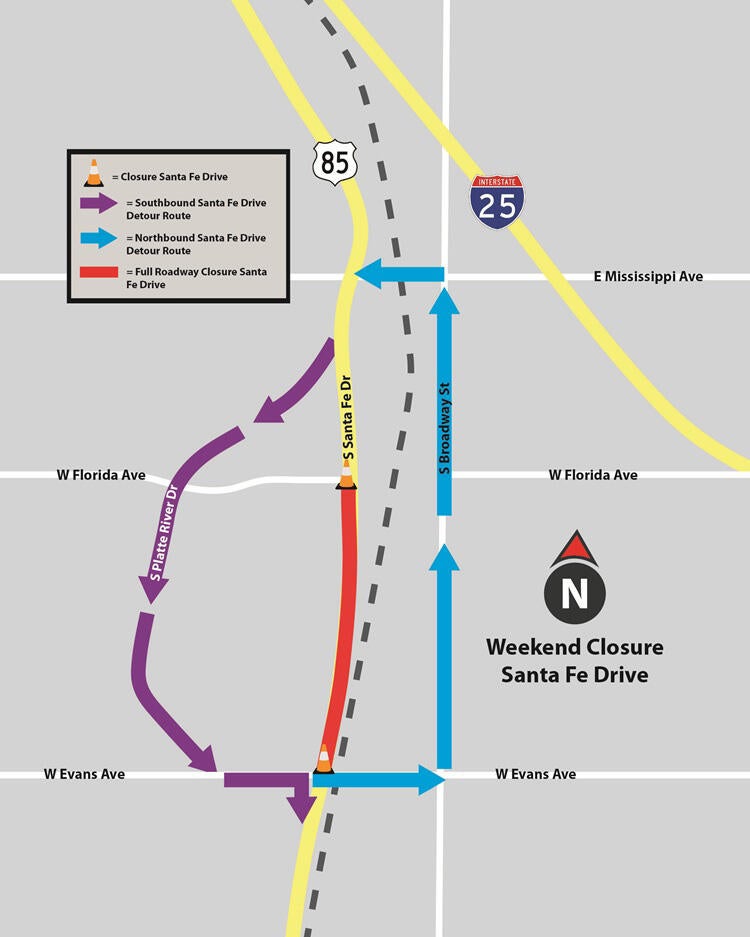
The Santa Fe Drive closure will begin at midnight on Saturday, July 11, and end on Monday, July 13, at 5 a.m. There will be detours in place. This includes:
- Southbound Santa Fe Drive Detour: Traffic will be routed to Platte River Drive to reenter southbound Santa Fe Drive at the West Evans Avenue on-ramp.
- Northbound Santa Fe Drive Detour: Access to northbound Santa Fe Drive will be at Mississippi Avenue via South Broadway Street.
- On-Ramp Closure: The West Evans Avenue on-ramp to northbound Santa Fe Drive will close at noon on Friday, July 10, to prepare for the full weekend closure and will remain closed until 5 a.m. on Monday, July 13. Traffic will be detoured to South Broadway Street to re-enter northbound Santa Fe Drive via Mississippi Avenue.
- Off-Ramp Closure: The southbound Santa Fe Drive off-ramp to West Evans Avenue will close for the full weekend period and remain closed until Friday, Sept. 11, while crews build new sidewalks and perform other concrete work at the southwest corner of the project. Detours will be posted to West Florida Avenue, West Dartmouth Avenue or West Hampden Avenue to bypass the ramp closure
During this closure, DOTI will reopen the underpass on Iowa Avenue. This is a new ADA accessible pathway that will be available between Santa Fe Drive and Acoma Street.

DENVER (KDVR) — Two officers, one now formerly of the Denver Police Department, face multiple charges relating to separate incidents in the past two months.
According to a release, now-former Denver Police Officer Gabriel Lucero was issued a citation for third-degree assault, official misconduct and false reporting, while Officer Javon Leach was cited for reckless driving and eluding.
The incident involving Lucero reportedly occurred on May 22 just before 1 a.m. in the 500 block of 16th Street. According to a release, Lucero was involved in an assault at a business, as he allegedly assaulted a person and walked away as others continued to assault the victim.
Security guards and an off-duty officer escorted him and the group out; however, Lucero reportedly identified himself as a Denver police officer and attempted to re-enter by using his police badge.
Lucero reportedly provided a false name without any other information, and further investigation verified Lucero as the person involved. Lucero was hired in 2025 and, due to his current probationary status, was fired as of Wednesday.
The incident involving Leach occurred around 1:41 a.m. on June 21, when Leach was reportedly pulling out of a parking lot on Larimer Street, attempting to drive against traffic.
Leach reportedly refused commands to stop as he left the area. Officials said he was found just seven minutes later, traveling at high speeds northbound on Park Avenue West.
He reportedly fled a traffic stop and continued to drive away, and officials deemed Leach to be the suspect following an investigation. He was placed in an off-line assignment while the case progresses, as they are considered misdemeanors.
“The Denver Police Department’s administrative review of Leach’s incident will begin once the criminal case is adjudicated, and that process includes the Denver Department of Safety and the Office of the Independent Monitor, a civilian oversight agency,” the release said.
-

 Los Angeles, Ca24 minutes ago
California teen e-biker baiting police to chase tracked by drone, arrested
-

 Detroit, MI44 minutes ago
Our picks for state\nSenate from Wayne Co. | Endorsements
-

 San Francisco, CA54 minutes ago
Man reported missing in San Francisco
-

 Dallas, TX59 minutes ago
How to buy France World Cup semifinal soccer tickets in Dallas
-

 Miami, FL1 hour ago
Miami-Dade Schools names six semifinalists for superintendent
-

 Boston, MA1 hour ago
Lawsuit: ICE detained East Boston father despite legal status
-

 Denver, CO1 hour ago
Victor Marx wins GOP primary for Colorado governor, defeating veteran lawmaker after unorthodox campaign
-

 Seattle, WA1 hour ago
Widower of pregnant woman who was shot to death in Seattle sues homelessness authority

