Denver, CO
Dining on Denver’s northside: Here are 14 old- and new-school restaurants


Denver native Tony Garcia remembers filling up on enchiladas at Chubby’s when he was a college student in the early 1970s. “It was fast food — but it was good food,” he recalled of the original location of the legendary Mexican restaurant, 1231 W. 38th Ave., which still draws crowds hankering for burritos, hamburgers and French fries blanketed in spicy green chile.
Just a few blocks away, Lechuga’s, 3609 Tejon St., has always been the spot for cannolis — not the sweet variety, but a more substantive sausage wrapped in puffy dough, Garcia said. Across the street, Garcia buys his tamales at Tamales by La Casita, a 50-year-old Denver institution.
This Denver institution makes 18,000 tamales per day — by hand
There’s also the gone-but-not-forgotten restaurants. Patsy’s, for instance, “was unabashedly old school; it was like going to an Italian restaurant from a 1940s movie,” remembered Garcia.
And Rosa Linda’s Mexican Cafe, which Rosa Linda Aguirre opened on West 33rd and Tejon Street in 1985 to feed both her family and her neighbors. The way she puts it: “We were like a bouquet, un florero.” As a thanks to the community — and to fulfill a promise to herself that she would feed the needy if her restaurant became successful — Aguirre served well over 50,000 turkey and green chile Thanksgiving meals before the restaurant eventually closed in 2015. Today, Aguirre and her son Oscar are carrying on the legacy with Tejon Food Co., which sells chorizo and spices.
Like many longtime Denverites, Garcia holds fond memories of eating at the Mexican and Italian restaurants that defined the restaurant landscape for decades on the city’s northside — which includes the Sunnyside, Berkeley, Highland and West Highland neighborhoods — and later became a destination for people all over the metro area.
“We were proud to have both of those communities represented,” said Garcia, who grew up in west Denver and is now a Chicano studies adjunct professor at Metropolitan State University of Denver and executive director of Su Teatro Cultural and Performing Arts Center.
These days, north Denver is defining the Mile High City’s dining scene in different ways. It’s home to a wildly diverse range of restaurants, from Asian standard bearers like Glo Noodle House, Ginger Pig and Ramen Star to sophisticated sandwich joints like Blackbelly Market, Odie B’s and the Grateful Gnome, as well as neighborhood staples like Pochitos Tortilla Factory, Parisi and Tacos Jalisco, and even the Michelin-starred Wolf’s Tailor.
Hungry for more? Here are 14 restaurants helping shape Denver’s Northside culinary scene.
Old-school restaurants
The Original Chubby’s
Stella Cordova bought Chubby’s Burger Drive-Inn in 1967, adding her famous green chile to the burgers and expanding the menu. She was a fixture at the restaurant until she passed away at age 100 in 2006. Among a small number of Denver restaurants that stay open late, Chubby’s serves hungry night owls until 3 a.m. on Fridays and Saturdays. 1231 W. 38th Ave.

Lechuga’s Italian
Lechuga’s hasn’t changed its recipe for sausage cannolis since it started serving them (invented them, perhaps) in 1961. The Little Devil cannoli is rolled with jalapenos and smothered in cheese and red sauce. The family restaurant does an $8 spaghetti night on Tuesdays, and serves spaghetti in buckets throughout the week. 3609 Tejon St.

Gaetano’s
Go for the mob lore, stay for the pasta. Gaetano’s is a neighborhood restaurant housed in a 1925 building that dishes out pizza, pasta and serves brunch on the weekend, with Italian dishes like buttery, peppery cacio e pepe sharing the menu with chicken and waffles. It has changed ownership several times over the decades, but was at one time run by the Smaldone crime family, who turned it into a hotbed for illegal gambling and bootlegging in the 1940s. 3760 Tejon St.
Carl’s Pizza
A nostalgic pizzeria that opened in 1953, Carl’s also serves spaghetti and meatballs, calzones and quarts of minestrone soup. The original owner was from Chicago, but these pizzas are made with a medium crust that’s not too thick, but not thin, either. Like Gaetano’s, Carl’s also had a bit of reputation at one point: The cops ate in the front room and the crooks in the backroom, recalled shop owner John Ludwig in an interview for a collective memory project on the Northside put together by History Colorado. 3800 W. 38th Ave.
Patzcuaro’s
While the sign and patio may be newer, Patzcuaro’s is a Denver institution: It opened in 1978 and is considered by some to be Denver’s first taqueria. Menu staples include tacos, like the tender pork ones marinated in adobo sauce, steaks smothered in salsa and enchiladas. Do yourself a favor and take a quart of green chile home. 2616 W 32nd Ave.

Tamales by La Casita
This 50-year-old family-run mainstay doesn’t sell only tamales, but that’s mainly what people from far and wide come in for, lugging out their favorite, in red or green, a dozen at a time. Around the holidays — the traditional time for tamale eating — it gets even busier. In fact, the shop produces an average of 18,000 scratch-made tamales every day. 3561 Tejon St.
Parisi
While Parisi doesn’t have as long of tenure as some of the old-school restaurants on this list, it has been around for 26 years, which is considerable taking into account how much Tennyson Street has changed over that time. Inspired by Florence, Parisi opened in 1998 as a small market and deli with imported Italian goods. Today, the counter-serve restaurant is the place to go for pizza, salads, pastas, and a scoop of gelato. 4401 Tennyson St.
New-school restaurants

The Wolf’s Tailor
Much sets The Wolf’s Tailor, and its tasting menus, apart, from its ambitious zero-waste mission to milling heritage grains, and experimenting with fermentation. The restaurant, which draws inspiration from around the world, opened in 2018, and earned a Michelin star in 2023 and 2024, plus a green star, which recognizes leaders in sustainability.
Diners enter through the backyard garden and see chefs firing dishes in the kitchen before checking in with the host — something “that initially was happening on accident, but that we kept because it gives guests a sense of place,” said Chef Kelly Whittaker, who operates ID Est hospitality group, which owns The Wolf’s Tailor with his wife Erika. 4058 Tejon St.
Kiké’s Red Tacos
Kiké’s Red Tacos got its start as a food truck, serving juicy birria tacos just as eaters on TikTok were fueling a lot of interest in cheesy and photogenic griddled tacos dripping in consome. To be able to reach more fans — and help ease long lines — the family-run business opened up a brick-and-mortar shop where birria ramen is on the menu, too. 1200 W. 38th Ave.
Odie B’s
Owner Cliff Blauvelt grew up in Sunnyside and chose the neighborhood to open his “rowdy little sandwich shop,” which serves some of tastiest breakfast burritos in town, along with brunch, stellar burgers and lunchtime sandwiches, like the Dirty Denver (green chile-braised short rib, cheese curds, beefy mayo, and salt and vinegar crispy onions on a hoagie), which entice fans to wait in line. Pair a breakfast sammy (there’s plenty of plant-based options, too) with a green chile Bloody Mary. 2651 W. 38th Ave.

Blackbelly Market
Blackbelly Market made its Denver debut last spring, expanding beyond its Boulder location, which took home a Michelin green star in 2023 and 2024 and earned a spot on the guide’s recommended restaurant list. Michelin also named Butcher Kelly Kawachi the 2023 Culinary Professional Award Winner. Pop into the Tennyson Street shop for a Cubano or banh mi. 4324 W. 41st Ave.
Tocabe
Tocabe opened in 2008 as Denver’s only restaurant featuring entirely Native American cuisine, like fry bread tacos and bison ribs. The founders also launched an online marketplace in 2021 to showcase more indigenous companies. 3536 W. 44th Ave.
Alma Fonda Fina
At the newly minted Michelin-star restaurant Alma Fonda Fina, owner Johnny Curiel is among a group of elite chefs who are helping lead Denver’s Mexican fine dining revolution. Curiel’s menu is influenced by the family recipes he brought with him from Guadalajara, like the frijoles puercos, a menu staple that riffs on one of his mom’s recipes; it includes refried beans, chorizo, salsa and queso that you can mop up with sourdough tortillas. The avocado margarita gets our vote as the star of the chef-driven cocktail menu. 2556 15th St.

Ash’Kara
Located in the building that was Rosa Linda’s Mexican Cafe for 30 years, Ash’Kara has quickly become its own kind of neighborhood favorite, offering cuisine from Israel, the Mediterranean and North Africa. That means anything from falafel and lamb kofte to tagine and carrot kibbeh. The bright space was also recommended in the 2023 and 2024 Michelin guides. 2005 W. 33rd Ave.
Subscribe to our new food newsletter, Stuffed, to get Denver food and drink news sent straight to your inbox.



Denver, CO
Victor Marx wins GOP primary for Colorado governor, defeating veteran lawmaker after unorthodox campaign

Victor Marx, a first-time candidate and nonprofit leader with a controversial personal history that’s drawn intense scrutiny, has edged out his more establishment opponent and will be Colorado Republicans’ gubernatorial nominee in November.
The Associated Press called the race for Marx late Thursday afternoon, nearly nine days after polls closed. He led the runner-up, state Sen. Barb Kirkmeyer, 39.9% to 39.4%, with 99% of ballots counted, according to the AP.
Marx had taken his first narrow lead over Kirkmeyer the day after the June 30 primary, and though the race remained close, he never lost the advantage. While outstanding deficient and overseas ballots helped delay a final call on the race, those votes only served to expand Marx’s margin. He led by 2,524 votes at 5:30 p.m. Thursday, out of about 522,000 ballots cast.
State Rep. Scott Bottoms was a distant third, with 20.8% of the vote.
A veteran lawmaker and former Weld County commissioner, Kirkmeyer had jumped to an early advantage on the strength of early ballot returns. But as votes returned on Election Day began to filter in, her lead thinned and collapsed. Within 48 hours of polls closing, and with few ballots left to count in Kirkmeyer’s Front Range strongholds, her path to retake the lead had all but vanished.
Marx will next face Democratic Attorney General Phil Weiser in November. No Republican has been elected to the governor’s office in more than 20 years. Four months out, Weiser appears to be heavily favored to continue Democrats’ electoral dominance.
In an email to supporters after the race was called, Marx said he was humbled to be the nominee and that the victory was “the starting line.”
“My team and I have put together this special message that I want every Coloradan to hear — Republicans, independents, unaffiliated voters, and Democrats who are open to a better way,” he said. “Because what we’re building now is bigger than a primary victory.”
In a video, he appealed to Coloradans who are frustrated with the status quo and don’t think things can change — citing his victory as proof they can.
“Now Phil Weiser, he’s a smart fella — but he represents the current system, because he is part of it,” Marx said. “And that current system has made Colorado more expensive, less safe and harder for regular families to trust government.”
In a separate statement, Kirkmeyer said she was proud of the race that she had run and the “clear vision” she had laid out for the Republican Party here.
“While we came up short in what appears to be the closest Republican gubernatorial primary in Colorado history, I’m grateful for every voter who placed their trust in us,” she wrote.
Echoing the pledge she’d made before Election Day, she pointedly did not endorse Marx. She said only that she hoped voters “choose the path that is best for Colorado” in November.
Kirkmeyer also threw a final jab at Marx, who declined in late May to tell 9News how many people he’d killed as an adult.
Kirkmeyer wrote that, “for the record, I still haven’t killed anyone.”
First-time candidate shrugged off questions
Marx’s primary win is a remarkable result for the embattled Colorado GOP and for Marx, a former Marine, martial arts instructor and nonprofit leader whose extensive and much-scrutinized personal history had drawn national headlines. It’s also attracted sharp criticism from other Republicans.
In his video, Marx appealed to Republican primary voters, saying there was room in his campaign for those who supported his opponents.
Marx had entered the fray last fall with no political profile and no experience as a political candidate. But by the time voters began receiving ballots last month, he’d ridden an atypical — if thoroughly modern — campaign to fundraising dominance and front-runner status.
Kirkmeyer’s support largely flowed from northern Front Range counties, nudging her ahead initially. But Marx picked up bigger margins among Election Day voters — meaning those more conservative voters skeptical of mail-in balloting.
He also won ruby-red El Paso County while racking up smaller wins in rural counties and grabbing enough in the Front Range to edge Kirkmeyer.
Map: Where did the votes come from in the Colorado primary races for governor?
In a pitch reminiscent of President Donald Trump, the arch-dealmaker, Marx has cast himself as a solutions-focused negotiator disinterested in partisan squabbles. In 2003, he founded All Things Possible Ministries, a Christian nonprofit that has provided stuffed animals and trauma support to people. It has also done work in conflict areas in Syria and Iraq, where Marx primarily worked away from the front lines as a funder and facilitator.
By 2024, the nonprofit’s annual revenue had surpassed $7.5 million, and Marx has said the group — from which he has resigned — now primarily works to help law enforcement.
Despite his outsider status, Marx was considered the likely winner in the weeks before Election Day. His narrow victory, then, came as something of a surprise, and, on election night, he speculated that Bottoms — a conservative pastor from Colorado Springs — had pulled votes from him. In El Paso County, Bottoms earned more than 20,000 votes, or 24% of the county’s Republican total.
Though Marx out-raised and out-spent both Kirkmeyer and Bottoms, it was Kirkmeyer who had been perceived as the expected nominee when she entered the race last year. Marx had never run for office before, and the stories he’s told about his life — that he’d killed a man at age 7, been involved in “high-risk humanitarian” operations across the globe and could free people from demonic possession — drew intense scrutiny and national punchlines.
But he repeatedly shrugged off questions about his background and said he stood by all that he had said and written.
Through his personality-heavy, direct-to-voter campaign, he encouraged Colorado Republicans to shrug it off, too. He spent heavily on direct mailers, which provided a boost to both his fundraising and name recognition.
Marx eschewed policy discussions and skipped nearly every debate. When he did participate in one, he spent part of the event leaning on the lectern, with his dog at his feet. Rather than deliver a closing statement, he prayed.

Campaigning his own way
Though he leaned into his outsider status, the aw-shucks appeal belied a careful campaign shaped by Marx’s emergence from a political environment forged by Trump: He skipped one debate after a moderator pressed him about his background, and he held a rally instead; his campaign later highlighted how many more people attended the rally than the debate.
His media operation was led by a former Turning Points USA staffer, and his campaign touted its social media posts’ views at Marx’s watch party last week. He was comfortable as a podcast guest, regularly released videos of himself and repeatedly assured voters that he was no politician.
Though Marx had little backing — or trust — from institutional Republican forces, the PAC that supported his campaign was established by a former senior official from Gov. Bill Owens’ administration. Marx also was endorsed by U.S. Rep. Lauren Boebert, the most nationally visible Colorado Republican.
His approach proved to be enough for Colorado Republicans to back him. But his next task will be far harder.
In November, he will face a surging Weiser, who last week dismantled U.S. Sen. Michael Bennet on his way to the Democratic nomination. Weiser proved an adept fundraiser and campaigner with statewide appeal, and he will look to lead a restless Democratic base that elected progressive candidates up and down the ballot.
In a statement Thursday, Weiser said Marx’s “views and style are far out of step with Coloradans, and his nomination for governor is a threat to our state’s values and our future.”
Republicans’ last statewide win was in a University of Colorado at-large regent’s race in 2016. The state GOP has had four elected party chairs since the last Republican gubernatorial bid in 2022, which ended with a culture war-focused Heidi Ganahl — who had won that at-large regent seat — losing by nearly 20 percentage points to Gov. Jared Polis.
Simultaneously, Marx may also have to contend with an independent candidacy from Greg Lopez, a former Republican congressman and gubernatorial candidate who is gathering signatures to make the fall ballot.
Stay up-to-date with Colorado Politics by signing up for our weekly newsletter, The Spot.

If you use Santa Fe Drive as a part of your daily commute, you will notice full closures this weekend on a popular section, from Florida Avenue to Evans Avenue, for the installation of a pedestrian bridge.
Once the 370-foot pedestrian bridge is completed, it will connect the east and west portions of Denver’s Overland neighborhood. This bridge will be used by pedestrians and bicyclists.
The Denver Department of Transportation and Infrastructure says this closure is needed to keep the traveling public safe. Large cranes will be used to set the two spans in place. Each one weighs about 215,000 pounds and is 180 feet long.
Once the bridge is completed in 2027, it will create a safer connection for pedestrians and bicyclists. It will link neighborhoods to trails, transit, parks, and local businesses without requiring residents to cross heavy traffic.
“Our neighborhood is quartered by transportation routes, so having a safe pedestrian bridge that can take people from one side to the other is an amazing development that neighbors have been asking for for years,” Jenn Greiving, President, Overland Park Neighborhood Association, said.
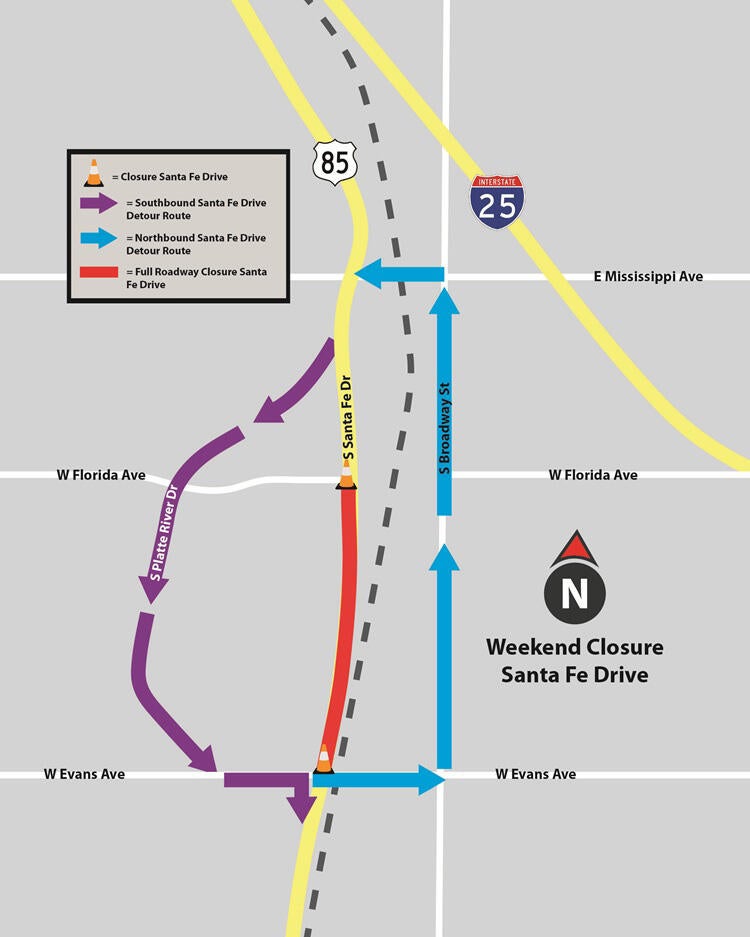
The Santa Fe Drive closure will begin at midnight on Saturday, July 11, and end on Monday, July 13, at 5 a.m. There will be detours in place. This includes:
- Southbound Santa Fe Drive Detour: Traffic will be routed to Platte River Drive to reenter southbound Santa Fe Drive at the West Evans Avenue on-ramp.
- Northbound Santa Fe Drive Detour: Access to northbound Santa Fe Drive will be at Mississippi Avenue via South Broadway Street.
- On-Ramp Closure: The West Evans Avenue on-ramp to northbound Santa Fe Drive will close at noon on Friday, July 10, to prepare for the full weekend closure and will remain closed until 5 a.m. on Monday, July 13. Traffic will be detoured to South Broadway Street to re-enter northbound Santa Fe Drive via Mississippi Avenue.
- Off-Ramp Closure: The southbound Santa Fe Drive off-ramp to West Evans Avenue will close for the full weekend period and remain closed until Friday, Sept. 11, while crews build new sidewalks and perform other concrete work at the southwest corner of the project. Detours will be posted to West Florida Avenue, West Dartmouth Avenue or West Hampden Avenue to bypass the ramp closure
During this closure, DOTI will reopen the underpass on Iowa Avenue. This is a new ADA accessible pathway that will be available between Santa Fe Drive and Acoma Street.

DENVER (KDVR) — Two officers, one now formerly of the Denver Police Department, face multiple charges relating to separate incidents in the past two months.
According to a release, now-former Denver Police Officer Gabriel Lucero was issued a citation for third-degree assault, official misconduct and false reporting, while Officer Javon Leach was cited for reckless driving and eluding.
The incident involving Lucero reportedly occurred on May 22 just before 1 a.m. in the 500 block of 16th Street. According to a release, Lucero was involved in an assault at a business, as he allegedly assaulted a person and walked away as others continued to assault the victim.
Security guards and an off-duty officer escorted him and the group out; however, Lucero reportedly identified himself as a Denver police officer and attempted to re-enter by using his police badge.
Lucero reportedly provided a false name without any other information, and further investigation verified Lucero as the person involved. Lucero was hired in 2025 and, due to his current probationary status, was fired as of Wednesday.
The incident involving Leach occurred around 1:41 a.m. on June 21, when Leach was reportedly pulling out of a parking lot on Larimer Street, attempting to drive against traffic.
Leach reportedly refused commands to stop as he left the area. Officials said he was found just seven minutes later, traveling at high speeds northbound on Park Avenue West.
He reportedly fled a traffic stop and continued to drive away, and officials deemed Leach to be the suspect following an investigation. He was placed in an off-line assignment while the case progresses, as they are considered misdemeanors.
“The Denver Police Department’s administrative review of Leach’s incident will begin once the criminal case is adjudicated, and that process includes the Denver Department of Safety and the Office of the Independent Monitor, a civilian oversight agency,” the release said.
-

 Alabama5 minutes ago
University of Alabama police officer's family leans on law enforcement community after his death
-

 Alaska8 minutes ago
Black bear breaks into Alaskan mall, eats a peach and relieves itself on floor before leaving: video
-

 Arizona13 minutes ago
Arizona tackling heat mitigation, could their efforts translate to Nevada
-

 California18 minutes ago
California bill would let insurers monitor driving data for discounts
-

 Arkansas20 minutes ago
ROBERT STEINBUCH: DEI deja vu | Northwest Arkansas Democrat-Gazette
-

 Colorado28 minutes ago
Colorado reports 90 cases of Cyclospora this year: Here’s what health officials want you to know
-

 Connecticut35 minutes ago
Marian Katz Obituary
-

 Delaware38 minutes ago
DE health officials ‘on pins and needles’ after measles cases in PA

