Denver, CO
Denver City Council approves $800 million National Western Center expansion project in 9-4 vote


DENVER — The Denver City Council on Monday authorized the city to spend more than $800 million over the next 35 years to expand the National Western Center.
The project will include the construction of a 160-room hotel, a 4,500-seat equestrian center, a parking garage, and income-restricted housing.
Denver City Council
The plan to redevelop the area and turn it into a year-round destination has been years in the making. However, Monday’s vote was not unanimous.
The Denver City Council approved the project in a 9-4 vote. Council members Sarah Parady, Shontel Lewis, Jamie Torres, and Serena Gonzales-Gutierrez voted against the measure. Council member Darrell Watson, who represents the area, voted for the measure, calling it a “win-win” for everyone.
Denver Mayor Mike Johnston released a statement after the city council’s vote, saying, “There is no more cherished tradition in Denver than the Stock Show. Today, we are further committing to carrying that feeling throughout the rest of the year with events, entertainment, and a renewed dedication to putting people to work and improving the lives of neighbors through sustained – and lasting – trust and partnership.”
The project is not without controversy. Some community members in the nearby Elyria-Swansea neighborhood have raised concerns about the plan.
“It continues to steamroll forward, and it continues to do so without any accountability for the public dollars being invested,” said Swansea resident Candi CdeBaca, a former Denver City Council member.
Denver City Council 
CdeBaca and others worry the project will displace people in the neighborhood.
“Our biggest concern in this community obviously is displacement,” she said.
People living in the area have been displaced before, like when Interstate 70 expanded. CdeBaca worries it will happen again with people being priced out of their homes.
“We’ve been fighting this fight for a very long time,” she said.
Sarah Lake, who led a successful campaign against a 2021 bond measure to build a new arena on the National Western Center campus, said building a new hotel and equestrian center is reckless.
“Just four years ago, voters overwhelmingly rejected spending $190 million to build the National Western Arena,” said Lake. “And now, here they are coming back, asking for four times that amount of money to build an equestrian center. So, it seems like it’s both economically reckless but also against the will of the voters who’ve already said this isn’t how they want their taxpayer dollars to be spent.”
Lance Nading, a local property owner who was appointed by the mayor to serve on a community outreach work group, said he is connected to the success of the National Western Center and its full development. However, he believes the National Western Center Authority needs to do a much better job of communicating with community leaders.
“They don’t engage with the actual leaders of GES in a meaningful way, so the end result is there’s a disconnect,” said Nading. “They do get community members to show up to their meetings. Sadly and unfortunately, they are not the true voices of the leaders in the GES (Globeville Elyria Swansea) communities. They’re just not.”
Sandra Ruiz Parilla and Nancy Santos are two GES community members who say they were very involved in providing ideas for the project. They believe it will be a great benefit to the community.
“We need to have neighborhoods being beautified,” said Ruiz Parilla. “But to be able to have that, we also need these kinds of developments that can offer those jobs, that can offer opportunities, that can offer better things for our communities.”
“The most important things for me are the opportunities they’re going to give the community,” added Santos.
Denver City Council delays vote on National Western Center expansion project to June
Ruiz Parilla told Denver7 she’s also concerned about displacement.
“The largest displacement in the community wasn’t the National Western Center, it was the I-70 project,” she said. “I was fighting to stop the I-70 project.”
Ruiz Parilla said she’s not blind to the challenges that the GES could face with gentrification. However, she believes the project will provide important opportunities for better jobs and education.
“Those are things we need,” she said.
As for CdeBaca, she and other community members asked the National Western Center Authority and the city to invest $16 million upfront into the GES Community Investment Fund (CIF) to pay for projects that could prevent displacement. She said this could include projects like a childcare center and housing.
The $16 million represented one percent of the total $1.6 billion in bond funds voters approved in 2015. The plan the city council approved will provide $9 million to the community investment fund over 35 years.
“$9 million over 35 years is absurd,” said CdeBaca. “That’s insufficient, and it can’t help the community right now.”
While they weren’t successful in getting the city council to vote down the expansion project, CdeBaca said they’re not giving up.
“Well, if anyone knows anything about this community, they know that we are well organized and will continue to fight until we can’t fight anymore,” she said.
Construction on the National Western Center expansion is expected to start this fall.
The project is one of three major initiatives Johnston’s administration has pushed through the city council in the last month. The other initiatives include the Park Hill acquisition and the National Women’s Soccer League (NWSL) intergovernmental agreement.

Denver7
Denver7 | Your Voice: Get in touch with Brandon Richard
Denver7 politics reporter Brandon Richard closely follows developments at the State Capitol and in Washington, and digs deeper to find how legislation affects Coloradans in every community. If you’d like to get in touch with Brandon, fill out the form below to send him an email.


After making fans wait all through the first round only to trade back, the Denver Nuggets finally get their man as they select with the 35th pick in the draft: Trevon Brazile, the 6’9 combo forward from Arkansas.
So who is Brazile?
Trevon is a freak athlete at 6’9.5 barefoot with a wingspan of almost 7’4 and a 41″ vertical jump. He can fly, with transition dunks that amaze and helpside blocks that astound. He can also hit from behind the arc if you leave him open, and he has soft hands around the rims for lobs and finishes. He can also be a good perimeter defender using that wingspan and his quick feet to get in position and make life tough. As I said about him before the draft: “When he is playing hard and engaged, he looks like a first round talent who can spot up for 3 or kill you at the rim while hounding ball-handlers on the perimeter.”
He is 23 years old already, however, and he still hasn’t found the necessary motor to bring that explosion and game-changing play for the whole time he’s on the court. He only shoots 66% from the charity stripe and doesn’t have much of an in-between game, so if he’s not driving the hoop or taking open threes his creation bag is a little thin. He spent his freshman year at Missouri, the alma mater of both Michael Porter Jr. and Josh Kroenke, so Josh would obviously have some insight into him from early in his college career.
But Denver has been in dire need of some size and athleticism and they just got both in the same package. Brazile at his best absolutely looks the part of an NBA player who can make an impact at both ends of the floor. Whether he can grow his game in shorter bench stints early in his career is certainly going to be intriguing to watch – and the Nuggets finally have a drafted player to pour some interest and effort into themselves.
Welcome to the Nuggets, Trevon Brazile!
Denver, CO
Denver Broncos Foundation launches extension of ‘ALL IN. ALL COVERED.’ emphasizing youth football participation

DENVER (KKTV) – In extension of the Denver Broncos Foundation’s helmet distribution program, they have launched the “ALL IN. ALL COVERED.” Statewide Youth Football Participation Program, in partnership with Every Kid Sports and Good Sports.
Over the course of five years, the program will aim to reduce financial barriers to play by providing financial support and essential equipment to increase youth participation in tackle and flag football.
The Foundation will fund registration fees for underserved youth through Every Kid Sports, while increasing access to both individual and shared team equipment through Good Sports.
The program aims to serve more than 17,000 children across Colorado, using football as a pathway to drive equitable access and sustained participation in sport.
“We’re excited to work with Every Kid Sports and Good Sports to grow youth football participation across Colorado and help open doors to the sport for both boys and girls,” said Bobby Mestas, Broncos Senior Director of Youth & High School Football.
Coaches and players from across the Pikes Peak Region had their first look at the new helmets they received for free from the Denver Broncos Foundation back last year.
Copyright 2026 KKTV. All rights reserved.

Draft day in Denver ended with a yawn.
But behind the scenes, the Nuggets were pleased by their anticlimactic outcome.
On the clock Tuesday night with the 26th pick in the NBA Draft, the Nuggets chose to trade out of the first round, beginning to replenish an asset pool that was drained by the previous front office regime. San Antonio moved up to No. 26 in exchange for giving Denver the No. 35 overall pick in Wednesday’s second round and two additional future second-round picks.
Denver now controls a 2028 Minnesota second-round pick and a 2031 Sacramento second-rounder, according to league sources. The Spurs selected Connecticut big man Tarris Reed Jr. at No. 26. The Nuggets will go into Wednesday with two picks — 35th and 49th. Multiple teams had already called them to inquire about No. 35 by the end of Tuesday night, one source told The Post.
Co-general managers Jon Wallace and Ben Tenzer have less than 24 hours to decide if they want to use that pick or parlay it into more future draft capital. Part of their rationale for trading back, multiple team sources told The Post, was that they felt the 2026 draft class had a substantial drop-off in talent around No. 20.
What the Nuggets eventually do with their new picks will determine how Tuesday’s trade is evaluated. Second-rounders are often used as trade assets rather than to select playable talent, and Denver’s shortage of them has inhibited its ability to get involved in trade conversations around the league recently. Wallace and Tenzer inherited the NBA’s most depleted war chest when they took over the front office in 2025, whereas adversaries like Oklahoma City and San Antonio are practiced in the art of asset accumulation.
If one first-round pick can slowly grow into a wider swath of lower-quality picks that can subsequently be put to good use in other trades to improve the roster, then No. 26 will have been a worthy sacrifice. That could take lots of time, hard work and negotiating tact.
But the Nuggets are also faced with awkward luxury tax decisions this offseason, and they’re tied to multiple contracts that are widely perceived as having negative value, namely Christian Braun and Zeke Nnaji. If they promptly use their new picks to dump either of those salaries without bringing back any helpful players, it would be a clear indicator that team ownership is prioritizing tax savings over roster improvement.
The front office’s challenge will be to balance and accomplish both goals, which tend to be at odds with each other. At least one salary-shedding move is essentially guaranteed to occur as Denver attempts to retain Peyton Watson in restricted free agency, as The Post reported in April.
Wallace and Tenzer still have not made a draft pick yet in their tenure. For now, Denver will treat it as a win if they can stockpile future picks and right some old wrongs. A seemingly tedious trade elicited applause inside the Nuggets’ war room Tuesday, even as team president Josh Kroenke was caught on camera looking disgruntled by something. His bemusement, according to a source, was in response to some confusion on the other end of the line as Denver was trying to call in the 26th pick on behalf of the Spurs.
San Antonio walked away from the first round with two prospects secured in Reed and Jayden Quaintance. Oklahoma City snagged Aday Mara 12th and Bennett Stirtz 16th — sobering reminders that talent is going to keep on flowing into the two rosters that pose the biggest existential threats to Denver.
Nuggets recent draft history
The Nuggets haven’t drafted in the top 20 since 2018 — the cost of becoming a perennial playoff team as Nikola Jokic entered his prime. They’ve gotten mixed results from their late first-round picks since then, which is typical at that stage of the draft. Five of their six first-rounders this decade are still on the active roster, though only two of them were in the everyday rotation last season: Christian Braun (21st) and Peyton Watson (30th), both of whom were selected by former GM Calvin Booth in 2022.
Nnaji (22nd in 2020) is the third-longest tenured player on the team, but the four-year, $32 million contract extension he signed in 2023 has turned out to be a small-scale albatross on Denver’s cap sheet. Bones Hyland (26th in 2021) was shipped off to the Clippers at the 2023 trade deadline after he caused locker room frustration by walking off the bench during a game. He plays for Minnesota now.
Braun was a bench contributor during Denver’s 2023 run to the championship and signed a five-year, $125 million extension last October. Watson will be a restricted free agent and an offseason priority for Denver’s front office in the coming weeks.
Julian Strawther (29th in 2023) has been in and out of the rotation throughout the first three years of his career, and his role was scaled back last season with Tim Hardaway Jr. slotted in at backup shooting guard. Strawther is eligible to sign a rookie-scale extension before next season, or he’ll become a restricted free agent in 2027. Denver traded three second-round picks to Phoenix to move up six spots for DaRon Holmes II (22nd in 2024), who tore his right Achilles tendon in his first Summer League game and spent most of last season developing in the G League.
The Nuggets’ 2025 first-rounder belonged to Orlando as part of their trade for Aaron Gordon. Their 2027 first currently belongs to Oklahoma City as part of the trade for the pick that became Watson.
Booth’s tenure was characterized by his willingness to mortgage future draft capital for immediate gain — or immediate salary relief. Most notably, he burned through six second-round picks in a matter of weeks during the 2024 offseason to get rid of Reggie Jackson and to move up for Holmes.
-
 Sports4 minutes ago
Mexico celebrates magical World Cup win over Czechia at rowdy Azteca Stadium
-

 World16 minutes ago
Venezuela rocked by 7.5 and 7.2 earthquakes: What we know
-
 News46 minutes ago
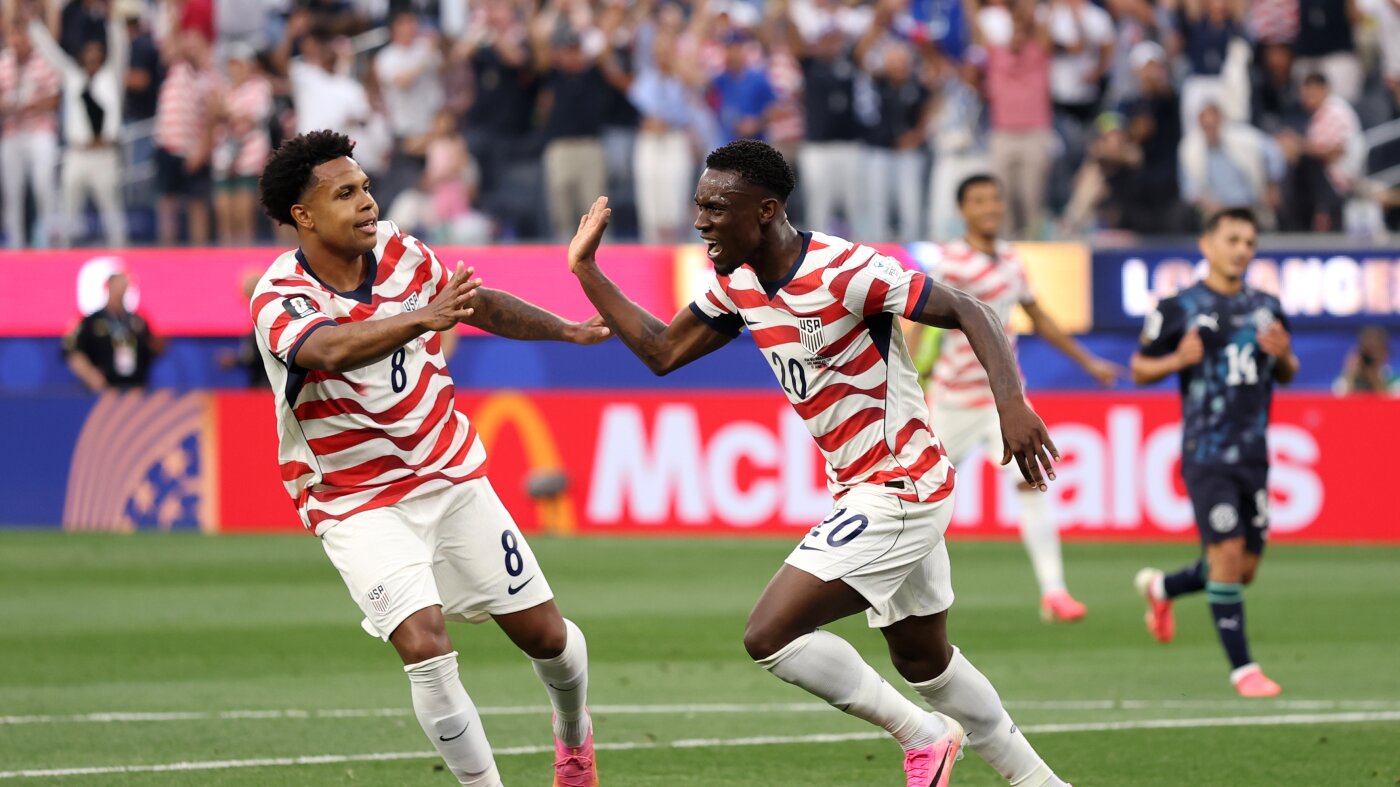
With a Round of 32 spot already clinched, the U.S. takes on Turkey in the World Cup
-

 Los Angeles, Ca2 hours ago
Hospital needs help identifying man found unconscious in downtown Los Angeles
-

 Detroit, MI2 hours ago
Large police presence for an investigation on Detroit’s west side
-

 San Francisco, CA3 hours ago
No tolerance for hate or crime at SF Pride this weekend, officials say
-

 Dallas, TX3 hours ago
Alanna Smith injury update: Dallas Wings player in concussion protocol
-

 Boston, MA3 hours ago
Boy, 13, hospitalized after being found unresponsive in swimming pool at Beverly home

