Denver, CO
“Christian privilege” in Colorado mountain town’s amphitheater fuels church-and-state storm


DILLON – Town leaders’ refusal to reconsider a longstanding practice of letting a Christian church use the Dillon Amphitheater for Sunday prayers has hurled the town into a national storm over worship in public facilities.
They now face potential lawsuits from pressure groups. Freedom from Religion Foundation attorneys are demanding an end to any preferential treatment for the Dillon Community Church. The rival First Liberty Institute sent a countervailing letter urging continued use, warning that recent U.S. Supreme Court decisions favor greater mixing of church and state.
Town staffers hit with multiplying requests from a diversity of religious groups to rent the amphitheater had proposed to shut down access by all outside groups and allow only town-sponsored events such as rock concerts. But town council members on June 11 rejected that approach and voted 5-1 to allow continued use by the church. Two members derided Dillon’s Denver-based contract attorney Kathleen Kelly for creating roadblocks after she raised constitutional concerns. Kelly resigned the next day.
The drama lit up chat sites — Friendly Athiest commenters decried “Christian privilege” — and led to a special meeting Wednesday night where town leaders faced a cacophony from residents. Then leaders accepted advice from a new attorney and back-tracked, temporarily prohibiting the use of the amphitheater by all groups until leaders set a legally defensible policy.
“There needs to be a separation of church and state. We cannot favor one denomination over another,” town manager Nathan Johnson said in an interview. “Now with the popularity of the venue we have more and more people reaching out. Everybody wants to be down there,” he said.
“If we are going to open up the amphitheater, we have to open it up for everybody.”
For more than 40 years, Dillon leaders have let the Dillon Community Church, a non-denominational Christian organization that owns a building a few blocks away, run evangelical “outreach” events appealing to Colorado high country visitors.
The amphitheater was built in 1993 as a low-key community band shell. Town officials have transformed it into one of the nation’s trendiest concert venues by investing $10 million, including a $1 million grant from the Colorado Department of Local Affairs, for an overhaul completed in 2018. Seats on a grassy hillside look out on the blue waters of Lake Dillon, a Denver Water reservoir, and majestic snow-splotched mountain peaks. Town officials charge a $25,000 fee for promoters of town-sponsored concerts. The venue holds up to 3,656 people. Town-sponsored activities also include country line dancing and yoga.

But religious worship is now canceled.
Dillon Community Church officials had lauded town leaders’ initial stance. “We are grateful that the council voted down the new policy that would limit all non-profit organizations that are not city-sponsored,” their posting said.
Senior pastor Jim Howard said Friday he’s confident town council members will sort out future access. “If they say we can’t use it while they figure out the legalities, we’ll stay in our building. We definitely don’t want a lawsuit,” Howard said.
The church paid a $1,100 annual rental fee, town officials said, and Howard said his 220-member church draws 300 to 800 people to the Sunday worship events.
Church members have mobilized. “Dillon Community Church should be grandfathered into whatever contract. They’ve been here for over 40 years,” church representative Wendy Myers told leaders at the packed special meeting. “It attracts an incredible number of our visitors who come to the county every single summer and love coming to church.”
She and others advocated opening the amphitheater to all religious groups. Former council member Tim Westerberg supports that but also spoke out against new council members’ political tactics. “They don’t seem to care about what the community thinks. They don’t seem to care about what their attorney says. They don’t seem to care about what the Constitution says. It’s just damn the torpedoes full speed away, bulldoze ahead our agenda.”

Problems around prayers in the amphitheater arose earlier this year when other religious groups, including a Jewish synagogue, Native American tribes, and people of various faiths planning weddings asked to rent the facility, Johnson said. “Everybody is attracted to the lake, the natural beauty of the lake,” he said.
“It’s a dilemma because an expectation has been set” in allowing the Dillon Community Church events.
When other religious groups requested access, “we put them on hold,” he said. “That’s what started this conversation. We haven’t told anyone ‘no’ – at least that I’m aware of. We want to have clear and definitive direction from the town council on what is allowed and not allowed in this setting.”
If Dillon officials excluded any other religious group, members of that group could file a civil rights lawsuit, said Madeline Ziegler, staff attorney for the Wisconsin-based Freedom From Religion Foundation, which has filed a legal petition seeking town communications with the Dillon Community Church and other groups to explore a possible lawsuit.
Dillon’s practice has sent “a signal to the town residents that their government prefers Christianity and that Christians will be treated better than other people in this town. That’s not a message that the people’s representatives should be allowed to send,” Ziegler said.
Dillon could avoid a lawsuit by setting a formal policy that includes “a welcoming and inclusive message that all are welcome and equally allowed to use the town’s facilities,” she said. Otherwise, town leaders would be acting to ensure “the continued dominance of one church that has the backing of the town over all other religious organizations.”
Attorneys with the Texas-based First Liberty Institute, a conservative Christian legal organization devoted to”restoring religious liberty,” have prevailed in cases at the U.S. Supreme Court, where justices have decided that “history and tradition” must be considered in determining whether government is too intertwined with religion.
Senior attorney Lea Patterson, in her letter sent Tuesday, encouraged Dillon leaders “to continue to allow the church to rent the amphitheater” so as not to invite a lawsuit.
Finding space for religion in Colorado increasingly presents challenges. Soaring real estate prices mean church groups can be hard-pressed to afford buildings, said Jon Stavney, director of the Northwest Colorado Council of Governments, which supports local leaders. “Look at the cost of housing. If you are a church, it makes sense to use public space at a reduced cost,” Stavney said.
In the Eagle Valley west of Vail, the Redeemer church rents space for Sunday worship at the public Brush Creek Elementary School.
For elected leaders, deciding to end a longstanding public worship tradition such as the Dillon Community Church’s use of the town amphitheater can be politically perilous because leaders in small towns typically have to face down residents in grocery aisles, he said.
“If I were in their shoes, and this entity had been using a public space for a long time, I would have some loyalty to the history of that group using that facility.”

Get more Colorado news by signing up for our daily Your Morning Dozen email newsletter.



If you use Santa Fe Drive as a part of your daily commute, you will notice full closures this weekend on a popular section, from Florida Avenue to Evans Avenue, for the installation of a pedestrian bridge.
Once the 370-foot pedestrian bridge is completed, it will connect the east and west portions of Denver’s Overland neighborhood. This bridge will be used by pedestrians and bicyclists.
The Denver Department of Transportation and Infrastructure says this closure is needed to keep the traveling public safe. Large cranes will be used to set the two spans in place. Each one weighs about 215,000 pounds and is 180 feet long.
Once the bridge is completed in 2027, it will create a safer connection for pedestrians and bicyclists. It will link neighborhoods to trails, transit, parks, and local businesses without requiring residents to cross heavy traffic.
“Our neighborhood is quartered by transportation routes, so having a safe pedestrian bridge that can take people from one side to the other is an amazing development that neighbors have been asking for for years,” Jenn Greiving, President, Overland Park Neighborhood Association, said.
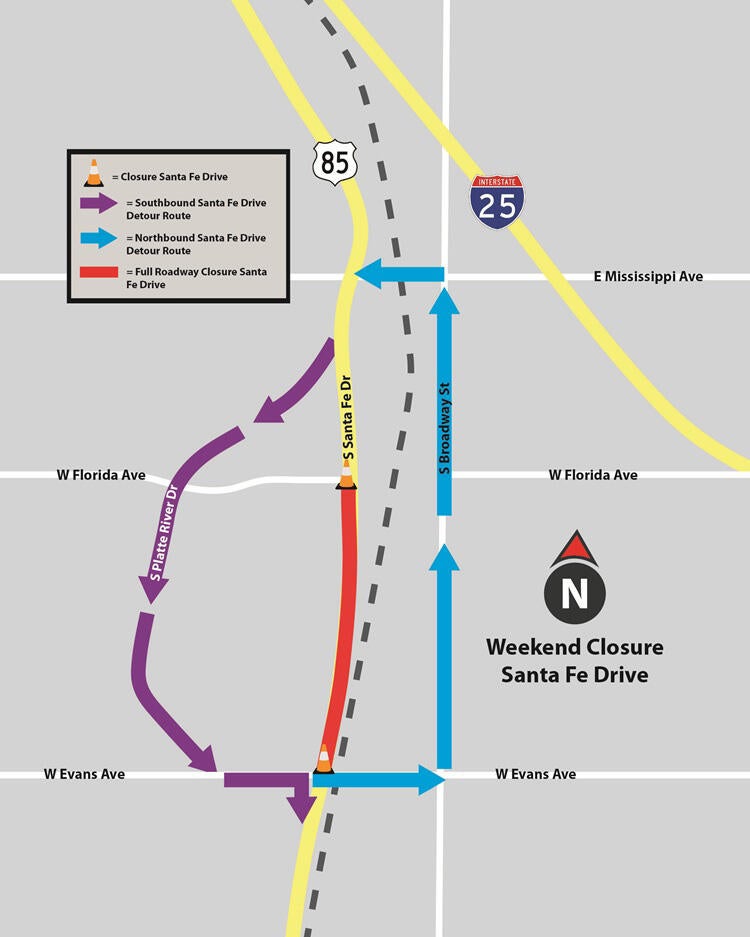
The Santa Fe Drive closure will begin at midnight on Saturday, July 11, and end on Monday, July 13, at 5 a.m. There will be detours in place. This includes:
- Southbound Santa Fe Drive Detour: Traffic will be routed to Platte River Drive to reenter southbound Santa Fe Drive at the West Evans Avenue on-ramp.
- Northbound Santa Fe Drive Detour: Access to northbound Santa Fe Drive will be at Mississippi Avenue via South Broadway Street.
- On-Ramp Closure: The West Evans Avenue on-ramp to northbound Santa Fe Drive will close at noon on Friday, July 10, to prepare for the full weekend closure and will remain closed until 5 a.m. on Monday, July 13. Traffic will be detoured to South Broadway Street to re-enter northbound Santa Fe Drive via Mississippi Avenue.
- Off-Ramp Closure: The southbound Santa Fe Drive off-ramp to West Evans Avenue will close for the full weekend period and remain closed until Friday, Sept. 11, while crews build new sidewalks and perform other concrete work at the southwest corner of the project. Detours will be posted to West Florida Avenue, West Dartmouth Avenue or West Hampden Avenue to bypass the ramp closure
During this closure, DOTI will reopen the underpass on Iowa Avenue. This is a new ADA accessible pathway that will be available between Santa Fe Drive and Acoma Street.

DENVER (KDVR) — Two officers, one now formerly of the Denver Police Department, face multiple charges relating to separate incidents in the past two months.
According to a release, now-former Denver Police Officer Gabriel Lucero was issued a citation for third-degree assault, official misconduct and false reporting, while Officer Javon Leach was cited for reckless driving and eluding.
The incident involving Lucero reportedly occurred on May 22 just before 1 a.m. in the 500 block of 16th Street. According to a release, Lucero was involved in an assault at a business, as he allegedly assaulted a person and walked away as others continued to assault the victim.
Security guards and an off-duty officer escorted him and the group out; however, Lucero reportedly identified himself as a Denver police officer and attempted to re-enter by using his police badge.
Lucero reportedly provided a false name without any other information, and further investigation verified Lucero as the person involved. Lucero was hired in 2025 and, due to his current probationary status, was fired as of Wednesday.
The incident involving Leach occurred around 1:41 a.m. on June 21, when Leach was reportedly pulling out of a parking lot on Larimer Street, attempting to drive against traffic.
Leach reportedly refused commands to stop as he left the area. Officials said he was found just seven minutes later, traveling at high speeds northbound on Park Avenue West.
He reportedly fled a traffic stop and continued to drive away, and officials deemed Leach to be the suspect following an investigation. He was placed in an off-line assignment while the case progresses, as they are considered misdemeanors.
“The Denver Police Department’s administrative review of Leach’s incident will begin once the criminal case is adjudicated, and that process includes the Denver Department of Safety and the Office of the Independent Monitor, a civilian oversight agency,” the release said.

Denver Nuggets standout forward Peyton Watson could find himself on another team before you know it.
With the Nuggets reportedly open to a sign-and-trade of Watson, could Denver really lose a core piece to their rotation?
It’s hard to imagine many teams being able to shoulder the financial weight of a Watson contract at this point because of the aprons and such, but he’s absolutely an asset to any contending team.
We’ve gone through and identified a few teams that make sense for Watson in the fall… including the one he’s already on at the moment. Hey, he might stay home, you never know!
The Clippers have been linked to Watson as a possible destination; he could help them immensely.
The Pistons have also been linked to Watson, which would help them a lot to contend for an NBA title.
Look, HYPOTHETICALLY, the Nets could move around some cap space with some player trades and such and get a deal done. They are one of the only teams in the NBA right now not in the negative with cap space.
The Grizzlies are the team with the least amount of negative cap space right now, per Spotrac. If they really wanted to pull off a Watson sign-and-trade… it would be hypothetically possible from a money standpoint.
Denver Nuggts
Look, it’s very possible Watson just stays in Denver on a brand-new deal. Who knows at this point?
-
Culture41 minutes ago
Which Version of the ‘Odyssey’ Should You Read?
-
 Lifestyle44 minutes ago
Terry Tempest Williams on why women with big ideas get labeled ‘crazy’ : Wild Card with Rachel Martin
-

 Technology56 minutes ago
Google’s Nest Thermostat has hit its best price of the year
-

 World59 minutes ago
Argentinian flight instructor jumps to death from plane, 22-year-old student forced to land alone
-

 Politics1 hour ago
Omar’s disclosures erased millions, leaving her with potential negative net worth. She won’t explain why.
-

 Health1 hour ago
Dr Oz links obesity to chronic disease surge, says GLP-1s can ‘jumpstart’ better health
-

 Sports1 hour ago
Pirates star pitcher makes unfortunate history after being taken out in middle of perfect game bid
-

 Technology1 hour ago
Medical identity theft follows you into the doctor’s office

