West
Defendant in Cash App founder's death found guilty of second-degree murder

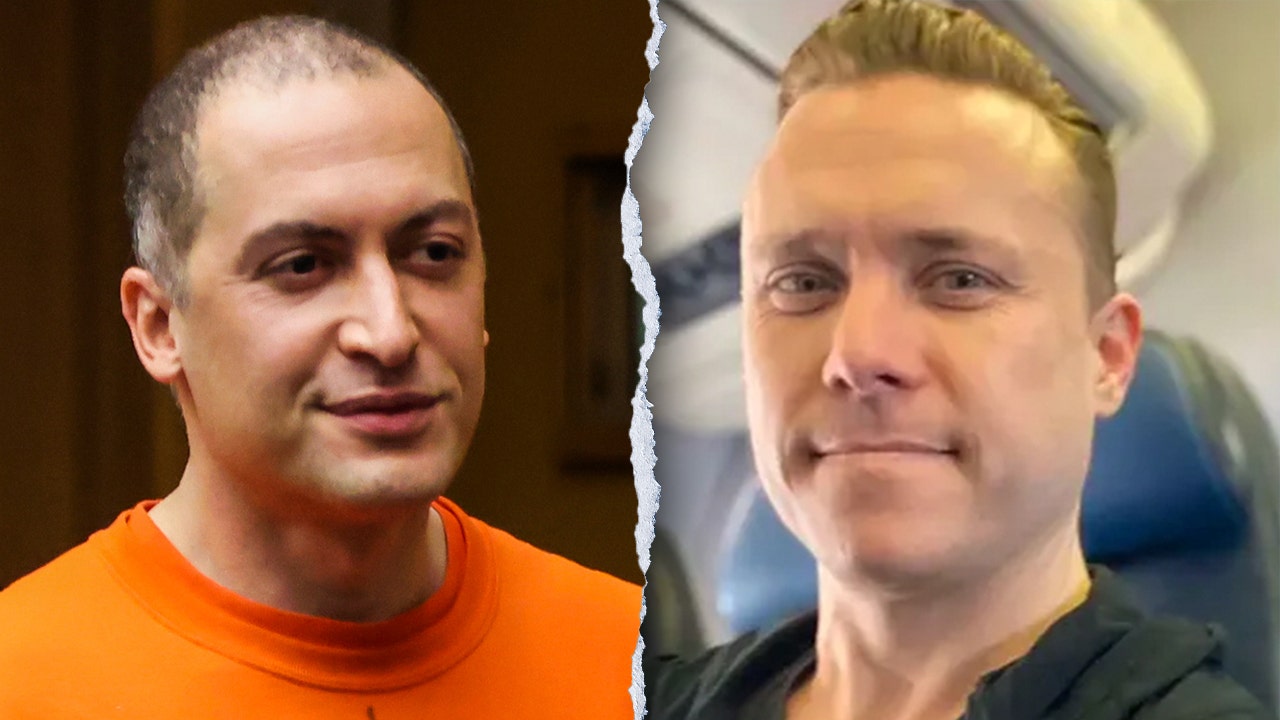
A San Francisco jury found Nima Momeni, the man accused of killing Cash App founder Bob Lee last year, found guilty of second-degree murder Tuesday.
Momeni was found not guilty of first-degree murder. The verdict was read out in San Francisco Superior Court on Tuesday morning local time.
The jury reached their verdict Monday afternoon after seven days of deliberations. He faces 16 years to life in prison.
Prosecutors alleged that Momeni, 40, a self-described tech entrepreneur, stabbed Lee three times with a knife he took from Momeni’s sister’s kitchen set in April 2023.
14 DETAINED IN ARMED AURORA, COLORADO HOME INVASION ARE LIKELY ILLEGAL GANG MEMBERS: POLICE
Nima Momeni, left, was accused of fatally stabbing Cash App founder Bob Lee, right. (Nima Momeni/LinkedIn, Bob Lee/Facebook)
After the verdict was read, Momeini gave no visible reaction, though one of his attorneys put a hand on his shoulder, according to KTVU’s Henry Lee, who was inside the courtroom as the verdict was read.
Bob Lee’s brother, Oliver Lee, praised prosecutors at a press briefing immediately afterward.
“I think it was a very difficult case to prove in this day and age and I think [prosecutors were] up against the wrath of lawyers and a very high-powered defense team that was very expensive and very media friendly… and I think they did a great job,” Oliver Lee said.
He said he wished that the jury had come back with first-degree murder, but conceded: “It is what it is.”
“I know for a fact I’m never going to have my brother back, but this is the best of all worst of outcomes, right? So this is where we are today,” Oliver Lee said.
Asked about how he felt when the verdict was read out, Oliver Lee said: “I thought I was having a heart attack.”
Momeni’s mother, Mahnaz Tayarani Babai, who attended every day of the trial, said defiantly that her son plans to appeal the decision.
“I know my son and he never does (sic) that,” she said. “But this is not a fair trial and we will stand and we will continue. We are strong. We have been in difficult times together.”
Nima Momeni, the man charged in the fatal stabbing of Cash App founder Bob Lee, makes his way into the courtroom for his arraignment in San Francisco on May 2, 2023. (Gabrielle Lurie/San Francisco Chronicle via AP, Pool, File)
San Francisco District Attorney Brooke Jenkins praised her prosecutors and said that the case was about two men in a private fight and not about the general crime rates in San Francisco.
She noted that Elon Musk had drawn nationwide attention to the killing at the time and connected it to crime in the city.
“After Bob Lee was murdered, Elon Musk took to Twitter to make an effort to really shame San Francisco and to make it seem like this was about lawlessness in San Francisco and about what’s going on in our streets,” Jenkins said.
“And we knew it was something different. And I think today proved once again that we are a city committed to accountability. We are a city committed to public safety, and that when something bad happens, which we can’t always control, that law enforcement at every level will respond to make sure that there is justice and accountability in each and every situation.”
SURVEILLANCE VIDEO SHOWS CASH APP FOUNDER USING KNIFE TO SNORT COCAINE BEFORE DEATH, DEFENSE ALLEGES
Prosecutors claimed that Momeni planned and carried out the killing after hearing that the Cash App founder had introduced Momeni’s sister to a drug dealer who she says gave her GHB (Gamma-Hydroxybutyric acid) and other drugs before sexually assaulting her at his apartment. GHB acts as a nervous system depressant.
Momeni lured Lee to an isolated spot by the Bay Bridge where he stabbed him before driving away in his car, prosecutors said. The prosecution said Lee’s blood was found on the blade and that Momeni’s DNA was found on the handle, per KTVU FOX 2.
Bob Lee’s ex wife, Krista Lee, is embraced by Rick Lee, Bob Lee’s father, at the Hall of Justice following Nima Momeni’s murder trial, on Dec. 17, 2024, in San Francisco. (AP Photo/Benjamin Fanjoy)
Momeni’s defense attorney said that he stabbed Lee in an act of self-defense as he tried to fend off an attack by Lee, who snapped over a bad joke. They say Lee was on a multi-day cocaine and alcohol bender and attacked Momeni with the knife over the joke, forcing Momeni to defend himself.
He testified during trial that Lee later walked away, showing no signs he was injured.
Attorneys for Momeni played bombshell surveillance video during closing arguments that they say shows Lee using a knife to snort cocaine hours before his death. They argued it was the same knife that Lee used to confront their client over the joke which led to the altercation.
Momeni testified he stopped his car after going over a pothole that caused Lee to spill the beer he was holding. Momeni said he then cracked a joke suggesting Lee should spend the last night of his visit with family instead of trying to find a strip club to keep the party going.
That’s when he says Lee pulled out the knife from his jacket pocket and attacked.
Bob Lee’s brother, Oliver Lee, praised prosecutors at a press briefing immediately afterward. (AP Photo/Benjamin Fanjoy)
Surveillance video showed the two men leaving the condo of the defendant’s sister, Khazar Momeni, around 2 a.m. on April 4, 2023, and getting into Momeni’s BMW.
Other surveillance footage showed them getting out of the car near the Bay Bridge, where the stabbing took place.
Lee was found staggering on a deserted downtown San Francisco street at 2:30 a.m., dripping a trail of blood and calling for help. He later died at a hospital.
Lee lived in Miami but was visiting the Bay Area when he was killed.
“I made a bad joke. I said if it was my last night in town, I’d go hang out with my family instead of f—— around in strip clubs. It set him off. He just blew up in front of me. He went from zero to one hundred. He was very angry,” Momeni said, according to KRON.
A courtroom sketch depicts Nima Momeni blotting his eyes as the verdict is read in on Dec. 17, 2024. Momeni was found guilty of second degree murder in the 2023 stabbing death of Cash App founder, Bob Lee. (Vicki Behringer)
However, the prosecution has mocked Momeni’s story, pointing out that he never called police to report Lee’s alleged attack or even after he learned Lee had died of stab wounds on the street where he had last seen him.
Lee created the mobile payment service Cash App in 2013 while he was working at Block, formerly known as Square. The app is a digital wallet which allows users to send, receive or save money.
Fox News’ Greg Norman and The Associated Press contributed to this report.
Read the full article from Here

Alaska
How the Trump-Putin summit in Alaska spawned the Kremlin’s myth of the ‘spirit of Anchorage’ — and why it collapsed — Meduza

Putin’s meeting with Trump in August 2025 gave rise to a new term in the arsenal of Russian diplomacy and propaganda: the “spirit of Anchorage.” The claim was that during the Russian president’s visit to Alaska, Russia and the United States had reached certain agreements on peace in Ukraine — agreements that were directly shaping events on the front and in diplomacy. For a full year, Russian politicians and pro-Kremlin journalists insisted that following the “spirit of Anchorage” was the key to breaking the deadlock in peace talks. After Putin rejected Zelensky’s public peace proposal — and as a fuel crisis triggered by Ukrainian strikes intensified — it became definitively clear that the “spirit of Anchorage” had evaporated. Trump acknowledged as much, and within days so did Putin. Writing exclusively for Meduza, political scientist and researcher at the Latvian Institute of International Affairs Sergejs Potapkins explains how the “spirit of Anchorage” came into being — and why it lasted as long as it did.
‘No deal until there’s a deal’
Russia and Europe watched Donald Trump’s campaign promise to end the war in Ukraine within 24 hours with equal hope — but with diametrically opposite expectations. Moscow anticipated that Kyiv would be forced into capitulation. Europe wondered what card up Trump’s sleeve might compel Putin to stop the aggression.
By July 2026, both sets of expectations had proved illusory. But the Trump-Putin meeting in Anchorage was the moment when that illusion briefly took on a life of its own.
The preparations for Putin’s visit to Alaska unfolded in an extremely contentious atmosphere. They were preceded by special envoy Steve Witkoff’s trip to Moscow on August 6, 2025. After his conversation with Putin, Washington came away believing the Kremlin was prepared to discuss a “land for peace” deal. European leaders received varying accounts: first, that Putin was willing to withdraw from the Zaporizhzhia and Kherson regions in exchange for recognition of Russian control over the Donetsk and Luhansk regions; then, that the discussion involved only minor territorial concessions by Ukraine.
According to Reuters, the State Department made no transcript of Witkoff’s meeting with Putin — which meant the Anchorage summit rested, from the very start, on nothing more than oral understandings.
The discussion of Ukraine’s territorial fate began between Washington and Moscow without Kyiv. Many Western governments feared a deal that the United States and Russia would strike at the expense of Ukrainian sovereignty. Before the Alaska summit, European leaders pressed Trump to uphold key conditions: no territorial concessions without Ukraine, no changes to borders by force.
The summit itself moved quickly — and ended with great symbolism but little substance. Putin received a red carpet, a warm welcome on American soil, and a conversation with the “leader of the democratic world,” but no final document followed, or even joint answers to journalists’ questions.
Trump said there was “no deal until there’s a deal,” while simultaneously speaking of progress and agreement on many points. Putin spoke of “understandings” and “the root causes of the conflict” — and warned Kyiv and Europe not to “try to derail the emerging progress.”
For Washington, the outcome apparently looked like a discussion of a possible peace formula with no commitments attached. Moscow presented it as a near-final agreement. For Russian propaganda, Anchorage became a convenient construct precisely because of its ambiguity: with no signed text, one could invoke not the letter but the “spirit.” That spirit was born in the void between “no deal” and “there is an understanding.”
From ‘impetus’ to ‘spirit’ to ‘understandings’
At first, Russian officials spoke not of a spirit but of the “impetus of Anchorage.” On October 8, 2025, Deputy Foreign Minister Sergey Ryabkov said that this “powerful impetus” had been largely exhausted.
Presidential aide Yuri Ushakov disagreed the following day. Then, on October 10, Dmitry Peskov used the now-familiar formula for the first time: “From the standpoint of the spirit of Anchorage.” Ten days later the term had fully crystallized: Ryabkov quickly changed his position and said there was no alternative to the “spirit of Anchorage” and that any settlement had to be sought within that framework.
The phrase thus ceased to be a metaphor for the pleasant atmosphere of the summit and became an instrument of propaganda and diplomacy. For a domestic audience, the “spirit” functioned as a symbol of progress in peace talks — at a time when no progress whatsoever was being made.
“The understandings reached in Anchorage are foundational, and it is precisely those understandings that can move the settlement process forward and allow for a breakthrough,” Peskov said in February 2026, many months after the Alaska meeting.
Russian propaganda also tried to load the “spirit of Anchorage” with more complex content — invoking Russia’s return from isolation and a deep partnership between Putin and Trump. “In Anchorage, we accepted the United States’ proposal. If you want to put it in man-to-man terms, they made an offer, we accepted it, so the matter should be settled. […] Having accepted their proposal, we’ve effectively fulfilled the task of resolving the Ukrainian issue and can move on to full-scale, broad, mutually beneficial cooperation,” Lavrov said.
Later — when Trump turned his attention to the war with Iran and once again grew disillusioned with Putin — the “spirit of Anchorage” unexpectedly became a convenient way to exit a partnership that had never materialized. Because no one could say precisely what the United States and Russia had agreed to, Moscow was free to accuse Washington publicly of failing to honor the commitments reached in Alaska.
In early June 2026, after Secretary of State Marco Rubio announced a new military aid package for Ukraine worth $400 million, Lavrov began publicly laying the groundwork for that retreat: “I very much hope that the experience of previous failures — when the West refused to honor agreements it had itself endorsed — will not be repeated with respect to the Alaska agreements. But so far, to our great regret, our American partners show no interest in this whatsoever.”
Ryabkov, who had already found himself in an awkward position over Alaska, chose to speak out again: he disavowed the “spirit of Anchorage,” saying he had never used such a phrase, and accused the United States and the West of departing from the “understandings of Anchorage.” Earlier, in May, Ushakov had also claimed to know nothing of the “spirit of Anchorage” and to have never used the phrase.
On June 26, Lavrov said Moscow had agreed to the American proposals on Ukraine — brought by Witkoff — even before Alaska, and that denying the existence of “agreements” therefore looked in bad faith from Russia’s perspective. Rubio responded that there had been a proposal in Anchorage but no agreement, and that if there had been an agreement, the war would already be over.
The final word came from Putin himself. Commenting on Rubio’s remarks, he confirmed that there had been no formal agreements between the United States and Russia in Alaska, that no documents had been signed, and that the two sides had discussed only the possibilities for ending the Ukrainian crisis.
From a chance at peace, the “spirit” had transformed into a surrogate for agreements that no one had negotiated or signed — a diplomatic myth holding that America had accepted Russia’s terms.
The “spirit of Anchorage” died not because anyone violated agreements that had been reached, but because those agreements had never existed. And the more insistently Moscow tried to invoke the spirit, the faster it dissipated.
At Meduza, we are committed to transparency about our use of artificial intelligence in the newsroom. The story you’re reading was written by one of our living, breathing journalists and translated from Russian using an AI model configured to follow our strict editorial standards. This translation process is the result of extensive testing and refinements to ensure our English-language coverage is timely and accurate. A Meduza editor reviews every draft before publication.
If you find any errors in this translation, please contact us at [email protected].
To read Meduza’s exclusive content in English, please subscribe to our newsletter.


Your language, your news, sign up for La Voz newsletter
If you want to stay informed and connected with the best information in Spanish, sign up for the La Voz newsletter: straight to your email.
Leer en español
What affects our families and our future deserves to arrive straight to your email inbox. That is the principle behind the newsletter from La Voz Arizona, a publication dedicated to serving the state’s Spanish-speaking community since 2000.
The weekly digest, now available for subscription, is designed specifically for the Latino community, providing useful information on education, immigration, sports, entertainment, health, technology and comprehensive coverage of events in Arizona, across the country, and the most newsworthy moments from Mexico and Latin America.
La Voz Arizona’s focus has always been to connect, share, and contribute to the development of its communities by providing accurate and timely information .
The team, Nadia Cantú, Claudia Núñez and Paula Soria also highlights the work of Latino residents who shape Arizona, from restaurant owners offering a taste of home to artists beautifying Valley streets and local festivals important to Mexican, Colombian, and Salvadoran communities .
If you want to stay informed, make better decisions, and stay connected with the best information in Spanish, this newsletter is for you. La Voz: straight to your email, with what you need to know, when you need it.
Subscribe today at azcentral.com/newsletters and click on La Voz.

BAKERSFIELD, Calif. (KBAK/KBFX) — The California Highway Patrol is urging drivers to stay focused on the road as they head out for Fourth of July celebrations.
The holiday weekend can be a dangerous time on our roads as millions of drivers are expected to travel.
CHP Officer Jorge Toro joined Eyewitness News Mornings to share how drivers can stay safe behind the wheel.
Officer Toro also highlighted the importance of sober driving over the holiday.
BE THE FIRST TO COMMENT
He says anyone hosting a party should make sure all of their guests get home safely, ensuring anyone who may be impaired doesn’t drive.
-

 Pittsburg, PA3 minutes ago
Fireworks Near Me: July 4th Events Around USC, Pittsburgh For 2026
-

 Augusta, GA10 minutes ago
As temps rise, Augusta officials open May Park cooling center
-

 Washington, D.C12 minutes ago
What’s that noise? What you need to know about D.C. flyovers Friday and Saturday – WTOP News
-

 Cleveland, OH18 minutes ago
Extreme heat warning ends Friday evening: What to expect
-

 Austin, TX25 minutes ago
Texas May Have the Best Defensive Back Class in America
-

 Alabama28 minutes ago
American Village to host Alabama’s official America 250 celebration in Montevallo
-
Alaska33 minutes ago
How the Trump-Putin summit in Alaska spawned the Kremlin’s myth of the ‘spirit of Anchorage’ — and why it collapsed — Meduza
-

 Arizona40 minutes ago
Your language, your news, sign up for La Voz newsletter


