West
Controversial bill that would have freed convicted felons serving life sentences stalls in legislature


A controversial California bill that would have freed some convicted felons serving life sentences has stalled in the legislature and will not be moving forward.
SB 94, authored by California Sen. Dave Cortese, would have given certain people serving life without parole the chance to petition to have their sentences reviewed if their crimes were committed before June 5, 1990.
Advocates for the measure said it was much needed to clear the state’s overcrowded prisons.
The Los Angeles Times editorial board, for instance, wrote in SB 94’s favor, arguing that “most eligible offenders are now in their 60s and 70s, well beyond the prime age for violent crime.”
COLORADO CITY COUNCIL MEMBER FIRES BACK AFTER GOVERNOR’S OFFICE DISMISSES ARMED GANG TAKEOVER AS ‘IMAGINATION’
A view of the California state capitol building on National Urban League California Legislative Advocacy Day on March 13, 2024, in Sacramento, California. (Arturo Holmes/Getty Images for National Urban League)
The board also argued that SB 94 did not aim to release prisoners unconditionally, but created “a multistep process that would let them make their cases for resentencing.” It also noted that “serial killers, cop killers and sex offenders would not be eligible.”
Anne Irvine, Founder and Executive Director of Smart Justice California, called SB 94 “sound policy that advances our shared goals of public safety and rehabilitation.”
Cortese introduced SB 94 last legislative session, but the measure stalled to allow time for more negotiations and amendments, such as narrowing the scope of eligible individuals and changing the number of petition attempts allowed from three to one per individual.
Cortese, who did not respond to Fox News Digital’s request for comment by deadline, said in a statement that amendments were drafted that “included language requested by several law enforcement agencies, excluded torture as a ‘special circumstance,’ codified full protection of victims’ rights.”
FILE- A California prison. A controversial California bill that would have freed some convicted felons serving life sentences has stalled. (BOP)
SB 94 missed a deadline this week to include the new amendments, and Cortese admitted Thursday that the measure does not have the votes to pass.
“The California model of rehabilitation often works, but we must do better. We must continue the conversation and revisit racist, inconsistent and harmful sentencing that has disproportionately impacted Californians for over twenty years, and will continue to wreak havoc until fixed,” Cortese said.
Republican lawmakers, meanwhile, hailed SB 94’s failure to pass this legislative session as a victory.
Senate Minority Leader Brian Jones, R-San Diego, called SB 94 “radical” and a “direct assault on the rights of California families who have suffered the unimaginable loss of a loved one at the hands of violent criminals.”
CALIFORNIA REPUBLICAN LAWMAKER REACTS TO ‘CRAZY’ BILL THAT WOULD GIVE UNDOCUMENTED FIRST-TIME HOMEBUYERS MONEY
“Together, we’ve ensured that when violent murderers brutally take a life, they lose their right to freedom—forever,” Jones said in a statement. “Their punishment is in the name: life without parole. While I’m relieved that this dangerous legislation is finally dead for the year, we’re ready to continue the fight if it comes back. Californians will not stand for letting heinous murderers roam our streets.”
Sen. Kelly Seyarto, R-Murrieta, said the outcome of SB 94 “would’ve been disastrous for public safety and victim’s rights.”
Sacramento, CA – March 20: California Assemblymember Bill Essayli along with fellow lawmakers honor women in California making an impact during Womens History Month on Monday, March 20, 2023, in Sacramento, CA. (Jason Armond / Los Angeles Times via Getty Images)
“We know that when voters come together and demand to be heard, even the supermajority has to take it seriously and listen to the will of the people,” Seyarto said. “That is what we saw happen today, a victory of the people over dangerous proposed policies.”
In an interview with Fox News Digital, Republican Assemblyman Bill Essayli of Corona assailed SB 94 as a slap in the face to the victims’ families who must relive the horror of the crimes during parole hearings.
“It’s so mean spirited and it’s just so cruel to these families to open up these wounds. They need some peace and some finality. And that’s what’s so destructive about this,” Essayli said.
Essayli argued that SB 94 was “just the beginning” of Democratic lawmakers’ wider ambitions for prison reform.
“If they get this bill through next year, they’re going to say, ‘okay, well, the new point in time is now 1995, then 2000.’ It’s this incrementalism that they love to do here in the legislature,” Essayli said, adding: “It took them a few years to get where they wanted to go. But we all know what the destination is.”
Read the full article from Here

NEWYou can now listen to Fox News articles!
Text messages about marriage, money and a “fresh start” took center stage in the murder trial of Utah author Kouri Richins, as prosecutors laid out what they say was her plan to move on from her husband and profit from his death.
Richins, 35, is charged with aggravated murder, attempted aggravated murder and multiple financial crimes in the March 3, 2022, death of her husband, Eric Richins. Prosecutors allege she poisoned him with a fentanyl-laced Moscow mule so she could collect life insurance money and begin a new life with her boyfriend. She has pleaded not guilty.
During opening statements, Summit County Deputy Attorney Brad Bloodworth read aloud a series of text messages he said were exchanged between Richins and a man identified in court as her boyfriend.
In one message sent the day before Eric’s death, Richins allegedly wrote: “If I was divorced right now and asked you to marry me tomorrow, you would?”
Internet searches recovered from the phone of Kouri Richins, a Utah mother accused of fatally poisoning her husband, are displayed on a screen during her murder trial at the Summit County Courthouse in Park City, Utah, Monday, Feb. 23, 2026. (Spenser Heaps/AP Photo, Pool)
Weeks earlier, prosecutors said she sent another message: “If he could just go away, and you could just be there, life would be so perfect.”
Jurors also heard that 16 days after Eric’s death, Richins allegedly sent her boyfriend a link to a Caribbean resort and wrote, “Are we there yet?” About a month after the death, prosecutors said she texted him, “I think I want you to be my husband one day.”
Bloodworth argued the messages reveal Richins’ desire to start over and pointed to what he described as mounting financial pressure.
According to prosecutors, Richins was facing substantial debt and believed she would inherit millions from Eric’s estate if he died. Bloodworth told jurors a prenuptial agreement would have limited what she received in the event of a divorce.
CHILDREN’S BOOK AUTHOR KOURI RICHINS SAYS SCANDAL AND NOTORIETY POISONED HER MURDER TRIAL
Body camera video is displayed on a screen during the murder trial of Kouri Richins at the Summit County Courthouse, in Park City, Utah, Monday, Feb. 23, 2026. (Spenser Heaps/AP Photo, Pool)
“Kouri Richins murdered Eric for his money and to get a fresh start at life,” Bloodworth said in court.
Prosecutors also highlighted phone activity from the early morning hours of March 4, 2022.
Bloodworth told jurors Richins first accessed her phone at 3:06 a.m. but did not call 911 until 3:21 a.m.
The state further referenced internet searches conducted after Eric’s death, including: “Can cops uncover deleted messages iPhone?”
Jurors were also told that three money-themed memes — including one that read “I’m rich!” — were accessed on Richins’ phone the morning Eric died.
Prosecutors allege the killing was tied to life insurance proceeds.
HOUSEKEEPER EXPECTED TO PLAY KEY ROLE IN TRIAL OF WIFE ACCUSED OF HUSBAND’S MURDER IN WEALTHY SKI TOWN
Defense attorney Kathy Nester shows the jury an image of a pill bottle while delivering her opening statement in Kouri Richins’ murder trial, Monday, Feb. 23, 2026. (Spenser Heaps/AP Photo, Pool)
Court documents state Richins purchased multiple life insurance policies totaling nearly $2 million and later changed the beneficiary designation to herself without Eric Richins’ authorization. Authorities say Eric discovered the change and switched the beneficiary back to his business partner.
Investigators also allege Richins intended to use insurance money to complete and flip a roughly $2 million Wasatch County mansion, an investment Eric’s family has said he did not approve of.
Defense attorney Kathryn Nester told jurors Eric struggled with chronic pain and substance use and died from an accidental overdose. In pretrial filings, Richins’ legal team has argued that a key prosecution witness changed their story and that the evidence against her is largely circumstantial.
“No family ever wants to believe that behind closed doors someone you loved is using drugs,” Nester said during opening statements.
The defense played Richins’ 911 call in court, in which she can be heard crying and telling a dispatcher her husband was not breathing.
“Those are the sounds of a wife becoming a widow,” Nester told jurors.
The third day of testimony ended unexpectedly after roughly an hour on the stand from the state’s lead crime scene technician.
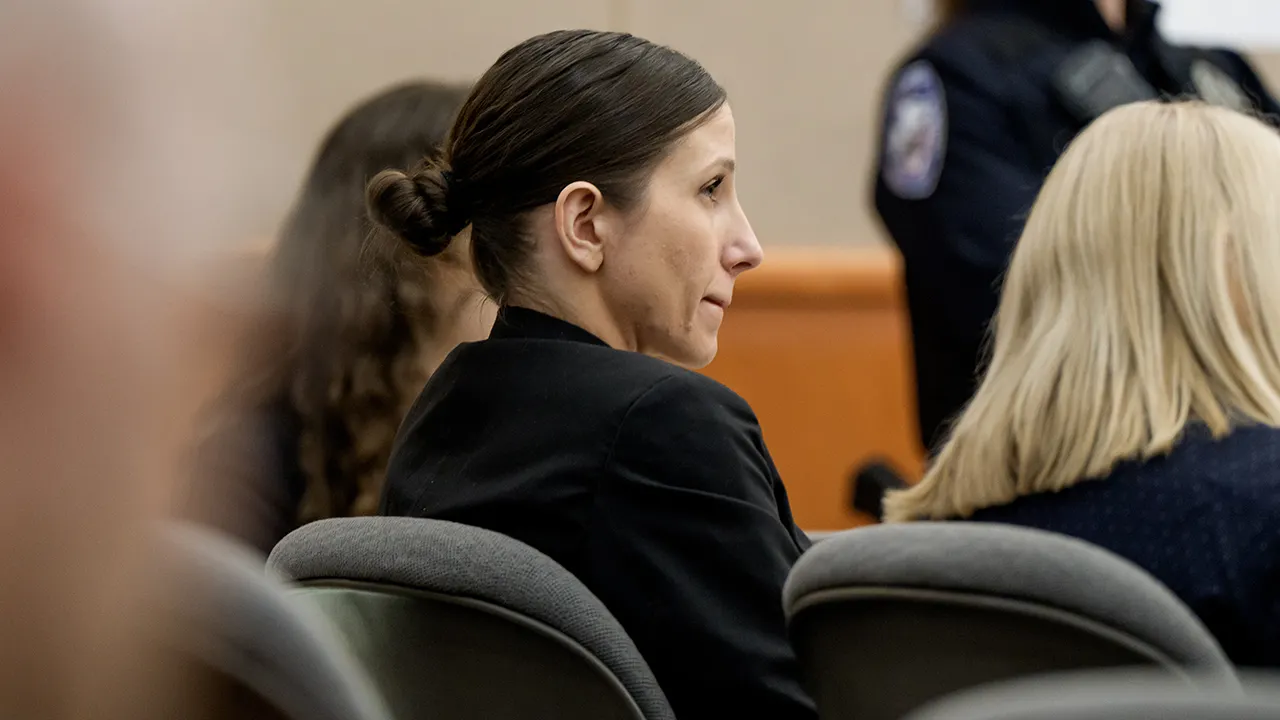
Kouri Richins looks on during her murder trial at the Summit County Courthouse, Monday, Feb. 23, 2026. (Spenser Heaps/AP Photo, Pool)
LIKE WHAT YOU’RE READING? FIND MORE ON THE TRUE CRIME HUB
Chelsea Gipson, the CSI technician who processed the Richins home, faced cross-examination focused on the evidence she collected, including prescription medications removed from the scene and whether she observed alcohol or THC gummies inside the residence. Gipson acknowledged the hydrocodone bottle recovered from the home was not tested for fentanyl and testified that no drug paraphernalia was found.
SIGN UP TO GET TRUE CRIME NEWSLETTER
Defense attorneys also questioned how certain areas were documented, noting that no photographs were taken of the kitchen, sink or closet during the initial processing of the scene.
FOLLOW THE FOX TRUE CRIME TEAM ON X
Kathy Nester walks back to her seat during the trial at the Summit County Courthouse, Monday, Feb. 23, 2026. (Spenser Heaps/AP Photo, Pool)
Judge Richard Mrazik called a recess around 9:30 a.m., citing a scheduling conflict. When court resumed shortly after 10:30 a.m., he dismissed jurors for the day, referencing “unforeseen emergency circumstances unrelated to the case.”
On Thursday, Kouri Richins’ housekeeper testified that she bought pain pills for her after repeated requests in early 2022. Carmen Lauber said Richins asked in early February 2022 for pain meds for an “investor,” took the pills and deleted their texts, and later left $1,000 at her Midway home for Lauber to pick up for another purchase.
Lauber also said she helped Kouri Richins obtain increasingly stronger drugs. She said she first sought out strong painkillers through a friend after Kouri Richins allegedly said her “investor” wanted something stronger, calling it the “Michael Jackson stuff.”
Lauber’s testimony followed a state toxicologist’s testimony acknowledging that Eric Richins could have taken fentanyl before having a drink, potentially undercutting prosecutors’ claim that Kouri Richins laced his Moscow mule.
Richins was arrested in May 2023. The case later drew national attention after she published a children’s book about grief following her husband’s death.
CLICK HERE TO DOWNLOAD THE FOX NEWS APP
The trial is expected to continue for several more weeks.
The Associated Press contributed to this report.
Stepheny Price covers crime, including missing persons, homicides and migrant crime. Send story tips to stepheny.price@fox.com.
Related Article

Read the full article from Here


DENVER — More than 24 hours after the United States and Israel attacked Iran, Coloradans are continuing to express their feelings about what the attack means not only for the world, but here in our state.
For the second straight day, Coloradans expressed their opinions on the steps of the state Capitol about the attack by the US and Israel on Iran.
But instead of anger, as was the case on Saturday, the tone on Sunday was more cheerful.
“Today it’s a celebration about like getting our freedom back, and we would love to have people to be happy with us,” said Forzun Yalme, who helped organize the event with Free Iran Colorado.
For some Iranian-Americans, the news of the attack brings a new sense of hope that freedom is near.
“For me to be Iranian-American, in 47 years here, I learned about democracy and human rights and what I like,” detailed Amir Tosh, another member of Free Iran Colorado. “I want to transfer what your values are for democracy, human rights, freedom to my country, my motherland.”
Denver rally shows divided feelings over U.S.-Israel action against Iran
“My uncle and grandma, grandparents, they were all so happy about what happened, because we can, like, now feel the freedom,” explained Yalme.
But some Iranian-Americans are more cautious.
Colorado’s only Iranian-American state representative, Yara Zokaie, doubts the operation will have a significant impact to Iran’s leadership.
“I’m sympathetic to people who want regime change by any means necessary, but I think we also need to stop and realize what this actually means,” said Zokaie. “Regime change is not something that can happen in one airstrike.”
Zokaie admits she herself was elated to hear Iran’s supreme leader and other top officials were killed in the attack.
But she hopes Coloradans remember the innocent people who have already been killed and those who are more likely to come.
“I ask that we remember the humanity of people in the Middle East as this news unfolds. I ask that we call for a peaceful resolution that we empower Iranian people who will bring change from within, and that we call for no war with Iran,” said Zokaie.
Several people at today’s event at the Capitol approached our Denver7 team. They shared their gratitude for President Donald Trump, the US military, and the Israelis for their action in helping bring freedom to Iran.
They hope others will see that as well. They plan on being here for the next hour and a half or so.

At 72, Oprah swears by this specific move for full-body strength – here’s why it’s so effective

Review | Hoppers: Pixar’s new animation is a hilarious, heartfelt animal Avatar

A look at some of the contenders to be Iran’s supreme leader after the killing of Khamenei

Map: Earthquake Shakes Central California

Video: Defense Officials Give No Timeline for War in Iran as U.S. Boosts Forces

Florida High School Football Rankings: Top 25 teams – Oct. 21

Cleary's 21 help Le Moyne down Central Connecticut State 69-64 in OT

How old is Bo Nix? What to know about Oregon quarterback ahead of 2024 NFL Draft

99th annual Pony Swim held in Virginia

Indiana Members Credit Union announced as new anchor tenant at Bottleworks District
Map: Earthquake Shakes Central California

Gas prices could jump as Middle East tensions threaten global oil supply

Pakistan calls troops, orders 3-day curfew as 24 killed in pro-Iran rallies

US says Kuwait accidentally shot down 3 American jets

House Republicans push Johnson to go to war with Senate over SAVE Act
-

 World5 days ago
Exclusive: DeepSeek withholds latest AI model from US chipmakers including Nvidia, sources say
-

 Massachusetts5 days ago
Mother and daughter injured in Taunton house explosion
-

 Denver, CO5 days ago
10 acres charred, 5 injured in Thornton grass fire, evacuation orders lifted
-

 Louisiana1 week ago
Wildfire near Gum Swamp Road in Livingston Parish now under control; more than 200 acres burned
-

 Technology1 week ago
YouTube TV billing scam emails are hitting inboxes
-

 Politics1 week ago
OpenAI didn’t contact police despite employees flagging mass shooter’s concerning chatbot interactions: REPORT
-

 Technology1 week ago
Stellantis is in a crisis of its own making
-

 News1 week ago
World reacts as US top court limits Trump’s tariff powers