Colorado
What’s Working: Colorado restaurant owners spoke out to change state policy this year. It worked, sorta.


Quick links: No tax on tips | Minimum wage by state | Denver budget woes | 16th Street update | Colorado Springs adds chipmaker
Kinda win some, sorta lose some, but get a lot of attention while doing it may best describe 2025’s lawmaking session for the Colorado restaurant industry, or at least for the Colorado Restaurant Association.
“This was one of the most challenging legislative sessions in my decade with the CRA, but we feel that we made some good progress on behalf of the restaurant industry,” said Sonia Riggs, the organization’s president and CEO.
Years of rising food, labor and operational costs have dismayed independent restaurants, already operating on low margins. While new eateries still open regularly, the demise of some well-known Denver-area restaurants in the past year and ongoing struggles of nearly all, spurred action by the organization that represents 5,000 food businesses around the state.
Even though a bill to end credit card fees on tax and tips failed, the restaurant association was “grateful and relieved” when Gov. Jared Polis vetoed a bill that would have made it easier for workers to unionize under the state’s unique Labor Peace Act.

One of the more heated bills attracted dozens of restaurant owners who showed up at the statehouse to testify in support of the so-called Restaurant Relief Act, aka House Bill 1208.
The bill proposed increasing the amount employers could offset hourly pay to tipped workers, whose own tips would cover the difference. It only applied to areas where the local wage was higher than the state’s, such as in Denver, where tipped servers make $15.78 an hour, or $4 more than the state’s tipped minimum.
Worker advocates fought back because it meant a pay cut for the lowest-paid workers. And not all restaurant owners were in support of the initial plan, including Holly Adinoff, owner and general manager of Sullivan Scrap Kitchen in Denver.
“It was heartbreaking to think that the only way that restaurants could succeed is by cutting wages 25% for people who are barely making it,” said Adinoff, also a member of the policy team at Good Business Colorado, a grassroots business organization that advocates for equitable communities. “It just doesn’t seem right to hurt the people that make our restaurant possible.”
Others, like advocates at the national One Fair Wage, wanted to eliminate the tipped credit so all workers are paid full minimum wage — and keep their tips.
After a massive overhaul, the bill passed but left the decision on whether to change the tipped credit to the local municipality. Polis hasn’t signed the bill into law yet, but Riggs called it “a big win” and said the governor is expected to sign it.
Even though no immediate relief is expected, all the attention to the plight of restaurants was appreciated by local owners, like Alec Schuler, chef-owner of the three Tangerine breakfast spots in Boulder, Lafayette and Longmont.
“I like the direction things are going. They’re trying to lower credit-card fees. They’re trying not to tax tips. There are things that are supporting restaurants that are generally better for me,” said Schuler, who supported changing tipped minimum wages even if only the Boulder location could benefit. “It’s minimal … but 80-cents an hour still adds up to a chunk of money.”
Still on the way: No tax on tips
On Tuesday, the U.S. Senate unanimously approved the No Tax on Tips Act, an issue that both presidential candidates supported during the election season.
If it becomes law as is, tipped workers — including restaurant servers, bartenders, baristas, food-delivery drivers and those at beauty salons or barber shops — won’t have to pay federal taxes on tips as they must today. The benefit, however, has limits including a deduction of up to $25,000 and only for tipped workers who earn $160,000 or less in 2025. The amount will adjust to annual inflation, according to a New York Times analysis.

There’s a similar measure that’s part of Trump’s big budget bill that would also exempt overtime pay from federal taxes.
CRA hasn’t taken a side on the policy, but other restaurant owners say it would be helpful because it allows tipped workers to save a little bit more of their earnings.
“Any way that we can get more money into our people’s hands is great,” said Adinoff, with Sullivan Scrap Kitchen. “I’m interested to see where it goes.”
Meanwhile, worker advocates at One Fair Wage, which took a hard stance against Colorado’s tipped-wages bill, said the No Tax on Tips Act won’t help two-thirds of workers out there who don’t even earn enough to pay federal taxes. It “completely ignores the core crisis facing millions of workers in the service sector: poverty wages,” the organization said in a statement.

According to the Internal Revenue Service, individuals who earn less than $14,600 a year don’t have to pay federal income taxes. That amounts to about $7 an hour if the person works a 40-hour workweek all year.
That’s well below Colorado’s current minimum wage of $14.81 and tipped minimum wage of $11.79. But 20 states pay the federal minimum of $7.25 and a tipped minimum of $2.13 an hour. Those states haven’t raised their minimum wage since the federal government required them to in 2009.
Sun economy stories you may have missed

➔ Front Range cities step up opposition to $99 million Colorado River water rights purchase. Western Slope communities, led by the Colorado River District, want to buy the historic Shoshone Power Plant water rights to support their economies. >> Read story
➔ A new art center debuts in an old Denver fortune cookie factory. The privately funded Cookie Factory opens May 24 and will focus on showing new work by two contemporary artists per year >> Read story
➔ Running a food truck in Denver (and the rest of Colorado) is about to get simpler. A bill signed into law Tuesday by Gov. Jared Polis will allow food truck operators to get a single license to operate in different parts of the state >> Read story

➔ How Trump’s “big, beautiful bill” would impact Medicaid in Colorado. Work requirements could increase the number of people without health insurance in Colorado, but other provisions may not cut as deep as earlier feared >> Read story
➔ AT&T buying Lumen’s home fiber business, including Colorado market, for $5.75 billion. Coloradans may be more familiar with Lumen’s old moniker, CenturyLink. >> Read story
➔ Colorado cities sue Jared Polis, state over housing policies. A lawsuit filed Monday argues the state is violating the right of local governments to shape how they grow and develop >> Read story
How Colorado is getting older

The Colorado Sun launched a new series of stories earlier this week to take a deeper look into what it’s like to get older in Colorado. Here are the first two stories:
💼📢 The Colorado Sun is hiring a Chief Operating Officer. We’re seeking a strategic, collaborative and operations-minded leader to join our team in a crucial role that will help shape The Sun’s next chapter. Applications close June 15. Apply now
Other working bits
➔ City of Denver warns of layoffs. Mayor Mike Johnston announced Thursday that the city is expecting $50 million less in revenue this year and anticipates a $200 million deficit next year due to the nation’s economic downturn that has consumers spending less. According to a presentation, he also shared that expenses outpaced revenue since 2023. The city immediately put a freeze on hiring and will make most employees take two to seven days of furloughs this year. In a news release, city officials also warned of possible layoffs in 2026. >> See the mayor’s presentation

➔ At least Denver’s 16th Street Mall is nearly done. But its name has changed. It’s now just called 16th Street. Construction has taken more than three years and is expected to be done by the fall. Denverite reported that the branding and renaming campaign cost $100,000.
➔ Colorado Springs attracts another chipmaker. Okika Devices, which rebranded itself in January as it shifted from analog design to products, picked the Springs for its new headquarters and research and development center. Based in Carlsbad, California, Okika currently employs six people and plans to add 20 in Colorado with an average annual wage of $104,250. The company is eligible for up to $402,532 in state income tax credits from Pikes Peak Enterprise Zone.
➔ Upcoming job fair for 9-1-1 call takers. What’s it like to be the person answering 9-1-1 calls? You can now find out — and apply for a job — during the Colorado 9-1-1 Resource Center’s virtual job fair on June 3. Two sessions, one at 2 p.m. and the other at 6 p.m., will share what training it takes and stories from working emergency communication specialists. RSVP if you’re interested in attending. >> Sign up
Got some economic news or business bits Coloradans should know? Tell us: cosun.co/heyww
Have a nice Memorial Day weekend! As always, share your 2 cents on how the economy is keeping you down or helping you up at cosun.co/heyww. ~ tamara
Miss a column? Catch up:
What’s Working is a Colorado Sun column about surviving in today’s economy. Email tamara@coloradosun.com with stories, tips or questions. Read the archive, ask a question at cosun.co/heyww and don’t miss the next one by signing up at coloradosun.com/getww.
Support this free newsletter and become a Colorado Sun member: coloradosun.com/join
Corrections & Clarifications
Notice something wrong? The Colorado Sun has an ethical responsibility to fix all factual errors. Request a correction by emailing corrections@coloradosun.com.



As a result of a snow drought and a heat wave that have both set records, some Colorado residents face the earliest restrictions on their water use ever imposed.
Denver Water announced Wednesday that it is seeking a 20% cut in water use, asking people to turn off automatic watering systems until mid-May and restricting the watering of trees and shrubs to twice a week.
“The situation is quite serious,” said Todd Hartman, a spokesperson for the utility. “We’re in such a dire situation that we could be coming back to the public in two or three months and saying you’re limited to one day a week.”
It is the earliest in the year that Denver Water has ever issued a restriction, Hartman said.
Colorado’s snowpack peaked at extremely low levels on March 12 — nearly a month earlier than usual — then cratered during the recent heat wave that cooked nearly every state in the West.
“We already had the lowest snowpack we’ve seen since at least 1981, and now, with the heat wave conditions, we’ve already lost about 40% of the statewide snowpack” since the March 12 peak, said Peter Goble, Colorado’s assistant state climatologist. “Conditions are looking more like late April or early May.”
The water restrictions are a harbinger of what’s to come in many Western states as officials try to manage widespread drought concerns. Nearly every snow basin in the Mountain West had one of its warmest winters on record and is well behind normal when it comes to water supply, according to the U.S. drought monitor. The dwindling snowpack is likely to raise the risk of severe wildfires, hamper electricity generation at hydropower dams and force water restrictions for farmers.
Hartman said nearly every community east of the Rockies, along Colorado’s front range, is in much the same boat as Denver.
City Council members in Aurora are considering similar water restrictions; reservoirs there stand at about 58%, according to the city’s website. In the town of Erie, officials declared a water shortage emergency on March 20 after they observed a massive spike in consumption.
Gabi Rae, a spokesperson for the town, said Erie was perilously close to having taps run dry because so many residents had started watering their lawns early amid the unseasonable heat.
“We were a day away from running out of water. That’s why it was such an emergency,” she said.
Erie officials demanded that residents stop using irrigation systems altogether.
Goble said this month’s heat wave has set records in every corner of Colorado, sometimes by double digits.
“I can’t remember seeing a single heat wave that broke this many records, and seeing it across such a large portion of the country is certainly eye-popping,” he said, adding: “I’m located in Fort Collins, and we got up to 91 last Saturday. The previous record for March was 81, so we smashed that record. And it wasn’t just one day, either.”
Denver Water, which serves about 1.5 million residents in the city and its surrounding suburbs, gets about half of its water from the Upper Colorado River Basin and the South Platte River Basin. The latter’s snowpack was at about 42% of normal Tuesday, the utility reported. The Upper Colorado River Watershed was at 55%.
Systemwide, Denver Water’s reservoirs are about 80% full, which is only about 5 percentage points lower than in a typical year.
“That sounds pretty good,” Hartman said. “Except that what we’re not going to be able to rely on is that rush of water that will bring those reservoirs back up, because the snowpack is so low.”
In other words, the snowpack — a natural water reservoir — is mostly tapped already and won’t replenish reservoirs later this spring and into summer, when runoff usually peaks.
In Erie, city workers plan to aggressively police water use until sometime next week using smart meters that monitor residential usage. Rae said the city is also sending utility workers to patrol neighborhoods and look for sprinklers that are turned on.
“People have been kind of annoyed with how aggressive we were, and I don’t necessarily think they understand the ramifications if we weren’t,” Rae said. “It is an actual serious emergency situation. We were so close to reaching empty, there would literally be no water coming out of the taps — hospitals, schools, fire hydrants, your home would have no water.”
Although the limits on outdoor watering will be lifted soon, Rae expects more restrictions later this spring and summer.
Colorado
Suddenly hazy skies in Denver prompt some residents concerned about wildfire smoke to call 911

Some people who live in the Denver metro area on Thursday afternoon were making calls to 911 after skies became noticeably hazy and winds kicked up. It was due to smoke from wildfires in Nebraska moving into Colorado. A cold front also was moving through the Front Range, and there is dust in the air.
The poor air conditions led to reduced visibility downtown after 3 p.m. Several of CBS Colorado’s City Cams showed dust or smoke in the air.
Temperatures were expected to drop by as much as 20 to 30 degrees with the cold front.
The suddenly dusty skies prompted at least one fire agency to put out a plea to residents to please only call 911 “if you see flames.” That warning was put out by South Metro Fire Rescue, which shared a photo on X of an office building with haze visible outside.
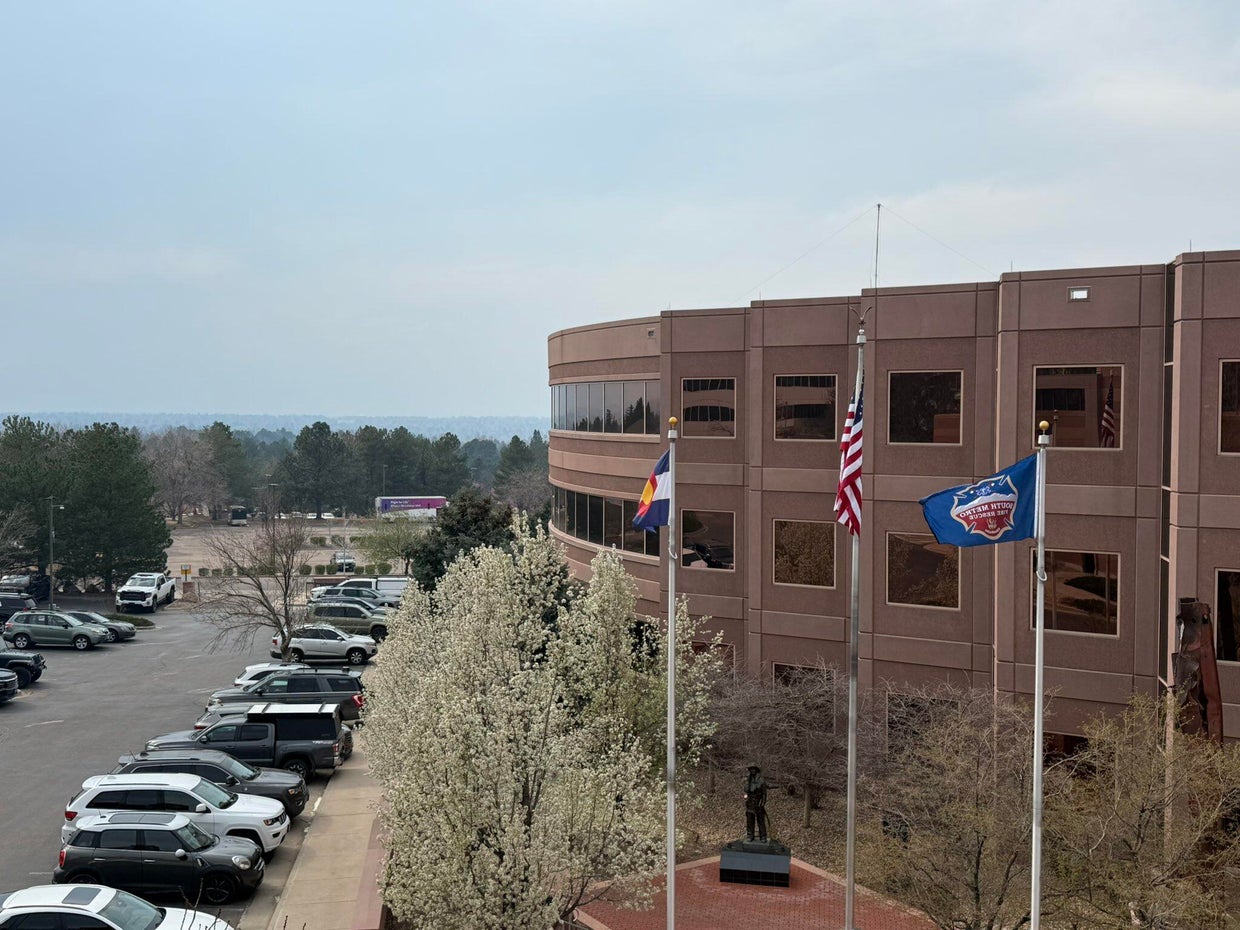
South Metro Fire Rescue said in their post that the smoke is from Colorado’s neighbor to the east. They called it a “significant haze” in the air.
Earlier this month, the Morrill Fire and the Cottonwood Fire burned a significant amount of Nebraska grassland and ranchland. They have mostly been contained by firefighters. Nebraska Gov. Jim Pillen said those two fires combined with several others have burned approximately 800,000 acres of land. On Thursday, Pillen announced that he is signing several executive actions intended to ease the burden caused by the fires.
There were no wildfires burning in the Denver metro area on Thursday afternoon.

ARAPAHOE COUNTY, Colo. (KKTV) – A homicide suspect based out of Colorado, wanted in a fentanyl-related death, is back in the state after being captured in Colombia.
The Arapahoe County Sheriff’s Office (ACSO) said 33-year-old Max Arsenault had been on the run since January 17.
Deputies said this stemmed from an incident in May 2023, where deputies responded to a call for a man named Nicholas Dorotik, who was found unresponsive.
ACSO said the cause of death was a mixed drug overdose involving meth and fentanyl, having about three times the lethal amount of fentanyl in his system.
One year later, Arsenault was arrested. He was scheduled for trial in January 2026 when deputies said he fled the country while on bond three days before the trial was set to start.
He was caught in Medellin, Colombia, on March 4, following a two-month international investigation. He has since been extradited back to Denver, where he is facing charges and awaiting trial.
Copyright 2026 KKTV. All rights reserved.

Exercise scientist reveals the strength training mistake many women make, even after lifting for years

Movie Reviews 2026: Ukrainian and World Premieres

Why Netflix Hiked Prices, Explained in One Chart

Toxic Confidence Has Taken Over

The White House has an app now, and Trump wants you to report people to ICE on it

Florida High School Football Rankings: Top 25 teams – Oct. 21

How old is Bo Nix? What to know about Oregon quarterback ahead of 2024 NFL Draft

Cleary's 21 help Le Moyne down Central Connecticut State 69-64 in OT

99th annual Pony Swim held in Virginia

Indiana Members Credit Union announced as new anchor tenant at Bottleworks District

WATCH: Senate hearing goes silent after Angel Father confronts top Dem over daughter’s death

US diplomat Marco Rubio denounces settler violence, tolls in Hormuz strait

Iran-linked hackers have breached FBI Director Kash Patel’s personal emails | CNN Politics

Live: CPAC 2026 Day 2

Video: Will ICE Change Under Its New Leader?
-

 Detroit, MI1 week ago
Drummer Brian Pastoria, longtime Detroit music advocate, dies at 68
-

 Movie Reviews1 week ago
‘Youth’ Twitter review: Ken Karunaas impresses audiences; Suraj Venjaramoodu adds charm; music wins praise | – The Times of India
-

 Sports6 days ago
IOC addresses execution of 19-year-old Iranian wrestler Saleh Mohammadi
-

 New Mexico5 days ago
Clovis shooting leaves one dead, four injured
-
 Business1 week ago
Disney’s new CEO says his focus is on storytelling and creativity
-

 Technology5 days ago
YouTube job scam text: How to spot it fast
-

 Tennessee4 days ago
Tennessee Police Investigating Alleged Assault Involving ‘Reacher’ Star Alan Ritchson
-

 Texas1 week ago
How to buy Houston vs. Texas A&M 2026 March Madness tickets