Colorado
US Fish and Wildlife backed Colorado plan to get wolves from Canada before new threats to take over program, documents show


The U.S. Fish and Wildlife Service backed Colorado’s plan to obtain wolves from Canada nearly two years before the federal agency lambasted the move as a violation of its rules, newly obtained documents show.
In a letter dated Feb. 14, 2024, the federal agency told Colorado state wildlife officials they were in the clear to proceed with a plan to source wolves from British Columbia without further permission.
“Because Canadian gray wolves aren’t listed under the Endangered Species Act,” no ESA authorization or federal authorization was needed for the state to capture or import them in the Canadian province, according to the letter sent to Eric Odell, CPW’s wolf conservation program manager.
The letter, obtained by The Colorado Sun from state Parks and Wildlife through an open records request, appears to be part of the permissions the state received before sourcing 15 wolves. The agency also received sign-offs from the British Columbia Ministry of Land, Water and Resource Stewardship and the Convention on International Trade in Endangered Species of Wild Flora and Fauna.
In mid-December, however, the Fish and Wildlife Service pivoted sharply from that position, criticizing the plan and threatening to take control over Colorado’s reintroduction.
In a letter dated Dec. 18, Fish and Wildlife Service Director Brian Nesvik put CPW on alert when he told acting CPW Director Laura Clellan that the agency violated requirements in a federal rule that dictates how CPW manages its reintroduction.
Colorado voters in 2020 directed CPW to reestablish gray wolves west of the Continental Divide, a process that has included bringing wolves from Oregon in 2023 and British Columbia in 2025.
The federal rule Nesvik claims CPW violated is the 10(j). It gives Colorado management flexibility over wolves by classifying them as a nonessential experimental population within the state of Colorado. Nesvik said CPW violated the 10(j) by capturing wolves from Canada instead of the northern Rocky Mountain states of Montana, Wyoming, Idaho, Washington, eastern Oregon and north-central Utah “with no warning or notice to its own citizens.”
CPW publicly announced sourcing from British Columbia on Sept. 13, 2024, however, and held a meeting with county commissioners in Rio Blanco, Garfield, Pitkin and Eagle counties ahead of the planned releases last January. The agency also issued press releases when the operations began and at the conclusion of operations, and they held a press conference less than 48 hours later.
Nesvik’s December letter doubled down on one he sent CPW on Oct. 10, after Greg Lopez, a former Colorado congressman and 2026 gubernatorial candidate, contacted him claiming the agency violated the Endangered Species Act when it imported wolves from Canada, because they lacked permits proving the federal government authorized the imports.
That letter told CPW to “cease and desist” going back to British Columbia for a second round of wolves, after the agency had obtained the necessary permits to complete the operation. Nesvik’s reasoning was that CPW had no authority to capture wolves from British Columbia because they aren’t part of the northern Rocky Mountain region population.
But as regulations within the 10(j) show, the northern Rocky Mountain population of wolves “is part of a larger metapopulation of wolves that encompasses all of Western Canada.”
And “given the demonstrated resilience and recovery trajectory of the NRM population and limited number of animals that will be captured for translocations,” the agencies that developed the rule – Fish and Wildlife with Colorado Parks and Wildlife – expected “negative impacts to the donor population to be negligible.”
So despite what Nesvik and Lopez claim, “neither identified any specific provision of any law – federal, state or otherwise – that CPW or anyone else supposedly violated by capturing and releasing wolves from British Columbia,” said Tom Delehanty, senior attorney for Earthjustice. “They’ve pointed only to the 10(j) rule, which is purely about post-release wolf management, and applies only in Colorado.”
More experts weigh in
In addition to the 2024 letter from the Fish and Wildlife Service, documents obtained by The Sun include copies of permits given to CPW by the Ministry of British Columbia to export 15 wolves to the United States between Jan. 12 and Jan. 16, 2025.
These permits track everything from live animals and pets to products made from protected wildlife including ivory.
The permit system is the backbone of the regulation of trade in specimens of species included in the three Appendices of the Convention on International Trade in Endangered Species, also called CITES. A CITES permit is the confirmation by an issuing authority that the conditions for authorizing the trade are fulfilled, meaning the trade is legal, sustainable and traceable in accordance with articles contained within the Convention.

Gary Mowad, a former U.S. Fish and Wildlife agent and expert on Endangered Species Act policies, said “obtaining a CITES certificate is unrelated to the 10j rule” and that in his estimation, CPW did violate both the terms of the 10(j) and the memorandum of agreement with the Fish and Wildlife Service, because “the 10(j) specifically limited the populations from where wolves could be obtained, and Canada was not authorized.”
Mike Phillips, a Montana legislator who was instrumental in Yellowstone’s wolf reintroduction that began in 1995, thinks “the posturing about a takeover seems like just casually considered bravado from Interior officials.”
And Delahanty says “Nesvik and Lopez are making up legal requirements that don’t exist for political leverage in an effort that serves no one. It’s unclear what FWS hopes to accomplish with its threatening letter,” but if they rescind the memorandum of agreement, “it would cast numerous elements of Colorado’s wolf management program into uncertainty.”
Looking forward
If Fish and Wildlife does as Nesvik’s letter threatens and revokes all of CPW’s authority over grey wolves in its jurisdiction, “the service would assume all gray wolf management activities, including relocation and lethal removal, as determined necessary,” it says.
But Phillips says “if Fish and Wildlife succeeds in the agency’s longstanding goal of delisting gray wolves nationwide,” a proposition that is currently moving through Congress, with U.S. Rep. Lauren Boebert’s Pet and Livestock Protection Act bill, the agency couldn’t take over Colorado’s wolf program. That’s because “wolf conservation falls back to Colorado with (its voter-approved) restoration mandate.” And “the species is listed as endangered/nongame under state law,” he adds.
If the feds did take over, Phillips said in an email “USFWS does not have staff for any meaningful boots-on-the-ground work.” Under Fish and Wildlife Service control, future translocations would probably be “a firm nonstarter,” he added, “but that seems to be the case now.”
A big threat should Fish and Wildlife take over is that lethal removal of wolves “in the presence of real or imagined conflicts might be more quickly applied,” Phillips said.

But it would all be tied up in legal constraints, given that gray wolves are still considered an endangered species in Colorado, and requirements of the 10(j) and state law say CPW must advance their recovery.
So for now, it’s wait and see if CPW can answer Fish and Wildlife’s demand that accompanies Nesvik’s latest letter.
Nesvik told the agency they must report “all gray wolf conservation and management activities that occurred from Dec. 12, 2023, until present,” as well as provide a narrative summary and all associated documents describing both the January 2025 British Columbia release and other releases by Jan. 18., or 30 days after the date on his letter. If they don’t, he said, Fish and Wildlife “will pursue all legal remedies,” including “the immediate revocation of all CPW authority over gray wolves in its jurisdiction.”
Shelby Wieman, a spokesperson for Gov. Jared Polis’ office, said Colorado disagrees with the premise of Nesvik’s letter and remains “fully committed to fulfilling the will of Colorado voters and successfully reintroducing the gray wolf population in Colorado.”
And CPW maintains it “has coordinated with USFWS throughout the gray wolf reintroduction effort and has complied with all applicable federal and state laws. This includes translocations in January of 2025 which were planned and performed in consultation with USFWS.”



Colorado
Suddenly hazy skies in Denver prompt some residents concerned about wildfire smoke to call 911

Some people who live in the Denver metro area on Thursday afternoon were making calls to 911 after skies became noticeably hazy and winds kicked up. It was due to smoke from wildfires in Nebraska moving into Colorado. A cold front also was moving through the Front Range, and there is dust in the air.
The poor air conditions led to reduced visibility downtown after 3 p.m. Several of CBS Colorado’s City Cams showed dust or smoke in the air.
Temperatures were expected to drop by as much as 20 to 30 degrees with the cold front.
The suddenly dusty skies prompted at least one fire agency to put out a plea to residents to please only call 911 “if you see flames.” That warning was put out by South Metro Fire Rescue, which shared a photo on X of an office building with haze visible outside.
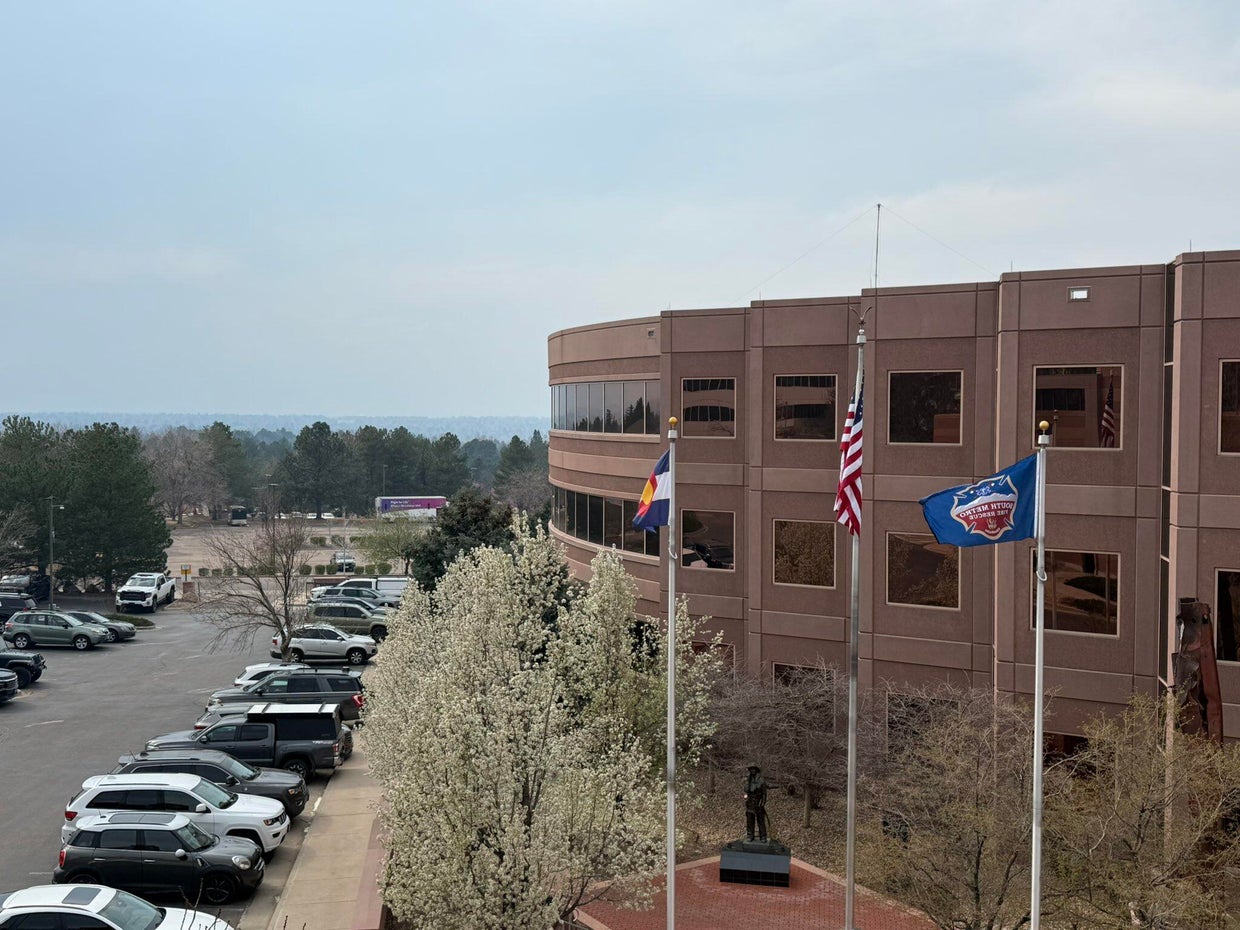
South Metro Fire Rescue said in their post that the smoke is from Colorado’s neighbor to the east. They called it a “significant haze” in the air.
Earlier this month, the Morrill Fire and the Cottonwood Fire burned a significant amount of Nebraska grassland and ranchland. They have mostly been contained by firefighters. Nebraska Gov. Jim Pillen said those two fires combined with several others have burned approximately 800,000 acres of land. On Thursday, Pillen announced that he is signing several executive actions intended to ease the burden caused by the fires.
There were no wildfires burning in the Denver metro area on Thursday afternoon.

ARAPAHOE COUNTY, Colo. (KKTV) – A homicide suspect based out of Colorado, wanted in a fentanyl-related death, is back in the state after being captured in Colombia.
The Arapahoe County Sheriff’s Office (ACSO) said 33-year-old Max Arsenault had been on the run since January 17.
Deputies said this stemmed from an incident in May 2023, where deputies responded to a call for a man named Nicholas Dorotik, who was found unresponsive.
ACSO said the cause of death was a mixed drug overdose involving meth and fentanyl, having about three times the lethal amount of fentanyl in his system.
One year later, Arsenault was arrested. He was scheduled for trial in January 2026 when deputies said he fled the country while on bond three days before the trial was set to start.
He was caught in Medellin, Colombia, on March 4, following a two-month international investigation. He has since been extradited back to Denver, where he is facing charges and awaiting trial.
Copyright 2026 KKTV. All rights reserved.


Pennsylvania-born indie rockers Tigers Jaw return with new album release

A new safety role at Rhode Island College comes into sharper focus after Brown shooting – The Boston Globe

NFL Draft Injury Analysis: Jalon Kilgore, S – South Carolina

Retired Air Force four-star general Maryanne Miller speaks at South Dakota Mines

What channel is Vanderbilt baseball vs Tennessee on today? Time, TV schedule to watch game

Florida High School Football Rankings: Top 25 teams – Oct. 21

How old is Bo Nix? What to know about Oregon quarterback ahead of 2024 NFL Draft

Cleary's 21 help Le Moyne down Central Connecticut State 69-64 in OT

99th annual Pony Swim held in Virginia

Indiana Members Credit Union announced as new anchor tenant at Bottleworks District

Video: Will ICE Change Under Its New Leader?

DHS shutdown breakthrough comes at cost for Republicans as funding fights nears end

Rubio joins crucial G7 talks as Iran war set to dominate second day

A surprise resignation could open the door for an independent to win a Montana Senate seat

Video: Savannah Guthrie Says She Believes Her Mother Was Taken for Ransom
-

 Detroit, MI1 week ago
Drummer Brian Pastoria, longtime Detroit music advocate, dies at 68
-

 Science1 week ago
How a Melting Glacier in Antarctica Could Affect Tens of Millions Around the Globe
-

 Movie Reviews1 week ago
‘Youth’ Twitter review: Ken Karunaas impresses audiences; Suraj Venjaramoodu adds charm; music wins praise | – The Times of India
-
 Science1 week ago
I had to man up and get a mammogram
-

 Sports6 days ago
IOC addresses execution of 19-year-old Iranian wrestler Saleh Mohammadi
-

 New Mexico5 days ago
Clovis shooting leaves one dead, four injured
-
 Business1 week ago
Disney’s new CEO says his focus is on storytelling and creativity
-

 Texas1 week ago
How to buy Houston vs. Texas A&M 2026 March Madness tickets