Colorado
The Arkansas River’s Big Timbers region reflects a complex history of Western expansion, Indigenous displacement


A view of the Big Timbers grounds used by the Cheyenne and Arapaho tribes, and participants in American westward expansion, to camp along the Arkansas River during the mid 1800s at the site of Bent’s New Fort (Mike Sweeney, Special to The Colorado Sun)
A view of the Big Timbers grounds used by the Cheyenne and Arapaho, as well as traders, trappers and the U.S. military, to camp along the Arkansas River during the mid 1800s at the site of Bent’s New Fort (Mike Sweeney, Special to The Colorado Sun)
What is a river?
It depends on your point of view. Sun reporters have fanned out along the Arkansas River, from the headwaters near Leadville to the border with Kansas, to learn what the river means to people in the places it runs through.
▶ Follow along for more from this series
ㅤ⚲ㅤ LAMAR
In late October, leaves still cling to cottonwoods that shade stretches of the Arkansas River, while the wind through their branches barely whispers the story of the landscape once known as Big Timbers.
These sturdy, intermittent groves and the mostly shallow water flowing past them mark the playground of Jake Rogers’ youth. This is where he and his buddies fished, fought Airsoft battles, hung out on a hunting stand high amid the twisted trunks and camped on land where his family still farms alfalfa and leases grazing pasture.
But for Rogers, now the 28-year-old curator of the Big Timbers Museum in this city of nearly 8,000, the river’s meandering ribbon ties together its more recent significance — as an engine for agriculture and, gradually, recreation — with a complicated history of westward expansion and native displacement from the water’s once heavily timbered banks that extended more than 60 miles west toward La Junta.
The Indigenous story of this region has largely disappeared with those people. Still, residents along the Lower Arkansas continally evaluate their own relationship to the river and its surroundings as part of Colorado’s living history.
This story first appeared in
Colorado Sunday, a premium magazine newsletter for members.
Experience the best in Colorado news at a slower pace, with thoughtful articles, unique adventures and a reading list that’s a perfect fit for a Sunday morning.
Land that once thrilled Rogers’ younger self with discoveries like a beaver pond or bleached cattle bones on grazing land south of the river that was once Mexico now carries a deeper meaning. His education has been complicated by the clash of cultures that not only removed the region’s earlier inhabitants, but in the process also changed the natural environment that has nurtured his love for the landscape.
Perhaps ironically, the land where Rogers’ family eventually settled once belonged to George Bent, the son of 19th-century trader and entrepreneur William Bent and his wife Owl Woman, daughter of a Cheyenne chief. It was the last of 29 sections given to mixed-blood relatives of prominent white men by treaty in the wake of the Sand Creek Massacre.
The museum stands on parcel No. 26. And in one corner of the main exhibit area, Rogers points to the original stone marker denoting parcel No. 29.
“My folks’ family farm is actually on that piece of land,” he says. “Their folks came out here during the Great Depression, and I’m not sure when they acquired the land out there, but yeah, that’s where I grew up gallivanting.”
Claims along the river
The top map shows claims awarded by treaty in 1865 to the children of the earliest white settlers and their Native American wives. The breakout map shows the location of those claims in and around Lamar. The current Big Timbers Museum sits on claim No. 26, while the family of the museum’s curator settled in the 1930s on claim No. 29. (Adapted from General Land Office map of State of Colorado, 1934. Download a full-sized PDF with more information here.)

Source: U.S. Department of the Interior/U.S. Geological Survey
List of claimants
Caro Hedge, the researcher who works with Rogers at the Big Timbers Museum, pores over old maps that portray the many faceted history of the area — whose precise definition can be a moving target.
“So the thing about Big Timbers is, if you ask somebody how long it was, you’ll get a different answer every time,” Hedge says. “Because if you go back to 1820 it was about 70 miles long and pretty much solid cottonwood trees on both sides of the river.”
Eventually, the Santa Fe Trail brought increased activity along the Arkansas, from traders and trappers to gold-rush hopefuls, while native tribes still used Big Timbers primarily in the winter. The actual wooded area began to shrink.
For example, when his source of firewood in the immediate area became depleted (and at the urging of his Cheyenne trading partners) William Bent moved his original fort — the historic site known as Bent’s Old Fort, a key commercial hub — several miles to the east.
“So at that point,” Hedge explains, “Big Timbers starts becoming just these swaths of timber separated by empty spots as land got put into use and cleared for roads and everything. People say, ‘How big is Big Timbers?’ And you’ll get all sorts of answers, depending on what year it was.”
Throughout his life, Rogers’ sensitivity to an environment so laden with lore — from Indigenous tribes to Spanish and Mexican possession to the arrival of white traders, trappers and, eventually, settlers — triggered conversations with his parents and grandparents “just talking about why things are the way they are here.”
An 1819 treaty with Spain designated the Arkansas River the border between U.S. territory and Spanish holdings, and later Mexico after it won independence in 1821, until the Treaty of Guadalupe Hidalgo in 1848. That marked the end of the Mexican-American war and brought most of present-day Colorado into the expanding United States.
But when his family bought adjacent land just south of the river, Rogers could stand on those banks an imagine a time when he would have been across the border in another country.
What Rogers learned about the Native American perspective in school revolved mostly around the 1864 Sand Creek Massacre, which essentially began at Fort Lyon, formerly known as Bent’s New Fort, where troops from the 1st and 3rd Cavalry, led by Col. John Chivington, rode nearly 40 miles north to slaughter more than 230 mostly elders, women and children.


Jake Rogers, curator of Big Timbers Museum, grew up on his family’s farm that’s bisected by the Arkansas River and was once part of the area in Prowers County known as Big Timbers. While cottonwood trees (seen in the framed 1910 photo) and native grasses still grow there, they lack the stature and numbers from the turn of the 20th century. (Mike Sweeney, Special to The Colorado Sun)
“In school, we spent maybe a week learning about it,” Rogers says. “But for the most part, my education was pursued afterward, and independently so. It was a pretty significant shift for me, because you learn how their way of life was deliberately deconstructed — basically, through westward expansion and Manifest Destiny.”
Another lesson he learned — and lived — came as a student at Lamar High School, where the school’s nickname, the Savages, was challenged for its disparaging depiction of Native American culture and finally succumbed to a state law banning most such mascots.
“In school, I absolutely took pride in the mascot,” says Rogers, who graduated in 2012. “I got caught up in the school spirit. As I grew older, I learned that it’s tough to justify that kind of a name.”
But what initially caught his attention about the region’s historical narrative — and kept it — was the array of plant life that native tribes cultivated in the area. Chief among these, in his observation, was dogbane, also called Indian hemp, that grows along the river and some of the creeks and was used to make cordage for clothing and netting, among other things. Also, he has noticed native plums have become rare, as have native grapes, early food sources managed by native people that began to disappear with displacement of the tribes.
And of course the trees. For the early white travelers, they provided shelter and fuel, but the soft wood was useless for replacing wagon axles or oxen yokes. Many Indigenous people regarded the cottonwood as a source of medicine and food for their horses, as well as a medium for carving spiritual artifacts.
Clusters of cottonwoods, many of good size, remain here and there along the Arkansas — although they no longer include the behemoths that inspired people to pose for photos amid improbably thick trunks. But they were plenty good for backyard camping trips, when Rogers and his scouting buddies could lie beneath them and imagine their 19th-century heyday.
As an adult, his appreciation gained depth and perspective, and piecing together the ecological and cultural history of his home turf became a hobby. He earned his associate of arts degree at Lamar Community College and then last year heard that the Big Timbers Museum was hiring an assistant. He landed the job, which “ended up being kind of an apprenticeship” as the museum’s curator prepared to step back.
Over these last few years, his understanding of the expansive history of the land and the river’s lifegiving thread has grown beyond childhood awe and led him to consider revisiting his education, perhaps through a lens of biology and history. It has certainly informed his vision of what the museum can impart to the community.
“I walked through those cottonwood forests,” Rogers says. “Most of my reverence for this place is definitely the kind of nature, the wilderness that exists here — the small, little sliver. I would like more people to realize that there are natural spaces here, out on the prairie, out in no-man’s-land, that are worth preserving and worth recognizing.”

An enduring native connection
Growing up, Chris Tall Bear would listen as the elders sat in a teepee or tribal ceremony recounting historical or cultural events. Sometimes, they would talk about a place of renewal. Of abundance. A sacred landscape.
The 54-year-old Southern Cheyenne descendant of survivors of the Sand Creek Massacre, a traditional chief and member of the Council of Forty-four, lives in Oklahoma. But he remembers trips to Colorado to visit his dad and hearing history handed down through the generations about the place known as Big Timbers.

“His grandfather would tell him they would move into the trees and that river was always going,” Tall Bear recounts. “It would give them water. They always had firewood. It was abundant. And just being there with your people, you know, it was a time when we were strong.”
Also powerful is the connection to a place he never lived, but where distant relatives on both sides of his family survived the massacre, and lived through events that displaced them to Oklahoma. There’s a sense of belonging to the Big Timbers region, yes, “but I feel like it is that whole area,” Tall Bear says.
“You’ve got to keep in mind back in 1865 a lot of these man-made boundaries were not in place, they were just areas, regions that were significant,” he adds. “Sand Creek, the whole ancestral area in general where they were wronged, that cultural patrimony, you might say, ties us to the land and the connection that the river played — the sacredness of those rivers and those waters.”
The river also served at some points in history as a tribal boundary, notes Fred Mosqueda, an outreach specialist and Southern Arapaho tribal historian and Sand Creek descendant.
“The Arkansas River was actually one of the points that the government used as a boundary for us, for the Cheyenne-Arapahoes,” he says. “They said that our area was between the Platte and the Arkansas.”
The trees also held meaning. Sun Dance lodges, sites of the dayslong ceremonial rituals practiced by Plains tribes, were built out of cottonwoods, which conferred them sacred status.
Tall Bear compares the connection to the once-forested banks of the Arkansas River to the one the Cheyenne also feel visiting Bear Butte in the Black Hills of South Dakota, where belief holds that the prophet Sweet Medicine received a sacred covenant.
“It’s still very, very sacred, and it’s one of those places that, once you step on that ground, it just feels like you’re home,” Tall Bear says. “I just cannot describe how good it feels. It’s restoring. It’s spiritual. It’s healing.”
Returning to the tribe’s Colorado territory, he adds, inspires similar feelings.
“There’s a sad history,” he says, “but it’s also a place of healing and coming to terms with the old and the future as well.”
He recalls driving through the region with his dad to harvest teepee poles from National Forest land near Gunnison and reflecting on the history of their people, “having honest conversations about how it feels to us as Cheyenne, what that area represents.”
“It’s the profoundness of distance, of freedom in the area,” Tall Bear explains. “It’s our medicines that we harvest — earth paints, mineral paints that are in the ground, resources that we needed when we had our renewal ceremonies that helped us with holistic healing. We’ve lost some of that knowledge.”
It was his father’s feeling that a return to the area can be restorative — a sense that Tall Bear shares.
“I’ve got a lot of hope that we’re going to reclaim that institutional knowledge,” he says. “It’s still there. It’s still in that region, it’s very much alive. We’ve just got to go back and look carefully for it and listen.”

An expansive history of tribal inhabitants
For centuries, tribal population of the area was diverse and complex.
Into the 1700s, Big Timbers represented the heart of an extensive Comanche trading center, boosted by the tribe’s entry into the horse trade and their shift from hunting on foot to hunting on horseback. They became the early military and economic power of the Great Plains, notes Jared Orsi, a Colorado State University professor and former state historian.
In the mid-18th century they began operating from the Big Timbers area and expanding a commercial network that stretched all the way to St. Louis and New Orleans, then under French control. Into the early 19th century, Big Timbers was a Comanche stronghold that attracted trading partners from hundreds of miles in every direction.
“The Cheyenne or Arapaho get there a little bit later and for them, the area is similarly important, environmentally and ecologically,” Orsi adds. “There’s tons of space on the Plains, but only a few spots are good for supporting human welfare. So having access to those resources is absolutely critical.”
Orsi notes that the Plains tribes were skilled at knowing how to travel north and south, away from the rivers, when necessary. But for European newcomers who didn’t have those skills, moving east to west along the rivers proved essential. And so, in addition to being good stopping places seasonally, rivers tended to be preferred travel routes.
Some historians cast the resulting conflict with westward expansion as essentially a contest for scarce resources that could meet human needs on a large scale.
“Bent puts his forts on the Arkansas River because this is the place where everybody comes,” Orsi says. “Everybody’s got to travel there. Everybody who wants to move about and camp seasonally has to come through there. And so the first American trading enterprises occur along the rivers, places like Big Timbers.”
Additionally, much of the early American settlement in the area revolved around ranching, especially after the Civil War, as reliable irrigation wouldn’t arrive until later that century. A rancher could claim a stretch of land along the river and graze cattle for miles.
Removing people who were competing for spaces along the rivers was necessary in order to make this economic model work, Orsi says, leading to “an ecological contest between settlers and native peoples, both of whom have lifestyles and economies that depend on having access to a small number of vital places.”
Significantly, the U.S. military presence along the Santa Fe Trail, which follows the Arkansas through the region, increased markedly between 1859 and 1865. That included the site of Bent’s New Fort, which the Army folded into nearby Fort Wise and then, in 1862, renamed Fort Lyon. It was from there that Chivington’s forces struck out in November of 1986 to attack the Cheyenne and Arapaho encampment at Sand Creek, leaving an invisible thread from the river that would tragically tie the tribes to the land long after they were displaced.
“It’s the darkest chapter in Colorado history, as far as I’m concerned,” says Sam Bock, a public historian and exhibit developer at History Colorado. “This happened at the height of the Civil War, before the Battle of Gettysburg, and the massacre was so horrifying and such a breach of military conduct that amidst the horrors of the Civil War, people are already dealing with this sense of all these atrocities.”
Land for native relatives
Almost a year after the attack at Sand Creek, the Treaty of the Little Arkansas officially proclaimed the events a massacre and promised reparations to survivors. Efforts to claim reparations continue to this day, but so far have been unable to clear legal hurdles. A privately funded study last year sought to quantify losses of life and land among 10 tribal nations that called Colorado home and foster renewed discussions about reparations with the state.
But the treaty’s promise of a quarter-section of land — 160 acres — to widows and orphans of the massacre never materialized. Still, more than two dozen people did come away with sections of riverfront property.
“There was another section in this treaty that gave full sections of land along the Arkansas on the northern bank to the sons and daughters of prominent white men in the area who had Indian wives and children,” says Hedge, the Big Timbers Museum researcher.

For instance, in addition to section No. 29, where the museum curator Rogers’ family eventually settled, John Prowers, the local county’s namesake, ended up with one of the sections because his wife, Amache — for whom the World War II-era Japanese American incarceration camp would be named — received section No. 14. All told, the parcels ran to Lamar from well west of present-day Rocky Ford.
“Most of them got collected up and made into some of the first major ranches in the area,” Hedge says. “But these did end up, technically, in Native American hands. They’ve all been sold and resold.”
In 1867, the Medicine Lodge Creek Treaty — actually a series of agreements among the U.S. and several Plains tribes — moved Southern Cheyenne and Arapaho people from Colorado onto an Oklahoma reservation. The succession of treaties was one mechanism in a plan designed to avoid costly military campaigns by removing tribes from the wave of westward expansion.
“The defeat of the native population of Colorado was partly military, but if you look at things like the Sand Creek Massacre, they were not decisive military battles,” says Orsi, the CSU professor. “They did not hamstring the ability of the Cheyenne or the Arapaho to engage in military activities and defend their land. The deepest reason for the ultimate surrender of the lands in 1867 was because their way of life, their economy, was no longer feasible.”
He puts it in these terms: Think of the native economy as mobile and expansive, in terms of land, and needing the ability to travel long distances — following the bison herds, for instance. That model ran headlong into the American strategy of using land not extensively, but intensively. Think of farmers and ranchers establishing ownership of parcels, then squeezing from those as much profit as they could.
“Those two ways of using land — intensively and extensively, communally versus privately — they can’t coexist,” Orsi says. “And so in order to impose this kind of economy of gridded small plots of land with unique owners, the United States government and the Colorado government needed to expel the peoples who wanted to use land globally and extensively.”

The river remains a constant
On a recent afternoon, John Carson, whose diminutive stature and bushy moustache conjure the image of his great-grandfather, the controversial soldier and frontiersman Kit Carson, hikes to the top of a windswept bluff where a modest stone marker stands on the site where Bent’s New Fort once stood.
Below, the Arkansas River weaves its way eastward to Lamar through prairie land punctuated with cottonwood groves, lacing together pieces of a landscape that reflects the contradictions inherent in America’s westward expansion.
William Bent moved his original trading post here in 1853 and leased it in 1860 to the Army — which, having built Fort Wise nearby on lower ground by the river, used Bent’s stone structure to house a commissary as well as an Indian Agency office. A year later, in perhaps an early foreshadowing of modern historical backtracking, Virginia Gov. Henry Wise, the post’s namesake, led his state’s secession from the Union, prompting the Army to rename the post Fort Lyon, after the first U.S. general killed in the Civil War.
Carson knows all this and much more by rote. He spent 25 years teaching at the high school and college levels, and years more working at the Bent’s Old Fort National Historic Site and participating in reenactments in the area. His expertise won him honors from the Colorado Tourism Board.
He dates his desire to teach history back to the sixth grade. And now, at 69, he can stand on the ground his noted forebearer traveled, probably dozens of times over a career that included a roughly nine-month stint working as a hunter for the Bents in the 1840s. A Colorado town and county both bear his name, but he also carries a mixed legacy: hero frontiersman, villainous instrument of Indigenous displacement.

So John Carson probably understands the nuances of the Big Timbers landscape a little differently than most.
“You can actually visualize Bent’s trading cabin he had down there on the bottom,” he says, referring to the now-private land by the river. “You can visualize the tribes coming in and setting up their winter camps, the horse herds, the buffalo, deer, antelope, coming down to the river for water. But for me, it’s a way — probably the only way today — to see, at least in your mind, what happened historically at the site.”
Carson also can imagine Chivington leaving this very spot with his troops on a 10-hour march to Sand Creek. The morally conflicting narratives of the past still live in the Big Timbers.
“There’s always dark spots in our history,” he says, “and that’s definitely one of them. There’s nothing we can do today to change what happened. We can learn from it, we can improve on it. But what happened, happened, and we just have to admit that sometimes human beings do bad stuff.”
Down below, in real time, the river moves on.
“It’s a constant in this part of the state,” Carson says. “The animals depended on it, the tribes depended on it, the farmers depended on it. The towns today depend on it. And as long as we don’t mess it up too awful bad, it’ll be what the future generations depend on.”



Colorado
Suddenly hazy skies in Denver prompt some residents concerned about wildfire smoke to call 911

Some people who live in the Denver metro area on Thursday afternoon were making calls to 911 after skies became noticeably hazy and winds kicked up. It was due to smoke from wildfires in Nebraska moving into Colorado. A cold front also was moving through the Front Range, and there is dust in the air.
The poor air conditions led to reduced visibility downtown after 3 p.m. Several of CBS Colorado’s City Cams showed dust or smoke in the air.
Temperatures were expected to drop by as much as 20 to 30 degrees with the cold front.
The suddenly dusty skies prompted at least one fire agency to put out a plea to residents to please only call 911 “if you see flames.” That warning was put out by South Metro Fire Rescue, which shared a photo on X of an office building with haze visible outside.
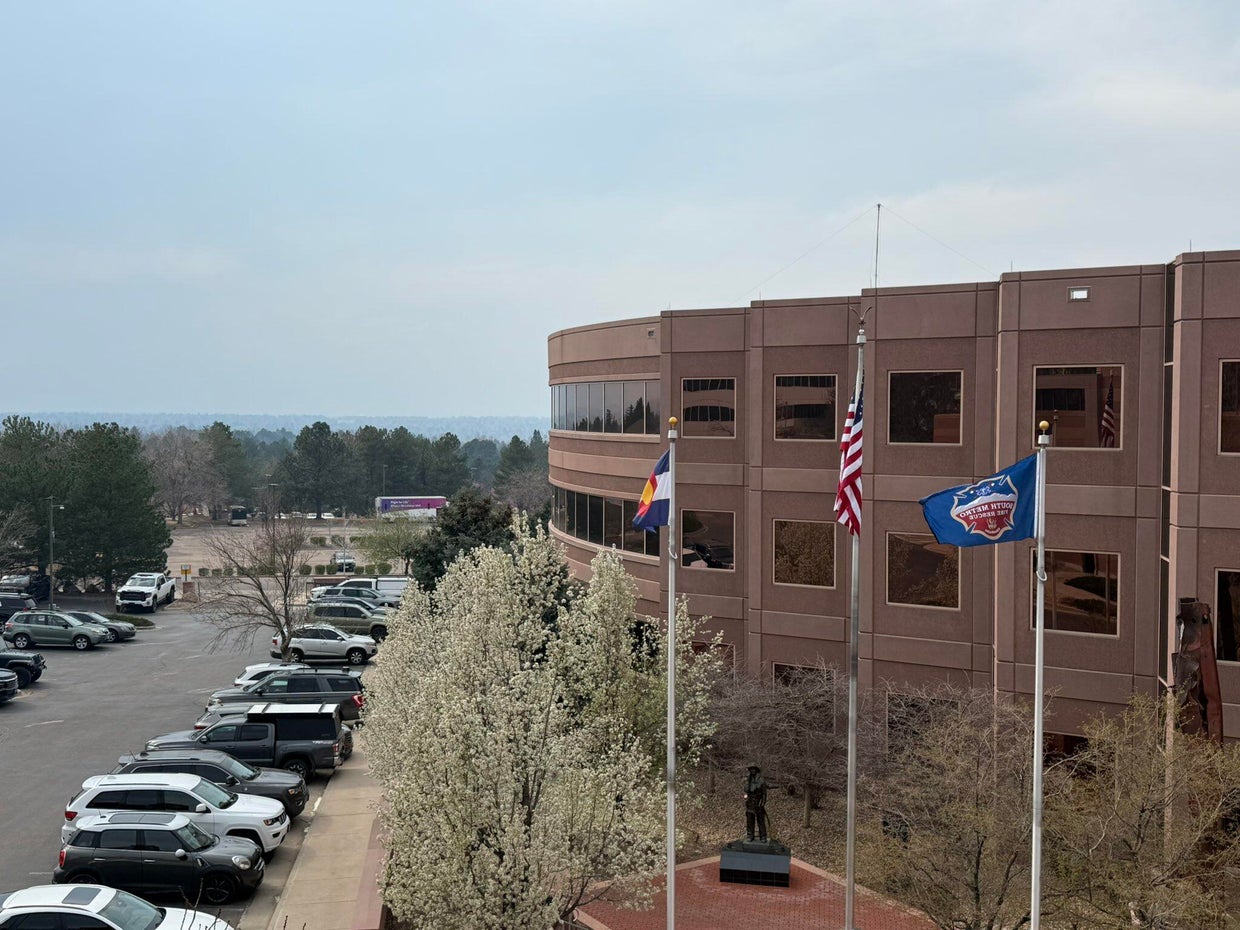
South Metro Fire Rescue said in their post that the smoke is from Colorado’s neighbor to the east. They called it a “significant haze” in the air.
Earlier this month, the Morrill Fire and the Cottonwood Fire burned a significant amount of Nebraska grassland and ranchland. They have mostly been contained by firefighters. Nebraska Gov. Jim Pillen said those two fires combined with several others have burned approximately 800,000 acres of land. On Thursday, Pillen announced that he is signing several executive actions intended to ease the burden caused by the fires.
There were no wildfires burning in the Denver metro area on Thursday afternoon.

ARAPAHOE COUNTY, Colo. (KKTV) – A homicide suspect based out of Colorado, wanted in a fentanyl-related death, is back in the state after being captured in Colombia.
The Arapahoe County Sheriff’s Office (ACSO) said 33-year-old Max Arsenault had been on the run since January 17.
Deputies said this stemmed from an incident in May 2023, where deputies responded to a call for a man named Nicholas Dorotik, who was found unresponsive.
ACSO said the cause of death was a mixed drug overdose involving meth and fentanyl, having about three times the lethal amount of fentanyl in his system.
One year later, Arsenault was arrested. He was scheduled for trial in January 2026 when deputies said he fled the country while on bond three days before the trial was set to start.
He was caught in Medellin, Colombia, on March 4, following a two-month international investigation. He has since been extradited back to Denver, where he is facing charges and awaiting trial.
Copyright 2026 KKTV. All rights reserved.


DHS shutdown breakthrough comes at cost for Republicans as funding fights nears end

Dementia risk signals could lie in simple blood pressure readings, researchers say

Indiana coach Cignetti sends message to star transfer with pre-practice dress code lesson

Drone food delivery launches in New Jersey

FKA twigs sues ex-boyfriend Shia LaBeouf over ‘unlawful’ NDA

Florida High School Football Rankings: Top 25 teams – Oct. 21

How old is Bo Nix? What to know about Oregon quarterback ahead of 2024 NFL Draft

Cleary's 21 help Le Moyne down Central Connecticut State 69-64 in OT

99th annual Pony Swim held in Virginia

Indiana Members Credit Union announced as new anchor tenant at Bottleworks District
DHS shutdown breakthrough comes at cost for Republicans as funding fights nears end

Rubio joins crucial G7 talks as Iran war set to dominate second day

A surprise resignation could open the door for an independent to win a Montana Senate seat

Video: Savannah Guthrie Says She Believes Her Mother Was Taken for Ransom

Stefanik grills University of Michigan leader on lack of audit after string of Chinese national arrests
-

 Detroit, MI1 week ago
Drummer Brian Pastoria, longtime Detroit music advocate, dies at 68
-

 Science1 week ago
How a Melting Glacier in Antarctica Could Affect Tens of Millions Around the Globe
-

 Movie Reviews1 week ago
‘Youth’ Twitter review: Ken Karunaas impresses audiences; Suraj Venjaramoodu adds charm; music wins praise | – The Times of India
-
 Science1 week ago
I had to man up and get a mammogram
-

 Sports6 days ago
IOC addresses execution of 19-year-old Iranian wrestler Saleh Mohammadi
-

 New Mexico4 days ago
Clovis shooting leaves one dead, four injured
-

 Texas7 days ago
How to buy Houston vs. Texas A&M 2026 March Madness tickets
-

 Tennessee3 days ago
Tennessee Police Investigating Alleged Assault Involving ‘Reacher’ Star Alan Ritchson