Colorado
Colorado lawmakers duel over data centers: Grant millions in tax breaks or regulate them without incentives?


Colorado lawmakers are deciding this year between two disparate approaches on data centers — one that aims to lure them to the Centennial State with millions of dollars in tax incentives and another that would implement some of the strictest statewide regulations in the country on the booming tech industry.
Either of the two competing bills would create the state’s first regulations specific to data centers. Sponsors of both bills say they hope to minimize environmental impacts from the power and water demands of the centers, while also ensuring that the cost of new infrastructure they need doesn’t wind up on residents’ electric bills.
Both bills are sponsored by Democrats but differ widely in what they’d do.
The bill supported by the data center industry — House Bill 1030 — would incentivize companies to comply with regulations in exchange for large tax breaks. The legislation would not regulate data centers whose owners forgo a tax break.
The other bill — Senate Bill 102 — would offer no incentives, instead imposing regulations on all large data center development across the state. It is supported by environmental and community groups.
“We want to make sure that as data centers come here, they come on our terms,” said Megan Kemp, the Colorado policy representative for Earthjustice’s Rocky Mountain office.
The bills have landed as debate over the future of data center regulation intensifies across the state. Data centers house the computer servers that function as the main infrastructure for the digital world. They crunch financial data, store patients’ health information, process online shopping, register sports betting and — increasingly — make possible the heavy data demands of artificial intelligence.
Several companies have begun construction on large data centers across the Front Range in recent years. A 160-megawatt hyperscale facility is under development in Aurora and could consume as much power as 176,000 homes once completed.
The construction of a 60-megawatt data center campus in north Denver has angered those who live by the site and prompted Denver city leaders last week to call for a moratorium on new data center development while they craft regulations for the industry. Larimer County and Logan County have enacted similar moratoriums.
Hundreds gathered Tuesday night at a community meeting about the northern Denver campus owned by CoreSite. Frustration in the crowd — which filled overflow rooms and the front lawn of the building that hosted the meeting — erupted as residents of the neighborhoods surrounding the center expressed concerns about how it would impact their air quality, power and water supplies.
Attendees said they did not know the data center was being built until they saw construction underway.
CoreSite leaders had planned to attend the meeting. But they pulled out of participating the day before because of safety concerns, company spokeswoman Megan Ruszkowski wrote in an email. She did not elaborate on the concerns. A Denver police spokesman said the department did not have any record of a police report filed by CoreSite in the days prior to the meeting.
CoreSite’s absence left officials from the city and utilities to answer the crowd’s questions and field their frustrations. City leaders told attendees that they had no say in whether the data center could be built because there are no city regulations specific to the industry.
“Data centers are proliferating quickly and we don’t know all the impacts,” said Danica Lee, the city’s director of public health investigations. “That’s why we need this moratorium.”
Promises of future regulation meant little to the residents of Elyria-Swansea, where the data center is scheduled to go online this summer. More than an hour into the meeting, a man took the microphone. He noted that so much of the conversation had focused on technicalities — but the information provided had not answered a question on many residents’ minds.
“How do we stop it now?” he asked, to a loud round of applause from the room.
Transformative opportunity?
Some in the state Capitol think more data centers would be beneficial for Colorado.
Supporters of the tax incentive bill in the legislature said luring the industry to Colorado would create high-paying jobs, help pay for electrical grid modernizations and strengthen local tax bases.
“This could be transformative for the state,” said Rep. Alex Valdez, a Denver Democrat who is one of HB-1030’s sponsors.
In exchange for complying with rules, data center companies would be exempted from sales and use taxes for 20 years for purchases related to the data center, like the expensive servers they must replace every few years. After two decades, the companies could apply for an extension to the exemption.
To earn the tax break, data center companies would have to meet requirements that include:
- Breaking ground on the data center within two years.
- Investing at least $250 million into the data center within five years.
- Creating full-time jobs with above-average wages, though the legislation doesn’t specify how many jobs would be required.
- Using a closed-loop water cooling system that minimizes water loss, or a cooling system that does not use water.
- Working to make sure the data center “will not cause unreasonable cost impacts to other utility ratepayers.”
- Consulting with the Colorado Department of Natural Resources about wildlife and water impacts.
While the bill would exempt data centers from sales tax on some purchases, they would still be on the hook for all other taxes, Valdez said, and would bring both temporary and permanent jobs. The bill does not specify how many permanent jobs must be created to qualify for the tax break.
Dozens of other states have enacted tax incentive programs for data centers. Such incentives are a key factor that companies weigh when deciding where to build, said Dan Diorio, the vice president of state policy for the Data Center Coalition, an industry group.
“Colorado is not competitive right now,” he said.
Figuring out the projected impact of the bill on the state’s finances gets complicated.
The legislature’s nonpartisan analysts estimated that the state would miss out on $92.5 million in sales tax revenue in the first three years, assuming a total of 17 data centers would qualify for the tax breaks in that time period.
But Valdez said that is revenue that the state otherwise wouldn’t see if the data centers weren’t built here. And the companies would still pay all other state and local taxes, he said.
“We see it as unrealized revenue, rather than a tax cut,” he said.
Some of that lost tax revenue would be offset by an increase in income taxes paid by low-income families, according to the bill’s fiscal note.
That’s because the projected decrease in sales tax revenue in the first year of the program would decrease the amount of money available for the state to provide its recently enacted Family Affordability Tax Credit. State law ties the amount available for the family tax credit to state revenue growth and whether the state collects money above a revenue cap set by the Taxpayer’s Bill of Rights. TABOR requires money above that level to be returned to taxpayers.
If the state doesn’t have excess revenue, it can’t fund that tax credit.
In the next fiscal year, which begins in July, data center companies would avoid paying $29 million in sales taxes, which would trigger a change in the family tax credit. Low-income families would be made to pay a total of $106 million more, the fiscal note estimates.
Bill sponsors are planning to address the fallout for the tax credit in forthcoming amendments, Valdez said.
“We’re not out to trigger any negative impacts to low-income families,” he said.

Baseline guardrails
Forgoing tax dollars during a state budget crisis is a hard sell to Rep. Kyle Brown, a Louisville Democrat sponsoring the regulatory bill. He and other supporters of SB-102 aren’t convinced tax incentives are necessary to bring data centers to the state.
Major construction projects are already underway, he said. In Denver, CoreSite chose not to pursue $9 million in tax breaks from the city but continued construction on its facility regardless.
“The point of our policy is (putting) reasonable, baseline guardrails on this development so it can be smart,” Brown said.
Brown last session co-sponsored a failed bill with Valdez that offered tax incentives to data centers. Since then, however, he’s seen other states that offer tax incentives express buyers’ remorse, he said.
Brown pointed to concerns in Virginia about rising electricity costs due to data center demand and a proposal by the governor of Illinois to suspend the state’s tax credit so that the impacts of the data center boom it sparked could be studied.
His bill this session — co-sponsored by Sen. Cathy Kipp, a Fort Collins Democrat — requires that data centers over 30 megawatts:
- Draw as much power as possible from newly sourced renewable energy by 2031.
- Pay for any additions or changes to the grid needed to serve the data center.
- Adhere to local rules about water efficiency.
- Limit the use of backup generators that consume fossil fuels; if such generators are necessary, they must be a certain type that limits emissions.
- Conduct an analysis of the data center’s impacts on local neighborhoods, engage in community outreach and sign a legally binding good-neighbor agreement if the community is disproportionately affected by pollution.
Owners of data centers would also need to report metrics annually to the Colorado Department of Public Health and Environment. They would cover the center’s annual electricity consumption, how much of that power came from renewable sources, the total number of hours backup generators were used and annual water use.
Utilities, too, would face additional requirements.
The legislation would ban utilities from offering discounted rates to large data centers. It also would prohibit them from supplying electricity to a data center if doing so would affect the utility’s ability to provide power to its other customers — or its ability to meet state emissions reduction goals.
Environmental groups supporting the bill say the state needs regulations to make sure the increased electrical demand generated by data centers doesn’t expand the state’s use of fossil fuels or slow the retirement of fossil fuel-powered plants.
If not done thoughtfully, the groups said, the increased electrical load could imperil the state’s climate goals.
“What we need to avoid is a race to attract data centers that turns into a race to the bottom,” said Alana Miller, the Colorado policy director for the Natural Resources Defense Council’s climate and energy program.
If the legislature enacts SB-102, it would implement the strictest data center regulations in the country and would ward off future data center development, Diorio said. He sees many of the rules as unattainable.
“It would make it nearly impossible to develop a data center in the state of Colorado,” he said.
Conversations between the sponsors of the two bills are underway, Valdez and Brown said. Both expressed hope that a consensus could be found between the two pieces of legislation.
Neither bill had been scheduled for a committee hearing.
Stay up-to-date with Colorado Politics by signing up for our weekly newsletter, The Spot.



As a result of a snow drought and a heat wave that have both set records, some Colorado residents face the earliest restrictions on their water use ever imposed.
Denver Water announced Wednesday that it is seeking a 20% cut in water use, asking people to turn off automatic watering systems until mid-May and restricting the watering of trees and shrubs to twice a week.
“The situation is quite serious,” said Todd Hartman, a spokesperson for the utility. “We’re in such a dire situation that we could be coming back to the public in two or three months and saying you’re limited to one day a week.”
It is the earliest in the year that Denver Water has ever issued a restriction, Hartman said.
Colorado’s snowpack peaked at extremely low levels on March 12 — nearly a month earlier than usual — then cratered during the recent heat wave that cooked nearly every state in the West.
“We already had the lowest snowpack we’ve seen since at least 1981, and now, with the heat wave conditions, we’ve already lost about 40% of the statewide snowpack” since the March 12 peak, said Peter Goble, Colorado’s assistant state climatologist. “Conditions are looking more like late April or early May.”
The water restrictions are a harbinger of what’s to come in many Western states as officials try to manage widespread drought concerns. Nearly every snow basin in the Mountain West had one of its warmest winters on record and is well behind normal when it comes to water supply, according to the U.S. drought monitor. The dwindling snowpack is likely to raise the risk of severe wildfires, hamper electricity generation at hydropower dams and force water restrictions for farmers.
Hartman said nearly every community east of the Rockies, along Colorado’s front range, is in much the same boat as Denver.
City Council members in Aurora are considering similar water restrictions; reservoirs there stand at about 58%, according to the city’s website. In the town of Erie, officials declared a water shortage emergency on March 20 after they observed a massive spike in consumption.
Gabi Rae, a spokesperson for the town, said Erie was perilously close to having taps run dry because so many residents had started watering their lawns early amid the unseasonable heat.
“We were a day away from running out of water. That’s why it was such an emergency,” she said.
Erie officials demanded that residents stop using irrigation systems altogether.
Goble said this month’s heat wave has set records in every corner of Colorado, sometimes by double digits.
“I can’t remember seeing a single heat wave that broke this many records, and seeing it across such a large portion of the country is certainly eye-popping,” he said, adding: “I’m located in Fort Collins, and we got up to 91 last Saturday. The previous record for March was 81, so we smashed that record. And it wasn’t just one day, either.”
Denver Water, which serves about 1.5 million residents in the city and its surrounding suburbs, gets about half of its water from the Upper Colorado River Basin and the South Platte River Basin. The latter’s snowpack was at about 42% of normal Tuesday, the utility reported. The Upper Colorado River Watershed was at 55%.
Systemwide, Denver Water’s reservoirs are about 80% full, which is only about 5 percentage points lower than in a typical year.
“That sounds pretty good,” Hartman said. “Except that what we’re not going to be able to rely on is that rush of water that will bring those reservoirs back up, because the snowpack is so low.”
In other words, the snowpack — a natural water reservoir — is mostly tapped already and won’t replenish reservoirs later this spring and into summer, when runoff usually peaks.
In Erie, city workers plan to aggressively police water use until sometime next week using smart meters that monitor residential usage. Rae said the city is also sending utility workers to patrol neighborhoods and look for sprinklers that are turned on.
“People have been kind of annoyed with how aggressive we were, and I don’t necessarily think they understand the ramifications if we weren’t,” Rae said. “It is an actual serious emergency situation. We were so close to reaching empty, there would literally be no water coming out of the taps — hospitals, schools, fire hydrants, your home would have no water.”
Although the limits on outdoor watering will be lifted soon, Rae expects more restrictions later this spring and summer.
Colorado
Suddenly hazy skies in Denver prompt some residents concerned about wildfire smoke to call 911

Some people who live in the Denver metro area on Thursday afternoon were making calls to 911 after skies became noticeably hazy and winds kicked up. It was due to smoke from wildfires in Nebraska moving into Colorado. A cold front also was moving through the Front Range, and there is dust in the air.
The poor air conditions led to reduced visibility downtown after 3 p.m. Several of CBS Colorado’s City Cams showed dust or smoke in the air.
Temperatures were expected to drop by as much as 20 to 30 degrees with the cold front.
The suddenly dusty skies prompted at least one fire agency to put out a plea to residents to please only call 911 “if you see flames.” That warning was put out by South Metro Fire Rescue, which shared a photo on X of an office building with haze visible outside.
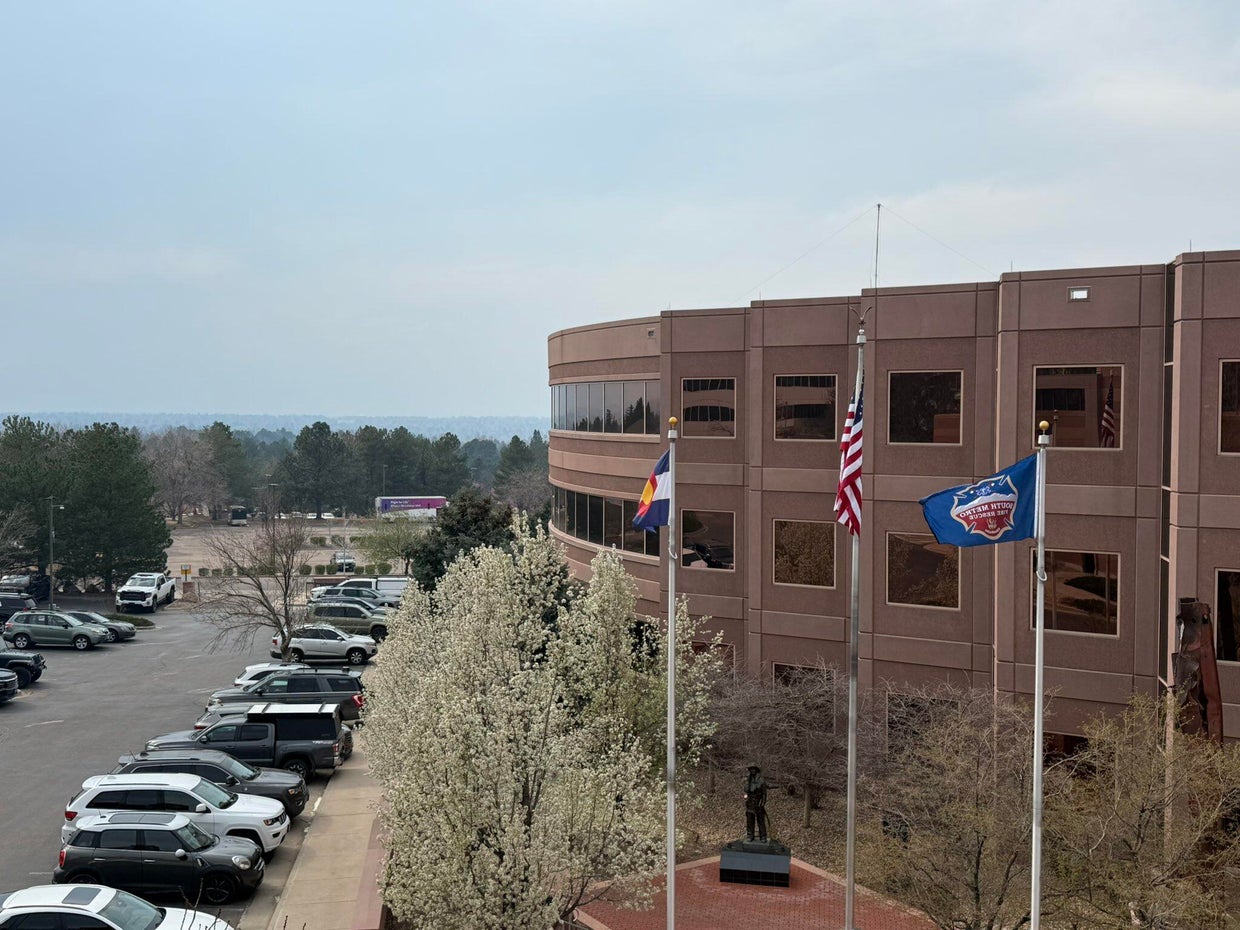
South Metro Fire Rescue said in their post that the smoke is from Colorado’s neighbor to the east. They called it a “significant haze” in the air.
Earlier this month, the Morrill Fire and the Cottonwood Fire burned a significant amount of Nebraska grassland and ranchland. They have mostly been contained by firefighters. Nebraska Gov. Jim Pillen said those two fires combined with several others have burned approximately 800,000 acres of land. On Thursday, Pillen announced that he is signing several executive actions intended to ease the burden caused by the fires.
There were no wildfires burning in the Denver metro area on Thursday afternoon.

ARAPAHOE COUNTY, Colo. (KKTV) – A homicide suspect based out of Colorado, wanted in a fentanyl-related death, is back in the state after being captured in Colombia.
The Arapahoe County Sheriff’s Office (ACSO) said 33-year-old Max Arsenault had been on the run since January 17.
Deputies said this stemmed from an incident in May 2023, where deputies responded to a call for a man named Nicholas Dorotik, who was found unresponsive.
ACSO said the cause of death was a mixed drug overdose involving meth and fentanyl, having about three times the lethal amount of fentanyl in his system.
One year later, Arsenault was arrested. He was scheduled for trial in January 2026 when deputies said he fled the country while on bond three days before the trial was set to start.
He was caught in Medellin, Colombia, on March 4, following a two-month international investigation. He has since been extradited back to Denver, where he is facing charges and awaiting trial.
Copyright 2026 KKTV. All rights reserved.

Retired Detroit sergeant faces new sexual assault charge involving 14-year-old victim from 2002

Trump floats sending federal agents to San Francisco to tackle crime

Dallas ISD will offer free pre-K starting next school year

Norwegian Cruise Line offers a first look at Luna, new cruise ship setting sail from PortMiami – WSVN 7News | Miami News, Weather, Sports | Fort Lauderdale

Boston ‘No Kings’ rally expected to draw 100,000; others planned across Mass.

Florida High School Football Rankings: Top 25 teams – Oct. 21

How old is Bo Nix? What to know about Oregon quarterback ahead of 2024 NFL Draft

Cleary's 21 help Le Moyne down Central Connecticut State 69-64 in OT

99th annual Pony Swim held in Virginia

Indiana Members Credit Union announced as new anchor tenant at Bottleworks District

Video: Will ICE Change Under Its New Leader?

DHS shutdown breakthrough comes at cost for Republicans as funding fights nears end

Rubio joins crucial G7 talks as Iran war set to dominate second day

A surprise resignation could open the door for an independent to win a Montana Senate seat

Video: Savannah Guthrie Says She Believes Her Mother Was Taken for Ransom
-

 Detroit, MI1 week ago
Drummer Brian Pastoria, longtime Detroit music advocate, dies at 68
-

 Science1 week ago
How a Melting Glacier in Antarctica Could Affect Tens of Millions Around the Globe
-
 Science1 week ago
I had to man up and get a mammogram
-

 Movie Reviews1 week ago
‘Youth’ Twitter review: Ken Karunaas impresses audiences; Suraj Venjaramoodu adds charm; music wins praise | – The Times of India
-

 Sports6 days ago
IOC addresses execution of 19-year-old Iranian wrestler Saleh Mohammadi
-

 New Mexico5 days ago
Clovis shooting leaves one dead, four injured
-
 Business1 week ago
Disney’s new CEO says his focus is on storytelling and creativity
-

 Technology5 days ago
YouTube job scam text: How to spot it fast