Colorado
As Sundance said goodbye to Utah, its Colorado connections became clear


PARK CITY, UTAH — The evening before the Sundance Film Festival kicked off its final appearance in Utah, Amy Redford stood on a temporary stage in a temporary gathering space and addressed a roomful of people.
“My dad loved this place and its people,” she said of her father, Robert Redford, and the state where, for more than 40 years, the Sundance Institute — with its series of labs for emerging filmmakers — and the festival have shaped the film industry, and to some extent American culture.
Boulder City Council approves $17.3 million incentives package for Sundance
Robert Redford died last September at 89, and his absence, as well as his vision, permeated this installment of the first festival without the Sundance Kid turned Elder Statesman. It’s hard to decide if it was fitting or a poetic injustice that Redford will not be following the festival to Colorado, a state he knew well, where Sundance will move in January 2027.
Colorado, though, is a state he knew well. Redford had, at one time, wanted to start his film festival in Colorado before heading to Utah. “Even though Bob Redford enjoyed a successful acting and directing career, he was never just content to rest on those laurels. He believed that with space to create and experiment, independent artists were poised to have a tremendous impact,” Ebs Burnough, chair of the board of trustees, told a roomful of film writers and journalists.
“And of course, he was right. To this day, artists who get their start at the Sundance Institute and at the film festival go on to shape storytelling, independent cinema, and our collective culture. And that has never mattered more than it does in this moment, when we need the empathy and inspiration and new perspectives independent storytelling provides,” he added.
Place is a funny thing. The wilderness of Utah, coupled with the intimacy of the ski town, served and shaped the festival well for decades — and vice versa. Now it moves to a new location at the foot of the Flatirons and adjacent to the Rockies. Boulder is beautiful, but as a city, it has a wholly different aura. And it has a university and a tech corridor.
Fortunately, Sundance hired the Boulder-based producer Paula DuPré Pesmen (“The Cove,” “Chasing Ice,” “Porcelain War”) to help envision the transition.
In the meantime, here are four things (there’s plenty more) to know about the globally renowned festival that concludes Sunday and the one headed to Colorado in January 2027.
Colorado represented
Colorado was represented a couple of times this year. “See You When I See You,” a Jay Duplass-directed film, premiered at Sundance. It is based on beloved Denver stand-up Adam Cayton-Holland’s 2018 book, “Tragedy Plus Time: A Tragi-Comic Memoir,“ about grief and his sister’s suicide. It stars David Duchovny, Hope Davis and Cooper Raiff and Kaitlyn Dever as siblings.
Then there was writer-director Ramzi Bashour, who in 2023 was among the cohort of young filmmakers working on their first feature during the Sundance Directors Lab, held at the Stanley Hotel in Estes Park. His debut feature, “Hot Water” — about a Lebanese mother and her son’s westward road trip — premiered in the U.S. Dramatic competition.
And the band DeVotchKa — with its roots in Colorado — returned to the place that launched them, as the festival celebrated the 20th anniversary of “Little Miss Sunshine.” “Yeah, everybody always says, ‘Man, I can’t believe it’s 20 years that flew by,’” frontman Nick Urata shared on a voice email. “But in this case, I have to say it doesn’t feel like that because that screening at Sundance 20 years ago was literally the first day of the rest of our lives. It was definitely the birth of our career as a band.”
They’d been touring and 21 years ago had self-released the album “How It Ends.” “Luckily, we got some airtime on listener-funded NPR stations, one of them being KCRW in L.A. And one morning they were playing us our song called “You’d Love Me,” he continued. “And Jonathan [Dayton] and Valerie [Faris], the directors, happened to hear it, and it sparked something. They got in touch with us about possibly using our music and doing some of the score for us. That is the coolest part of this whole story. The fact that those songs were released to little fanfare independently, and then it was repackaged along with this beautiful film, and the same exact songs were on the soundtrack album, and it got a Grammy nomination.”
Making young filmmakers household names
The Sundance labs are “a sneak peek at the artists you might see here … in the future,” Redford said in her speech. The next morning proved her prescient. When the Oscar nominations were announced, Sundance was well represented. Writer-director Ryan Coogler’s “Sinners” made history with 16 nominations. Nipping at its heels was Paul Thomas Anderson’s “One Battle After Another,” with 13. Chloe Zhao’s “Hamnet” garnered eight.
All three directors developed their first features in the Directors Lab: Coogler with “Fruitvale Station,” which starred his actor muse Michael B. Jordan; Anderson with the film that became “Hard Eight,” Zhao with “Songs My Brothers Taught Me,” set on the Pine Ridge Indian Reservation. And then there’s last year’s mournfully gorgeous meditation on a changing west, “Train Dreams,” which had four nominations, including Best Picture. The Oscar-nominated “Come See Me In the Good Light,” the tear-jerking, laugh-evoking documentary about the late Colorado Poet Laureate, Andrea Gibson, and her wife, the poet Megan Falley, as they faced Gibson’s cancer diagnosis, also won a nomination.
Colorado’s documentary filmmakers rule
Another world premiere was Daniel Roher and Charlie Tyrell’s “The AI Doc: Or How I Became an Apocaloptimist.” As engaging as it is terrifying, the doc about the reasonable existential dread AI has engendered in some, including director Roher, was produced by Colorado-based filmmaker Shane Boris and multi-hyphenate Ted Tremper (“Borat Subsequent Moviefilm,” “The Daily Show.”)
“We did the film with the intention of making a work that would be engaging, that could bring people into this issue,” said Boris. “But, also with like clarifying very complicated topics in a very short amount of time and in a way that gave people a sense of agency in a moment where it feels like everything is just happening to us as opposed to us.”

In his young career, Boris has an Oscar for “Navalny” and two nominations for “Fire of Love” and “The Edge of Democracy.” The movie, which demanded a deft editor, had two: Daysha Broadway and Denver’s own Davis Coombe, a Primetime Emmy winner for Jeff Orlowski’s social-media indictment, “The Social Dilemma.”
In one fell swoop, Colorado became a global film hub
While Sundance will be Colorado’s — heck, the country’s — biggest film fest in 2027, it arrives in a place that already has a rich film festival tradition. Shoutout to XicanIndie Film, Fest Durango Film Festival, Mountain Film, the Dragon Boat Film Festival, Rocky Mountain Women’s Film, the Boulder International Film Festival, the Denver Film Festival, and more. In fact, the Denver Film Festival had one of its best-attended iterations last November and will soon celebrate its 50th anniversary.
Sundance also arrives in Colorado at a time when the state is undergoing changes. Earlier this month, Gov. Jared Polis and the Colorado Office of Economic Development and International Trade announced the state’s new film commissioner: Lauren
Grimshaw Sloan, whose time at SeriesFest means she knows the ins and outs of festivals. The one-two punch of Sundance and the Telluride Film Festival (over Labor Day weekend) have seemingly made Colorado a global film destination.
At the end of her festival-eve comments, Redford encouraged the gathered. “Let’s make it a great festival celebration, remembrance and hope for all that is possible,” she said.
Subscribe to our weekly newsletter, In The Know, to get entertainment news sent straight to your inbox.



As a result of a snow drought and a heat wave that have both set records, some Colorado residents face the earliest restrictions on their water use ever imposed.
Denver Water announced Wednesday that it is seeking a 20% cut in water use, asking people to turn off automatic watering systems until mid-May and restricting the watering of trees and shrubs to twice a week.
“The situation is quite serious,” said Todd Hartman, a spokesperson for the utility. “We’re in such a dire situation that we could be coming back to the public in two or three months and saying you’re limited to one day a week.”
It is the earliest in the year that Denver Water has ever issued a restriction, Hartman said.
Colorado’s snowpack peaked at extremely low levels on March 12 — nearly a month earlier than usual — then cratered during the recent heat wave that cooked nearly every state in the West.
“We already had the lowest snowpack we’ve seen since at least 1981, and now, with the heat wave conditions, we’ve already lost about 40% of the statewide snowpack” since the March 12 peak, said Peter Goble, Colorado’s assistant state climatologist. “Conditions are looking more like late April or early May.”
The water restrictions are a harbinger of what’s to come in many Western states as officials try to manage widespread drought concerns. Nearly every snow basin in the Mountain West had one of its warmest winters on record and is well behind normal when it comes to water supply, according to the U.S. drought monitor. The dwindling snowpack is likely to raise the risk of severe wildfires, hamper electricity generation at hydropower dams and force water restrictions for farmers.
Hartman said nearly every community east of the Rockies, along Colorado’s front range, is in much the same boat as Denver.
City Council members in Aurora are considering similar water restrictions; reservoirs there stand at about 58%, according to the city’s website. In the town of Erie, officials declared a water shortage emergency on March 20 after they observed a massive spike in consumption.
Gabi Rae, a spokesperson for the town, said Erie was perilously close to having taps run dry because so many residents had started watering their lawns early amid the unseasonable heat.
“We were a day away from running out of water. That’s why it was such an emergency,” she said.
Erie officials demanded that residents stop using irrigation systems altogether.
Goble said this month’s heat wave has set records in every corner of Colorado, sometimes by double digits.
“I can’t remember seeing a single heat wave that broke this many records, and seeing it across such a large portion of the country is certainly eye-popping,” he said, adding: “I’m located in Fort Collins, and we got up to 91 last Saturday. The previous record for March was 81, so we smashed that record. And it wasn’t just one day, either.”
Denver Water, which serves about 1.5 million residents in the city and its surrounding suburbs, gets about half of its water from the Upper Colorado River Basin and the South Platte River Basin. The latter’s snowpack was at about 42% of normal Tuesday, the utility reported. The Upper Colorado River Watershed was at 55%.
Systemwide, Denver Water’s reservoirs are about 80% full, which is only about 5 percentage points lower than in a typical year.
“That sounds pretty good,” Hartman said. “Except that what we’re not going to be able to rely on is that rush of water that will bring those reservoirs back up, because the snowpack is so low.”
In other words, the snowpack — a natural water reservoir — is mostly tapped already and won’t replenish reservoirs later this spring and into summer, when runoff usually peaks.
In Erie, city workers plan to aggressively police water use until sometime next week using smart meters that monitor residential usage. Rae said the city is also sending utility workers to patrol neighborhoods and look for sprinklers that are turned on.
“People have been kind of annoyed with how aggressive we were, and I don’t necessarily think they understand the ramifications if we weren’t,” Rae said. “It is an actual serious emergency situation. We were so close to reaching empty, there would literally be no water coming out of the taps — hospitals, schools, fire hydrants, your home would have no water.”
Although the limits on outdoor watering will be lifted soon, Rae expects more restrictions later this spring and summer.
Colorado
Suddenly hazy skies in Denver prompt some residents concerned about wildfire smoke to call 911

Some people who live in the Denver metro area on Thursday afternoon were making calls to 911 after skies became noticeably hazy and winds kicked up. It was due to smoke from wildfires in Nebraska moving into Colorado. A cold front also was moving through the Front Range, and there is dust in the air.
The poor air conditions led to reduced visibility downtown after 3 p.m. Several of CBS Colorado’s City Cams showed dust or smoke in the air.
Temperatures were expected to drop by as much as 20 to 30 degrees with the cold front.
The suddenly dusty skies prompted at least one fire agency to put out a plea to residents to please only call 911 “if you see flames.” That warning was put out by South Metro Fire Rescue, which shared a photo on X of an office building with haze visible outside.
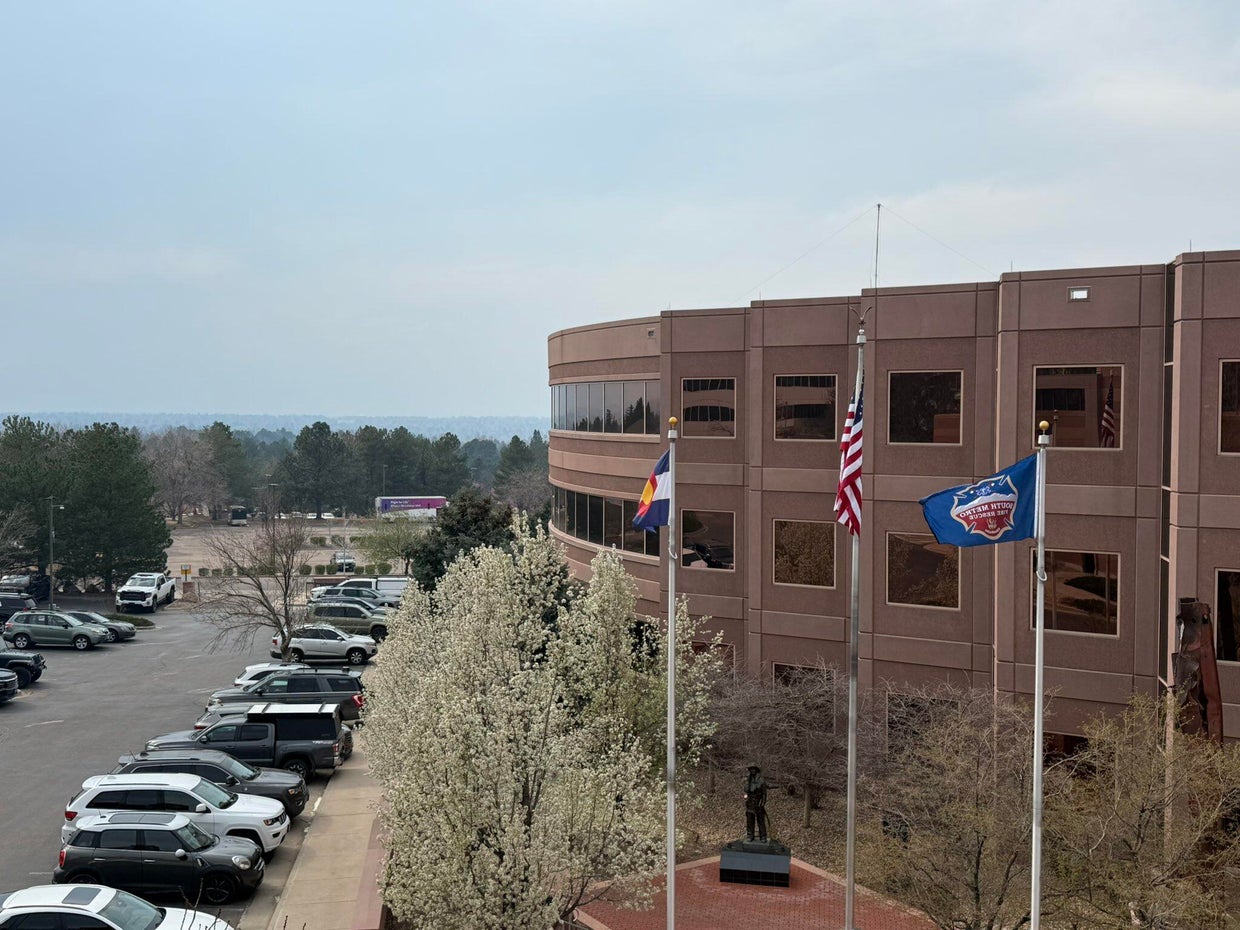
South Metro Fire Rescue said in their post that the smoke is from Colorado’s neighbor to the east. They called it a “significant haze” in the air.
Earlier this month, the Morrill Fire and the Cottonwood Fire burned a significant amount of Nebraska grassland and ranchland. They have mostly been contained by firefighters. Nebraska Gov. Jim Pillen said those two fires combined with several others have burned approximately 800,000 acres of land. On Thursday, Pillen announced that he is signing several executive actions intended to ease the burden caused by the fires.
There were no wildfires burning in the Denver metro area on Thursday afternoon.

ARAPAHOE COUNTY, Colo. (KKTV) – A homicide suspect based out of Colorado, wanted in a fentanyl-related death, is back in the state after being captured in Colombia.
The Arapahoe County Sheriff’s Office (ACSO) said 33-year-old Max Arsenault had been on the run since January 17.
Deputies said this stemmed from an incident in May 2023, where deputies responded to a call for a man named Nicholas Dorotik, who was found unresponsive.
ACSO said the cause of death was a mixed drug overdose involving meth and fentanyl, having about three times the lethal amount of fentanyl in his system.
One year later, Arsenault was arrested. He was scheduled for trial in January 2026 when deputies said he fled the country while on bond three days before the trial was set to start.
He was caught in Medellin, Colombia, on March 4, following a two-month international investigation. He has since been extradited back to Denver, where he is facing charges and awaiting trial.
Copyright 2026 KKTV. All rights reserved.

50 years of DC Metro: A look back in photos

WKYC Channel 3

Austin’s Star Is Still Shining Bright: Venture Funding To City’s Startups Hits All-Time High

How To Watch: Michigan vs Alabama in NCAA Tournament Sweet 16

This Day in Alaska History-March 27th, 1964

Florida High School Football Rankings: Top 25 teams – Oct. 21

How old is Bo Nix? What to know about Oregon quarterback ahead of 2024 NFL Draft

Cleary's 21 help Le Moyne down Central Connecticut State 69-64 in OT

99th annual Pony Swim held in Virginia

Indiana Members Credit Union announced as new anchor tenant at Bottleworks District

Video: Will ICE Change Under Its New Leader?

DHS shutdown breakthrough comes at cost for Republicans as funding fights nears end

Rubio joins crucial G7 talks as Iran war set to dominate second day

A surprise resignation could open the door for an independent to win a Montana Senate seat

Video: Savannah Guthrie Says She Believes Her Mother Was Taken for Ransom
-

 Detroit, MI1 week ago
Drummer Brian Pastoria, longtime Detroit music advocate, dies at 68
-

 Science1 week ago
How a Melting Glacier in Antarctica Could Affect Tens of Millions Around the Globe
-
 Science1 week ago
I had to man up and get a mammogram
-

 Movie Reviews1 week ago
‘Youth’ Twitter review: Ken Karunaas impresses audiences; Suraj Venjaramoodu adds charm; music wins praise | – The Times of India
-

 Sports6 days ago
IOC addresses execution of 19-year-old Iranian wrestler Saleh Mohammadi
-

 New Mexico5 days ago
Clovis shooting leaves one dead, four injured
-
 Business1 week ago
Disney’s new CEO says his focus is on storytelling and creativity
-

 Texas1 week ago
How to buy Houston vs. Texas A&M 2026 March Madness tickets