California
Oil prices are skyrocketing, but this is why companies won’t rush to drill in California

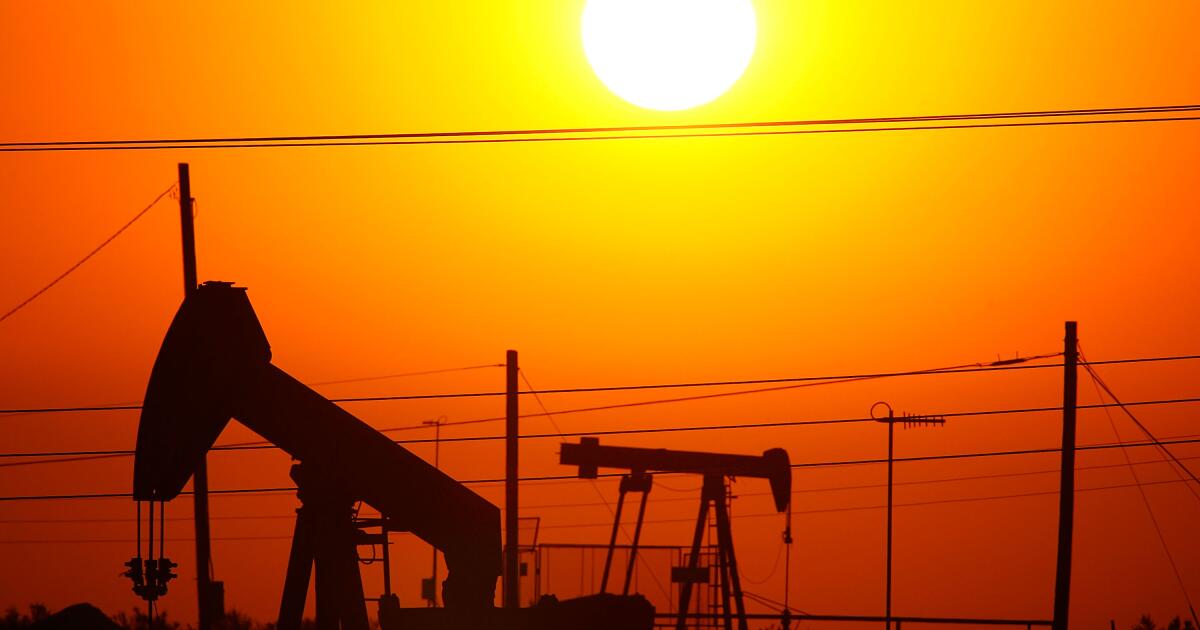
If you are an oil producer with wells in California and global oil prices have risen to over $100 a barrel in the last week, are you going to drill new wells?
It’s a question that touches the lives of hundreds of thousands of Californians who either live near oil wells or receive royalty checks as mineral rights owners.
Experts said probably not, given this state’s aging fields and the unpredictability of global prices.
It’s too early for data that will show if companies have ordered more drilling rigs on their fields — known as the rig count — since the U.S. and Israel invaded Iran and sent oil prices soaring. But analysts and producers say only if prices stay above $80 for at least a year do they expect an increase in drilling.
“Nobody expects today’s high prices to last and we could very likely get back to the low $60 [per barrel] environment we faced just a few weeks ago,” said Rock Zierman, chief executive of the California Independent Petroleum Assn. trade group.
Experts say the unique geology of California’s fields, and the nature of its heavy crude, make new projects, and efforts to pump more oil out of existing ones, costlier and more energy-intensive than drilling in other parts of the country.
In the Permian basin of New Mexico and west Texas, for example, producers can more quickly and economically ramp up extraction of light crude oil trapped in shale rock.
But even there, “operators are wary of adjusting plans to spend more drilling capital if prices come back down after the conflict ends, which is currently suggested by the oil price curve,” said Matthew Bernstein, vice president of North America oil and gas at the consulting firm Rystad Energy.
“Instead, companies will enjoy the added cash flow buffer of higher prices and boost cash on their balance sheets and pay out shareholders,” he said.
California oil production has been on the decline since the 1980s, largely because existing oil fields are becoming depleted and there are more economical places to produce.
At a certain point, that can begin to hurt the whole local business ecosystem of oil wells, pipelines and the refineries that turn crude oil into gasoline, jet fuel and diesel.
Last April, Valero announced its intentions to take its Benicia refinery offline next month, citing a difficult regulatory environment. Phillips 66 in Wilmington shuttered in December, blaming market dynamics.
That same month, the San Pablo pipeline, the sole line connecting Central Valley oil fields to refineries in the San Francisco Bay Area, also shut down, citing low oil volumes and a loss of refinery customers. Drillers started sending their product north in trucks.
In September, in an effort to boost pipeline throughput, Gov. Gavin Newsom signed a bill to streamline permitting for up to 2,000 new oil wells in Kern County, where new permits had been held up in litigation since 2020.
Since that took effect this year, the California Geologic Energy Management Division has permitted 139 new wells in Kern County, more than the 121 wells permitted from 2023 to 2025 across the state.
That signals “an appetite to drill,” said Matt Woodson, an analyst at Wood Mackenzie. But oil companies, which lobbied for the change, are still blaming refinery and pipeline closures, as well as the lower prices fetched by California crude compared with imports, for limiting projects.
“A temporary bump in price is not enough incentive to overcome the uncertainty of whether or not we can get our oil to market,” Zierman said.
Chevron, which operates two California refineries in addition to some of the state’s largest oil fields, said the permits were a welcome change but that proposed updates to the state’s cap-and-trade program that would make refiners pay more to pollute “threaten to reverse any kind of benefit that the industry has received.”
California Air Resources Board officials say the updates were designed to keep fuel supplies reliable and affordable “throughout the transition to carbon neutrality.”
Analysts expect a slowed but ongoing decline of oil, in line with the intentions of the state.
“I think you can start to stabilize that a little bit to where production declines slow,” said Robert Auers, an analyst with RBN, of the new permits. “But I would be shocked to see actual production growth. It’s more just ‘what’s your decline rate?’”
It’s dicey to balance. Last year, the California Energy Commission identified declining crude production as a problem for local refineries, which produce 90% of the gasoline used in the state.
In a letter to Newsom in June, commission Vice Chair Siva Gunda said the main factors driving refinery closures were falling demand for gasoline, increasing competition from global consolidation, aging infrastructure requiring significant maintenance, and a high cost of operating.
But he also warned that low in-state oil volumes could contribute to refinery instability because even though California refineries import about 75% of their oil, some of them are engineered for the specific qualities of California crude.
Refinery instability is a problem, Gunda wrote, because additional closures could “outpace demand decline for petroleum based-fuels,” leading to future price spikes.
In other words, California is trying to transition away from oil-based fuels, but the gasoline can’t disappear faster than people are giving it up.
Several experts have said that instead of trying to drill, the state should move to reduce its reliance on the California’s teetering refineries that have what UC Santa Barbara professor Paasha Mahdavi called a “cartel-like” market hold over the state.
That looks like boosting public transit and electric vehicles, but, in the shorter term, it could also mean improving California’s capacity to import more finished gasoline from abroad and other states, where prices are typically lower. Already officials are looking into a project from Phillips 66 and pipeline giant Kinder Morgan that could deliver gasoline, diesel and jet fuel from as far as Missouri by 2029.
“Let’s just be like the rest of America,” said Mahdavi, who directs UCSB’s Energy Governance and Political Economy lab. “Let’s quit this energy island that we’ve created for ourselves, because we’re not connected.”
Whether energy companies drill more in the U.S. or not, he added, it’s not going bring down the high price of gasoline, which is driven by crude oil prices set on the international market. To shift the needle there, you would have to meaningfully add to supply to replace the 20 million barrels per day being cut off by Iran, and any new production isn’t going to do that.

California
CDFW News | California Fish and Game Commission Takes Emergency Action to Prevent White Shark Take and Reduce Potential Interactions Between Hooked Sharks and Swimmers

Prosecutors Honored for Their Work to Protect Wildlife; Southern Resident Killer Whale Named CESA Candidate
Anticipating a larger presence of white sharks in Southern California as a result of warmer El Niño ocean conditions, the California Fish and Game Commission (Commission) adopted emergency regulations at its June 17-18, 2026 meeting to further protect the large ocean predator and reduce the potential for dangerous interactions with ocean users. These regulations will prohibit the use of certain fishing gear from beaches and nearshore that are used to hook large sharks and could create hazards for nearby beachgoers.
Forecasted warmer waters shift the preferred range for juvenile white sharks northward from Mexico and lead them to stay in California nearshore areas later in the year. The emergency regulations protect not only white sharks but also people recreating in the ocean, decreasing the risk of dangerous human encounters with sharks that are hooked with wire leaders from piers and beaches.
Specific gear types used to target large sharks, including hooks greater than 1.5 inches in maximum inside measurement and wire or metallic lines and leaders, will be prohibited when recreational fishing from shore or within 1,000 yards of shore from Pigeon Point (San Mateo County) south to the U.S.-Mexico border. Shore fishing includes beaches, banks, piers, jetties, breakwaters, docks and other man-made structures connected to the shore. Unless extended, the emergency regulations will expire 180 days after being filed with the secretary of state. The Commission may pursue up to two 90-day extensions of the emergency action and, ultimately, may propose continuing the restrictions through a regular rulemaking if the regulations prove to be effective.
Prosecutor of the Year
Commissioners recognized two deputy district attorneys who have demonstrated their dedication to protecting California’s natural resources and have effectively collaborated with the California Department of Fish and Wildlife (CDFW) to prosecute wildlife crimes. San Luis Obispo County Deputy District Attorney Ken Jorgensen and San Diego County Deputy District Attorney Michael McCann were presented with the Prosecutor of the Year Award for 2025.
Jorgenson’s work resulted in a landmark $165,000 settlement and injunctions in a case involving rare plant habitat destruction, and in another case a $12,500 fine and five years of probation for often under-prosecuted commercial fishing violations.
McCann assisted in the prosecution and investigation surrounding a global wildlife trafficking ring connected to illegal drug and firearm trade. The investigation disrupted a sophisticated trafficking network and resulted in multiple felony and misdemeanor charges, with more anticipated.
Southern Resident Killer Whale
The Commission named the southern resident killer whale (orca) a candidate species for listing under the California Endangered Species Act (CESA). This population of orcas inhabits ocean waters from British Columbia to California and is estimated to now number as few as 75.
Orcas face threats such as limited availability of prey; Chinook salmon are a primary food source and have experienced population decline across the entire West Coast range of orcas. The species’ abundance has also been impacted by past practices of capture for live display.
CDFW will have one year to complete a review on the status of orcas, of the best available science, before the Commission can make a final decision on CESA listing. Orca is currently listed as endangered under the federal Endangered Species Act and is considered depleted under the federal Marine Mammal Protection Act.
Western Spadefoot
Continued from the Commission’s April meeting, a decision to consider CESA candidacy for western spadefoot frog was postponed to the August meeting to give environmental advocates and the solar industry additional time to collaborate on proposing exceptions to CESA protections that would be allowed under Fish and Game Code Section 2084.
Meeting Participation and Next Meeting
Commission President Eric Sklar, Vice President Darius Anderson and Commissioners Samantha Murray and Erica Zavaleta were in attendance for both days of the June Commission meeting. Commissioner Jacque Hostler-Carmesin was in attendance for the first day. The meeting was held in Sacramento.
The complete agenda for the meeting, along with supporting information, is available on the Commission website. Archived video of past Commission meetings is available online. The next regularly scheduled meeting of the Commission is scheduled for Aug. 12-13, 2026, at the California Natural Resources Agency building in Sacramento. Participants are encouraged to attend in person, with options available for Zoom or phone; for more information visit the Commission website.
The Commission authorized public notice of upcoming potential regulation changes related to:
Harpoons and Flying Gaffs Allowance: A discussion hearing is scheduled for Aug. 12-13 and an adoption hearing Oct. 14-15 on amendments to regulations related to allowing use of harpoons and flying gaffs in the recreational tuna fishery.
###
Media Contacts:
Krysten Kellum, CDFW Communications, (916) 825-7120
Alicia de la Garza, CDFW Communications, (916) 754-7237
California
Bug infestation found at California Department of Education headquarters, employees sent home

Bugs have once again been found inside the California Department of Education headquarters in downtown Sacramento, prompting employees to leave the building and raising concerns among workers about returning to the office.
Employees were instructed to go home after bugs were detected in the building, according to state workers and union representatives.
They say it’s not the first time. Union representatives and employees confirmed to CBS News Sacramento that this is the second bug-related incident at the headquarters in the past two years.
“If they’re in one place, it’s very easy for them to be throughout the entire building,” said Anica Walls, president of SEIU Local 100.
The discovery has renewed concerns about workplace safety, particularly as state employees prepare for expanded return-to-office requirements.
“Let’s do what’s necessary and make sure that our employees stay safe and that when they are in the building, they’re not contracting or taking home anything that they don’t need to be,” Walls said.
The California Department of Education confirmed the building experienced a bed bug incident in 2024. However, officials said they are still awaiting pest control reports to determine whether the insects recently discovered are bed bugs or another species.
State workers say they want a permanent solution rather than temporary fixes.
“It’s smart to fix the problem the correct way rather than trying to just mitigate the issue and shut down certain floors,” Walls said.
While most state agencies are scheduled to move to a four-day-a-week, in-office schedule beginning next week, California Department of Education employees will continue their current hybrid schedule of two in-office days per week through the end of the year.
In a statement, the department said it is working with the Department of General Services and pest control specialists to inspect the entire building.
“As stated in the message to our employees, we are actively coordinating follow-up inspections and remediation efforts and will provide updates as soon as additional information becomes available,” the department said.
Union representatives said the department was responsive during the previous infestation and expressed hope for a quicker resolution this time.
“Last time, they were really receptive to the conversations with employees, which was good. We’re hoping for another good outcome, hopefully just a little more expedient this time,” Walls said.
CBS News Sacramento also spoke with a local pest control company, which said that if the insects are confirmed to be bed bugs, treatment could take several months.
The process typically involves repeated inspections and treatments every one to two weeks, including high-heat treatments reaching approximately 160 degrees and extensive cleaning to prevent the infestation from returning.
California
First look: Space Shuttle Endeavour in ready-to-launch position at California Science Center


LOS ANGELES – This fall, space fans will get to see the Space Shuttle Endeavour like never before in its new permanent home at the California Science Center in the Exposition Park area.
What we know:
The new Samuel Oschin Air and Space Center at the California Science Center officially opens on November 13.
Also, an introductory film includes footage from Endeavour’s final launch before being retired in 2011.
“We felt from the beginning this is the most impressive way to see the space shuttle and it gives people views that almost no one ever got a chance to see,” said Jeff Rudolph, President & CEO of the California Science Center.
What they’re saying:
Since 2012, Los Angeles has been home to the Space Shuttle Endeavour. It has been on display horizontally at the California Science Center.
But the vision was always to have it on display upright.
“It’s really exciting and everyone who sees it is in awe and that’s really what we were trying to do was create that real sense of emotional high and inspire people to learn more,” said Rudolph.
This is the only display of its kind and it can’t be duplicated. The orange tank attached to the shuttle is the last mission-ready one in existence.
“I think what we’ve done is present something that is going to be a truly life-changing and transformative experience for education,” said Kenneth Phillips, Curator for Aerospace Sciences at the California Science Center.
Visitors will also be able to see inside the space craft that carried astronauts to space 25 times, including Mae Jemison, the first Black woman to go to space and now-Arizona Senator Mark Kelly.
When the exhibit opens to the public in November, visitors will be able to ride up an elevator alongside the space shuttle and view it from the top.
“That’s the view that nobody but the crew saw. That was a very special vantage point. Nobody got to do that,” said Phillips.
What’s next:
The California Science Center expects the exhibit to be popular. Tickets will go on sale well before the opening.
-

 World8 minutes ago
Who will control Africa’s AI infrastructure and at what cost
-
 News35 minutes ago
The Supreme Court says the U.S. can turn away asylum seekers at the border
-

 Los Angeles, Ca2 hours ago
Jury says it is deadlocked in trial of man accused in Palisades Fire
-

 Detroit, MI2 hours ago
Scene active as police shoot, kill man on Detroit’s west side
-

 San Francisco, CA2 hours ago
Civil grand jury report warns of wildfire risk at SF’s Glen Canyon Park
-

 Dallas, TX2 hours ago
Ivory Coast advances at World Cup, how to buy Ivory Coast tickets
-

 Miami, FL3 hours ago
Men used fake credentials to enter Brazil vs. Scotland match at Miami Stadium, deputies say
-

 Boston, MA3 hours ago
3 arrested after trying to break into downtown building, Boston police say – The Boston Globe

