California
Feds face skeptical judge in lawsuit to overturn California’s ban on masked ICE agents

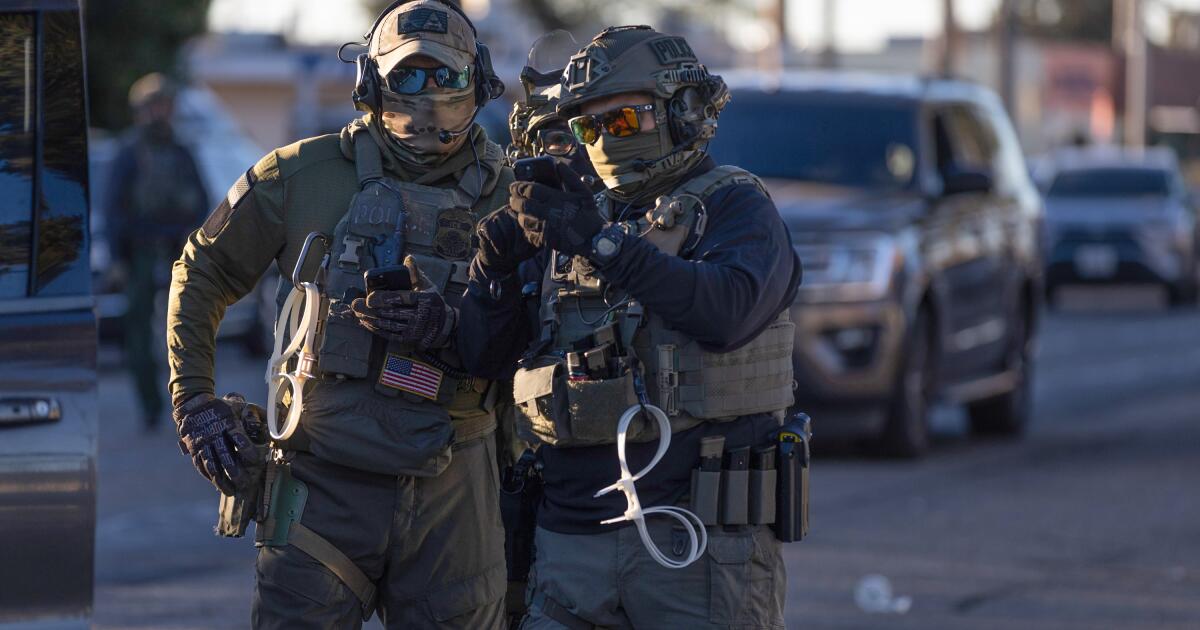
A top Trump administration lawyer pressed a federal judge Wednesday to block a newly enacted California law that bans most law enforcement officers in the state from wearing masks, including U.S. Immigration and Customs Enforcement agents.
Tiberius Davis, representing the U.S. Department of Justice, argued at a hearing in Los Angeles that the first-of-its-kind ban on police face coverings could unleash chaos across the country, and potentially land many ICE agents on the wrong side of the law it were allowed to take effect.
“Why couldn’t California say every immigration officer needs to wear pink, so it’s super obvious who they are?” Davis told U.S. District Judge Christina A. Snyder. “The idea that all 50 states can regulate the conduct and uniforms of officers … flips the Constitution on its head.”
The judge appeared skeptical.
“Why can’t they perform their duties without a mask? They did that until 2025, did they not?” Snyder said. “How in the world do those who don’t mask manage to operate?”
The administration first sued to block the new rules in November, after Gov. Gavin Newsom signed the No Secret Police Act and its companion provision, the No Vigilantes Act, into law. Together, The laws bar law enforcement officers from wearing masks and compel them to display identification “while conducting law enforcement operations in the Golden State.” Both offenses would be misdemeanors.
Federal officials have vowed to defy the new rules, saying they are unconstitutional and put agents in danger. They have also decried an exception in the law for California state peace officers, arguing the carve out is discriminatory. The California Highway Patrol is among those exempted, while city and county agencies, including the Los Angeles Police Department, must comply.
“These were clearly and purposefully targeted at the federal government,” Davis told the court Wednesday. “Federal officers face prosecution if they do not comply with California law, but California officers do not.”
The hearing comes at a moment of acute public anger at the agency following the fatal shooting of American protester Renee Good by ICE agent Jonathan Ross in Minneapolis — rage that has latched on to masks as a symbol of perceived lawlessness and impunity.
“It’s obvious why these laws are in the public interest,” California Department of Justice lawyer Cameron Bell told the court Wednesday. “The state has had to bear the cost of the federal government’s actions. These are very real consequences.”
She pointed to declarations from U.S. citizens who believed they were being abducted by criminals when confronted by masked immigration agents, including incidents where local police were called to respond.
“I later learned that my mother and sister witnessed the incident and reported to the Los Angeles Police Department that I was kidnapped,” Angeleno Andrea Velez said in one such declaration. “Because of my mother’s call, LAPD showed up to the raid.”
The administration argues the anti-mask law would put ICE agents and other federal immigration enforcement officers at risk of doxing and chill the “zealous enforcement of the law.”
“The laws would recklessly endanger the lives of federal agents and their family members and compromise the operational effectiveness of federal law enforcement activities,” the government said in court filings.
A U.S. Border Patrol agent on duty Aug. 14 outside the Japanese American National Museum, where Gov. Gavin Newsom was holding a news conference in downtown Los Angeles.
(Carlin Stiehl / Los Angeles Times)
Davis also told the court that ICE‘s current tactics were necessary in part because of laws across California and in much of the U.S. that limit police cooperation with ICE and bar immigration enforcement in sensitive locations, such as schools and courts.
California contends its provisions are “modest” and aligned with past practice, and that the government’s evidence showing immigration enforcement would be harmed is thin.
Bell challenged Department of Homeland Security statistics purporting to show an 8,000% increase in death threats against ICE agents and a 1,000% increase in assaults, saying the government has recently changed what qualifies as a “threat” and that agency claims have faced “significant credibility issues” in federal court.
“Blowing a whistle to alert the community, that’s hardly something that increases threats,” Bell said.
On the identification rule, Snyder appeared to agree.
“One might argue that there’s serious harm to the government if agents’ anonymity is preserved,” she said.
The fate of the mask law may hinge on the peace officer exemption.
“Would your discrimination argument go away if the state changed legislation to apply to all officers?” Snyder asked.
“I believe so,” Davis said.
The ban was slated to come into force on Jan. 1, but is on hold while the case makes its way through the courts. If allowed to take effect, California would become the first state in the nation to block ICE agents and other federal law enforcement officers from concealing their identities while on duty.
A ruling is expected as soon as this week.


BAKERSFIELD, Calif. (KBAK/KBFX) — The California Highway Patrol is urging drivers to stay focused on the road as they head out for Fourth of July celebrations.
The holiday weekend can be a dangerous time on our roads as millions of drivers are expected to travel.
CHP Officer Jorge Toro joined Eyewitness News Mornings to share how drivers can stay safe behind the wheel.
Officer Toro also highlighted the importance of sober driving over the holiday.
BE THE FIRST TO COMMENT
He says anyone hosting a party should make sure all of their guests get home safely, ensuring anyone who may be impaired doesn’t drive.

California is returning a stretch of rugged Mendocino County coast to the Indigenous nations whose ancestors once stewarded its shores.
State transportation officials recently approved the transfer of Blues Beach and the surrounding bluffs to Kai Poma, a nonprofit founded by representatives of the Sherwood Valley Band of Pomo Indians, Round Valley Indian Tribes and Coyote Valley Band of Pomo Indians.
The transfer of 136 acres just south of the community of Westport will mark the first time land managed by the California Department of Transportation has been returned to Indigenous tribes.
“This is beyond huge,” said J. Carlos Rivera, tribal chairman of the Sherwood Valley Band of Pomo Indians. “It’s enormous from our tribal perspective that we are basically obtaining the land that our people once lived on before colonization.”
California purchased the swath of rocky cliffs and windswept shoreline in the 1960s to expand the construction of Highway 1 and create a scenic viewpoint for highway travelers, according to a California Coastal Commission report.
More recently, public access has been largely unregulated, and summer weekends and holidays have drawn large groups who camp and party on the beach, at times driving through sensitive areas, damaging cultural sites and leaving behind trash, the report states.
Kai Poma plans to conduct cultural and archaeological resource studies and environmental surveys and then prepare a resource management plan for the property, according to planning documents. The nonprofit and the Coastal Commission have drafted a public access management plan that states the land will be open from sunrise to sunset.
Rivera described the entire property as a sacred site. The coastal waters are used by tribal people for seaweed and abalone gathering, and the shores host youth cultural camps, he said. “Protecting the land, it has a deeper meaning for us because we’re connected to the land,” he said.
The effort to acquire the land took years — and required a change in state law. Caltrans lacked the ability to transfer land to tribal governments until 2021, when Gov. Gavin Newsom signed a bill sponsored by state Sen. Mike McGuire (D-Healdsburg) that enabled the transfer, according to a news release issued at the time. The law also bars commercial activity on the property and requires public access be maintained.
“With 136 acres now officially transferred into tribal stewardship, one of the most spectacular stretches of the Mendocino Coast will be forever protected,” McGuire said in a statement.
“This agreement, the first of its kind in California, gives these three dynamic Native American tribes the rightful opportunity to reclaim sacred lands and cultural traditions on this special piece of earth. And it’s about damn time.”
The land transfer cleared its last regulatory hurdle June 26 with the approval by the California Transportation Commission, said Neil Thapar, an attorney who works as an advisor and legal consultant to Kai Poma. Caltrans staff will next record the deed transferring the title from the state of California to Kai Poma, which is expected to happen any day, he said.


Fireworks Safety Guide
Essential safety tips for buying, handling, and watching fireworks to ensure a safe celebration.
With July 4 falling on a Saturday this year, many businesses and organizations are taking the day off Friday, July 3, to mark America’s 250th birthday. From banking to mail service, here’s what’s open and closed for the holiday weekend.
Most federal offices closed, mail service to continue
Non-essential federal offices will be closed on July 3. However, mail service will continue as normal, and post offices are scheduled to remain open.
Most California government offices to remain open
Most California government offices will be open on July 3, with some exceptions.
DMV offices throughout the state will be open. However, the Employment Development Department will be closed.
DMV offices that offer Saturday hours will be closed on July 4.
Private parcel services to remain open
UPS and FedEx are both scheduled to operate normally on July 3, but will suspend service on July 4.
Stock markets closed
Both the New York Stock Exchange and Nasdaq will be closed on July 3.
Most banks to stay open
While most banks were expected to operate normally on July 3, some may operate under modified holiday hours. All banks will be closed on July 4.
Online banking services should remain operational.
Grocery stores
Most major grocery chains will be open on both July 3 and July 4. Trader Joe’s locations will be open for regular business on July 3 but will close early at 5 p.m. on the Fourth of July.
Retailers
Many major retail stores, such as Walmart and Target, plan to operate under normal business hours on both July 3 and 4. All Costco warehouse stores operate under normal business hours on July 3, but will close on July 4.
Restaurants
Most major restaurant chains remain open on July 4, but some will have limited hours. All Raising Cane’s locations will close on July 4.
-

 San Francisco, CA10 minutes ago
Marina braces for Golden Gate Bridge fireworks show, massive crowds
-

 Dallas, TX13 minutes ago
Maradona’s ‘Hand of God’ ball heads to auction in Dallas
-

 Miami, FL18 minutes ago
Miami-Dade sheriff urges residents to celebrate Fourth of July safely
-

 Boston, MA25 minutes ago
Jaylen Brown says Celtics showed ‘lack of respect’ after trade to 76ers – The Boston Globe
-

 Denver, CO28 minutes ago
Who are the Top 5 offensive linemen in Denver Broncos history?
-

 Seattle, WA33 minutes ago
Seattle’s Lake Union to light up with big July 4 fireworks show for America’s 250th
-

 San Diego, CA40 minutes ago
New training program grants tribal members access to reservation land during emergencies
-
Milwaukee, WI43 minutes ago
Leaders of ‘United for Venezuela Emergency Relief Campaign’ grateful for support


