California
Column: California voters are fed up with crime and, apparently, inaction by Democrats

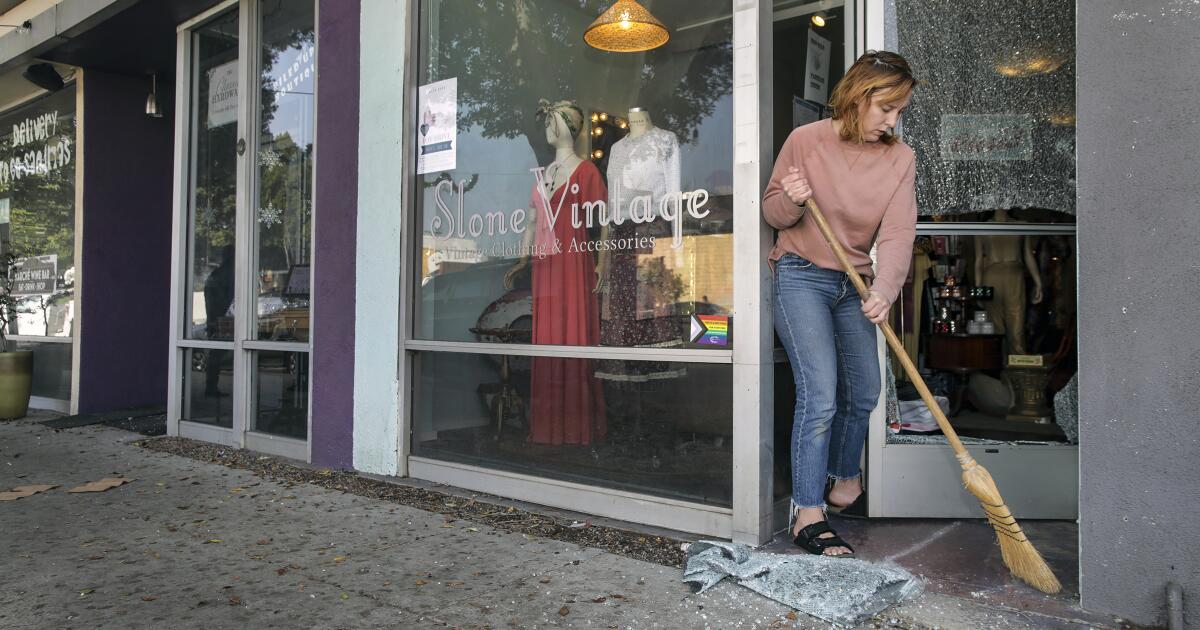
Gov. Gavin Newsom and Democratic legislative leaders vehemently oppose an anti-retail theft measure on the November ballot. But they’re being ignored by California voters who support the proposal overwhelmingly.
Maybe voters don’t know about the governor’s and lawmakers’ strong opposition. Or maybe they do and don’t care. They’re following their own instincts and thinking that California — again — is too easy on bad guys.
The pendulum apparently is swinging back from left to center on crime and incarceration. Three decades ago California was over on the right with the war on drugs and tough three-strikes sentencing for repeat felons. Then we gradually moved left by dramatically reducing punishment. Opinions continue to sway.
The support numbers are stunning for Proposition 36, sponsored by the California District Attorneys Assn. It would increase punishment for theft and hard drug offenses and impose required treatment for repetitive criminal addicts.
The initiative is ahead by an astonishing 45 percentage points, according to a new poll of likely voters by the nonpartisan Public Policy Institute of California: 71% to 26%, with only 3% undecided.
That’s unprecedented for a controversial ballot measure.
Well, controversial among politicians anyway. But seemingly not among voters.
“I was surprised by the level of support,” says Mark Baldassare, a pollster with the Public Policy Institute of California.
But he adds this caution: “Propositions aren’t like candidate races. The bottom can fall out of them. And the campaign for and against 36 really hasn’t started yet. It’s easy for people to say ‘no’ on a proposition rather than ‘yes.’ Especially if someone comes along and points out a fatal flaw.”
Sure. But don’t bet on it. Opponents have a very steep hill to climb to conquer Proposition 36.
It’s ahead among every demographic group, including Democrats by a landslide margin: 63% to 33%. Self-described liberals support it by 56% to 41%.
Baldassare notes that of the 10 state ballot measures, voters consider Proposition 36 the most important by far, his poll found.
Another independent survey last month by the UC Berkeley Institute of Governmental Studies also showed the measure holding a huge lead: 56% to 23%, with 21% undecided.
IGS pollster Mark DiCamillo cited the “great visibility” of retail theft — caught on camera or witnessed personally by voters — as a reason for heavy support of Proposition 36.
“It’s kind of outrageous to voters, what they’re seeing,” DiCamillo told Times reporter Mackenzie Mays. “And they’re linking it to the approval of Proposition 47.”
That proposition swung California to the left on crime punishment 10 years ago. Federal court pressure had mounted to reduce prison and jail overcrowding. The measure passed lopsidedly, reducing some felony crimes to low-punishment misdemeanors–including shoplifting when the stolen goods were worth less than $950.
Misdemeanor arrests are harder to make because a cop must witness a crime or possess a judge’s warrant. Anyway, judges began freeing petty thieves. So, cops stopped responding to shoplifting complaints. Merchants ceased bothering to report the crimes. And smash-and-grab thefts increased.
PPIC researchers recently reported on a yearlong study of Proposition 47’s impact.
“Under Prop 47, prison and jail populations plummeted as did arrests for drug and property crimes after certain offenses were reclassified from felonies to misdemeanors,” the report stated.
But it said the pandemic also contributed to fewer apprehensions. As people stayed home to prevent the spread of COVID, there were “fewer encounters with police, resulting in fewer arrests,” the researchers contended.
At any rate, public pressure increased on Sacramento Democrats to do something — and they didn’t for several years. They probably thought the growing anti-47 pushback would just fade. It didn’t.
Newsom was one of Proposition 47’s most vocal original advocates and has been a staunch defender.
“We don’t need to go back to the broken policies of the last century,” he insisted. “Mass incarceration has been proven ineffective and is not the answer.”
Newsom’s initial answer included trying to strongarm Proposition 36 off the ballot. It failed awkwardly, leaving legislative leaders perturbed at the governor.
Proposition 36 would roll back parts of Proposition 47. The governor backed a legislative package aimed at curtailing retail theft without significantly altering Proposition 47. But he concocted a nutty “poison pill” that would have automatically killed the Democrats’ own anti-crime legislation if Proposition 36 was approved by voters.
The aim was to coerce Proposition 36’s sponsors into tossing in the towel and accepting the Legislature’s offering. But Democrats rebelled at the governor’s bizarre scheme and refused to insert the deadly pill into their package.
The Legislature ultimately passed 13 bills that Newsom and Democratic lawmakers hope will satisfy voters’ demands that California do more to combat smash-and-grabs and shoplifting.
“The bills they passed do some good things, but by and large they’re half measures,” asserts Gregory Totten, chief executive of the California District Attorneys Assn. “Our law [36] says consequences of stealing have to be ratcheted up.”
The initiative also would impose tougher penalties for sales of deadly fentanyl and treat it similar to other hard drugs, such as heroin and cocaine. Some people possessing hard drugs could be sentenced merely to treatment.
Outside Sacramento, some major Democrats have heard the voters, read the polls and are supporting Proposition 36. They include Mayors London Breed of San Francisco, Todd Gloria of San Diego and Matt Mahan of San Jose.
But Sacramento Mayor Darrell Steinberg, a former state Senate leader who has spent his career trying to generate treatment for the drug-addicted homeless and mentally ill, opposes Proposition 36.
He contends that 36 offers a “false promise” of treatment. It’ll fall short because the emphasis will be on law enforcement, not treatment of addicts, Steinberg predicts.
But so far, Newsom and Sacramento Democrats haven’t been leading anyone away from Proposition 36. Voters are headed in the opposite direction.




California
Supreme Court blocks California law limiting schools from telling parents about trans students

BAKERSFIELD, Calif.(KBAK/KBFX) — The U.S. Supreme Court has temporarily blocked a California law that limited when schools could require staff to disclose a student’s gender identity, clearing the way for schools to tell parents if their children identify as transgender without getting the students’ approval.
Rear view of multiracial students with hands raised in classroom at high school
The decision came after religious parents and educators, represented by the Thomas More Society, challenged California school policies aimed at preventing staff from disclosing a student’s gender identity.
Erwin Chemerinsky, dean and professor of law at the University of California Berkeley School of Law, said the ruling favors parents’ ability to be informed. “The Supreme Court today rules in favor of the claim of parents to be able to know the gender identity and gender pronoun of the children,” Chemerinsky said.

FILE:{ }transgender flag against blue sky background { }(Photo: AdobeStock)
The decision temporarily blocks a state law that bans automatic parental notification requirements if students change their pronouns or gender expression at school. The Thomas More Society called the decision a major victory for parents, saying the court found California’s policy likely violates constitutional rights.
Chemerinsky said the Supreme Court’s action is an emergency ruling. “This law is now put on hold. So what this means is that schools can require that teachers and other staff inform parents of the gender identity or gender pronouns of children,” he said.
Kathie Moehlig, founder and executive director of Trans Family Support Services, said she is concerned about how the ruling could affect students who do not have supportive families.
“I am really concerned about our kids that do come from these non affirming homes, that they know that they’re going to get in trouble, that they’re going to possibly have violence brought against them possibly kicked out of their homes,” Moehlig said.
Moehlig said parents should eventually know, but that the conversation should happen when a student feels safe. “Our students are going to be less inclined to confide in any adults that might be able to help to get them access to mental healthcare, to a support system. They may still tell their peers but they’re certainly not going to tell any other adult,” she said.
Equality California, a LGBTQ+ civil rights organization, shared a statement:
Equality California, the nation’s largest statewide LGBTQ+ civil rights organization, released the following statement from Executive Director Tony Hoang in response to today’s U.S. Supreme Court shadow docket ruling in Mirabelli v. Bonta regarding California’s student privacy protections for transgender youth. Today’s decision by the U.S. Supreme Court to intervene in this case is deeply disturbing. By stepping in on an emergency basis, the Court has effectively upended California’s student privacy protections without hearing full arguments and before the judicial process has run its course. While not surprising, this move reflects a dangerous willingness to short-circuit the established judicial process to dismantle protections for transgender youth. While this case continues to be litigated, the ruling revives Judge Benitez’s prior decision, which broadly targets numerous California laws protecting transgender and gender-nonconforming students — threatening critical safeguards that prevent forced outing and allow educators to respect a student’s affirmed name and pronouns at school. These protections exist for one reason: to keep students safe and ensure schools remain places where young people can learn and thrive without fear. To be clear: today’s decision does not impact California’s SAFETY Act, which prohibits school districts from adopting policies that forcibly out transgender students. The SAFETY Act remains in full effect, and we will continue defending it. Transgender youth deserve dignity, safety, and the freedom to learn without fear. We will never stop fighting for transgender youth and their families. Equality California will continue working with parents, educators, and advocates to ensure schools remain safe, welcoming, and focused on the success and well-being of every student.
The case now returns to the U.S. Court of Appeals for the Ninth Circuit, which will decide whether the California law is constitutional.

Congressman Kevin Kiley has announced his plan to run in California’s newly redrawn 6th district.
In a statement on Monday, Rep. Kiley revealed he had considered running in the 5th District – which could have set up a possible showdown between two current Republican officeholders.
“It’s true that I was fully prepared to run in the new 5th, having tested the waters and with polls showing a favorable outlook in a “safe” district. But doing what’s easy and what’s right are often not the same,” Kiley stated.
Kiley currently represents California’s 3rd district, which originally comprised counties making up much of the back spine of the state.
As of the Prop. 50 redistricting push, the 3rd district was redrawn for the 2026 midterm election to lean toward the Democratic Party – with those eastern spine of California counties lopped off and more of Sacramento County, including Rancho Cordova, added.
California’s new 6th district is now comprised of Rocklin, Roseville, Citrus Heights, much of North and East Sacramento, and the city of West Sacramento. Democratic Rep. Ami Bera currently represents the district, but will be running for the new 3rd district in 2026.
Other declared candidates for the 6th district include Democrats Lauren Babb Thomlinson, Thien Ho, Richard Pan, Kindra Pring, Tyler Vandenberg, and Republicans Christine Bish, Craig DeLuz, and Raymond Riehle.
Kiley was first elected to the House in 2022 and was reelected in 2024.

SAN RAMON, Calif. (KGO) — An earthquake with a preliminary magnitude of 3.4 struck near San Ramon at 11:21 p.m. Sunday, the U.S. Geological Survey said.
USGS said the tremor was about 8.4 km in depth.
According to the Geological Survey, people typically report feeling earthquakes larger than about magnitude 2.5.
The closer to the surface an earthquake occurs, the more ground shaking and potential damage it will cause.
No injuries have been reported.
This is the latest quake in San Ramon, which has seen multiple strings of tremors in the past several months.
Bay City News contributed to this report.
MAP: Significant San Francisco Bay Area fault lines and strong earthquakes
Zoom in on the map below and compare where you live to the significant faults and where strong earthquakes have struck in the Bay Area.
Stay with ABC7 News for the latest details on this developing story.
RELATED STORIES & VIDEOS:
Copyright © 2026 KGO-TV. All Rights Reserved.

Millionaire philanthropist allegedly gunned down by worker in female wig; ambushes Maryland trooper: police

War in the Middle East: Iran’s broad retaliation in the Gulf • FRANCE 24 English

Bruce Campbell announces cancer diagnosis; ‘Fear not,’ he tells fans

Vigil held for 2-year-old girl killed in SF Mission Bay crash

Dallas Fed says ‘older, experienced workers’ likely have less cause for concern about AI job displacement

Florida High School Football Rankings: Top 25 teams – Oct. 21

Cleary's 21 help Le Moyne down Central Connecticut State 69-64 in OT

How old is Bo Nix? What to know about Oregon quarterback ahead of 2024 NFL Draft

99th annual Pony Swim held in Virginia

Indiana Members Credit Union announced as new anchor tenant at Bottleworks District
War in the Middle East: Iran’s broad retaliation in the Gulf • FRANCE 24 English

Trump sends official notification to Congress on strikes against Iran

Unexpected birth brings hope to near-extinct Amazon tribe

Supreme Court blocks redrawing of New York congressional map, dealing a win for GOP

Map: Earthquake Shakes Central California
-

 World5 days ago
Exclusive: DeepSeek withholds latest AI model from US chipmakers including Nvidia, sources say
-

 Massachusetts6 days ago
Mother and daughter injured in Taunton house explosion
-

 Denver, CO6 days ago
10 acres charred, 5 injured in Thornton grass fire, evacuation orders lifted
-

 Louisiana1 week ago
Wildfire near Gum Swamp Road in Livingston Parish now under control; more than 200 acres burned
-

 Politics1 week ago
OpenAI didn’t contact police despite employees flagging mass shooter’s concerning chatbot interactions: REPORT
-

 Technology1 week ago
Stellantis is in a crisis of its own making
-

 Oregon4 days ago
2026 OSAA Oregon Wrestling State Championship Results And Brackets – FloWrestling
-

 Technology1 week ago
Arturia’s FX Collection 6 adds two new effects and a $99 intro version