West
CA lawmaker demands federal probe amid fire destruction, as Sacramento seeks unity and accountability

California lawmakers called for unity amid the historic Los Angeles wildfires, while at least one fired off letters to Congress calling for federal investigations into Sacramento’s fire preparedness and environmental policies.
Republican lawmakers also said at a news conference Monday that any talk of gaveling-in the special session with the express purpose of buttressing the state against President-elect Trump should be quashed.
Assemblymember Carl DeMaio, R-San Diego, said he is sending letters to members-designate of the new Trump administration and top oversight lawmakers, suggesting officials in Sacramento will not “get to the truth” on the blazes.
DeMaio said tragedies like wildfires are a rare issue that can unite Republicans and Democrats, adding Californians “stand united in wishing the best to these communities for a speedy recovery.”
ESSENTIAL PHONE NUMBERS FOR LOS ANGELES-AREA RESIDENTS AND HOW YOU CAN HELP THEM
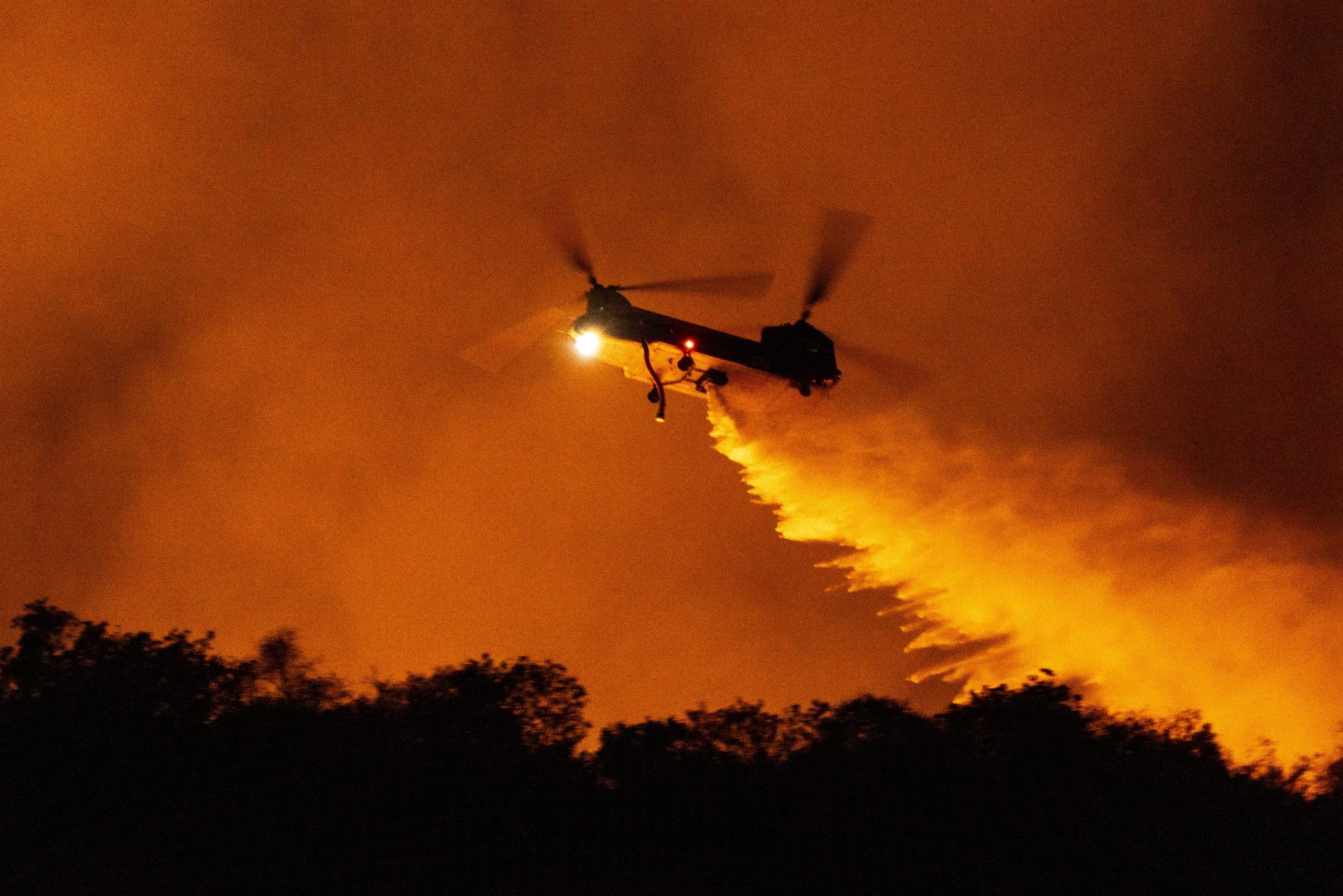
A helicopter drops water on the Palisades Fire in Mandeville Canyon, Saturday, Jan. 11, 2025, in Los Angeles. (Etienne Laurent)
“But I also believe that Californians also stand united on a very important issue of accountability. Why were we not better prepared for this disaster? All Californians are asking that question.”
DeMaio said the legislative special session should include oversight hearings on questions he claimed Gov. Gavin Newsom has not sufficiently answered.
“He’s given [questioners] nothing but evasion and yes, frankly, dishonesty,” DeMaio claimed. “I do not believe that we are going to get to the truth if we leave the investigation in the hands of Gov. Gavin Newsom and other state and local politicians.”
DeMaio said two of his letters have been sent to Senate Homeland Security Committee Chairman Rand Paul and House Oversight Committee Chairman James Comer, both of Kentucky, to probe “a number of failures by state and local politicians on these fire disasters.”
He added that he will ask President-elect Trump to also sign an executive order requesting federal agencies investigate California’s lack of brush management, public land maintenance and inadequate water supply and infrastructure in the fire-affected areas.
CA DEMOCRATS URGE FEDS TO APPROVE HIGH SPEED RAIL FUNDING BEFORE DOGE NIXES BOONDOGGLE
Assemb. Carl DeMaio (CQ/Getty)
Lawmakers also hammered insurance companies and warned the state’s insurance market could go insolvent if changes aren’t made amid dropped coverages and private companies pulling out of the state.
Assembly Minority Leader James Gallagher, R-Yuba City, noted his district weathered the 2019 Paradise fire, and offered the caucus’ condolences and support to those dealing with the crisis in Los Angeles.
“Our thoughts and prayers are going out to those community members and those first responders who are fighting and doing God’s work fighting these fires as we speak. I want to make sure that we’re doing everything we can to help get people safe, to help people recover,” Gallagher said.
“[W]e need to do a whole lot more to combat and prevent catastrophic wildfires in our state,” he said, adding that both wildfire prevention and issues with the state insurance market must be addressed in the special session.
Gallagher said that in 2021, he and other lawmakers fought for $1 billion in funding for such issues, and that there has been a major reduction in appropriations since then.
“We’re calling for immediate action on recovery to help ensure that these communities recover from this disaster, but also on the real solutions that will help us to be a stronger, more resilient state against catastrophic wildfires.”
CA DEMS MOVE TO TRUMP-PROOF THE STATE
DeMaio, Gallagher and Sen. Shannon Grove, R-Bakersfield, also voiced concerns about the state’s insurance market.
Grove listed off almost a dozen insurance companies which she claimed either stopped writing Californian homeowners’ insurance, limited renewals or left the state’s market.
She noted homeowners cannot get or refinance a mortgage without proof of insurance and called for “permanently eliminating red tape and expediting cleanup and recovery and rebuild for all Californians affected by wildfires.”
For his part, Newsom has reportedly proposed $2.5 billion in additional emergency response and preparedness funding.
Assemblymember Diane Dixon, R-Newport Beach, said seven of the 15 deadliest California wildfires have occurred over the past 10 years, and that little seems to change in the way of preparedness.
CLICK TO GET THE FOX NEWS APP
California Gov. Gavin Newsom. (Getty)
Former Republican Gov. Pete Wilson reopened the Santa Monica Freeway only 66 days after a 1994 earthquake-spurred collapse, she said.
Under Newsom, CalFIRE’s ranks and budget have both nearly doubled to nearly 11,000 members and $3.8 billion. The state’s forest management budget also increased under the potential 2028 presidential candidate.
In a tweet rejecting Republicans’ claims about cuts to fire prevention funding, Newsom’s press office tweeted that it presented a “purposefully misleading graphic that starts when a one-time budget supplemental was injected to respond to the horrific fires in 2019/2020.”
Fox News Digital reached out to Newsom, as well as the Trump Transition and Comer for response to DiMaio’s letters.
Read the full article from Here


Lucas Herbert/Arapahoe Basin Ski Area
Friday morning wrapped up a warm storm across Colorado’s northern and central mountains, bringing totals of up to 10 inches of snowfall for several resorts.
Higher elevation areas of the northern mountains — particularly those in and near Summit County and closer to the Continental Divide — received the most amount of snow, with Copper, Winter Park and Breckenridge mountains seeing among the highest totals.
Meanwhile, lower base areas and valleys received rain and cloudy skies, thanks to a warmer storm with a snow line of roughly 9,000 feet.
Earlier this week, OpenSnow meteorologists predicted the storm’s snow totals would be around 5-10 inches, closely matching actual totals for the northern mountains. The central mountains all saw less than 5 inches of snow.
Here’s how much snow fell between Wednesday through Friday morning for some Western Slope mountains, according to a Friday report from OpenSnow:
Aspen Mountain: 0.5 inches
Snowmass: 0.5 inches
Copper Mountain: 10 inches
Winter Park: 9 inches
Breckenridge Ski Resort: 9 inches
Arapahoe Basin Ski Area: 8.5 inches
Keystone Resort: 8 inches
Loveland Ski Area: 7 inches
Vail Mountain: 7 inches
Steamboat Resort: 6 inches
Beaver Creek: 6 inches
Irwin: 4.5 inches
Cooper Mountain: 4 inches
Sunlight: 0.5 inches
Friday and Saturday will be dry, while Sunday will bring northern showers. The next storms are forecast to be around March 3-4 and March 6-7, both favoring the northern mountains.

Hawaiian Airlines’ passengers are back in federal court trying to stop something most people assumed was already finished. They are no longer arguing about whether they are allowed to sue. They are now asking a judge to intervene and preserve Hawaiian as a standalone airline before integration advances to a point this spring where it cannot realistically be reversed.
That approach is far more aggressive than what we covered in Can Travelers Really Undo Alaska’s Hawaiian Airlines Takeover?. The earlier round focused on whether passengers had standing and could amend their complaint. This court round focuses on whether harm is already occurring and whether the court should act immediately rather than later. The shift is moving from procedural survival to emergency relief, which makes this filing different for Hawaii travelers.
The post-merger record is now the focus.
When the $1.9 billion acquisition closed in September 2024, the narrative was straightforward. Hawaiian would gain financial stability. Alaska would impose what it described early as “discipline” across routes and costs. Travelers were told they would benefit from broader connectivity, stronger loyalty alignment, and long-term fleet investments that Hawaiian could no longer fund independently.
Eighteen months later, the plaintiffs argue that the outcome has not matched the pitch. They cite reduced nonstop options on some Hawaii mainland routes, redeye-heavy return schedules that many readers openly dislike, and loyalty program changes that longtime Hawaiian flyers say diminished redemption value. They frame these not as routine airline integration but as signs that competitive pressure has weakened in our island state, where airlift determines price and critical access for both visitors and residents.
What is different about this filing compared with earlier debates is that it relies on developments that have already occurred rather than on predictions about what might happen later.
The HA call sign has already been retired. Boston to Honolulu was cut before competitors signaled renewed service. Austin’s nonstop service ended. Multiple mainland departures shifted into overnight red-eyes. And next, the single reservation system transition is targeted for April 2026, a process already well underway.
Atmos replaced both Hawaiian Miles and Alaska’s legacy loyalty programs, and readers immediately reported higher award pricing, fewer cheap seats, no mileage upgrades, and confusion around status alignment and family accounts. Each of those events can be described as aspects of integration mechanics, but together they form the factual record that the plaintiffs are now asking a judge to examine in Yoshimoto v. Alaska Airlines.
The 40% capacity argument.
One of the more interesting claims tied to the court filing is that Alaska now controls more than 40% of Hawaii mainland U.S. capacity. That figure strikes at the core of the entire issue. That percentage does not automatically mean monopoly under antitrust law, but it does raise questions about concentration in a state that depends exclusively on air access for its only industry and its residents.
Hawaii is not a region where travelers have options. Every visitor, every neighbor island resident, and every business traveler depends on our limited air transportation. The plaintiffs contend that consolidation at that scale reduces competitive pressure and gives the dominant carrier far more leverage over pricing and scheduling decisions. Alaska says that competition remains robust from Delta, United, Southwest, and others, and that share shifts seasonally and by route.
Competitors reacted quickly.
While Alaska integrated Hawaiian’s network under its publicly stated discipline strategy, Delta announced its largest Hawaii winter schedule ever, beginning in December 2026. Delta’s Boston to Honolulu is slated to return, Minneapolis to Maui launches, and Detroit and JFK to Honolulu move to daily service. Atlanta also gains additional frequency. Widebodies are appearing where narrowbodies once operated, signaling Delta’s push into higher capacity and premium cabin layouts.
Those moves complicate the monopoly narrative. If Delta is expanding aggressively, one argument is that competition remains active and responsive. At the same time, Delta filling routes Alaska trimmed may reinforce the idea that structural changes created openings competitors believe are profitable, and that markets respond when gaps appear.
What changed since October.
In October, we examined whether the case would survive dismissal and whether passengers could refile. That moment felt more procedural than what’s afoot now. It did not alter flights, fares, or loyalty programs.
This filing is different because it is tied to post-merger developments and seeks emergency relief. The plaintiffs are asking the court to prevent further integration while the merits are evaluated, arguing that each added step toward full consolidation this spring makes reversal less feasible as systems merge, crew scheduling aligns, fleet plans shift, and branding converges.
Airline mergers are designed to become embedded quickly, and once those pieces are fully intertwined, unwinding them becomes exponentially more difficult, which is why the plaintiffs are pressing forward now rather than waiting any longer.
The DOT conditions and the defense.
When the purchase of Hawaiian closed, the Department of Transportation imposed conditions that run for six years. Those conditions addressed maintaining capacity on overlapping routes, preserving certain interline agreements, protecting aspects of loyalty commitments, and safeguarding interisland service levels.
Alaska will point to those commitments as evidence that consumer protections were built into the core approval. The plaintiffs, however, are essentially claiming that those conditions are either insufficient or that subsequent real-world changes undermine the spirit of what travelers were told would remain. That tension between formal commitments and actual experience is at the core of this dispute.
Hawaiian had not produced consistent profits for years.
That is the actual financial situation, without sentiment. Alaska did not spend $1.9 billion to preserve Hawaii nostalgia. It purchased aircraft, an international and trans-Pacific network reach, and a platform it thinks can return to profitability under tighter cost control.
What this means for travelers today.
Nothing about your Hawaiian Airlines ticket changes because of this filing. Flights remain scheduled. Atmos remains the reward program. Integration continues unless a judge intervenes.
However, Alaska now faces a renewed court challenge that points to concrete post-merger developments rather than speculative harm. That scrutiny alone can bring things to light and influence how aggressively future route decisions and loyalty adjustments occur.
Hawaiian Airlines’ travelers have been vocal since the start about pricing, redeyes, lost nonstops, and loyalty devaluation. Others have said very clearly that without Alaska, Hawaiian might not exist in any form at all. Both perspectives exist as background while a federal judge evaluates whether the integration should be impacted.
You tell us: Eighteen months after Alaska took over Hawaiian, are your Hawaii flights better or worse than before, and what changed first for you: price, schedule, routes, interisland flights, or loyalty programs?
Lead Photo Credit: © Beat of Hawaii at SALT At Our Kaka’ako in Honolulu.
Get Breaking Hawaii Travel News


Warm storm delivers modest totals to Colorado’s northern mountains

Connecticut moves to crack down on bottle redemption fraud

Elon Musk-Led Overhaul of Delaware Business Law Upheld by State Court

FuelFest kicks off at South Florida Fairgrounds this weekend

No. 3 Georgia to Host Top-Ranked Auburn for Regular Season Finale – University of Georgia Athletics

Florida High School Football Rankings: Top 25 teams – Oct. 21

Cleary's 21 help Le Moyne down Central Connecticut State 69-64 in OT

How old is Bo Nix? What to know about Oregon quarterback ahead of 2024 NFL Draft

99th annual Pony Swim held in Virginia

Indiana Members Credit Union announced as new anchor tenant at Bottleworks District

Where Iran’s ballistic missiles can reach — and how close they are to the US

Has India’s influence in Afghanistan grown under the Taliban?

Bill Clinton to testify before House committee investigating Epstein links

Read Judge Schiltz’s Order

Vulnerable House Dem lashes out at Trump’s ‘racist’ SOTU challenge: ‘That was uncomfortable’
-

 World2 days ago
Exclusive: DeepSeek withholds latest AI model from US chipmakers including Nvidia, sources say
-

 Massachusetts2 days ago
Mother and daughter injured in Taunton house explosion
-

 Montana1 week ago
2026 MHSA Montana Wrestling State Championship Brackets And Results – FloWrestling
-

 Oklahoma1 week ago
Wildfires rage in Oklahoma as thousands urged to evacuate a small city
-

 Louisiana5 days ago
Wildfire near Gum Swamp Road in Livingston Parish now under control; more than 200 acres burned
-

 Technology6 days ago
YouTube TV billing scam emails are hitting inboxes
-

 Denver, CO2 days ago
10 acres charred, 5 injured in Thornton grass fire, evacuation orders lifted
-

 Technology6 days ago
Stellantis is in a crisis of its own making